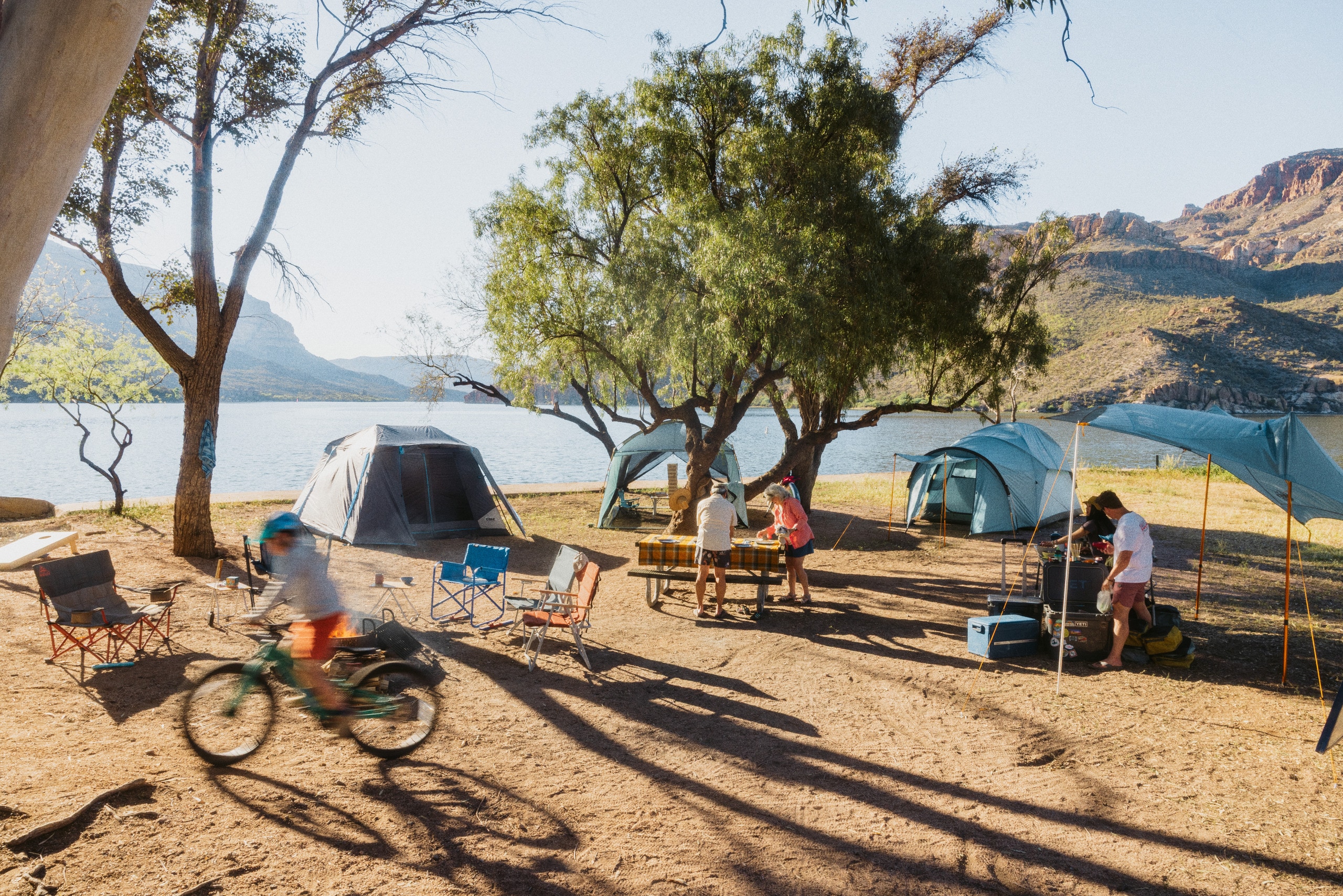
Whether you’re a family car camper, an overlander or fall somewhere in between, settle in—the search for your next nylon abode begins here. This year’s crop of tents for car camping proves there’s a perfect home away from home for anyone who wants to venture outside.
Here’s the skinny: When you’re car camping, you don’t need to worry about the bulk or weight of your gear (more on this below). That means you can enjoy shelters that are roomier and more feature-packed than backpacking tents. Such shelters are also often easier to set up than their backpacking cousins—and typically more affordable. These nice-to-have features can make sleeping outdoors a more enjoyable experience.
More than a dozen REI Co-op Member testers and staffers across the country sampled the best tents you can find at REI Co-op and distilled all of that feedback into what you’ll find in this guide. So pack the car. Whether you’re gearing up for a camping trip with a large crew or planning an adventure for two, you’re sure to find the perfect car-camping tent right here.
Test Results
Find our quick recommendations here or read on for the full breakdown of this season's best camping tents sold at REI.
- REI Co-op Westward 4 Tent [score: 95/100] - Editors' Choice Award Winner
- The North Face Wawona 6 Tent [score: 92/100]
- REI Co-op Base Camp 4 Tent [score: 90/100]
- Zempire Aerospeed 6 Air Tent [score: 79/100]
- Gazelle T4 Hub Tent [score: 87/100]
- Kelty Discovery Basecamp 6 Tent [score: 79/100]
Jump to Buying Advice or How We Test.
Editor's note: We updated this article on June 29, 2026, to include The REI Co-op Westward 4 Tent.
Test Results at a Glance
Tent | Floor area | Best for | Score (out of 100) |
|---|---|---|---|
68 square feet | Tall campers, windy conditions, campers who want room to sprawl | 95 | |
86.11 sq. ft. | Car camping, tall campers, durability | 92 | |
59 square feet | Small groups, stargazers, campers who want a vehicle attachment | 90 | |
95.5 sq. ft. | Large groups, fair weather, sprawling comfort | 79 | |
61 sq. ft. | Campers who want standing room and an easy setup | 87 | |
88 sq. ft. | Budget-conscious campers, large groups | 79 |
Our Tester Favorites


REI Co-op Westward 4 Tent
Score 95
Floor area 68 square feet
Vestibule area 20.27 sq. ft.
Peak height 69 in.
Number of doors 2
Packaged weight 15 lbs. 6.9 oz.
Best for Tall campers, windy conditions, campers who want room to sprawl
A spacious, lofty tent often comes with a tradeoff: The extra surface area makes it more susceptible to collapsing in windy conditions. Not so with the Westward 4 Tent from REI Co-op. This 4-person shelter has a 69-inch peak height—lofty enough for those under 5 feet, 9 inches to stand at its center and taller campers to sit upright—and held firm amid 30 mph gusts during a tester’s February camping trip in Wyoming.
“We staked it down and didn’t have any issues with bending poles or the wind coming through the fly,” says Courtney H., who tested the shelter in Curt Gowdy State Park in Wyoming. (Related reading: Gear Review: Testing the REI Co-op Westward 4 Tent)
At about 15.5 pounds, it’s also light enough to haul from car to campsite—as long as you’re counting the distance in steps, not miles. “I was camping at a designated campsite where we could pull our car up and unload, so I didn’t have to carry the tent very far,” says Brooke B., our tester in Florida. “I thought the weight of the tent was manageable and not too heavy.”
Other features testers loved: a generous vestibule large enough to store packs or a gear bin, a wide mesh ceiling that offers primo stargazing, two doors for after-dark bathroom breaks without stepping over tentmates and a zippered port for routing a charging cable from the car or a charging station into the tent.
When packed in its stuff sack, the shelter fit in testers’ roof boxes and truck beds. One tester notes it could be tight for campers short on cargo space but that it’s worth making room for. “I would rather have to make more space in my truck for the tent to come with us than to have a smaller or less sturdy tent,” says Brooke.
For all the tent's interior room, testers report a shared sentiment about the Westward’s capacity: Fitting four people can feel cramped if all four are sleeping on plush pads. A tent’s listed capacity equates to how many sleeping pads can fit on its floor. But if the pads are wider or longer, they can make things feel tight. The good news: This tent also comes in a 6-person size. Buy here.
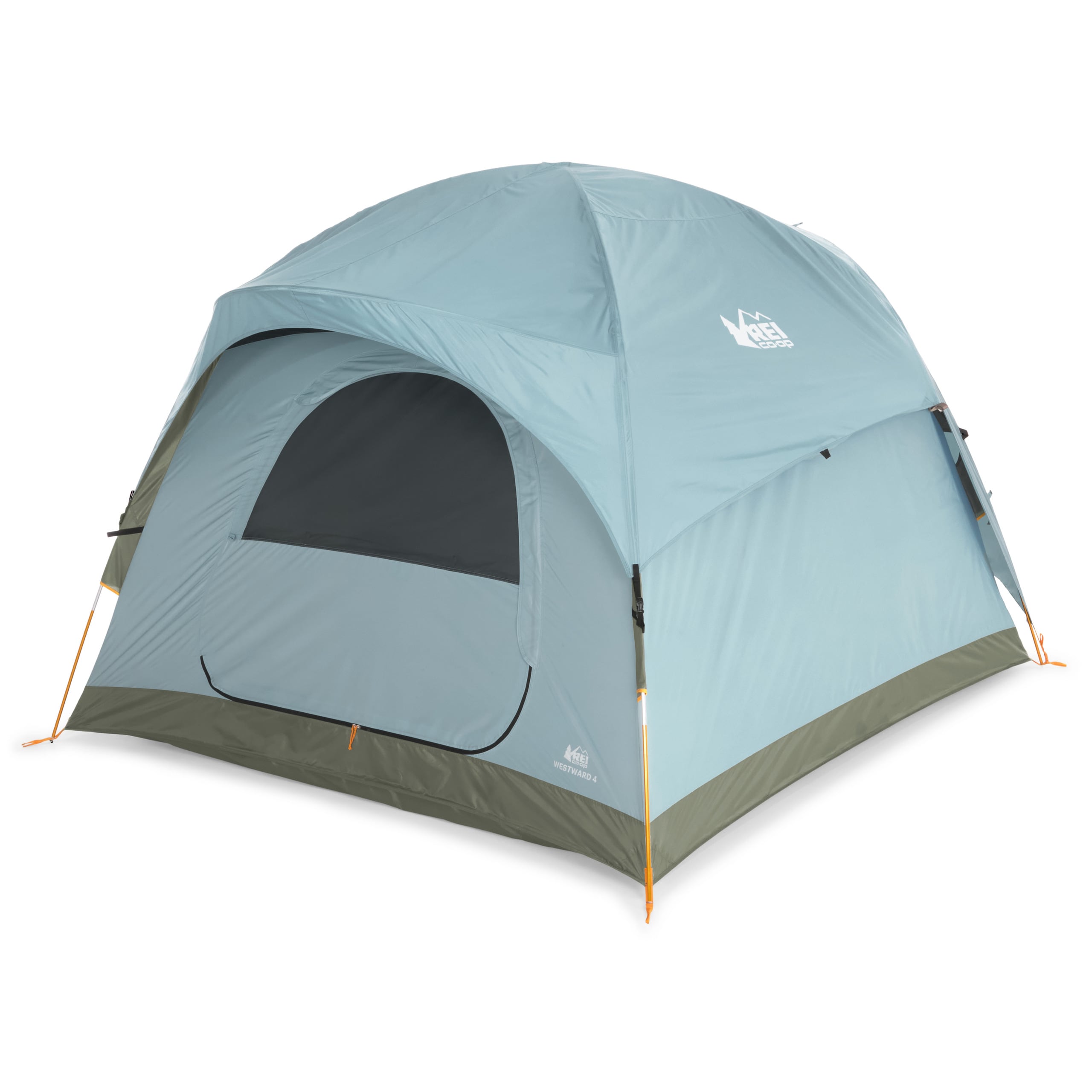
Bottom Line: Spacious and sturdy, the REI Co-op Westward 4 Tent is a cozy hideaway no matter the weather.
Testing Stats:
- Testing states: Florida, Kansas, Wyoming
- Best testing story: “We were impressed by how well the Westward 4 handled the wind,” says Courtney, who also loved the tent’s sky blue and sage green color scheme. “It’s a pretty minor detail, but I always like when my tent (and my house, for that matter) seems to fit in with its surroundings.”


The North Face Wawona 6 Tent
Score 92
Floor area 86.11 sq. ft.
Vestibule area 44.7 sq. ft.
Peak height 76 in.
Number of doors 2
Packaged weight 19 lbs. 1.2 oz.
Best For Car camping, tall campers, durability
With more than 86 square feet of interior space and a 44-square-foot vestibule, The North Face Wawona 6 offers ample room for your whole crew and gear storage without sacrificing durability. “After being in the wind all day, it was great to hang out in the [tent’s] vestibule to get away from it,” says Halee K., a member-tester who was able to fit two chairs and a small table while dispersed camping in Illinois. “We were able to shut one side of the vestibule to block the wind and still watch the sunset out of the other side.”
While the tent is made to sleep six people, filling to capacity could feel tight. It makes up for that with ample standing room, though, topping out at over six feet—enough space to change clothes without crouching. Tents this tall can become wobbly in rough weather, but the Wawona 6 earned high marks for being a reliable shelter on windy nights. “The tent held up wonderfully in 30-mile-an-hour gusts,” the Illinois-based tester says. “There were no loud flapping noises.”
Color-coded poles simplify the tent’s setup—just make sure to read the directions in full beforehand as some testers found their first setup attempt less intuitive than that of other shelters. Tearing it down and packing it up is a breeze, though, thanks to the tent’s duffel-style stuff sack. “All tent bags should be made like this one,” says Halee. Although our testers found the Wawona 6 lighter than most comparable tents this shelter’s spaciousness does require a bit of sacrifice in the weight category (its packed weight is more than 19 pounds). Consider it for car camping or short pack-ins, splitting the pieces among your group for easier carrying.
Testers also praised details like smooth zippers and durable materials. One note: This shelter has a compatible footprint, but you’ll have to purchase it separately. Buy here.
Bottom Line: With a porch-like vestibule for storage and impressive weather protection, this tent is ideal for groups looking to spread out and get comfortable outside.
Testing Stats:
- Testing states: Illinois and New York
- Best testing story: It warms our gear-nerd hearts when testers fall hard for a product, as our Illinois-based tester did with the Wawona 6. "I couldn't be happier with this tent,” she says, praising in particular the vestibule that allowed her to escape inclement weather without having to lie down in a cramped tent. “I'm telling everyone I know about it. It's already got its own name, Oliver.”
![Base Camp 4 Tent [3/4 front view with rainfly]](/media/d2f8eaa7-d562-4fd1-8f03-cbd763fd624a/?size=440)

![Base Camp 4 Tent [Front view]](/media/fc2f7391-abbe-48dc-bb8b-3693d0c25613/?size=440)

![Base Camp 4 Tent [Back view with rainfly on]](/media/e8b619e7-d195-46d2-854f-a2a3643e57f9/?size=440)
REI Co-op Base Camp 4 Tent
Score 90
Floor area 59 square feet
Vestibule area 23 + 15.5 square feet
Peak height 63 inches
Number of doors 2 doors
Packaged weight 17 lbs. 5.6 oz.
Best for Small groups, stargazers, campers who want a vehicle attachment
Cramped quarters? Not with the Base Camp 4 from REI Co-op. This four-person shelter maximizes space with a deep awning (John F., our member-tester in New Mexico, stationed a camp chair beneath it to wait out a squall) and a generous vehicle attachment (like a large vestibule; sold separately) that’s spacious enough for four camp chairs and a table.
All that, and it packs down to about the size of six Nalgene water bottles.
“No four-person tent is ever going to pack down small, but this packs down smaller than the [other] 4-person tent I have been using for years,” says John.
Because more people typically means more gear, testers appreciate the shelter’s interior and roof pockets as well as hang loops that make organization a cinch. Additionally, four roof vents encourage air flow (a must when housing several stinky campers) and offer primo stargazing if you ditch the fly. Two wide-mouth doors on either side allow access without crawling over campmates and, if you’ve maxed the capacity, can make the tent feel a little less claustrophobic.
One caveat: Larger campers may feel squished. Peak height is a little less than 5 feet, 3 inches. Even so, one of our taller testers felt that the shelter’s superior weatherproofness made up for that: “I was prepared to not like this tent because it did not have standing headroom,” says John, who is 5 feet, 9 inches tall. “But, after using it through hot days and several violent, windy thunderstorms, I really came to like it.”
It's also worth noting that the Base Camp 4 doesn’t include a tent footprint. To extend your shelter’s life and make clean-up easier, you can purchase the matching footprint separately. “I needed to clean the bottom quite a bit and it's much more awkward to clean the bottom of a tent than just a footprint,” says Ever Meister, REI Co-op Hike and Impact editor who tested the tent in Minnesota. Buy here.
Bottom Line: With wide doors, roof vents, a deep awning and an optional vehicle attachment, the REI Co-op Base Camp 4 fits small groups comfortably.
Testing Stats:
- Testing states: Minnesota and New Mexico
- Best testing story: “I loved being able to spread out and lounge with a book, listening to the rain and the birds. When there was a break in the weather, having the open roof vents was such a treat. I also love the side vents toward the bottom of the tent, which let Helen enjoy a little morning breeze. She's a senior cocker spaniel and she's fully blind, so she loves to be able to just sniff around outside; I loved watching her little head lift up when she caught an interesting scent waft in from the vents near her bed. And listen—if Helen's happy, I'm happy.”

![Aerospeed 6 Air Tent [3/4 front view with rainfly]](/media/680c15da-029e-45f0-8871-c225288528e4/?size=440)


Zempire Aerospeed 6 Air Tent
Score 79
Floor area 95.5 sq. ft.
Vestibule area 18.1 + 18.1 sq. ft.
Peak height 80 in.
Number of doors 2
Packaged weight 19 lbs. 12 oz.
Best For Large groups, fair weather, sprawling comfort
It’s not an exaggeration to say that the Zempire Aerospeed 6 Air Tent offers nearly as much square footage as some of the smallest apartments in New York City (95.5 square feet, count ’em) plus enough height (80 inches) for pretty much anyone except professional basketball players to stand fully upright. With a unique inflatable frame standing in for poles (more on this later), this tent is made for spreading out and getting comfortable with as little added bulk as possible.
As with all tents, the caveat remains that the amount of people who could technically fit differs from the amount that can comfortably fit. The Aerospeed 6 Air Tent is designed to fit six people, but if all six are adults, there’s really only room for people to sleep and not much space for gear. But if your campmates include small children or four-legged friends, you’ll be fine. “This was a good amount of space for six people that are small,” says Kristen C., a member-tester who camped alongside her spouse and five small kids with ease.
What really sets this tent apart is its inflatable frame. It takes less than two minutes to blow up using the included pump and comes with brow poles to support the tent’s two entrances. And while the sheer size of this shelter feels indulgent, the weight is far less than other tents of the same size (19 pounds without the pump) thanks to the airy design. Some testers were initially skeptical about the sturdiness of such a frame, but in the end were pleasantly surprised at how solid it felt in fair-weather conditions. Their only caveat: The size of this tent makes it vulnerable to toppling or sagging in blustery weather, as member-testers Halee K. and Elena K. experienced. If you often camp in windy conditions, consider a different shelter.
The tent’s size and limited portability (unlike other shelters like the The North Face Wawona 6, you can’t divide the components among a group for easier carrying), the Aerospeed 6 Air Tent is best suited for car camping or short walk-in sites. Packing it down can be challenging, too: Halee who camped at a designated site in Missouri, found the tent “almost impossible to get back in the bag,” so be prepared for some possible wrestling.
But if your priorities are sprawling comfort and lighter weight, this shelter has you covered. “This tent packed down to almost the same size as my wheeled cooler,” says Elena, who camped at a beach in Maryland. “I drive a Prius, and fitting all of our gear wasn't an issue. If your priority is campsite comfort, go for it!” Buy here.
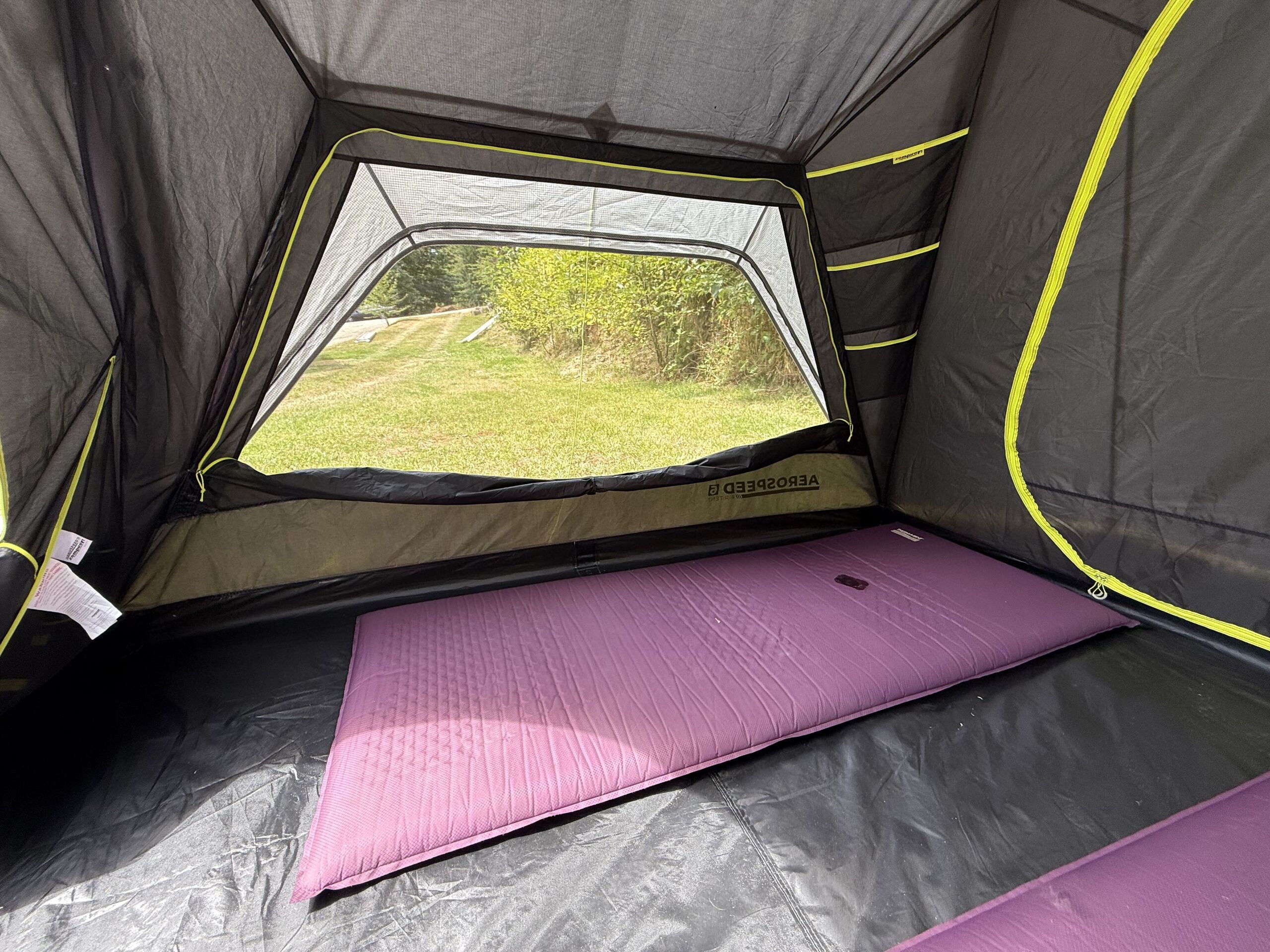
Bottom Line: The Zempire Aerospeed 6 Air Tent offers premium square footage with a unique, streamlined setup, but its tall profile may not perform as well in high winds or less-than-solid ground conditions.
Testing Stats:
- Testing states: Missouri, Maryland and Washington
- Best testing story: With big tents come big responsibilities: Be prepared to be the talk of your camping loop. “At camp, my friends joked that we were living in a mansion because of the tent’s size and they were envious that we were able to stand up and change clothes in our tent.”
Other Solid Picks
![T4 Hub Tent [3/4 front view with rainfly (Alpine Green)]](/media/c6f4348d-a30b-4f6c-a65b-468ad06a8cd8/?size=440)

![T4 Hub Tent [Front view (Alpine Green)]](/media/fa8afaee-7f81-49af-9dcf-b56febfc610d/?size=440)
Gazelle T4 Hub Tent
Score 87
Floor area 61 sq. ft.
Vestibule area None
Peak height 78 in.
Number of doors 2
Packaged weight 30 lbs.
Best for Campers who want standing room and an easy setup
"One minute," declares REI Expert Advice Camp editor Sarah Grothjan. "That's how quick this thing goes up." Once you unroll the body, the T4 Hub from Gazelle pops up instantaneously. Stake it down, then you're done. If you're wondering why all tents aren't built like this, there are downsides—namely weight (30 pounds) and packed size (8.6 inches by 67.5 inches—not a typo). That means you need ample storage space when it's not in use, both in your home and vehicle. But, if you're set there, enjoy the easy-breezy pop-up design. The T4 Hub is also surprisingly sturdy in 20 mph winds, thanks to its weight, hefty poles and 210-denier polyester fabric. Inside, there is enough space for most people to stand up in, plus double doors and plenty of pockets and windows. Buy here.


Kelty Discovery Basecamp 6 Tent
Score 79
Floor area 88 sq. ft.
Vestibule area None
Peak height 68 in.
Number of doors 1
Packaged weight 13 lbs. 14 oz.
Best for Budget-conscious campers, large groups
A six-person tent for less than $200 is a bit of a unicorn, especially when that tent weighs less than 14 pounds. But that's exactly what you get with the Kelty Discovery Basecamp 6. Of course, at this price point you're bound to lose a few bells and whistles. This shelter is admittedly far simpler than a more feature-rich tent, but sometimes the basics are all you need for a night under the stars.
During a test in eastern Kansas, one tester found the tent comfortably fit a family of six and stood up to a nighttime shower. It shed the two inches of rain that fell during the night, and the dome shape handled wind better than other similar-size tents in this lineup. Plus, it was easy to set up, even with just one person on the job. One tester's biggest concern was the tent-door zipper that occasionally became stuck or snagged on the fabric—a problem he worried could worsen with use. Buy here.
Buying Advice
Car-camping tents are generally larger, more spacious and more feature-packed than backpacking tents. They're also heavier. That extra weight can be a challenge if you plan to haul your setup over many miles. But the beauty of car camping is that your vehicle does all the heavy lifting for you. To reflect that, the tents in this guide are roomy, feature-rich and more affordable than most backpacking shelters. They’re not the most portable options, though there are some crossover tents (like the Kelty Discovery Base Camp 6) that are comfortable enough for front-country camping and light enough for backpacking if you split up the tent parts among a few different trekkers.
When choosing a camping tent, you’ll want to consider a few key factors, including capacity, the number of doors or vestibules as well as nice-to-have features like storage pockets and gear loops. Read on to learn more about what to look for in each category.
Capacity
Every tent model features a number in its name that corresponds, roughly, to how many people can fit inside when lying down shoulder to shoulder. There isn’t an industry standard for how much room each person gets, so think of it as a maximum; four sleepers can fit in a four-person tent, but that many people will feel more comfortable in a six-person shelter.
Also take a look at tent specs before buying. The floor area can help you think about where you can position sleeping pads to maximize space, and peak height can tell you how much headroom you’ll have. The Zempire Aerospeed 6 tent boasts the tallest peak height and largest floor area in this list—and comes with some tradeoffs for all that space, including being more unstable in high winds.
Vestibules and Doors
The space inside the main body of the tent isn’t the only space that matters. If you plan on spending extended time inside your tent–either to play games with kiddos or get reprieve from a rain shower or sun–you’ll appreciate having a vestibule. These indoor-outdoor spaces on the other side of a tent’s door are covered and accessible from the inside of the tent but don’t eat into the floor space. They’re also great for storing extra gear and wet clothes. The REI Co-op Westward 4, REI Co-op Base Camp 4, North Face Wawona 6 and Zempire Aerospeed 6 tents all come with vestibules. Sometimes vestibules are sold separately.
If there are more than a couple of sleepers in your tent, having multiple doors is nice. It allows folks to enter and exit without stepping over one another or getting in anyone’s way. Having more than one door can also allow for a nice cross breeze or extra ventilation on warm days. All of the tents in this article have two doors, except for the Kelty Discovery Basecamp 6.
Features
When choosing your tent, it’s also worth considering attributes like organization, ventilation and even color. These nice-to-have features may make a tent more costly, but they can be worth it for the extra comfort or functionality.
For instance, interior pockets, gear lofts and gear loops are great for hanging or storing your sundries to preserve floor space for sleeping. You can also hang a lantern or headlamp from a gear loop for hands-free illumination. Multiple internal pockets can be nice if you want every camper to have their own storage space.
A removable rainfly is another feature to consider. Being able to completely detach it in good weather allows you to enjoy the nature around you and stargaze at night. Another nice-to-have option: If you have multiple people sleeping in a tent or are camping in rain or humidity, you might want the ability to open vents in the tent to increase airflow and minimize condensation without having to keep the doors unzipped.
A bright-colored tent can also make the inside feel more comfortable and pleasant when it’s gray and murky outside. It also makes the shelter more visible from afar. A neutral-colored tent, on the other hand, will blend in with its surroundings more.
How We Test
Through late winter and spring of 2026, we’ve sent dedicated car campers—including REI Members and staffers from across the country—into campgrounds and parcels of wide-open public land to evaluate the best shelters you can find at REI Co-op. Our testers dealt with blazing sunshine, unrelenting rain and gale-force winds, scrutinizing their shelters for everything from leaks and privacy windows to gear storage and durability.
Our gear testers rated each shelter on its spaciousness, weight, weather resistance, durability, structure, ease of setup and packed size. We averaged those scores to give each tent a combined score out of 100. The tents on this list performed highest in those categories. The REI Co-op Westward 4 performed supremely well across the board and earned an Editors' Choice Award. The North Face Wawona 6, REI Co-op Base Camp 4 and Zempire Aerospeed 6 also earned high marks. The Gazelle T4 Hub and Kelty Discovery Basecamp 6 scored well in some but not all categories, carving out niche uses for these tents.
There will be additional tents added to this guide as we continue to test on a rolling basis. Once feedback is in, we will update this guide.