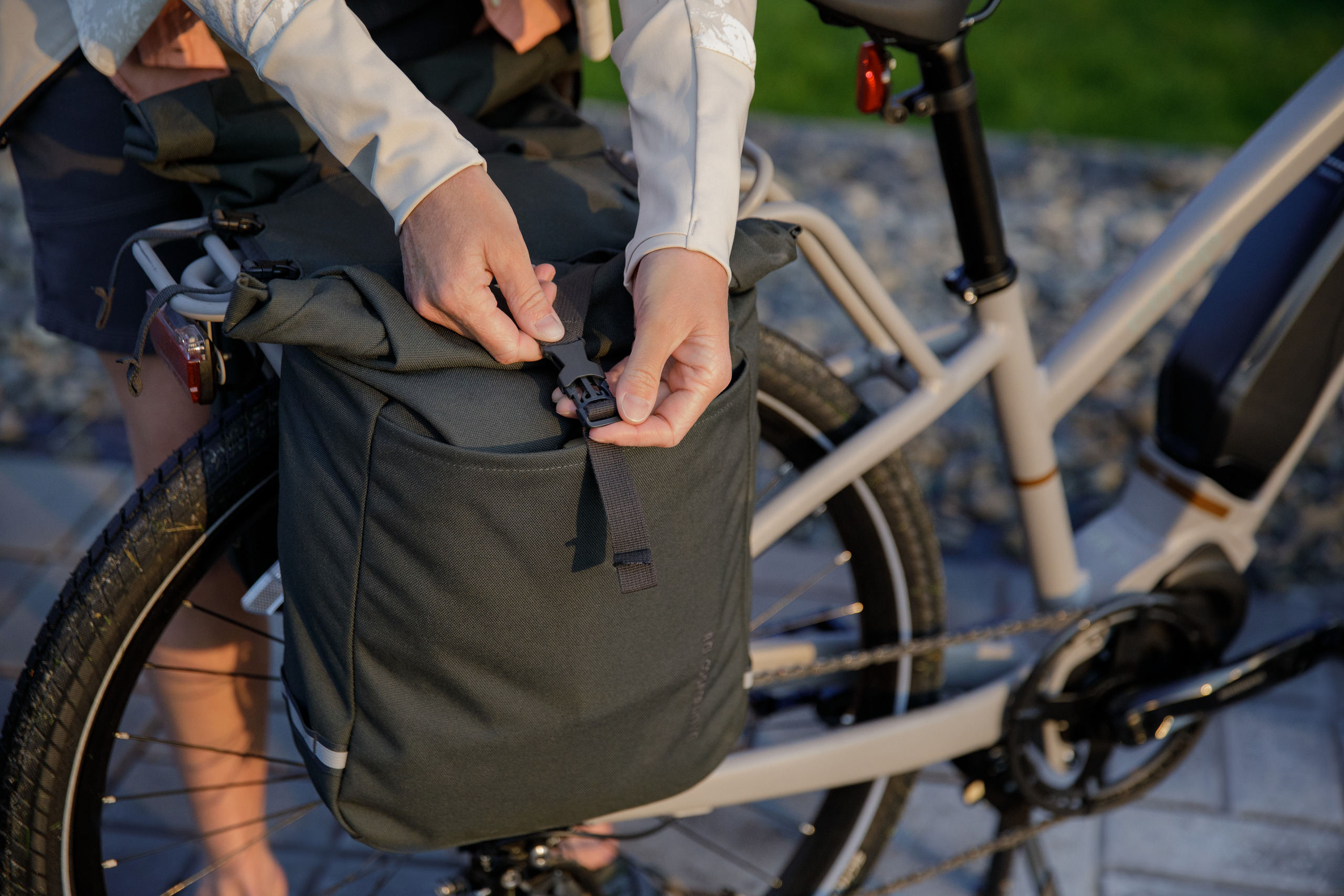
Even cyclists obsessed with packing light need to carry the essentials on every ride: a spare tube, a carbon-dioxide inflator or pump, a multi-tool and some cash for emergency snacks. Unless you love to ride around with jersey pockets bulging or slinging a messenger bag, a bike bag—which your bike, rather than you body, supports—is the perfect place to stash your stuff. We had 19 testers put a slew of on-bike bags through the wringer over several months to find the best options for riders ranging from casual commuters to hard-core bikepackers.
So, don't be that rider who has to borrow a flat kit or a multi-tool to get you home on your next bike ride. These bags fit securely on different parts of your bike and stylishly keep your kit in check, whether your essentials include the basics or something extra. Here are our testers' picks for the best gear-carrying options available at the co-op.
Best Bike Handlebar Bag


Po Campo Domino Handlebar Bag
Score 93
Gear capacity 4.3 L
Dimensions 10.3 x 6 x 4.25 in.
Weight 9 oz.
Sustainability Contains recycled materials
After decades spent stuffing tools, pocket burritos (only kind-of kidding) and other debris into jersey pockets or too-small seat bags, cyclists finally realized that handlebar bags could swallow up ride accessories while keeping them easily within reach. The Domino Handlebar Bag from Po Campo bested others in this category, hitting the sweet spot between everyday carry and bikepacking luggage.
Our Vermont-based tester found the Domino versatile and functional during a trip that included rides in New York City and Washington, D.C. It held all her essentials and was easy to remove and take with her when she locked up her bike. At 4.3 liters, the Domino was big enough to fit her phone, wallet, charger, granola bar and headphones, but not so big that it interfered with her steering or hand placement. The handlebar bag is stylish, too: With a detachable strap and jauntily colored exterior option, it converts from handlebar bag to bag-about-town quickly. "It also served as a fashionable purse for our evening out in town," she says.
A three-point secure Fixi-Strap™ system secures the bag to the top of your handlebars and around the head tube; hook-and-loop straps make it easy to take on and off. The Domino handlebar bag's brightly colored interior, made from recycled plastic, helps you find your stuff quickly (no black holes here). That organizational ease is augmented by its five pockets—two exterior and three interior—which additionally keep your treasures from banging around inside. Our tester also appreciated the slightly structured shape of the bag. She could easily open it while riding to access snacks—a major benefit during a 160-mile overnight trip on the Chesapeake and Ohio Canal towpath in West Virginia. Also important: The waterproof exterior and water-protected zippers helped shut out water when she got caught in a drenching rainstorm and then continued riding through mud. Buy here.
Bottom Line: A functional, appropriately sized handlebar bag that stashes your essentials and looks good doing it.
Testing Stats:
- Miles: 300+
- Testing states: Maryland; New York; Virginia; Washington, D.C.; West Virginia
- Testing story: "By day I was biking on the muddy gravel with a handlebar bag, by night I was wearing a dress and a 'purse'," one tester says. "I was able to bring minimal things on my overnight biking trip because my gear was so versatile."
Best Bikepacking Seat Bag


Revelate Designs ECOPAK Shrew Seat Bag
Score 94
Gear capacity 2.25 L
Dimensions 12.5 x 4 x 4 in.
Weight 5 oz.
Sustainability Contains recycled materials
A seat bag is essential if you're planning to get epic or rowdy on your ride. It should expand to fit the necessities for a big day on the bike: spare clothes, snacks, tools for more major trailside repairs—in short, anything you might need when you're venturing off the beaten track and can't rely on a friendly bike shop to help you out of a bind. However, very few seat bags are compatible with the bikes we typically like to take out on big adventures, which often feature rear suspension and/or dropper seatposts. So we were delighted to give the ECOPAK Shrew Seat Bag from Revelate Designs a spin through the rugged singletrack in Vermont, where our testers for this product are located.
Our lead tester (a high school math teacher) used the ECOPAK Shrew for mountain bike rides "when I needed some extra junk in my trunk and didn't feel like carrying a backpack." Because she also enjoys using her bike for epic adventures and quality leisure time, "extra junk" includes essentials—spare tube, pump, patch kit, front and rear lights—plus a hammock for some mid-ride lounging. Another tester, a fat-tire biker who rides all winter long, loaded up on trailside repair tools, just in case of a mishap.
"I was pleasantly surprised with how the weight was distributed when packed fully," our first tester, the teacher, notes. "I thought for sure this bag would swing around willy-nilly on the back of my bike because it only attaches at two points. It did not! I didn't notice the bag at all, even when it was fully packed with my hammock."
This brings us to two key points as defined by our math teacher: how the ECOPAK Shrew mounts, and how it should be packed. Most seat bags use a traditional mounting system that attaches to the saddle rails and to seatpost; that can interfere with a dropper seatpost, which allows a rider to lower the seat quickly for better balance over rough terrain. The beauty of the ECOPAK Shrew is that it mounts only to the saddle rails via a pair of independent rail straps that hold the bag in place without connecting to (or scratching) your seatpost. That said, it's important to confirm that your frame and dropper post can accommodate a 2.25-liter bag. Our 5-foot-3-inch tester didn't have enough room on her size small mountain bike to fully drop her seat without the bag rubbing. Our other 5-foot-6-inch tester, however, didn't have issues on her size small fat-tire bike.
As to packing styles, more is more in the case of the ECOPAK Shrew. It's simple to pack and easy to detach; just squeeze the the spring-loaded clips at the end of the rail straps and slide them out. A bonus: You don't have to take the bag off to access what's inside, as it's easy to unbuckle and open the roll-top closure. While that buckle should, in theory, compress the Shrew to accommodate smaller loads, our tester found that the weight was better distributed, and the bag more secure, when fully packed. In other words: Epic adventures are this bag's jam.
Bottom Line: The Shrew seat bag is your BFF when you're gearing up for a big day out on the bike, or simply subscribing to the more-is-more mentality.
Testing Stats:
- Miles: 50+
- Testing state: Vermont
Best Bike Trunk Bag

Topeak TrunkBag DXP - Strap Mount
Score 94
Gear capacity 22.6 L
Dimensions 14.1 x 9.8 x 8.5 in.
Weight 2 lbs. 8.5 oz.
Frequent bike commuters know there's a fine line between a bag that's the perfect size for everyday items and one that's too big. If you elect to go the minimalist route, you may find yourself leaving the grocery store balancing a carton of eggs on your handlebars and strapping a gallon of milk to your top tube. Grocery Jenga is a game we've all played at some point, but with the TrunkBag DXP from Topeak, you're more likely to come out the winner.
At face value, this is a standard looking trunk bag that fits onto a rear rack. It's got an expandable top and a cinch-down water bottle holder, and our tester hardly noticed it while it was installed and loaded. Made of 600-denier polyester that uses a unique material process to help enhance weather resistance, the TrunkBag is burlier and stiffer than most. Our Bentonville, Arkansas-based tester loved how easy it was to fill the trunk part of the bag, due to that stiff construction. It easily fit two water bottles, a towel, snacks, sunscreen, beverages and a change of clothes for trips to the local swimming hole.
But the TrunkBag has a secret weapon locked inside its side compartments: two expandable panniers that unzip from the main trunk compartment to swallow the extra items that you didn't know you'd be picking up along your commute. Our tester also appreciated the internal dividers that make it easier to stay organized, while the bright-yellow interior lends a pop of cheery color and reduces the feeling that you're pawing around in a black hole when you just need to find your sunscreen.
Note that the trunk bag will fit on any back rack with a platform, but if you plan to use the panniers, you'll need a beam rack with side frames attached or a traditional rack with struts to avoid the panniers banging into your rear wheel. The system attaches via hook-and-loop straps and is easy to take on and off, although our tester says it was so easy to load while it was on the bike that she typically left it in place. After all, who knows when you're suddenly going to need a full 22.6 liters of carrying capacity? With this expandable trunk bag, you'll be ready when you do.
Testing Stats:
- Miles: 20+
- Testing states: Arkansas
- Best testing story: "This bag still looks brand new, even after being handled fairly roughly," admits our tester. "I did drop my bike once while testing the Topeak bag and was pleasantly surprised that nothing came out or needed to be adjusted."
Other Top Performer


Ortlieb Back-Roller Panniers - Pair
Score 94
Gear capacity 40 L
Dimensions 16.5 x 12.6 x 6.7 inches
Weight 4 lbs. 3.1 oz
One of the sturdiest and most durable bags we tested, the Back-Roller Panniers from Ortlieb are also fully waterproof. They kept the contents of our D.C.-based tester's bags dry through severe downpours, mud, and dry and dusty conditions during daily commutes and a two-day bikepacking trip from D.C. to West Virginia, and back. Note that the bags will only keep your belongings dry if you roll the top closure at least three times (so, no overstuffing this pannier), and take care to always buckle the top to the carrying handle on the sides to avoid any water sneaking in.
"The bags were very easy to clean and kept all of the elements on the outside and the contents of the bags clean and dry," the tester notes. "They look as good as new after being sprayed off with a hose, and the insides stayed dry and clean."
The panniers can be installed as a pair or singly, and easily swallowed up everything from camping gear to a laptop. Our tester appreciated that the Back-Roller Panniers could be swapped easily among his three bikes—a gravel bike and two commuter-style bikes—without needing a proprietary rack system (although you should always check the specs before buying). He found the bags easy to load up while on the bike because of their "firm and defined structure" that gave him confidence that the items inside would stay put without shifting. Buy here.
Other Top Performer


Revelate Designs Hopper Frame Bag
Score 92
Gear capacity 4 L
Dimensions 11 x 7 x 2.5 in.
Weight 6 oz.
At just 6 ounces and a hauling capacity of 4 liters, the Hopper Frame bag from Revelate Designs punches far above its weight. If you're wondering how much, exactly, this frame bag can hold, the answer is: four bars or gummy snacks, a tube of Nuun hydration tablets, a wallet, a 500-milliliter silicone water bottle, a phone and a wind vest or jacket. That's a lot. "The volume-to-weight ratio on this bag is awesome," says our Vermont-based tester, a mechanical engineer who observes such things. "And because it mounts toward the front of the frame, you won't know it's there, even when stuffed with water, snacks and layers." While the stated width of the bag (2.5 inches) expands a bit when loaded, he still appreciated that the bag wasn't much wider than his frame and sits far enough forward that it doesn't interfere with pedaling motion.
The Hopper isn't technically waterproof, but it faced some mud puddles and a good hose soaking during a gravel enduro race in Vermont, and our tester had to work extra hard to get it drenched. The easy-access flap top helped our tester reach food and electrolytes (and avoid a bonk). And, he adds, "The fuss-free closure is secure and effortless to use even when you're smoked late in the day and reaching back into a jersey pocket seems like a chore." One thing to note: Our tester used the Hopper Frame Bag exclusively on his gravel bike. While this bag is compatible with some full-suspension bikes with vertically mounted shocks, the placement of your bottle cage and the shape of your frame will dictate whether it fits or not, so measure carefully before buying.
Other Top Performer


Ortlieb Handlebar Pack - 9 Liters
Score 92
Gear capacity 9 L
Dimensions 16 x 6 x 6 in.
Weight 13.2 oz.
While we think the Po Campo Domino handlebar bag is the most versatile choice for cyclists looking to boost storage capacity for daylong rides or casual overnights, riders with more gear will find the Ortlieb Handlebar Pack a better fit for their needs. At 9 liters, the waterproof pack is nearly three times the size of the Domino and is specifically geared for bikepackers needing to carry clothes, sleeping bags or other camping essentials for multi-night tours.
Featuring roll closures at both ends for quick access and attached via hook-and-loop straps with side-release buckles, the Ortlieb handlebar pack is 16 inches long—short enough to fit between (most) drop handlebars—and about 6-by-6 inches around. That makes it an excellent choice for the rider looking to augment a frame pack or seat bag with additional storage for a longer trip, but slightly less versatile for casual daytrips. Our Vermont-based tester loaded this bag up with his camping stove, sleeping bag and sleeping pad during a three-day bikepacking trip around Mount Katahdin in Maine, with room to spare for other things. "You can access what's inside without taking off the bag, but it's clunky and not easily done," he says.
He also recommends packing it before mounting it on your bike: As with many bikepacking bags, it takes a bit of effort to get everything packed and balanced. Our tester used this on a gravel bike and a cross-country-style mountain bike, both of which had carbon handlebars—so he appreciated the included spacers/pads on the straps that held the bag in place without rubbing on his bars or his steerer tube. The waterproof exterior also kept "the things that I desperately wanted to stay dry, dry," he says. "The bikepacking trip in Maine had a little bit of everything: rain, humidity, sun, dust. This bag held up very well and kept its contents totally dry and clean."
Buying Advice
When choosing the best bag for your bike, consider several factors like function and capacity and how the bag attaches to your bike.
Capacity and Function
You don't need to strap on 40 liters of carrying capacity if you're only going out for a short jaunt, but everyone needs to pack the essentials in case of a mishap: a spare tube, a pump or CO2, a multi-tool and a tire lever. Consider how much gear you’ll need and how frequently you need to access it.
Capacity
If you’re a commuter lugging a laptop, spare clothes and some basic personal hygiene items to get you to your 9-to-5 smelling relatively fresh, consider a bike bag with a hauling capacity of about 25 liters. And if you’re an all-weather commuter who also can’t resist stopping at the grocery store on your way home, you’ll want the waterproof 40-liter Ortleib Back-Roller Free Panniers, which swallow up tons of stuff and keep it dry in wet conditions. Those with a rear bike rack but who prefer not to embrace the pack-mule mentality may be just fine with an expandable trunk bag, like the Topeak TrunkBag DXP.
Function
Some bike bags mount directly to the bike’s frame or onto rear or front bike racks. Consider how often you might need to access the items in the bag too.
For riders who like to get a little rowdy or whose rides typically eschew pavement for dirt or singletrack, bike bags that attach to the handlebars—like the Po Campo Domino Handlebar Bag—or to your frame—like the Revelate Designs Hopper Frame Bag—will stay out of the way while stashing your stuff. And if you’ve got a dropper post and enjoy big days out of the bike, something like the Revelate Designs ECOPAK Shrew Seat Bag that fits under your saddle will let you go out loaded, but still able to shred.
And finally, consider the weight of your bike bag. Yes, you’re just going to fill it up with stuff, but starting with a lightweight bag will help streamline the load. Of course, larger-volume bags will necessarily weigh more. But we were quite impressed with the weight-to-volume ratios of the Revelate Designs Hopper Frame Bag and the Revelate Designs ECOPAK Shrew Seat Bag, both of which feel sturdy but won’t unnecessarily weigh you down.
Attachment Points
While buying a bike bag doesn’t have to be complicated, if you want to roll with a set of panniers or a trunk bag, you’ll need a rear rack. Our pannier pick—the Ortleib Back-Roller Frees—doesn't require a proprietary rack, but you will still need to measure the rack you’re planning to use to be sure it aligns with the hook-and-loop attachment points on both bags. Likewise, you can run the Topeak TrunkBag DXP on any rear rack with a platform, but if you're going to use the expandable panniers, you'll need a beam rack with side frames attached or a traditional rack with struts to avoid the panniers from banging into your rear wheel. You’ll also need to measure your bike before going all-in on the Shrew Seat Bag, as you’ll need enough clearance between your saddle rails and your tires to use this bag with a dropper post. Same goes on the Hopper Frame Bag; your rear shock and the placement of your water bottle cage (if you use one) will dictate whether or not you can use this bag with a full-suspension mountain bike.
And while handlebar bags such as the Po Campo Domino and the Ortlieb Handlebar Pack are fairly one-size-fits-all, riders with carbon handlebars or frames will want to check to be sure the main contact points between bike and bag are well-padded or at least unlikely to cause damage to your bike from the friction created by riding.
How We Test
We sent 20 of our hard-charging testers out into the wild to test nearly two dozen bags. We invited them to put the bags through the wringer during races, casual rides, bikepacking excursions, camping trips and daily commutes, and collected data from California to Colorado, Minnesota to Arkansas, and including Vermont; Maine; Massachusetts; Washington, D.C.; Maryland and Virginia.
After thousands of combined hours and miles in the saddle, we asked testers to fill out a form evaluating each bag’s durability, function, features, attachment points, waterproofness and ease of use. Our testers rated each bag on a 100-point scale for each metric, with the total score reflecting the average of those ratings.
While it’s tricky to get an apples-to-apples comparison across types, as a compact saddle pack isn’t even in the same category as beefier Ortlieb panniers—the bags listed here were top performers in each of their respective categories and presented unique or clever ways of solving the problem of carrying gear on a bike without feeling weighed down or overburdened.
Lastly, while it wasn’t an official category in our test, we preferred bike bags that kept us organized. No one wants to spend more time than is necessary pawing through a bag to find what you need. Bags with brightly colored interiors or innovative storage and organizational features got top marks from us. We all have to carry our own burdens on the bike, but it’s far more fun when your baggage is stashed neatly, compactly and stylishly as you ride down the road.