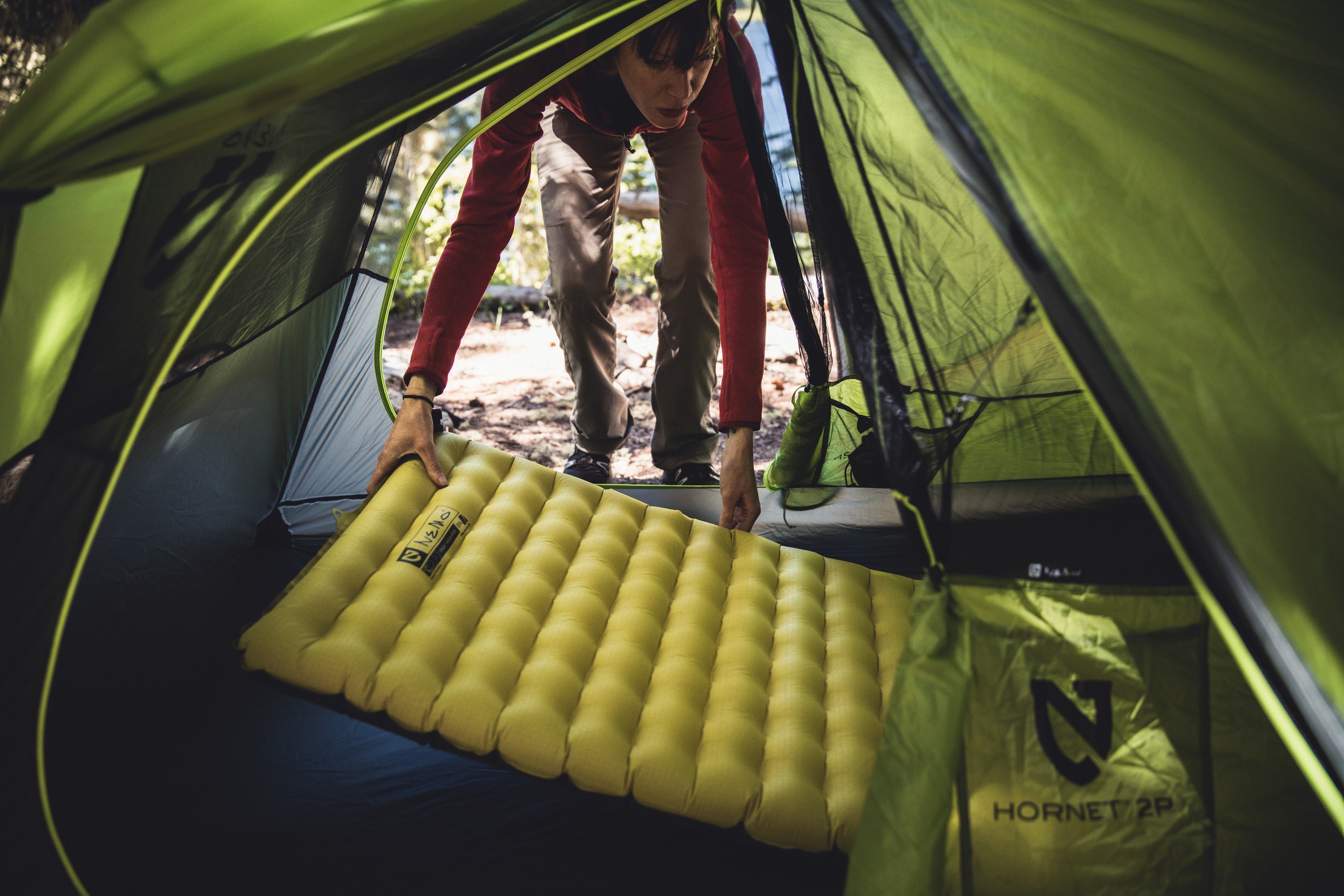
Sleeping pads play two very important roles when it comes to a good night’s rest outside: They provide cushioning and insulation. While it might seem like having a comfortable surface to sleep on is a pad's most useful function, its ability to keep you warm throughout the night is often more important. In this article, we explain the various types of sleeping pad construction and outline the factors to consider when choosing among them. We spoke to experts about interpreting a product's specs and sought their advice on pairing sleep preferences with sleeping pad choices.
This article covers:
What to Consider When Choosing a Sleeping Pad
Because surfaces that are cooler than 98°F will drain your body’s warmth and leave you shivering by morning, it’s important to have a pad that prevents heat loss by acting as a barrier between you and the cold. Your pad should also provide a comfortable sleep surface, be easy to transport to the types of campsites you frequent and be durable enough to withstand years of adventuring. There are also nice-to-have considerations when choosing a pad, like quiet construction and ease of inflation.
Ingrid Johnson, a product information specialist at REI Co-op who spent 10 years assisting sleeping pad shoppers, advises people shopping for a pad to “pick two.”
“There is no sleeping pad that is good at everything, so you have to prioritize the two qualities that are most important for your needs and let the others go,” she explains. Cushioning, warmth, weight, packability, durability and price are all variables when evaluating the “best” sleeping pad. “But you can rarely get them all, because sometimes they cancel each other out,” Johnson explains. Warmer pads generally weigh more due to their extra insulation. Lighter options generally cost more, thanks to innovative (and ounce-sparing) materials and construction. Shoppers should therefore focus on their two most important criteria and evaluate the models that excel at those two.
If you can, start by trying various sleeping pads in person (as you might when shopping for a home mattress). Your local REI Co-op store offers the ability to lie on various pads, evaluate their size when packed and unfurled, and compare models side by side.
Here are some high-level considerations for navigating the available options. We’ll dive into each one in more depth below.
Activity: Consider whether you’ll be car camping, backpacking or bikepacking. This can guide your buying decision. Generally, the farther you’ll be walking with your sleeping pad before laying it out on the ground for the night, the more you’ll want to consider your pad’s weight. If you’re camping three feet from your car, you can get away with a cozier (and heavier) pad.
Sleeping Pad Type: There are three main types of sleeping pads: air pads, closed-cell foam pads and self-inflating pads. Whether or not they inflate—and their mechanism for inflation—affects weight, packability, comfort, price and convenience. We dive into the pros and cons of each type in more depth below.
Insulation and R-value: Sleeping pads come in a range of insulations (measured by R-value) that are optimized for hot summers, winter camping and everything in between. Higher R-values correspond to more warmth.
Sleeping bag compatibility: You’ll want a sleeping pad that complements the bag you plan to pair with it to maximize comfort and thermal performance.
Features: Factors such as the pad’s durability, inflation design, baffle structure and sustainability features may influence your choice depending on personal preferences, budget and activity.
Your Sleep Style: Side-sleepers, cold sleepers and campers who toss and turn as they snooze may want to prioritize pad attributes that suit their unique needs.
Types of Sleeping Pads: Air, Self-Inflating, Foam
There are three main types of sleeping pads: Closed-cell foam, self-inflating and air pads. Each has its advantages depending on your intended use.
Air Pads
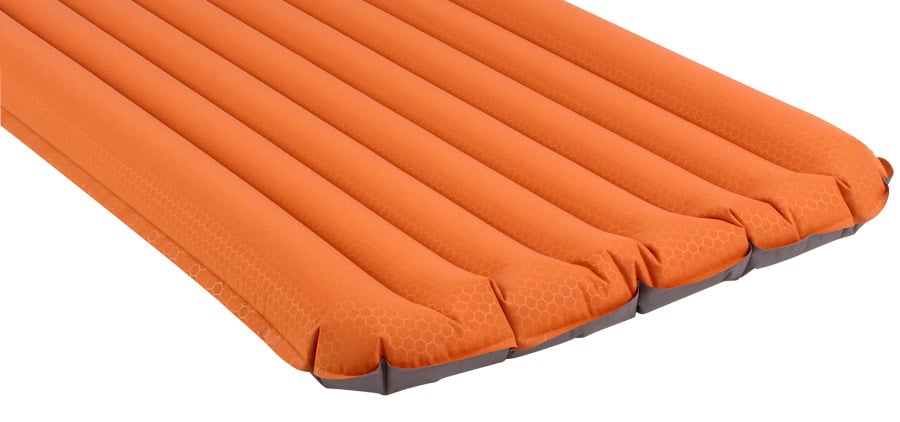
These inflatable camping mattresses look like pool rafts—but unlike water-toys, air pads generally contain some measure of insulation to prevent the ground from drawing away sleepers’ body heat (some air pads are even suitable for extreme cold). Designs and intended uses vary widely, so be sure that the one you pick has an R-value suited for the temperatures you expect.
Pros: Air pads are comfortable, lightweight and pack down very small. You can customize the firmness of the mattress by releasing or adding air from the valve(s). Many air pads feature alternative inflation methods, such as an accessory sack that you connect to the valve of the pad, fill with air and roll to push air into the pad. Such inflation methods allow you to save your breath while reducing moisture accumulation inside the air pad.
Cons: Air pads become more expensive as they drop in weight and packed size. They can be punctured or ripped (this is most common when sharing a tent with dogs), but field repairs are possible if you carry the appropriate patch kit. (Related article: How to Repair a Sleeping Pad)
Air pads tend to lose air pressure with dropping temperatures, so check and adjust the firmness right before you go to sleep. Moisture from breath can get trapped inside, which may eventually lead to degraded performance or bacterial or mold issues. Using a hand pump will help prevent moisture buildup, as will storing your pad unrolled with valve(s) open.
Closed-Cell Foam Sleeping Pads
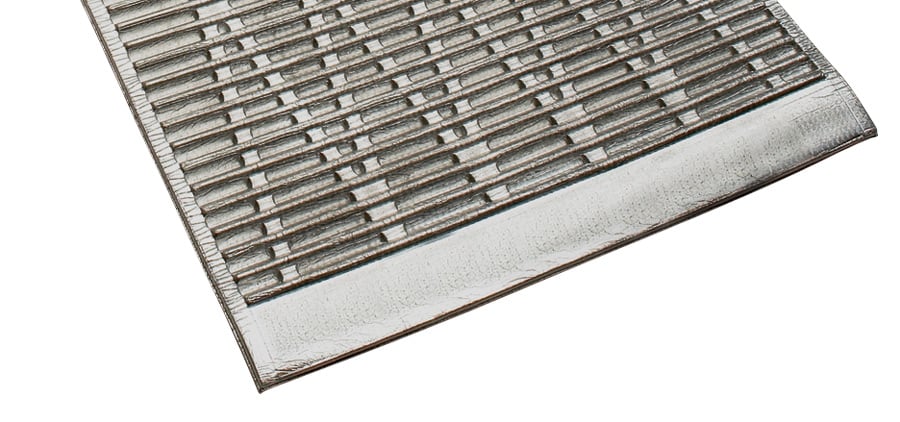
These basic backpacking and camping pads are made of dense foam filled with tiny, closed air cells. They're usually rolled up or folded in an accordion formation.
Pros: They're lightweight, inexpensive, durable and offer consistent insulation in all conditions. You don't need to worry about punctures or leaks. They work great underneath other types of pads to improve insulation, prevent punctures and reduce the buildup of moisture from under-pad condensation in cold conditions. You can carry them on the outside of your backpack without fear of damage, and they can double as sit pads at camp.
Cons: Relatively stiff and firm, they are less comfortable than air pads and tend to be bulky. They are not as warm, either: Most have an R-value around 2.
Self-Inflating Pads
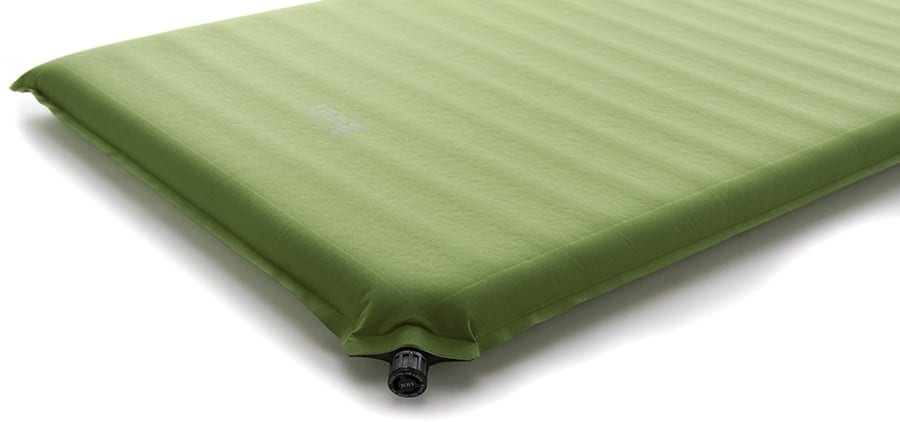
Self-inflating pads combine open-cell foam (which is more flexible and compressible than closed-cell foam) and air. Opening the valve(s) brings in air automatically and allows the foam to expand. Though all self-inflating pads are bulkier than air pads when packed, some are specifically designed for backpacking and can be folded lengthwise and then rolled up to fit inside your pack. Self-inflating pads offer a broad range of options for warmth, thickness, size and cost.
Pros: Foam’s structural cushioning makes them extra comfortable, with excellent insulation. Some are fairly compact when deflated, and you can adjust their firmness by adding or releasing air. They're generally more durable than air pads.
Cons: They're heavier and more expensive than closed-cell foam pads, yet not as compact as air pads. They can be punctured or ripped, though it’s typically easy to repair them in the field.
How to Choose the Right Pad Based on Your Activity
Consider what activity you’ll use the pad for and what the temperatures will be. How you use the sleeping pad and where should strongly influence the type of pad you choose. Bikepacking, kayaking and other sports with limited gear-carrying capacity call for lighter, more packable styles than an activity like car-camping, which typically allows for bigger, plusher, heavier options.
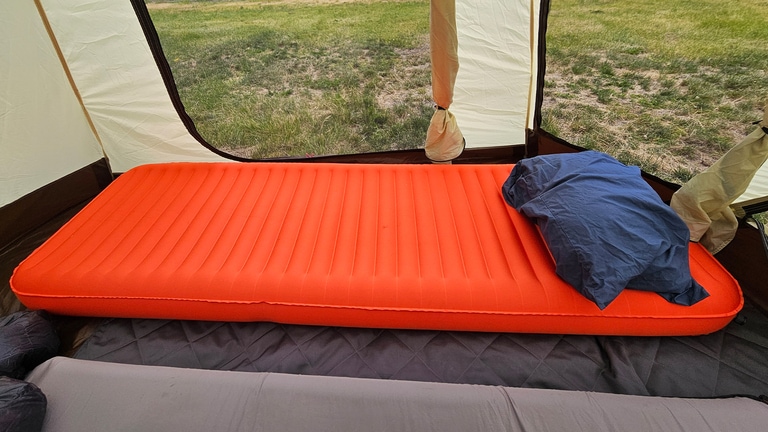
Car camping: When you're not limited by size and weight, you can choose a thicker, larger pad that prioritizes comfort. Self-inflating pads are often good choices for car camping because they’re extra comfy. (Related article: The Best Sleeping Pads for Camping: Tested)
Large inflatable air mattresses or camping cots are another option if you want to use regular sheets and blankets instead of a sleeping bag. However, alternatives to sleeping pads are relatively heavy, bulky (even by car-camping standards) and may lack insulation. Check product specs.
Backpacking: Those who cherish comfortable sleep when backpacking (or touring by bike, canoe or kayak) might choose self-inflating or air pads, which offer a variety of thicknesses, durability levels, insulation value and weight. Compressibility and weight savings are important when you're carrying your pad for long miles, making it a good idea to consider how the pad’s size complements your carrying capacity. Optional chair kits—which use straps to secure a folded pad—allow your self-inflating or air pad pinch-hit as a comfortable seat with a backrest.
Minimalist backpacking (or bikepacking): Here’s where low weight and packability override all other factors. When cutting as many ounces as possible is your goal, an ultralight air pad is probably going to be your best bet. Some insulated full-length air pads now weigh less than a pound. If you’re bikepacking, be sure to look at the packed sizes of your pad options to ensure compatibility with a bike’s panniers or your backpack capacity.
Thru-hiking: Long-distance hiking makes low weight important, but durability for the long haul is also key. Closed-cell foam pads are a popular pick, with some thru-hikers choosing a "short" or "3/4 length" foam pad to save weight. (You can lay your empty pack or extra clothing under your feet for a bit of insulation if needed.)
Winter camping: An insulated, high R-value air pad works well for snowy conditions and cold air temperatures, and pads for extremely cold weather have an R-value of 5.5 or higher. Because R-value is additive, consider using a closed-cell foam pad underneath a high R-value air pad or self-inflating pad. The closed-cell foam adds insulation, helps protect the inflatable pad from punctures, and forms a barrier against moisture that tends to collect under your pad with cold ground temperatures. It also serves as a backup if the inflatable pad is damaged and cannot be repaired.
Understanding R-Value and Warmth
Insulation and R-Value
A sleeping pad's insulation is crucial to a warm night's sleep because you lose body heat to the cold ground beneath you. To counteract this, pads use a variety of materials and construction techniques to prevent heat loss.
A sleeping pad's R-value measures its capacity to resist (hence the “R”) heat flow through it. It’s a more straightforward stat than you might expect: The higher a pad's R-value, the better it will insulate you from cold surfaces. A pad with an R-value of 2.0 is twice as warm as pad with an R-value of 1.0, and if you want to calculate the total insulation for stacked sleeping pads, simply add their R-values.
Sleeping pad R-values vary greatly, but here are some general guidelines:
- R-value less than 2.0 are suitable for warm weather
- R-value 2.0 to 3.9 are suitable for cool weather
- R-value 4.0 to 5.4 are suitable for cold weather
- R-value 5.5 and greater are suitable for extremely cold weather
Manufacturers now have a uniform way to test sleeping pads for R-values, which means you can confidently compare this key spec between any two pads, regardless of the brand, model or type of pad.
R-Value and Your Sleep System
A sleep system consists of three basic components: the sleeping bag, the sleeping pad and the sleeper's clothing. Sleeping bag temperature ratings assume use with a pad that has an R-value of 4. If you sleep warm, you may be able to get away with a lower R-value pad in most seasons (one measuring 2 or 3, for example). If you sleep cold, you may want to choose a pad with a higher R-value so you can enjoy your bag’s stated temperature range.
Ground temperatures can also play a role, says Johnson: Camping in spring, when the earth hasn’t warmed up yet, calls for a warmer sleeping pad than the one you’d need in fall when warmer ground temperatures don’t draw away as much body heat.
Yet for most people, there’s no need to overthink R-value, says Ed Zebrowski, product information specialist for REI Co-op. “Summer pads are fine for most three-season uses,” he says. “Winter camping is when you need to really pay attention to insulation ratings.”
What Sleeping Pad and Sleeping Bag Rating Should I Get?
Condition | Warm | Cool | Cold | Very Cold |
|---|---|---|---|---|
Expected Nighttime Low | 50°F | 32°F | 20°F | 0°F |
Pad: R-Value Range | Under 2 | 2 - 3.9 | 4 - 5.4 | 5.5+ |
Bag: Temperature Rating | 30°F or lower | 20°F or lower | 15°F or lower | 0°F or lower |
What to Know About Sleeping Pad Size, Weight and Packability
Shape
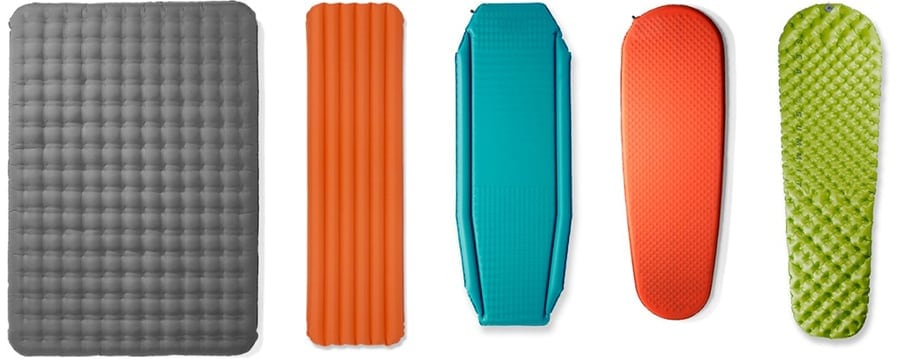
A typical rectangular sleeping pad offers a little more room to move around while sleeping, but you can save weight by choosing a mummy or tapered shape that reduces volume and packs smaller. If you're backpacking with a partner, a two-person lightweight sleeping pad can save ounces.
Size
Most pads measure 20 inches across and 72 inches long, but that’s changing as manufacturers increasingly cater to a variety of body shapes. If you need more space or tend to roll around a lot, you may want a width of 25 or 30 inches (but consider the size of your tent to ensure you can fit wider pads). Long, 78-inch pads ensure that tall folks’ feet stay insulated from the ground. Often the "long" version of a pad defaults to being wider as well, though in some styles you can get a wide pad that is still "regular" length.
Body weight need not factor into your choice of sleeping pad, even for inflatable air pads. Most manufacturers don’t publish weight limits for their pads because “no human exists that can blow out the welding or the seams,” explains Zebrowski. Larger-bodied campers can confidently choose any inflatable pad that accommodates their dimensions and uses.
Weight
The lighter the pad, the less durable it will generally be, says Johnson. Because the strongest materials and constructions add ounces, campers who prioritize long-lasting gear will probably want to choose a pad that lands in the middle of the weight spectrum, rather than on the lightest end. Most insulation technologies also add some weight, so if you’re camping in cold climates, you should expect to carry a heavier pad.
Packability
If packability is paramount, look for air pads that use compressible forms of insulation, such as reflective film or fiberfill. Foams (open- and closed-cell) increase cushioning and insulation but reduce packability.
Comparing Packed Sizes
Large | Mid | Small | Smallest |
|---|---|---|---|
Closed-cell foam pads and plush, self-inflating pads roll or fold into long, 20- to 27-inch bundles that are too bulky to be carried in backpacks. Strap them to the pack’s exterior or use them for car-camping. | Light, compressible foams in some self-inflating pads allow them to be folded in half when packed to achieve a smaller size. | Air pads that use fiberfill or interior air chambers to slow heat transfer pack smaller than self-inflating pads. | Lightly-insulated air pads that use an ounce-shaving mummy shape are most compressible and pack the smallest. |
Sleeping Pad Features and Innovations
Air valves, fabrics, insulations and construction technologies have all evolved in recent years to give campers and backpackers a startlingly comfortable experience when sleeping on the ground.
Airing up—and down
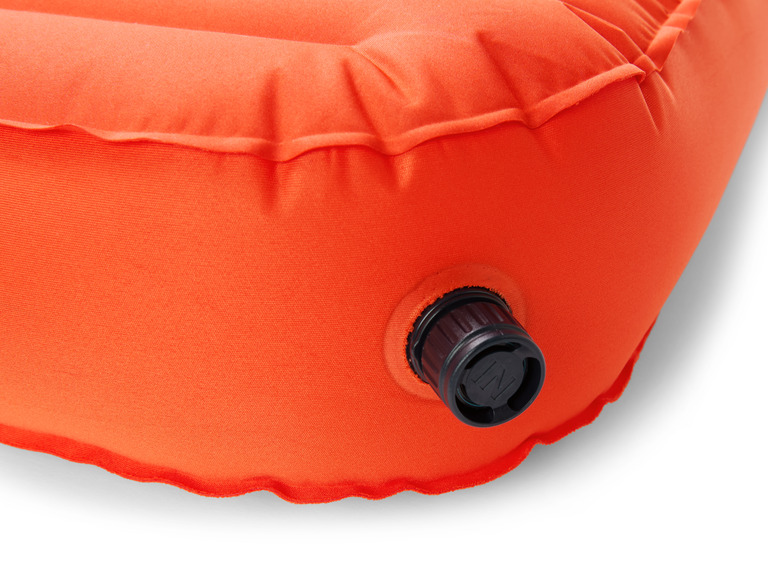
Not long ago, air pads used simple inflation valves (similar to the ones on beach balls) that required a lot of huffing and puffing to bring the mattress to full loft. That’s since changed: Broad, flat valves are now common, and they offer numerous advantages when it comes to ease of inflation (and deflation).
Flat valves fill and deflate faster, and most pair with some sort of airbag (imagine a hot air balloon) that captures large quantities of air and funnels it into the pad. Exped pioneered this idea with its Schnozzle pump bag, but many manufacturers now offer variations on the tool. Not only does this system eliminate a lot of lung effort, but it also reduces the amount of exhalation moisture that collects inside the pad. The drier interior is less likely to grow mold and bacteria.
Large, flat valves also make deflating the pad faster and easier. And because the air escapes more completely, air pads have become more compressible when packed.
To make air management even easier, campers can purchase a battery-powered air pump, such as the Flextail Max Pump 3. It comes with six different nozzles to inflate not only camping mattresses, but also pool tubes and other inflatables. It deflates pads just as easily and completely to speed packing.
Despite the moniker, self-inflating pads don’t actually achieve full loft all by themselves. They do rely on passive air intake to expand the open-cell foam, but they also require a few human-generated puffs to finish the job.
Insulation options
Closed- and open-cell foam provide cushioning and insulation, but foams are bulky, so manufacturers have also developed ways to bring low-bulk insulations to air pads.
Therm-a-Rest pioneered the use of reflective sheets (such as aluminum-coated PVC film) with its NeoAir, which effectively put space blanket technology into an air pad to deliver impressive insulation with minimal weight and bulk. This development has now become ubiquitous across the industry, and it’s evolved to become quieter too (the original technology made a loud crinkling sound when sleepers moved).
Exped uses goose down (in pads such as the winter-ready Ultra 7R) and wool (which tops the LuxeMat). Other brands use synthetic insulation. Sea to Summit lines some of its air pads with Thermolite synthetic fill, a combination of hollow and solid fibers that loft as the pad is inflated to trap warm air and raise the pad’s R-value. The benefits of each depend on personal preference: Some campers prefer the feel (and sometimes the ethics) of natural materials that aren’t made from petroleum (as synthetics are).
Sustainability
Some companies are reducing their environmental impact by using recycled and post-consumer materials in their sleeping pads.
Here are a few sustainability features you can look for when choosing a pad:
- Bluesign: A product may meet bluesign criteria or contain materials that meet bluesign criteria. This means it meets standards meant to keep chemicals of concern out of every step of the supply chain during its production. You can usually find this listed in the product specs online, or you can look for the bluesign logo on the product’s hang tag.
- Recycled content: Synthetic fabrics and insulations made from recycled materials (especially post-consumer waste) require less energy to produce. Look at the materials list in the product description.
- Repairability: REI Green Vests and customer information specialists are your best source for anecdotal reports on product failures and returns. Remember that fabric punctures are easily repaired, while welds and valves are tougher to fix or replace. And closed-cell foam offers virtually no risk of failure, promising an extra-long life of use.
Durability
Durability relates to sustainability in that a long-lasting pad reduces the item’s environmental impact over time. Durable sleeping pads (especially ones that rely on airtight seals) also give campers peace of mind, knowing that they can sleep without fearing middle-of-the-night leaks or punctures.
In general, durability increases with the pad’s carry weight. “There’s a pretty direct correlation,” confirms Johnson. That’s because the lightest constructions and materials aren’t always the strongest: They prioritize weight savings over durability. Designs that do offer both tend to cost significantly more. You can buy a pad that’s light, rugged or cheap—but not all three.
“If durability is paramount, look at the middle of the price and weight range,” suggests Johnson. Pads in this category typically feature tried-and-true constructions that may not be the lightest, or the fanciest, but do deliver trail-tested reliability.
Fabric denier can offer clues to a pad’s durability. Denier measures a fiber’s thickness, with lower numbers corresponding to thinner fibers. Thus a 20-denier fabric may be more easily ripped or punctured than a 70-denier material, but fabric strength also varies by fiber content (some materials are tougher than others and don’t need thicker diameters to achieve reliability).
Johnson has also found that with self-inflating and air pads, fabric durability is less important than the strength of the welds and valves. “You can patch fabric in the field,” she notes, “But you can’t effectively repair a split seam.” When durability is critical, ask an REI Co-op Green Vest about constructions (such as Sea to Summit’s liquid-extruded lamination) that are known for their low failure rate.
Fabrics Options
Synthetic fabrics remain popular for their lightweight durability and compressibility. And some manufacturers top some sleeping pads with stretchy materials that feel comfy as your favorite t-shirt.
Factors for Individual Sleep Styles
When choosing a sleeping pad for camping, it pays to consider your individual sleep style. Side sleepers and back sleepers have differing needs in sleeping pads. So do people who toss and thrash as they sleep. Side sleepers typically prefer more cushioning to support their shoulders and hips and prevent them from drilling into the ground with side-body pressure. Thicker pads are popular among side sleepers, who often find 4 inches to be their magic number (an ultralight model might measure 2.5 inches thick). Open-cell foam also adds cushioning that side-sleepers appreciate. A few pads even use zoned cushioning to place extra support where certain sleepers might need it. Some women’s-specific pads reinforce the hip area or increase the insulation at the feet.
Air pads’ varying baffle shapes can accommodate a range of personal sleep preferences. Some campers find that horizontal baffles feel more stable and comfortable. Others like the “cradle” effect they might enjoy with vertical baffles. In fact, some manufacturers surround vertical baffles with extra-thick “rails” along the sides that help high-movement sleepers stay centered on the pad. Quilted baffles claim to distribute pressure points better than parallel channels. Trying various options in-store is the best way to discover your individual preference.
If you’re noise-sensitive, lying on mattresses is also the best way to evaluate how quiet they are. Some fabrics and especially reflective film insulations issue loud, crinkly sounds when a sleeper moves. The choice of a pad’s shape and size can also be steered by sleep habits. People who turn a lot as they sleep may not get adequate ground coverage from a narrow, mummy-shaped pad. But for still, rarely-move sleepers, mummy shapes can trim weight and pack size without compromising comfort.