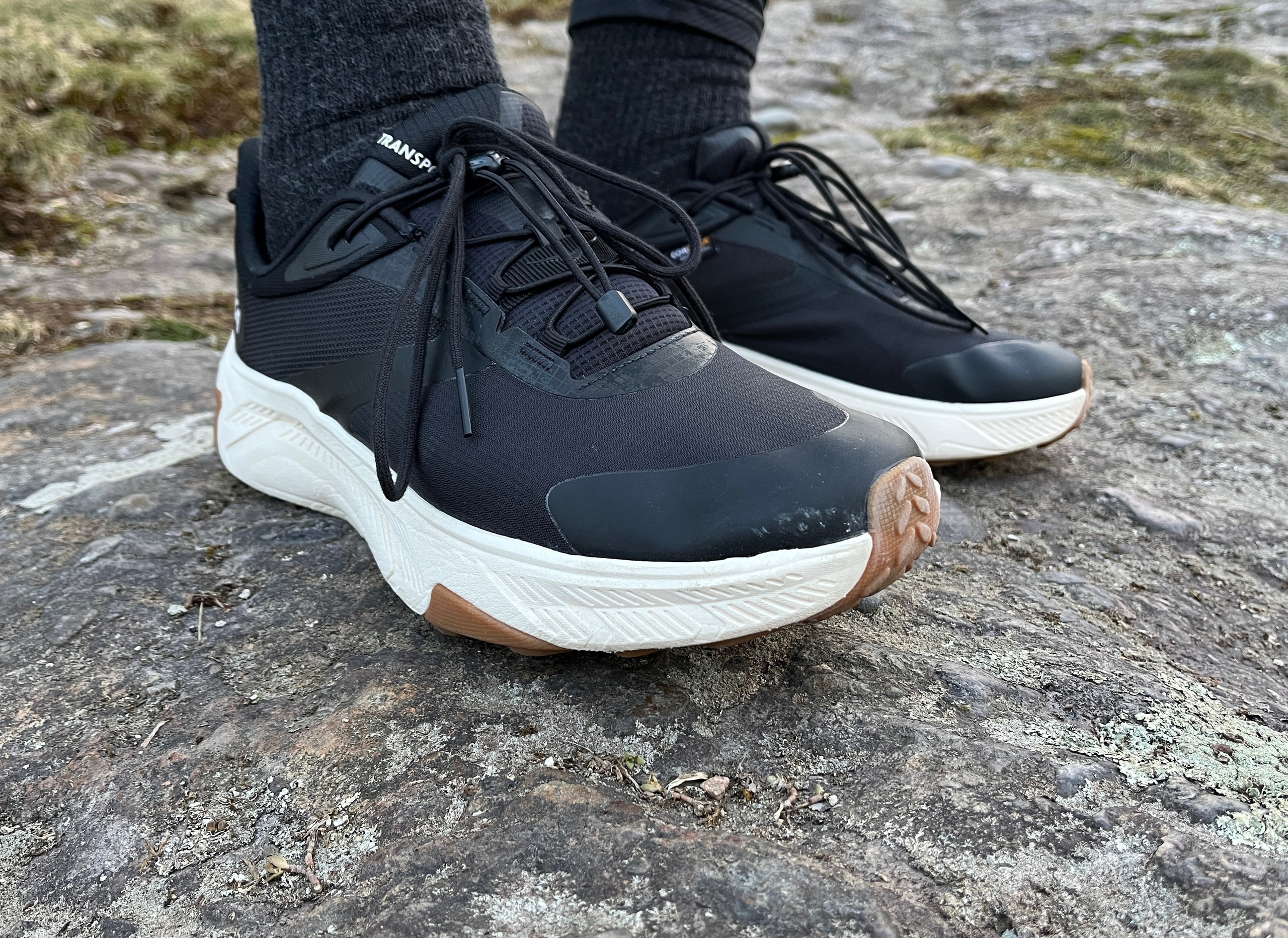
When you live in a city or metro region like most of the world’s population does, hiking might not always look like scaling scree slopes or burrowing through remote boglands. As a guidebook writer, journalist and hiking guide based in Boston, I’d wager that at least 70% of my annual rambling happens in urban parks and conservation lands, and on city sidewalks and streets—sometimes gleaming from fresh rain, sometimes speckled with broken glass.
That’s why the new Transport 2 from HOKA, a “city to trail” shoe for explorers who find themselves negotiating a range of terrains and surface, made my toes wiggle with intrigue.
As it turns out, the Transport 2 is the thicker, more cushioned sequel to one of the brand’s best-selling shoes. Where the original Transport surprised HOKA loyalists with its firmness and lower-plush support, this new version boasts a softer sockliner and collar, and a boosted stack height more alike to classic HOKA styles.
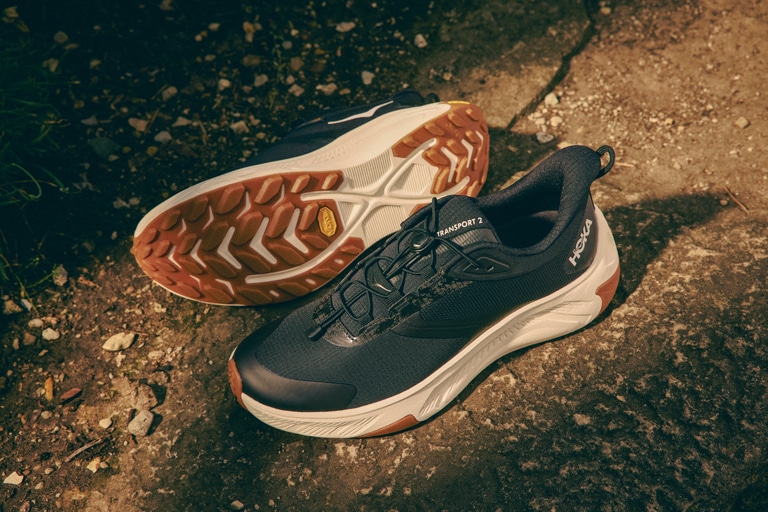
But, the promised through-line between the two editions is traction, both on the trail and off. Throw in some exterior water repellent treatment and sustainability-minded design touches like a 30% sugarcane EVA midsole and a recycled Vibram® outsole, and you’ve got a hiking shoe that begs to be put through the wringer.
So, that’s what I did.
Testing the HOKA Transport 2 Shoes
I got to know the HOKA Transport 2 shoes over two weeks in Rhode Island and my home state of Massachusetts, where I’m an urban trail builder, guide and avid hiker. In that time, I slipped into them for one of my favorite strolls through Boston’s beech woods and puddingstone crags of parks. Then, I cranked things up with longer, more route-planned hikes across green spaces in Greater Boston and Providence. (The latter is one of the rare cities where you can walk merely a mile from a trailhead to a historic chili dog counter.) Wearing the shoes became habitual enough that I was soon lacing them up for more mundane voyages to the grocery store or gym.
Meet the Tester
Tester | Years hiking | Testing locations | Testing duration (miles) | Terrain |
|---|---|---|---|---|
Miles Howard | 32 |
| 64 |
|

Who is this shoe for?
As an urban hiker, I cross paths with a lot of folks whose hikes begin and end at their front door, often when they have a breather from work or a window of free time. These shoes were designed with them in mind. Lightweight and stylish with moderate cushioning and reliable traction, the HOKA Transport 2 is a town-to-trail shoe designed for anyone who often finds themselves ping-ponging between city streets, groomed park paths and grocery store runs. Adventurers who travel light will also get a lot of mileage from the Transport 2.
Pros | Cons | Best for |
|---|---|---|
Minimal break-in | The 2-in-1 lacing system is overcomplicated but provides added stability | Spontaneous hikes or runs on a mixture of natural and built environments |
Reliable traction on light to moderate terrain | Limited grip on more rugged surfaces, especially when wet | Packing light for travel to urban and rural destinations |
Ample midsole support | Inconsistent heel stabilization | Urban hikers who want one shoe that does it all |
Aesthetically versatile enough for active and casual wear |
Other versions:
Comfort
I’ve worn and walked in HOKA shoes for years, but I had some initial doubts when I first laced these up. The toe box was a bit narrower than expected, especially over thicker socks. But then, something surprising happened. As I walked just a half-mile to Boston’s Arnold Arboretum, the shoes eased with each minute of movement. Within minutes, the toe box felt less constrictive and I was able to appreciate the shoes’ plush interior linings. One hour later, I’d climbed the muddy trail to the summit of Peters Hill for a panoramic view of the city, and it already felt like I had been wandering around in the Transport 2s for weeks. They seemed to flex and breathe with each step.
The next day, I wore them to the more rustic urban woodlands at Franklin Park, where pudding stone slabs often extrude from the ground and offer a neat change of pace from dirt and concrete. That same initial stiffness faded quickly, allowing a comfortable hike—like a car engine might sound a bit gurgly as it warms up. The eventual ride was consistently supportive, with a solid rocker that helped my gate feel nature and minimally labored. Additionally, the HOKA team wasn’t kidding when they promised a cushier ride with the Transport 2, provided by a plush, 30% sugarcane EVA midsole. Only once or twice did I experience a more wobbly footstep, as one sometimes does with softer midsoles. And, this may have been less reflective of the Transport 2 and more illustrative of New England’s spongy midwinter ground.
Traction
Winter in Boston might not seem like the best time to test a shoe like the HOKA Transport 2, given the likelihood of running into unshoveled snow, but winters here are soupier and more erratic than they used to be. In just a few weeks, I saw how the Transport 2s performed on bone-dry, sodden and slick surfaces, including on sidewalks covered in rime ice that can form after freezing fog sweeps through the city.
Overall, they performed well. The 4 mm lug depth on the Vibram® outsoles bumps these shoes into hiking boot territory. With most of the lugs facing forward, I was able to safely saunter across chewed up and smoother outdoor surfaces, both of which I often encounter when puttering around the city. That said, hiking shoes often struggle to get a good grip on slicker built surfaces like brick sidewalks or vinyl and laminate flooring, thanks to a quirk of footwear design: Deeper-lugged outsoles are typically designed for softer, more uneven surfaces, and can be less compatible with hard, polished terrain. As soon as I wore my Transport 2s to run some city errands, I began to appreciate the versatility of their outsole. In fact, the grip was strong enough it occasionally felt jolting to make contact with the ground and stop short, mid-step. This was a fleeting annoyance that became less startling with each Transport 2 expedition.
Some compromise may be inevitable with footwear designed for traipsing both indoors and out. I tested the Transport 2s’ limits on a hike in the Middlesex Fells Reservation, a 2,575-acre forest directly north of the city. An unseasonably warm front soaked the slabby trails, and the Transport 2s were an imperfect match for these slick rock surfaces. I often found myself slipping and grabbing at tree branches. The following weekend, However, on a day trip the following weekend to Providence and a climb through the Neutaconkanut Hill woodlands, I had far less trouble on the smoother, more groomed trails. The shoes stuck great to the “lethal when wet” wooden bog bridges on some of these trails.
Overall, the Transport 2s might not be my first choice for scrambling up moist rock slabs on a mountainside, but as an everyday shoe or for a lighter or more groomed hike, I would be more likely to reach for them.
Support
The Transport 2’s snug midfoot and toe box segments paired with the moderate stack height makes for solid protection from impact and elements. Despite occasional wobbles on uneven terrain, these were largely stabilizing and propulsive underfoot. As for ankle support, however, I struggled with looseness in the collar, in part due to the 2-in-1 quick-toggle lacing system in addition to the more traditional tie-ups. While both laces combined provide extra stability up top, I found the dual system somewhat cumbersome.
Initially, I discarded the traditional lace in favor of a faster on/off when I’m ready to hit the pavement or trail, but I quickly learned that the extra lace is essential for securing the ankle. I hadn’t even made it to the end of my street when I felt ankle friction from the collar. Luckily, I had the extra laces in my pocket, and re-installing them instantly solved the problem by adding more precise tension throughout the upper. While the Transport 2 does feature a plusher collar than the first model, the added padding never stood out in testing. With those traditional laces dialed, the collar felt no different than any other shoe designed for outdoor activity.
Other Considerations
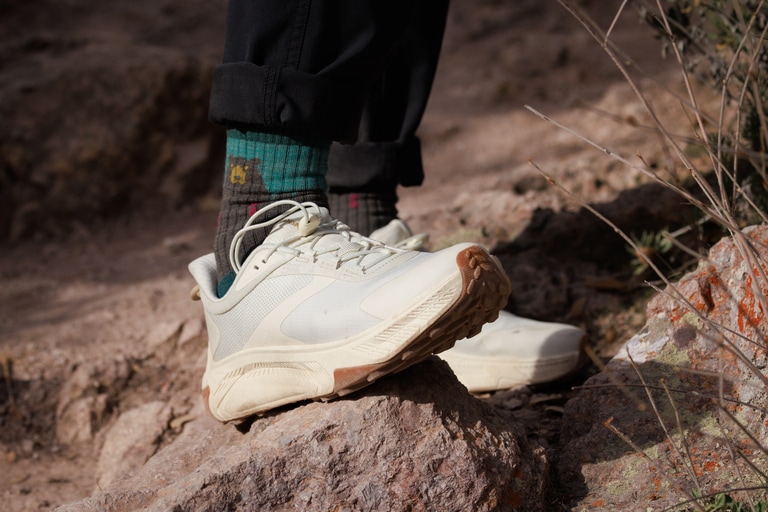
Durability: While mostly limited to smoother surfaces, my intercity wanderings included a couple of trip hazards and near-falls in places. After snagging a foot on an exposed tree root and chunk of rock, the Transport 2 appeared unscathed. The interior liner shows no signs of wear after a few weeks of regular use.
Water-resistance: The Transport 2 is treated with a durable water repellent (DWR) treatment.
Weight: The Transport 2 is on the lighter side for trail-to-town footwear. (per pair: 1 lb. 3.37 oz. women’s, 1 lb. 6.58 oz. men’s)
Bottom Line
As a hiker regularly caught between the rustic and the cosmopolitan, I like the HOKA Transport 2s. They’re capable for around-town and paved or groomed trail use; easy to get acquainted with fresh out of the box; and reasonably springy and flexible for well-cushioned shoes. The shoes’ shortcomings are annoyances, not dealbreakers, and I’m happy to have them in my arsenal of adventure footwear. This spring, I’m planning a walk from London to Oxford in the United Kingdom. If the trip logistics work out, the Transport 2s will definitely be coming along.