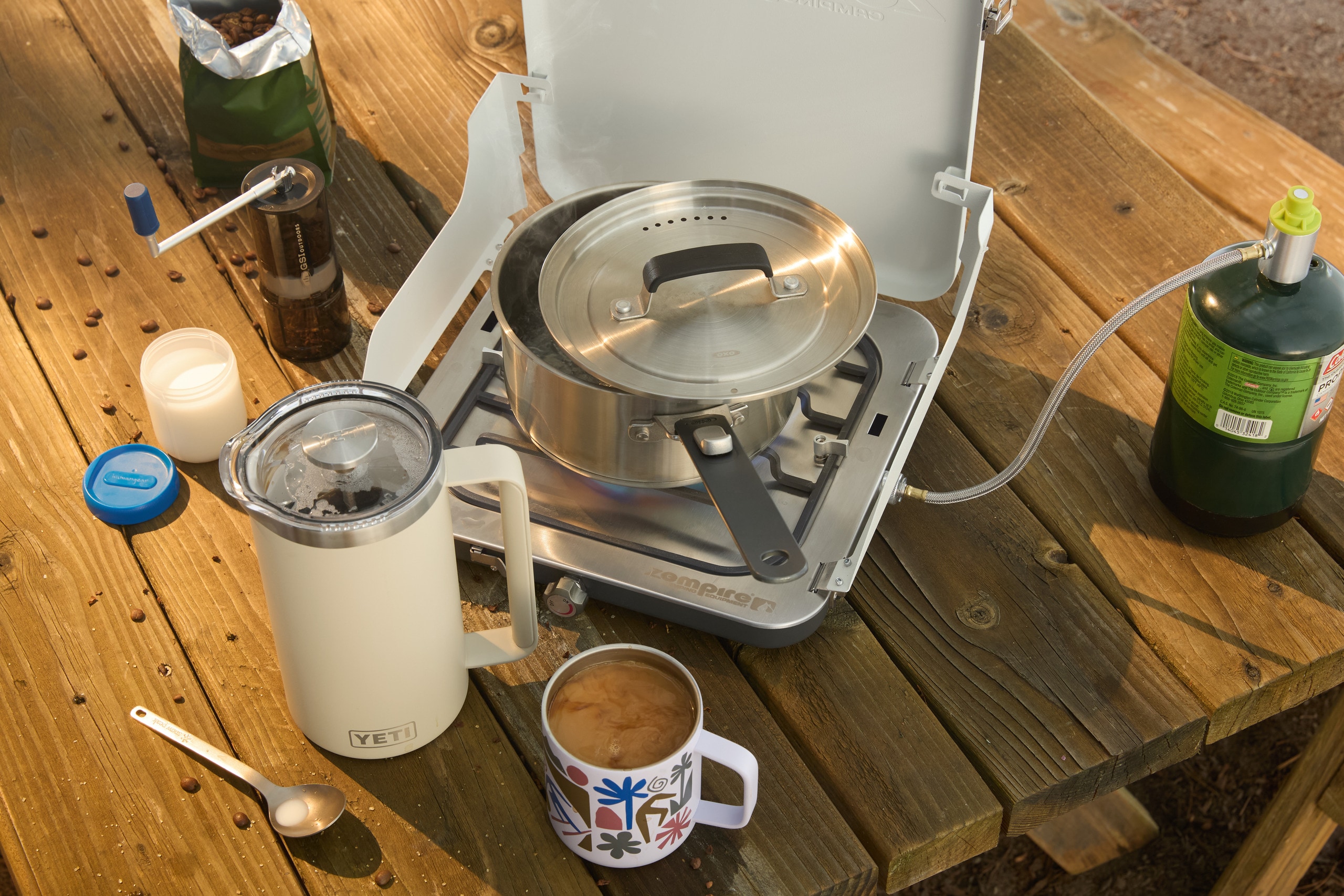
Backpackers carrying all their gear over multiple days or many miles often prefer simple, no-fuss menus that require only basic cookware—sometimes as little as a cup and a spork. Campers, though, have options. When your vehicle does the heavy lifting for you, there's little need to skimp on your camp kitchen. You can bring all the tools for prepping a multicourse dinner or breakfast buffet. Of course, there are options for every type of camper, whether you're a solo, no-frills adventurer or the designated chef of a larger group.
Read on for an overview of your outdoor cookware options or use the menu below to skip ahead.
- Cookware Set or Individual Pieces
- Cookware Material Options
- Other Cookware Considerations
- Camp Utensils
- Camp Kitchen Gadgets
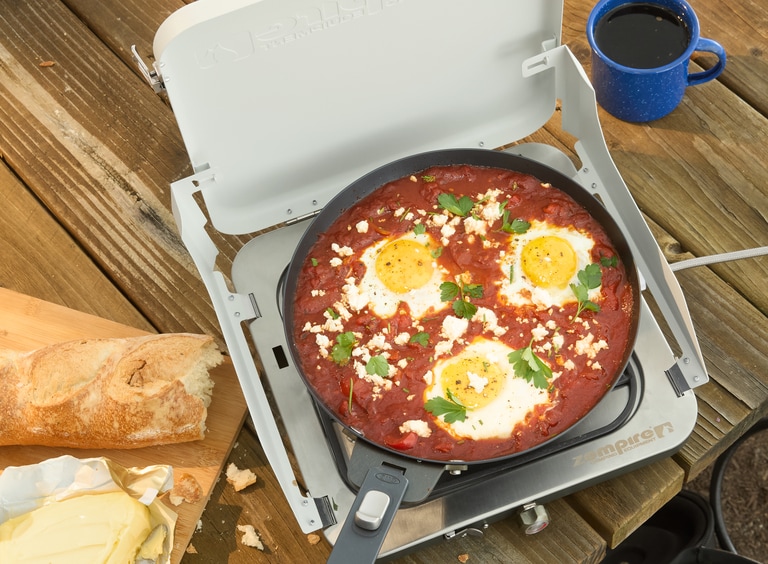
Cookware Set or Individual Pieces
You can buy a complete set of cookware or customize your own by purchasing items piece by piece.
Camp cooksets are collections of pots, pans and lids designed to nest together. Some cooksets include dinnerware such as cups, mugs or plates that nest within the pots.
Individual pieces allow you the freedom to build your set exactly the way you want it. Customizing your kitchen kit allows you to tailor not only what cookware you purchase but also its final weight and amount of space it takes up in your chuck box.
Cookware Material Options
It's important to consider what cookware material makes the most sense for your needs. Some options are lightweight and affordable but less durable over time. Others are long-lasting but are more expensive or heavier. Here, we break down the pros and cons of the most common cookware materials.
Pros | Cons | |
|---|---|---|
Aluminum | Lightweight, affordable and a good conductor of heat. Good for simmering foods without scorching. | Breaks down slowly when exposed to acidic foods. Dents and scratches easily. |
Hard-anodized aluminum | This oxidized material resists scratches and abrasion and is long-lasting. | None. |
Stainless steel | Tougher, more scratch-resistant than aluminum. | Heavier than aluminum, doesn't conduct heat as uniformly (can cause hot spots that scorch food). |
Titanium | Super lightweight—it's your lightest option without compromising strength. Highly corrosion-resistant, heats up quickly and operates effectively without maximum heat. | More expensive than other options. Conducts heat less evenly than stainless steel. It's important to not overheat it. |
Cast iron | It's tough and ideal for baking or cooking. Naturally nonstick after being seasoned. | Very heavy and requires specific care. |
Nonstick coating | Makes cleanup a breeze. | Less durable than regular metal surfaces. Most can be scratched by metal utensils. |
A Note on Cookware Materials
Aluminum: Some people ask if using aluminum cookware is unhealthful. Based on reports from the National Institutes of Health, the Food and Drug Administration and the London-based Alzheimer's Society, no health risks are associated with the use of aluminum pots, pans or skillets. States the Alzheimer's Society: "No convincing relationship between aluminum and the development of Alzheimer's disease has been established." While not a health concern, cooking leafy greens or cauliflower in aluminum cookware is not recommended since it can impact the taste and appearance.
Nonstick coatings: Cookware coated with food-grade fluoropolymer PTFE can emit toxic fumes if severely overheated. Inhaling these fumes can cause flu-like symptoms in humans, and they have been known to kill pet birds. Use caution when cooking with nonstick-coated cookware (don't use when broiling food, for example) or consider using uncoated options instead.
BPA: Bisphenol A (BPA) is a synthetic compound of potential concern on older cookware. All cookware items sold by REI are BPA-free where food or liquid contact the cookware.
Other Cookware Considerations
Pot size: The largest pot in your cook set should hold approximately 1 pint per person in your party.
Number of pots: This depends on the type of cooking you plan to do and how many campers are in your party. If you plan to cook dehydrated food for 2 people, then 1 pot is sufficient. More elaborate meals and larger groups require additional pots and pans.
Lids: Lids reduce cooking time, save fuel and reduce splatter. Some cooksets feature a lid for every pot, while others have a single lid that can be used on several different-sized pots. Others can even double as frypans. Certain lids can also serve as plates, which can lighten your load.
Pot lifters or grippers: Make sure you have some way to pick up your pots and pans safely. Most cooksets include one gripper for all their pots. Just remember to pack it with you.
Extras: Some cooksets come complete with mugs, utensils, plates and even towels. This is convenient if you're starting from scratch or plan to cook for a large group. It can be redundant if you're not.
Camp Utensils
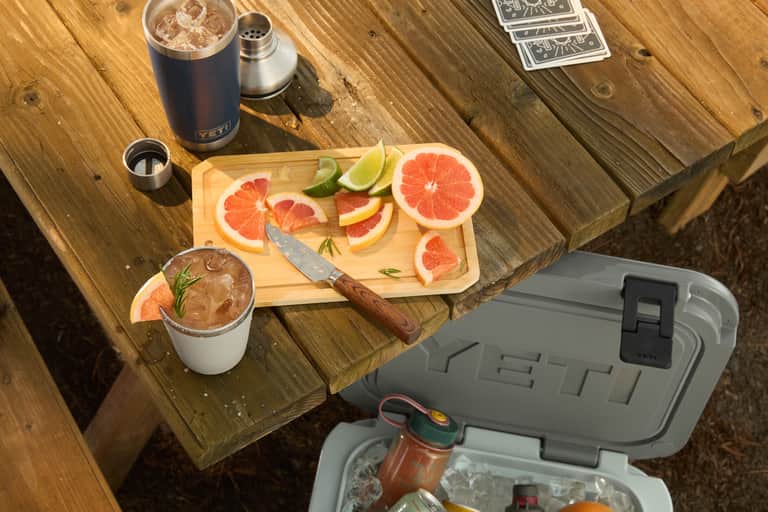
Don't forget to pack cutlery, a kitchen knife for chopping or slicing and kitchen tools like tongs, spatulas, whisks, a serving spoon and a slotted spoon. When deciding what you need, consider what you plan to cook and how you intend to serve it. If you plan on making pancakes or frying eggs for breakfast, for instance, make sure you have a spatula and a whisk on hand. If you plan on preparing a salad, you'll need a sharp knife for chopping veg and tongs or a large spoon for serving it.
Like with pots and pans, many camp kitchen utensils are sold in sets—some even come with handy cases to help keep everything organized. Of course, you can also purchase certain items, like spatulas, individually. Buying single items is a good idea if you already have most of your utensils or if you need a couple extra for helping hands.
Camp Kitchen Gadgets
Campers don't have to "rough it" with these appliances on hand:
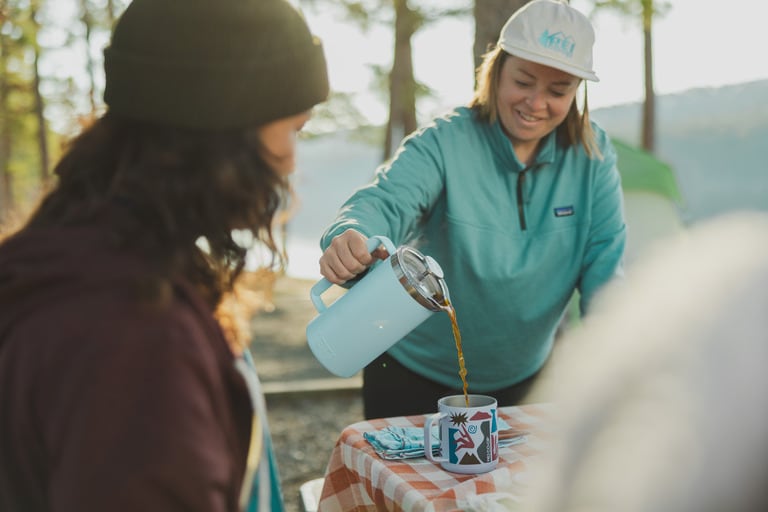
- French press: Brands now make camp-specific options that are hardier than your at-home version, so you can have good coffee even at camp.
- Dutch oven: Use this to slow cook meats, simmer stews and more.
- Cooking iron: Handheld broilers are great for making hot sandwiches and campfire treats.
- Roasting forks: No need to search for the perfect roasting stick when you have one of these. They're great for cooking marshmallows or hot dogs.
- Spice shakers and squeeze bottles: Sauce and single-serve spice packets are great for ounce-counting backpackers, but campers have space for a wider variety of seasonings. Stash your favorites in shakers or squeeze bottles so you always have them handy.
- Can opener: There's little worse than arriving at camp without a way to open your canned chili, soup or veggies. Keep a travel-size version in your chuck box.
- Cocktail shaker: Campers are no longer limited to beer and canned wine. Bring an insulated, camp-specific cocktail shaker for mixing drinks at camp.
- Insulated pitcher: Making cocktails (or mocktails) for a large crew? Whip up your favorite in an insulated pitcher.
Don't forget to bring cleanup supplies as well. See the REI Expert Advice Camp Kitchen Checklist for a comprehensive list of cooking gear.