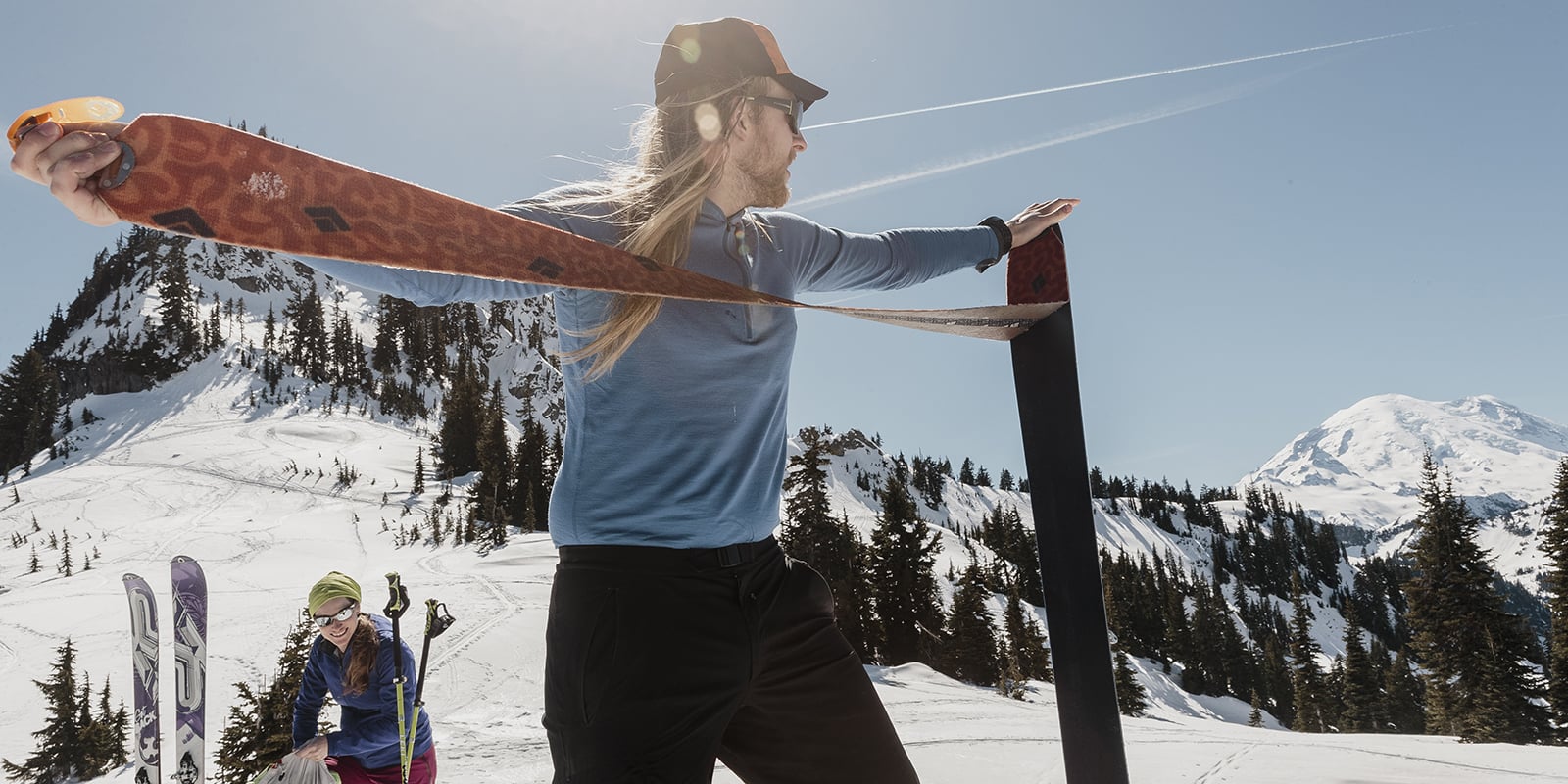
Ready for backcountry skiing? Climbing skins, ski crampons, telemark leashes and knee pads are all useful accessories to consider.
This article covers the basics of each item.
Video: How to Choose Climbing Skins
Climbing Skins
Skins are strips of material that attach to the undersides of backcountry and metal-edge touring skis to provide traction for uphill travel. Advantages:
- They save energy by keeping you from backsliding on moderate terrain.
- They save time by allowing you to take a direct, uphill route instead of having to traverse across gentler terrain.
- They provide a little extra control when you're carrying a heavy pack.
The outer surface of skins has hairs or scales that grab the snow, preventing backward movement of the skis. They were once made of actual animal skins, but now are all synthetic. When the skis are moved forward, these surfaces flatten out to allow some glide.
Skins are sold as pre-cut (designed to fits a specific ski) or trim to fit, which you can cut or customize to fit your skis.
Key Considerations
You have three decisions to make when buying these ski skins: material, width and length. With those three factors, you're balancing cost, weight, durability and glide versus grip.
Skin Material
If you're going on long ski tours, you may want mohair for the best glide and weight savings. For most people and most uses, you'll be fine with skins that are synthetic or a blend of mohair and synthetic.
Synthetic: Typically nylon or polyethylene plastic, synthetic skins are typically the most durable, provide great traction but it tends to be a bit heavier and it doesn't tend to glide as well as mohair.
Mohair skins: Offers excellent glide, solid grip and are lighter weight than nylon. It tends to be the most expensive of the three.
Blend: A combo of nylon and mohair, these skins balance grip, glide, durability, weight and price.
Climbing Skin Width
Next, consider the width of the ski skins, which balances the need for grip with weight savings. Skins are sold in 5mm width increments, from about 80mm to 145mm.
Wider skins provide better traction on steep terrain, while narrower skins save weight on longer backcountry tours.
- For maximum coverage, subtract 5 to 7mm from the widest point of your ski (which is typically the tip). For example, if you have a ski where the widest part is 130mm, choose a skin that is 125mm wide. That gives you good coverage over most of your ski, once you trim the skins.
- If you're looking to save weight, opt for a climbing skin that's as wide as the narrowest part of your ski, or the waist. For example, if your ski is 105mm underfoot, choose a skin that's 105mm wide. That gives you good coverage underfoot with a bit less coverage at the tip and tail of your skis.
For metal-edge touring skis with relatively little sidecut, buy skins in a width as close to your skis' waist width as possible. You want them to cover the ski base up to the metal edges.
For telemark and backcountry skis with wide tips and tails, you have two choices. You can use waist-width skins on these skis, but a significant portion of the ski base at the tips and tails will not be covered, reducing climbing grip. Or you can buy skins in a width close to that of your skis' tips and then trim them to the exact hourglass shape of your skis, allowing optimal climbing grip.
Climbing Skin Length
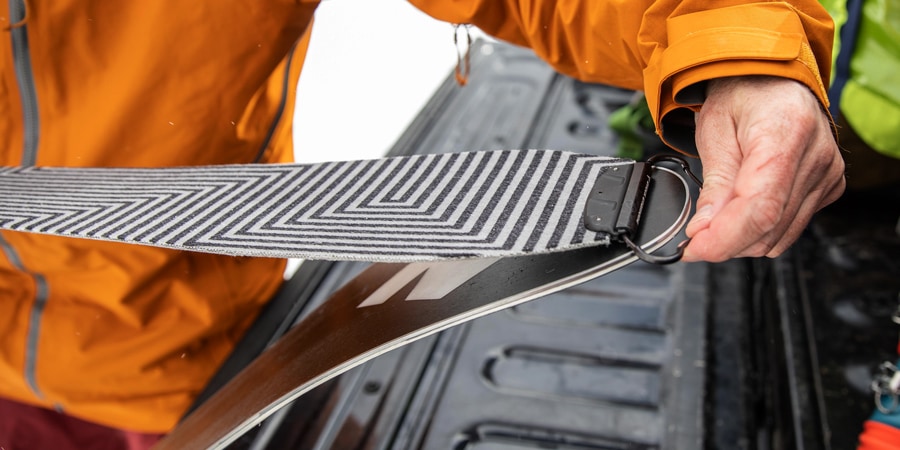
Skins can cover the full length of the ski or just the middle section (so-called kicker skins). They typically attach to ski bases with adhesive, buckles, straps or a combination of these.
Skins are sold in length ranges to match ski sizes. Get the range that fits your ski and then trim the skins to match the exact length of your skis.
Winter camping or hut-to-hut skiing with a big pack is much easier with full-length skins. On a day trip devoted to carving as many turns as you can, you may do just fine with shorter skins. How often you ski can also determine how much you want to invest in your skins.
A few ski manufacturers are now offering skins designed and pre-trimmed specifically for their skis. In some cases, they may be the only skins that will work on those skis.
To store skins, make sure they are completely dry, then fold them with the sticky sides together. Use the mesh sheet typically provided with skins to make it easier to pull the skins apart. This also prolongs the life of the adhesive. Keep some skin wax handy, too, to prevent freezing or ice/snow buildup.
Ski Crampons
Snow can sometimes be too steep or icy for skins alone to provide enough traction. Use ski crampons to add grip and security for going up or crossing especially steep, icy slopes. Ski crampons usually attach to the binding hinges. When you step down, the crampon bites in; when you lift your foot, it comes up off the snow.