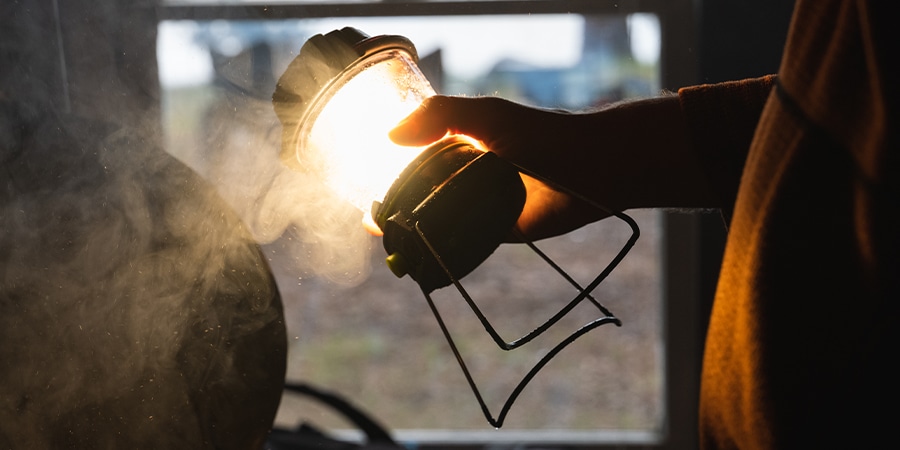
After the sun goes to sleep, the stars come out to play—and with a lantern, you can too. But the lanterns on this list aren’t the old-school variety you might immediately think of (well, except for this one). These picks have LEDs and ridiculous brightness. Some have solar panels so they can soak up the sun’s rays for extra run time, and others have built-in power packs to charge your devices. There’s even one you can manually crank for more light after the batteries peter out.
When choosing a lantern, consider what activities you'll be using it for, be it camping, backpacking or weathering a potential power outage at home. Then decide what features you want. This can include "fun" features like colorful light settings or functional ones like waterproofing. Finally, read on to find the light for you. It’s time to banish darkness and keep the adventures rolling.
Test Results
Find our quick recommendations here or scroll to read the full reviews.
- Goal Zero Lighthouse 600 Lantern & USB Power Hub – Editors' Choice Award winner
- LuminAID Max Quick Inflate Solar Lantern with Phone Charger – Editors' Choice Award winner
- Black Diamond Moji R+ Lantern
- Barebones Railroad Lantern
- BioLite Luci 44' Solar String Lights with Detachable Power Hub
- Coleman Powerhouse Dual Fuel Lantern
- BioLite Luci Original Clear 2.0 Inflatable Solar Lantern
- Haven 6000 3-in-1 Solar Lantern + Flashlight + Power Bank
Editor's note: We updated this guide on September 22, 2026 to include the Barebones Railroad Lantern, BioLite Luci 44' Solar String Lights with Detachable Power Hub and Haven 6000 3-in-1 Solar Lantern + Flashlight + Power Bank.


Goal Zero Lighthouse 600 Lantern & USB Power Hub
Score 98
Maximum brightness 600 lumens
Average run time 2.5 hours (high), 180 hours (low)
Battery Rechargeable 5200 mAh lithium ion NMC
Weight 1 lb. 1.6 oz.
One lantern made it to our tester/first responder’s list of favorites: the Lighthouse 600 from Goal Zero. A top scorer in every metric that matters, the Lighthouse 600 has specs that belie its compact dimensions. It’s roughly the size of a coffee mug when its collapsible legs are folded, yet it emits a whopping 600 lumens. That’s enough to illuminate most tent sites, the front of a car being jumped back to life or a family room during an unexpected blackout. One tester set up the Lighthouse 600 at their cook station while car camping at Gross Reservoir outside Boulder, Colorado, and it provided enough ambient light for her pal to pitch their tent 50 feet away without a headlamp.
The simplicity and battery-longevity of the Lighthouse 600 is another hallmark. From its single dial, you can fire up both sides of the lantern for 360-degree light or just one for more directional light (like if you wanted to illuminate your tent repair without waking up your neighbors), as well as adjust brightness. The lantern also has a USB port for plugging in and juicing up other devices like a phone, headlamp or portable battery pack from its power stores. Its own integrated USB charger wraps around its middle, so you never have to dig for the cord at the bottom of your pack.
Its three charging methods—including one that doesn’t require anything more than a little muscle power—are what make this lantern a top pick for emergency situations. One of our testers deployed the Lighthouse 600 on a winter blackout in northern New England during which she lost power for more than a week. This lantern kept shining for three full winter days before petering out—and it only took a dedicated arm workout to power it back on. That’s right: Pop the lever out of the top of the lantern and start cranking for a mechanical boost to the battery. (Goal Zero calls it a 10-to-1 ratio: 10 minutes of its lowest-level light for every 1 minute of cranking.) It’s a great insurance policy against a dead battery, making this lantern a versatile choice for emergency kits or bug-out bags. The Lighthouse 600 also pairs neatly with the Goal Zero suite of solar panels, so it can recharge via UV rays if connected.
Physical features are a rarity at this weight, but the Lighthouse 600 does have a metal, swinging handle, which makes it easy to carry or pop on a sturdy tree branch or tarp line.
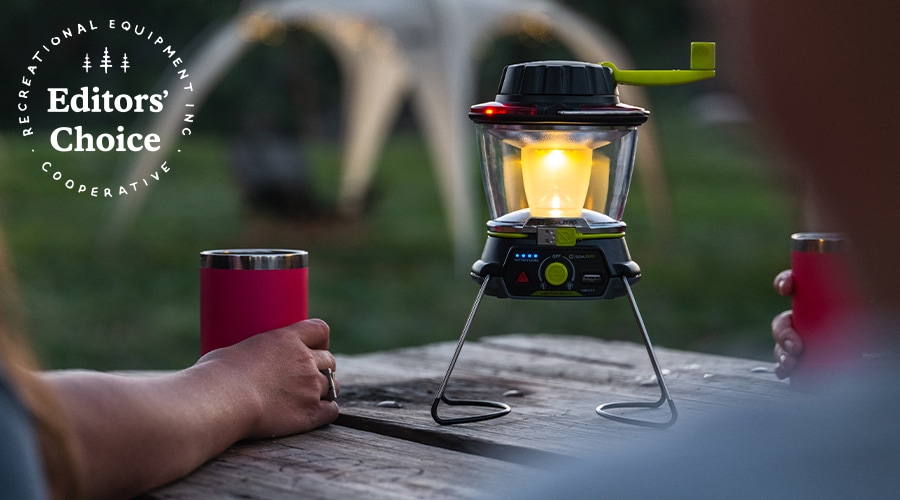
Bottom Line: If you’re looking for a dependable lantern that can provide reassurance for unexpected situations, you can’t do better than the Goal Zero Lighthouse 600, which is bright, easy to use and packed with helpful features.
Testing Stats:
- Nights out: 30
- Testing states: California, Colorado, Idaho, Maine, Montana, Nevada, New Hampshire, Utah
- Best testing story: “When we’re gearing up for day three of a week-long power outage in rural Maine, we value all the light we can get. This lantern shone as our beacon as we helped the local fire department shovel out our neighbors and welcomed us home where dinner was waiting for us — thanks to a propane stove and the light cranked up from the Goal Zero Lighthouse. We even charged our phones with it at night, so we could keep up with the local weather throughout that crazy week.”

![Max Quick Inflate Solar Lantern with Phone Charger [Phone and lightning charging cable not included]](/media/c8789d87-d278-4e4d-8f7c-5a31d769f21d/?size=440)
LuminAID Max Quick Inflate Solar Lantern with Phone Charger
Score 97
Maximum brightness 200 lumens
Average run time 3–5 hours (turbo), 6–8 hours (high), 12–16 hours (medium), 44–50 hours (low), 60–72 hours (flashing)
Batteries Rechargeable 2000 mAh lithium ion
Weight 12.5 ounces
OK, backpackers, hear us out. We know weight and space are of the essence, so a lantern may seem like overkill when you already have a headlamp in your kit. But the upgraded LuminAID Max Quick Inflate Solar Lantern with Phone Charger (previously called the LuminAID PackLite Max 2-in-1 Phone Charger) will convince you otherwise—and it saves you the weight of a battery pack, too.
As a lantern, the waterproof Max Quick Inflate delivers up to 200 lumens via five modes. Hang the tissue box–size lamp from a tree to illuminate small campsites or affix it to the tent ceiling for visibility when changing, reading or producing epic night photography. The Max Quick Inflate can run for up to 50 hours on the “low” setting, which is why our testers love it for multiday hikes and hut trips. Best part? The lantern has a built-in solar panel, so you have a backup if your batts die.
Or harness the sunshine and use the Max Quick Inflate as a charging station. A built-in USB port allows you to plug in and juice up a phone, headlamp or camera. One tester appreciated the versatility when his phone died on a backcountry ski adventure around New Hampshire’s Tuckerman Ravine on Mount Washington. “Even after powering up my phone, the Max Quick Inflate had enough in the tank for a little lantern-light après in the parking lot,” he says.
Back to weight and space: If we haven’t convinced you yet, consider that the versatile Max Quick Inflate weighs less than a pound and collapses to about the size of a Rite-in-the-Rain notebook, stowing easily in a pack’s top lid. Did we mention that this lantern self-inflates, requiring no huffing and puffing to blow up your light? One Alaska-based guide, who brought it on a two-week ski-mountaineering trip, called it “the best weight I could carry.”
Bottom Line: Trekkers will appreciate the versatility of the LuminAID Max Quick Inflate Solar Lantern with Phone Charger, a portable lantern and charging station worth its ounces.
Testing Stats:
- Nights out: 44
- Testing locations: Alaska, Colorado, Iowa, Maine, Massachusetts, Montana, New Hampshire, Wyoming, Vermont; Alberta, British Columbia and Yukon Territory, Canada
- Best testing story: One tester discovered that the Max Quick Inflate makes for an OK pillow in a pinch—“not compared to an actual pillow, but to a pile of smelly clothes with pokey zippers,” she says. On a winter ski-mountaineering trip, she’d hang it from the tent ceiling at night for chores like straightening up drying gear, reading topo maps and removing her contact lenses, then she’d take it down, deflate it “just a smidge” and tuck it in the hood of her sleeping bag.


Black Diamond Moji R+ Lantern
Score 96
Maximum brightness 200 lumens
Average run time 5 hours (high), 8 hours (medium) 100 hours (low)
Batteries Rechargeable 1500 mAh Li-ion
Weight 2.8 ounces
Looking for a simple lantern that you can clip onto a backpack, toss in a gear hammock or keep handy on your way to the outhouse? Look no further. The Moji R+—a rechargeable version of the popular Moji from Black Diamond, and the newest iteration of the ReMoji—is a little baseball of a lantern with a couple of D-rings for easy lashing. Compared with a previous version, Black Diamond slashed the Moji R+'s weight nearly in half, doubled the lumens and increased the run time by dozens of hours. (We lasted 30 hours on high and low.)
The compact Moji R+ sports many of the same settings of a headlamp—maximum brightness, dimmable light, strobe—but with a couple of key differences. For starters, the globe is frosted, which creates soft, ambient light—a pleasant departure from the harsh spotlight effect campers get when hanging a headlamp from the tent ceiling. It also has a rainbow cycle, so you can let it flow through the spectrum like hot tub lighting or stop it on the solid color of your choice (including red light).
The Moji R+ has collapsible hooks, which allow you to string it on anything without a carabiner, while four magnetic dots let you snap it to a fridge or car door when you’re out of the field. It fully charges via USB in less than three hours, and it’s waterproof.
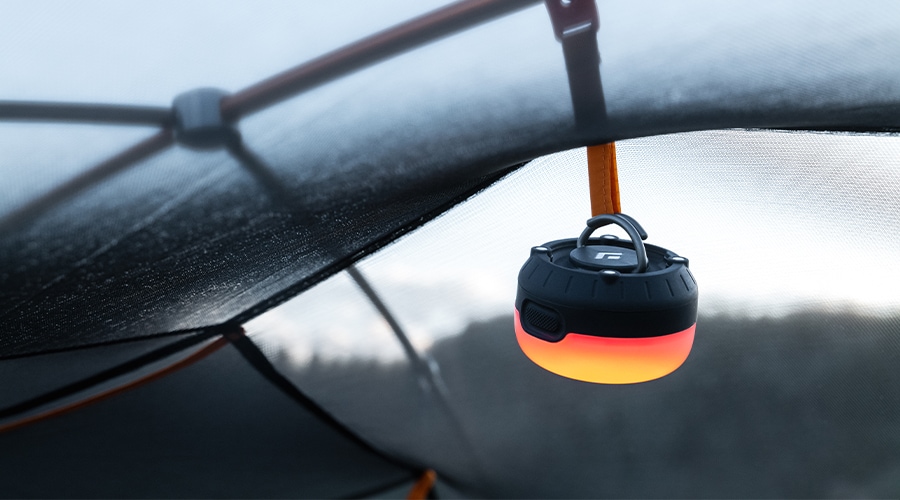
Bottom Line: For a lightweight, compact lantern that can hang just about anywhere, the rechargeable Black Diamond Moji R+ is best in test.
Testing Stats:
- Nights out: 38
- Testing states: Alaska, Colorado, Maine, Massachusetts, Montana, New Hampshire, Vermont, Wyoming; Quebec, Canada
- Best testing story: On a road trip through New England, one Maine-based tester clipped the Moji R+ to her dog’s harness at camp when the sun set each day. The leashed dog, “in his infinite wisdom,” his mom says, took off into the woods on an otherwise routine midnight potty break. “Without the lantern, I wouldn’t have been able to easily spot where he was tangled up with a tree,” says the tester, who then used the Moji R+ to pick her way back to the tent.

Barebones Railroad Lantern
Score 93
Maximum brightness 200 lumens
Average run time 3.5 hours (high), 100+ hours (low)
Battery Rechargeable 4400 mAh lithium-ion
Weight 2 pounds
Best for Camping, outdoor dining
The Barebones Railroad Lantern doesn’t just light up a campsite—it gets noticed, too. During a 4-day camping trip in Shenandoah National Park, tester Gilberto G. fielded compliments from neighboring campers curious where it came from. Part of the appeal is the build itself: four Edison-style LED bulbs glow at a warm 300K behind a glass globe, with metal and copper accents that read more like a piece of furniture than outdoor gear.
But the old-timey, classic aesthetic comes with tradeoffs: It may be too nice for camping. “My wife liked it enough that it never went back in the camping bin,” says Gilberto. “It now lives on our deck and comes out for dinner at home.”
Of course, it can’t just look good. The Railroad earns its keep with the stepless dimmer. Most lanterns force a choice between two or three fixed brightness levels, making you choose among the limited options. But the Railroad’s dimmer solves that, sliding from a warm-and-low glow for eating to a brighter light best for cooking or packing up in the dark. “It lets the lantern work as a table light at low output and a task light at high, which is why I did not need a second light source for dinner,” says Gilberto.
Tester Laurie G., who also brought it camping during a road trip to Wisconsin and Georgia last summer, agreed that the aesthetic was the highlight: “Love the style!” But she flagged a concern: The glass globe and turn-key switch aren’t indestructible. Pack carefully so you don’t bend or bust your Railroad by tossing it around with other gear. And it’s not ideal for hiking.
For car campers who don’t mind babying it a little, it’s tough to beat. The rechargeable 4400 mAh lithium-ion battery charges via USB-A to USB-C, and the lantern can also run wired as a 12-volt fixture without the battery installed at all. Tester Heather R. has used the lantern for more than a year and over 50 hours of runtime. In that testing window, she calls it invaluable for actual sleeping-in-the-car camping. During an overnight near the Mount Elbert Trailhead in Colorado, she hung it on a hangar hook near the car window while cozying up in her sleeping bag to read at night.
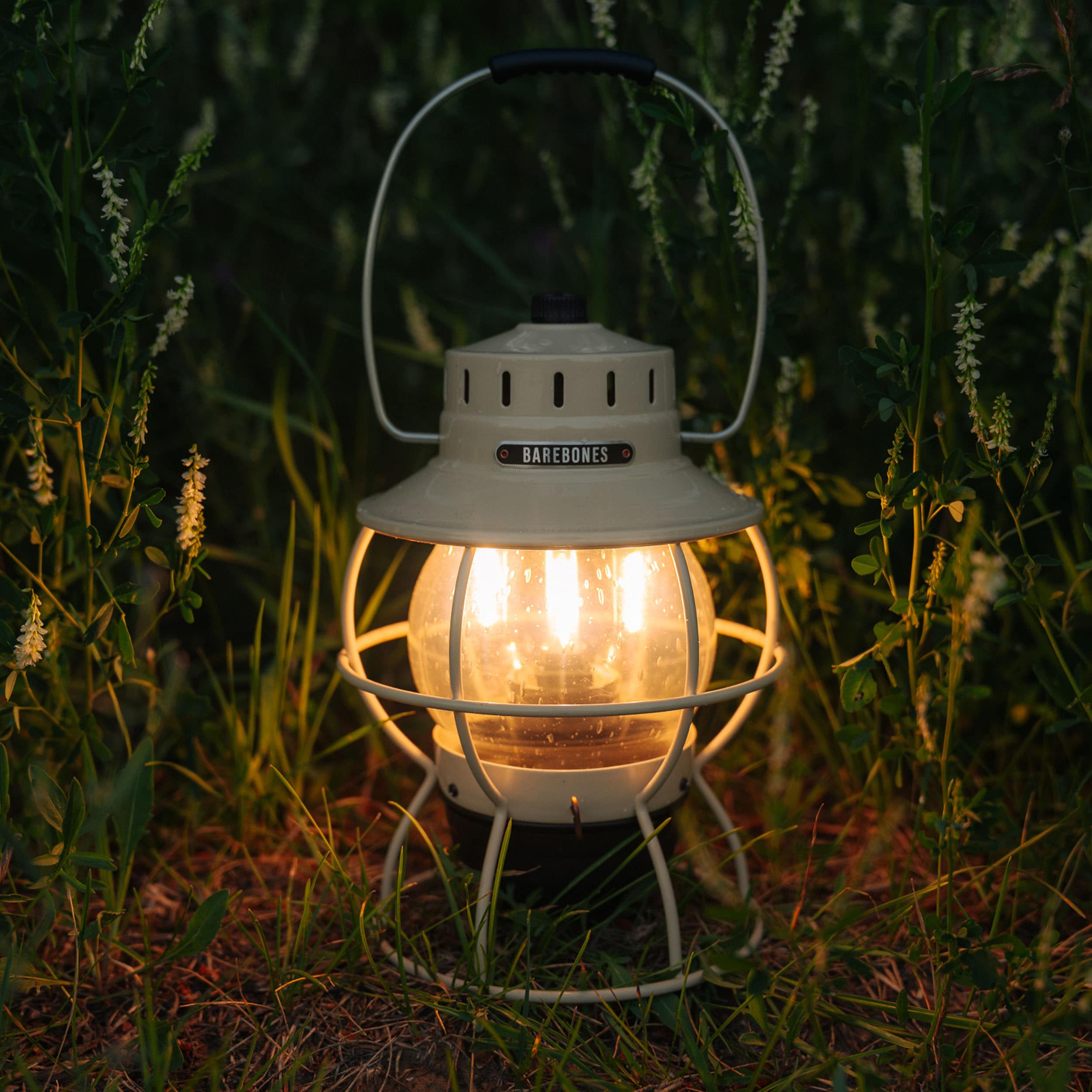
Bottom Line: If you want a genuinely stylish lantern with a smart dimmer that pulls double-duty as a conversation piece at your dinner table, the Barebones Railroad Lantern is a great pick
Testing Stats:
- Nights out: 35
- Testing states: Colorado, Georgia, Utah, Virginia, Wisconsin
- Best testing story: “This past winter, a group of our friends and family all got together for a Friday night moonlit Nordic ski,” says Colorado-based tester Heather R. “I parked the Railroad on the cocoa table with some snacks so when we were done skiing, we had an outdoor version of a moonlight dinner. So fun!”


BioLite Luci 44' Solar String Lights with Detachable Power Hub
Score 92
Maximum brightness 140 lumens
Average run time Up to 8 hours (high), up to 24 hours (medium), up to 40 hours (low)
Batteries Rechargeable 4000 mAh lithium-ion
Weight 1 lb. 10.2 oz.
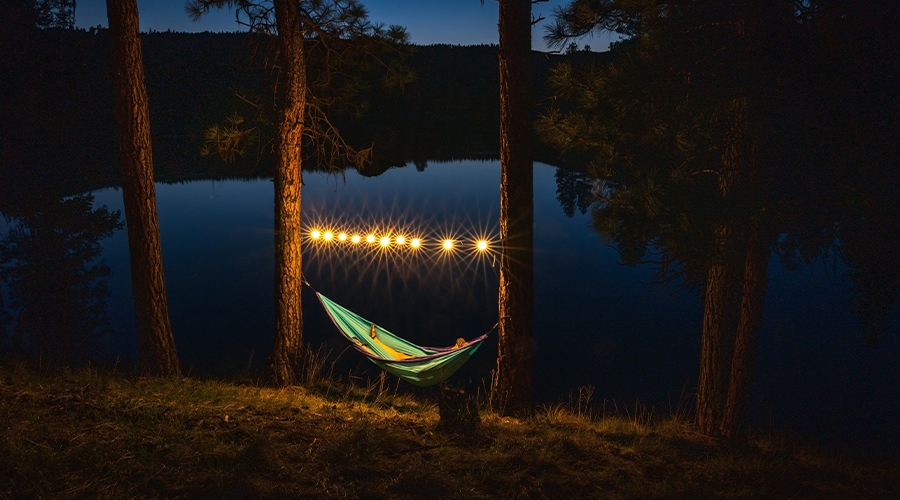
A strand of lights might not be an obvious choice for camping, but it should be. Instead of pooling the light in one spot like a traditional lantern, string lights let you spread it out or even encircle an area you want to brighten. Our favorite for the occasion is the BioLite Luci Solar String Lights + Detachable Power Hub, a 44-foot-long strand decorated with 20 nodes. This updated version also has a detachable power hub, so you can juice it up over a multiday camping trip without removing your string lights from tree limbs. The effect is A+ ambiance with a lot less work.
Testers noted the durable nylon cord rarely tangles, easily wrapping up around the plastic base and telescoping in when not in use. That base holds a small solar panel, which can power the lights for more twinkling when the battery runs out. BioLite claims 16 hours in direct sun can fully charge the device. Testers had no problem after a day or two (this varied based on the amount of direct sunlight) of the lights sitting on a vehicle dashboard in New England. A built-in USB port means you can also power up other gadgets with the hub, making you the campsite superstar.
The Luci Solar String Lights + Detachable Power Hub is a slam dunk for car camping: String it around a picnic table or tent vestibule. Though a little bulky for ounce-counting backpackers, it can fit in a pack if you want to up the ambience of your backcountry site. It’s less than 2 pounds and about the size of a Tupperware container, so you can easily slide it in the brain of a backpack or lash it to the top lid for on-the-go solar charging.
Our testers also lauded its versatility in more casual pursuits. One tester brightened up her tailgate for a season of post-adventure hangs and sunset missions. “Best night: Hot drinks and an apple crumble were enjoyed on the Maine–New Hampshire state line under the glow of these lights,” she wrote on her gear tester feedback form. She couldn’t have been happier at the ability to Pinterest-out her truck.
Bottom Line: The BioLite Luci 44' Solar String Lights with Detachable Power Hub are a fun and flirty way to light up your space and charge your devices at the same time.
Testing Stats:
- Nights out: 22
- Testing states: Alaska, Colorado, Maine, Minnesota, New Hampshire, Vermont, Washington
- Best testing story: While testing this string of lights in the snowy woods of New Hampshire last winter, one tester found a new friend in the form of a barn owl perched on a nearby fence. “I flicked through the high, medium and low power levels to see what would happen, and the owl seemed to dig it by hooting softly every time the light changed,” they say.


Coleman Powerhouse Dual Fuel Lantern
Score 88
Maximum brightness 800 lumens
Average run time up to 5 hours (high), up to 20 hours (low)
Power source White gas or unleaded gasoline (sold separately)
Weight 4 lbs. 10.4 oz.
Light up your backcountry hut, ice-fishing shed or backyard picnic the old-fashioned way with the Powerhouse Dual Fuel Lantern from Coleman. Why a gas-powered lantern, you ask? For starters, it will be your best friend in extreme-cold conditions, which can drain batteries in other lanterns faster than you can say “nor’easter.” (Just ask the Maine-based testers who relied on it during a weeklong power outage—thankfully, it would have to be pretty darn cold for your gas to freeze.) Plus, weather is less likely to affect this lantern compared to other gas-powered options, thanks to glass that protects the flame from strong winds, snow and rain.
Top off the attached fuel canister with white gas or car-grade unleaded gasoline, then enjoy the warm glow of the flame and the nostalgia of gas-powered light. An adjustable dial lets you soften the intensity to reading-light levels or fire it up to illuminate your whole campsite.
Of course, there are a few reasons the ol’ Coleman is a classic. Most obviously, some may find the hissing sound of the gas to be too loud (others may find it nostalgic). And, as you’d expect from gear originally developed in 1914, it’s heavy and less intuitive than others on this list. To use it, screw the lantern atop the fuel canister, tie on the mantles, ignite the gas flow, lower the glass and attach the lid. (Don’t worry, instructions are included.)
Bottom Line: For a hardy, classic lantern that won’t leave you hanging in extreme weather, the gas-powered Coleman Powerhouse Dual Fuel lantern lived up to testers’ expectations.
Testing Stats:
- Nights out: 9
- Testing states: Maine, Massachusetts, New Hampshire
- Best testing story: Two winter holiday seasons in a row, Mainers have had wicked storms roll through. But thanks to the Coleman Powerhouse Dual Fuel, the path was always brightly lit. One tester illuminated his walkway and driveway on a sleeting morning without power to plow out a path to reach town. This lantern lit up the entryway again when he returned home to no electricity that night. “It was the only thing that didn’t fail in single digits in New England—that’s wicked tough.”


BioLite Luci Original Clear 2.0 Inflatable Solar Lantern
Score 85
Maximum brightness 75 lumens
Average run time Up to 24 hours
Batteries Rechargeable 1000 mAh lithium-ion (solar or USB-C recharge)
Weight 4.4 ounces
Best for Backpacking, camping with kids
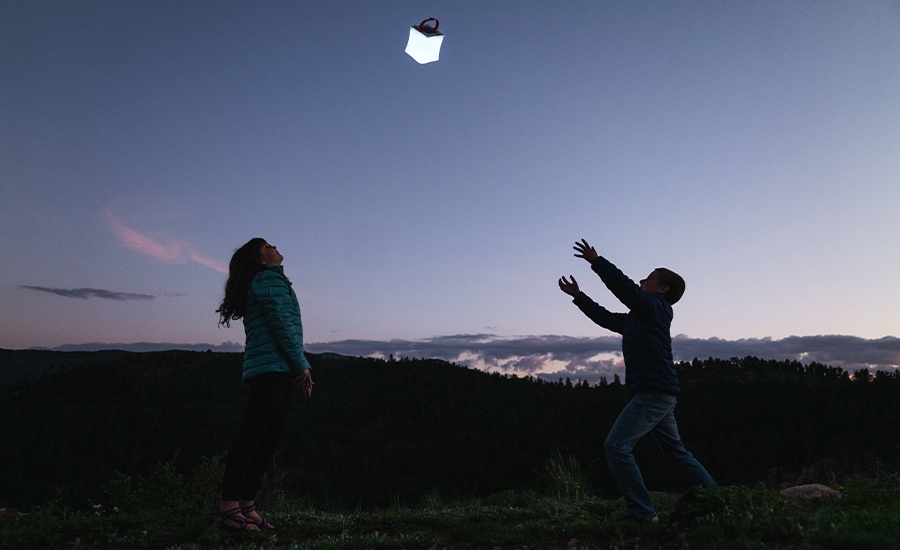
The BioLite Luci Original Clear 2.0 is built for minimalist trips. It collapses down to almost nothing, and both of our testers called it the lightest, most portable lantern they’d used while tucking it flat into a backpack pocket. Durability held up, too. Our Florida-based tester Doug W. said his grandson “treated it like volleyball,” and it tolerated it a champ. Meanwhile, tester Annie Z. also lauded the Luci’s longevity after she clipped it to her backpack for a Colorado backpacking trip in Indian Peaks Wilderness, dropped it onto rocks along the way, and it still escaped unscathed. “Pros of the lantern were the weight, durability and compaction,” she says.
Charging is straightforward. Annie never bothered topping off the battery before leaving home. She just clipped the lantern to her pack and let the solar panel do its thing as she hiked, never coming close to draining the stated 24-hour run time. Doug charged the traditional way with the included USB cable, but found it ran a bit short.
Brightness was the main letdown. With 75 lumens, both testers found it dimmer than expected and wished for a warm-light option instead of the single cool-toned setting. Still, Annie’s husband managed to use the lantern as a beacon to navigate back to camp during a sudden rainstorm, so the Luci certainly does its job well.
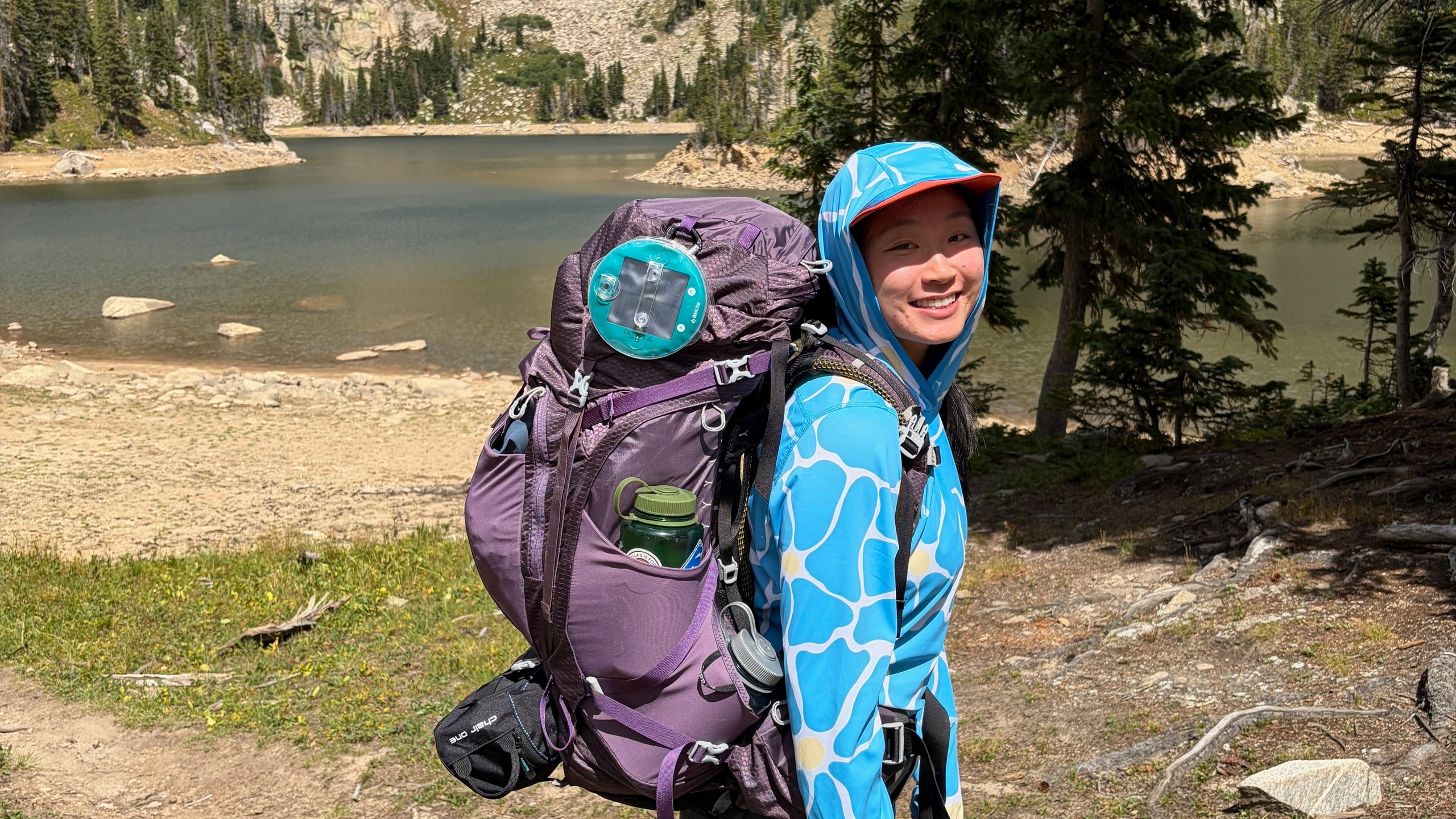
Bottom Line: If ounces, pack weight, and a nearly indestructible design matter more than all-out brightness, the BioLite Luci Original Clear 2.0 Inflatable Solar Lantern is tough to beat.
Testing Stats:
- Nights out: 5
- Testing states: Colorado, Florida
- Best testing story: “At one point my husband and another backpacker in our group went to filter water. The place to fill water was a 20-minute walk away, and during that time a cloud and rain rolled through,” said tester Annie Z. “I left the BioLite Luci outside on a branch next to our tents. My husband used the lantern as a beacon on the way back across this large meadow. Despite the lower lumens, he could clearly see the rain-dusted lantern from the trail (100 ft away).”
![6000 3-in-1 Solar Lantern + Flashlight + Power Bank [Cell phone not included. ]](/media/96a35155-44fe-474a-b553-baf0fdb889a4/?size=440)


HAVEN Lantern 6000 3-in-1 Solar Lantern + Flashlight + Power Bank
Score 91
Maximum brightness 650 lumens
Average run time 8 hours (high), 22 hours (medium), 100 hours (low)
Batteries Rechargeable 6000 mAh lithium ion
Weight 1 lb. 2 oz.
Best for Camping, van life, rafting
The 6000 3-in-1 from HAVEN Lantern doesn't just light up a tent—it runs the whole campsite. During three camping trips spanning Ohio and Michigan, tester Sera K. put the lantern's solar charging to the test. She set it outside for a few hours before her first trip, unsure whether it came pre-charged. After that, it didn't need to be babied. Across more than 7 nights of combined use, the battery never dipped low enough to need more juice.
But the Haven's real party trick might be its built-in red light. "My favorite feature of this lantern that I've never had in any other lantern is the red-light option," says Sera. "I prefer to use red light at camp whenever possible when I'm hanging out, and it was really nice to have this integrated into a lantern." She used the folding carabiner handles to hang it from her tent ceiling and found the red setting bright enough to rival her headlamp's high beam.
But it comes with tradeoffs. The 6000 3-in-1 earns some of its lower marks on usability. Two separate buttons—one for the lantern and one for the flashlight—are both finished in the same white-on-white housing. "The operation buttons are kind of difficult to find because the white color of the buttons blends into the color of the lantern itself," Sera says, adding that she initially mistook the flashlight button for the lantern's main control. A built-in emergency strobe setting compounded the issue: Because it can't be skipped or disabled, she had to cycle through a jarring flashing light every single time she wanted to switch to red.
Still, quirks aside, the 6000 3-in-1 earns it keep with sheer brightness. Thanks to the maximum 650 lumens, you’ll never have trouble seeing. “This lantern can get bright,” Sera reports. “Its highest brightness setting was way brighter than I ever needed for my use.”
Bottom Line: With a bright, solar-assisted battery and an integrated red-light mode, the HAVEN Lantern 6000 3-in-1 Solar Lantern + Flashlight + Power Bank is a strong pick for campers who want one light to do it all.
Testing Stats:
- Nights out: 8
- Testing states: California, Michigan, Ohio
- Best testing story: “The red light was actually quite bright, possibly even brighter than the brightest setting on my headlamp, which was great for being able to see things without having to worry about losing my night vision,” said tester Sera K. “One rainy night in Michigan, we sat in the tent playing Wingspan for a couple hours under the lantern's red light. That was my first time playing a board game in a tent, but it probably won't be the last.”
Buying Advice
When choosing the perfect lantern for you, consider power source, brightness, features, weight and portability (especially if you intend to play backcountry two-square with your lantern).
Power Source
Batteries—of one kind or another—make most modern lanterns tick. The majority of lanterns run on alkaline or rechargeable lithium-ion batteries, and both have their benefits.
A lantern that runs on disposable batteries is more predictable. When the lantern dies, pop in new ones. (You are carrying spares with you, right?) Alkaline batteries are sold widely, and they often hold their charge better over time if unused, making them great for emergency-kit lanterns.
A lantern that runs on a rechargeable lithium-ion battery, on the other hand, tends to be more versatile. You can fully juice it and start off every trip at 100% by plugging it into a power source. Such lithium-ion batteries also tend to operate better than alkaline batteries in colder conditions, and they hold a more consistent brightness as they die. And if your lantern offers a manual way to recharge the batteries—for instance, the Goal Zero Lighthouse 600 Lantern can be revived using a hand crank—it can also make a great addition to an emergency kit. The ability to rely on manual charging in emergencies can make or break a situation.
In this guide, most lights use a rechargeable lithium-ion battery, and each can be charged through an external power source via USB. Some can be juiced multiple ways, which helps them last even longer away from a wall outlet or electric power source: The Goal Zero Lighthouse 600 can also be charged mechanically with a hand crank, while the LuminAID Max Quick Inflate Solar Lantern with Phone Charger and BioLite Luci 44' Solar String Lights with Detachable Power Hub can also be charged with solar energy.
In this guide, one light runs on fuel instead of batteries: the Coleman Powerhouse Dual Fuel Lantern.
Brightness
Lumens, which correspond to how bright a light is, are often listed in specs as a lantern’s output. The higher the number, the brighter the light in its highest setting.
While some lanterns boast hundreds of lumens, you don’t actually need all that many to see things close at hand. If you’re only using your lantern to create ambiance or look at things close-up, you can get away with 100 lumens or fewer, using something like the Black Diamond Moji R+ or even the BioLite Luci Original 2.0 Clear Solar Inflatable Lantern. (String lights like the BioLite Luci 44’ Solar String Lights with Detachable Power Hub are also great options for this.)
If you want to see a little more—like your cook space, your eating area, or even your entire campsite or hut—brightness is more important. The Goal Zero Lighthouse 600, LuminAID Max Quick Inflate Solar Lantern with Phone Charger, Haven 6000 3-in-1 Lantern, or the Barebones Railroad are more traditional lanterns in this sense.
Features
All lanterns create light, but some can do more. The Black Diamond Moji R+ can cycle through a rainbow of colors, perfect for setting an ambiance or enjoying with young kids. The Goal Zero Lighthouse 600, LuminAID Max Quick Inflate Solar Lantern with Phone Charger and BioLite Luci 44’ Solar String Lights with Detachable Power Hub allow you to charge other devices through built-in USB ports. Decide what additional features or light settings you want before selecting your lantern.
Weight and Portability
Finally, consider if you plan to carry your lantern on backcountry adventures and where you’d like to store it.
On this list, the LuminAID Max Quick Inflate Solar Lantern with Phone Charger and Black Diamond Moji R+ are the best choices for backpackers who want a lightweight lantern that doesn’t consume too much prized space inside a pack.
Each lantern on this list will fit nicely inside a gear bin. Just make sure to store your Coleman Powerhouse Dual Fuel Lantern in a sealed bag to prevent bugs from nesting inside and blocking the fuel/airflow.
How to Choose and Use a Lantern
How We Tested
By the summer of 2026, we've sent dozens of nighttime-loving testers into the field with the best lanterns and string lights available at REI Co-op. They lit up the darkness across the country, from Southeast Alaska (with a whopping three hours of daylight in early spring) to the White Mountains of New Hampshire (just nine hazy hours). They tried out lanterns in tents and huts, as well as backyards and tailgates.
After dozens of nights, our co-op member-testers filled out feedback forms that asked them to evaluate each light's portability, durability, brightness, battery life, features and ease of use. They rated each lantern or string lights on a 100-point scale for each metric; the scores listed here are the averages.
The eight lights featured in this guide received the highest average scores in the test.
Photography by Andrew Bydlon