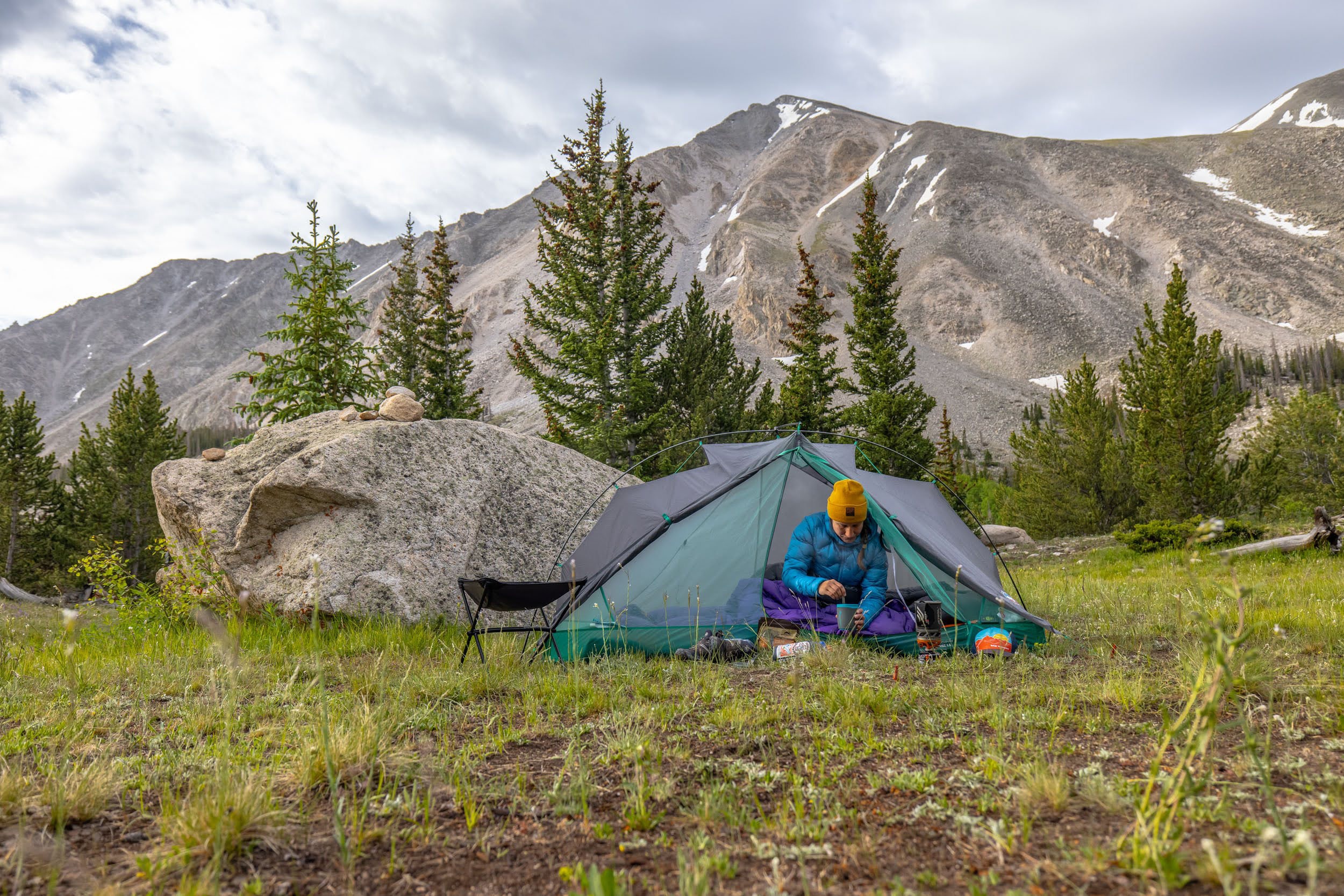
The first time I pushed a Big Agnes tent to its limits was during a surprise hail storm nearly 10 years ago. I was backpacking the Colorado Trail when marble-size ice chunks started pelting me. I quickly pitched my Big Agnes Fly Creek UL 1 Tent, unsure that it'd keep me safe and warm amid the storm, since some ultralight tents can collapse or tear in inclement weather. It remained sturdy even as the hail and high winds destroyed other hikers’ tents nearby. The Fly Creek UL 1 is still my go-to shelter all these years later.
In January 2026, Big Agnes released two new ultralight shelters: the single-poled, semi-freestanding Pitchpine and the lighter trekking-pole-style String Ridge. Both feature a touch more room compared with standard 1- or 2-person tents thanks to their added .5 sizing. I tested them both in Colorado's backcountry in February and March. Read on for my first impressions.
Meet the Gear Tester
Tester | Lifetime Backpacking Miles | Testing Location | Testing Duration | Hot or Cold Sleeper | Low Temperature |
|---|---|---|---|---|---|
Mary Beth "Mouse" Skylis | 4,000+ | Colorado | 4 nights, 40 miles | Cold | 34°F |
Testing Conditions and Parameters
Amid an unseasonably warm February, a friend, two dogs and I decided to test the String Ridge 2.5 and Pitchpine 1.5 close to home in Colorado’s Estes Park. We planned to hike a few miles to a remote mountain, spend the evening testing our gear’s limits and return home. But after a Pitchpine VST 1.5 sample ripped during setup (more on this below), we decided to hike out early and resume testing when the skies weren’t threatening to erupt with rain and snow.
After receiving a replacement Pitchpine VST 1.5, I spent another long weekend hiking alone at lower elevations in the Rocky Mountain range to test both tents in high winds. I experienced light precipitation, overnight lows just above freezing and 30 to 40 mph gusts.
Who are these tents for?
The Big Agnes String Ridge and the Big Agnes Pitchpine are solid choices for 3-season backpackers who want a roomy shelter in a lightweight package comparable to a tarp shelter. The String Ridge, which comes in 1.5- and 2.5-person capacities, is best for ounce-sparing, minimalist backpackers. The Pitchpine, which comes only in a 1.5-person capacity, is ideal for solo adventurers (or solo adventurers with a small pooch) who want an ultralight shelter without the task of pitching a trekking-pole-style tent.


Big Agnes String Ridge VST 2.5 Tent
Design type Nonfreestanding
Floor area 35 square feet
Vestibule area 9 + 9 square feet
Number of doors 2 doors
Packaged weight 2 lbs. 1.6 oz.
Pros | Cons |
|---|---|
Similar weight to tarp shelter | Lightweight fabric is less durable |
Condensation control thanks to an extra mesh door | Harder to stake on gravel and rock |
Packs small (about the size of a 34 oz. Nalgene) | Three trekking poles required for full set up |
Pricey |


Big Agnes Pitchpine VST 1.5 Tent
Design type Semifreestanding
Floor area 22 square feet
Vestibule area 8 square feet
Number of doors 1 door
Packaged weight 1 lb. 15.1 oz.
Pros | Cons |
|---|---|
Fast, easy setup | Lightweight fabric is less durable |
Generous vestibule for organizing gear | Top of the tent sags slightly due a loose top clip |
Sturdy ultralightweight design | Pricey |
Durability and Sturdiness
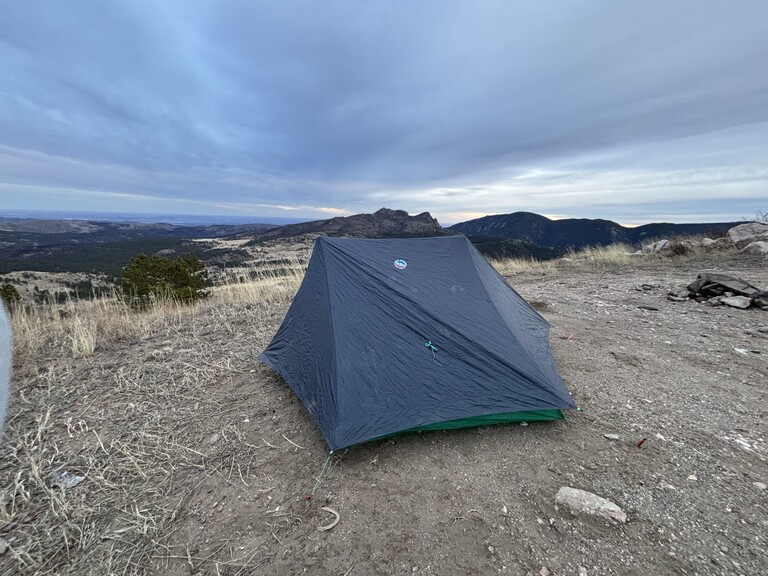
Photo Credit: Mary Beth Skylis
The first time I took the Pitchpine VST 1.5 to the Colorado backcountry, it ripped. I was pitching the tent ahead of a looming storm when a 7-inch-long hole formed at the seam near one of the tent clips. I was stunned. In all my long trails, I’d never seen such a thing. Had I handled it with too much gusto? Possibly. But the rock in my gut told me to reconsider taking this tent to a mountaintop with 50 mph winds.
After speaking with the folks at Big Agnes, I learned that mine was an early tent sample and the brand implemented a pattern change ahead of production to improve the shelter's durability. A week later, I took a replacement Pitchpine VST 1.5 to a similar spot in the Rockies and found that the seam did, in fact, seem hardier. Just in case, I used a DIY ground cloth to protect the fabric. After three days of backpacking in the tent without a tear, my worries surrounding the shelter’s durability softened.
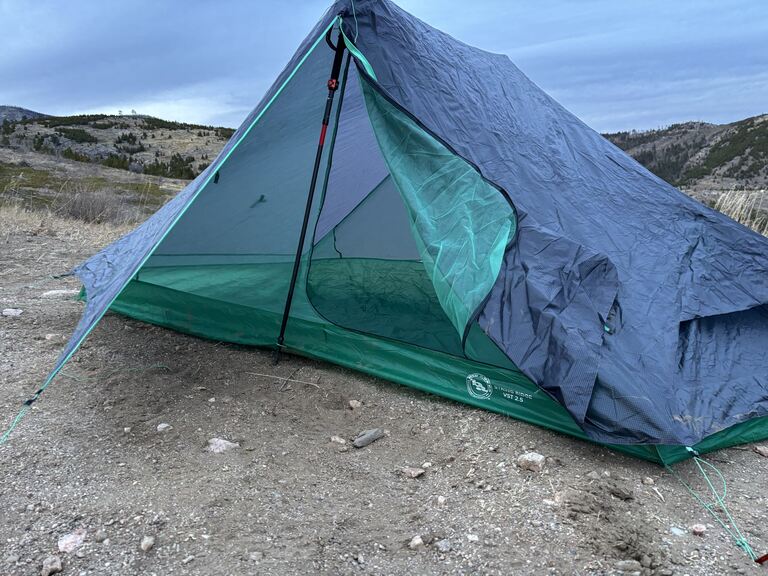
The String Ridge VST 2.5 is made with the same fabrics as the Pitchpine, and I had no problems with durability. The String Ridge felt sturdy and capable of handling light to moderate storms.
Weight and Packability
I packed both tents for my first round of backpacking and found them both highly compressible, especially after removing the poles from the Pitchpine bag. The String Ridge VST packs down slightly smaller than the Pitchpine, thanks to its poleless design—the tradeoff being that you carry trekking poles to pitch it. The String Ridge VST requires three trekking poles for setup (the 1.5-person requires only two) that makes it a tougher carry for a solo backpacker. The Pitchpine comes with a single tent pole for setup.
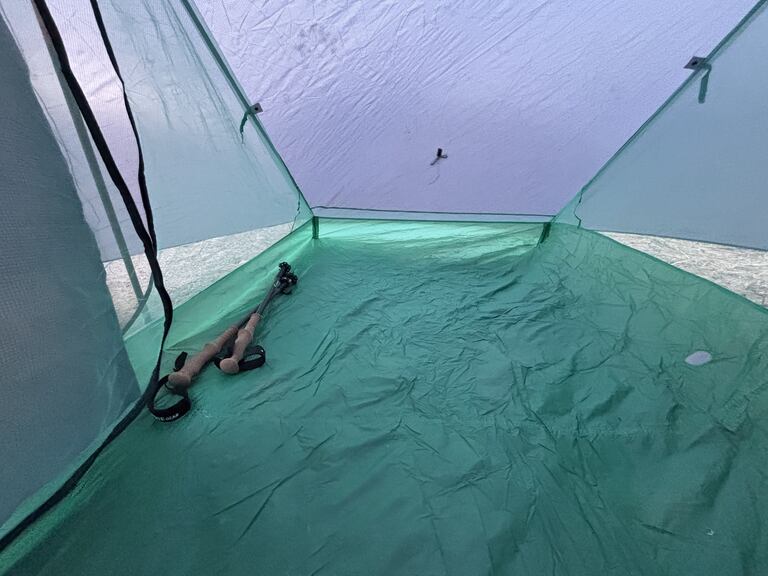
Each tent has a 22-square-foot floor area, but the String Ridge has one extra square foot of vestibule space and a 7-inch taller peak height (47 inches total) than the Pitchpine. It was easy for me, as a 5-foot-7-inch woman, to sit up in both tents, and even taller campers should be able to sit upright comfortably.
While I tested the 2.5-person version of the String Ridge VST Tent, it’s also available in a 1.5-person capacity. The Pitchpine VST Tent only comes in a 1.5-person version, which is about 8 ounces heavier than the same-capacity String Ridge.
The Pitchpine felt slightly roomier than other one-person tents I’ve tested (the .5 sizing provides enough extra room to store gear), hitting a sweet spot between weight savings and space. It's perfect for solo backpackers who appreciate the chance to sprawl. It also has a small vestibule, which I used to store some of my gear.
The String Ridge VST, however, felt like the Taj Mahal of tents, especially for a solo backpacker like me. Its generous interior is ideal for foul-weather days when you're stuck inside (as I was a couple times). The String Ridge would make a better fit for someone with a dog, or a tall hiker who needs the extra length (it’s 7 feet long).
Without consulting any directions, I was able to easily set up both the Pitchpine and String Ridge.
The String Ridge took longer because I needed to modify tension, which is typical when pitching a trekking-pole-supported tent. When pitching the String Ridge, I found it easier to erect by creating tension from the start by staking out the tent corners first. I then modified my trekking poles’ height and cinched down the guylines after the initial setup.
It’s worth noting that the Pitchpine’s top clip, which fastens the pole to the tent body, kept slipping out of place, but the remainder of the clips easily connected to the tent poles.
Weatherproofing and Warmth
Both tents’ rainfly and tent floor are made from lightweight, waterproof fabric that can withstand severe storms without leaks. I put this to the test during a minor storm in Colorado and found that the rainwater beaded up on the exterior of the tents. Even after about an hour of saturation, the tent remained dry inside.
Compared to earlier Big Agnes tents like the Fly Freek UL1, which I used on the Colorado Trail, these tents use a Hyperbead fabric that’s a little lighter, more abrasion-resistant and has better ventilation. While some tents I’ve used tend to collect condensation inside, the fabric of both tents remained dry even after two days of backpacking.
As a year-round backpacker, I appreciate a shelter that can also keep me warm. Even though these 3-season shelters aren’t designed for winter trips, I stayed toasty on my February outings in Colorado. The more compact Pitchpine VST 1.5 warmed up with body heat in chilly conditions, which was convenient when temperatures dipped to 38°F one night of my testing.
While my testing was limited to winter, I suspect the tents will perform well in warmer months as well. Both shelters are made from lightweight, breathable fabrics, and the String Ridge has mesh panels that allow airflow.
Other Features
Most trekking-pole tents I’ve tested entail positioning poles inside the tent to prop it up, so you need to navigate around them while inside. Plus, the pressure of sharp pole tips can wear tent fabric over time. The String Ridge VST 2.5, however, features reinforcements on the exterior, so you can place poles outside the tent doors and free up the entire interior. The String Ridge also has two exterior loops at the bottom for attaching pole tips before staking them in the ground. No more staking poles directly into tent fabric. I suspect the loops will be one of the first things to wear out since they're made from a single piece of cord instead of a metal, grommet-style closure.
My qualm with the String Ridge 2.5 is it requires three trekking poles for a complete setup, which is a limitation for single backpackers. Solo adventurers should consider the 1.5-person version, which requires only two poles.
Bottom Line
Both the Big Agnes String Ridge and Pitchpine are ultralight shelters for 3-season outdoor fun. Ounce-counting adventure duos should consider the String Ridge VST 2.5, which is spacious enough for two people plus some gear. The thoughtfully designed trekking-pole-supported tent is easy to set up even if you have little experience with this shelter style. The Pitchpine VST 1.5 provides a just-right balance of comfort, weight savings and internal space, making it ideal for solo ultralighters camping alone or with a four-legged tentmate.
Like most ultralight shelters, both tents trade some durability for their weight savings, so handle them with care.