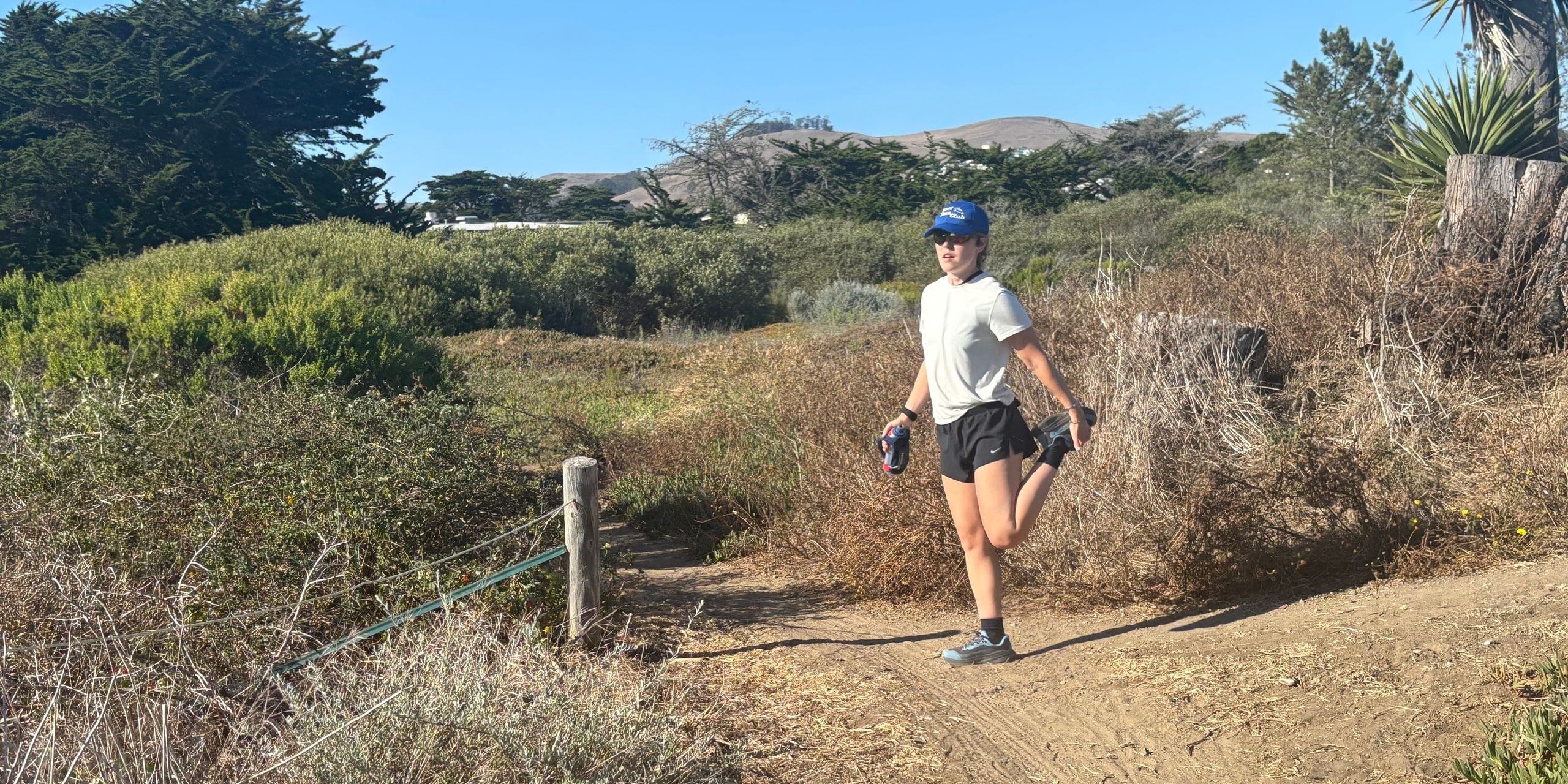
If you live anywhere near hiking trails—or have taken a trip somewhere with a thriving outdoor culture—you may wonder whether hiking deserves a place in your workout rotation. And if you're a runner, you may dismiss the idea. After all, hiking is slower, it won’t let you chase the same PRs on Strava and it may not neatly fit into your existing training plan.
What if ditching the running mindset for a weekly hike could help you build a stronger aerobic base, train the muscles you need for running and provide a much-needed psychological release?
We talked to two experts—Yitka Winn, product copy editor at REI Co-op and an avid trail and ultrarunner; and Julie Buchsbaum, REI sales specialist, ultramarathon runner and run club co-leader at the Seattle REI flagship store—about how hiking can complement a running practice in ways that might surprise you.
Read on for the full article, or jump to a section:
You can use hiking to build an aerobic base
According to Winn, one of the most common mistakes runners make is not spending enough time running at easy efforts. "A lot of us naturally drift toward more moderate or hard efforts on our regular training runs," she says, "but doing too much of this can be counterproductive, since it shortchanges us of the most critical element of running training: building the aerobic base.”
Think of your aerobic base as the engine underlying your running performance. When you train at a truly easy effort below your lactate threshold, you're helping your cardiovascular system become more efficient at delivering oxygen to your muscles. Over time, this translates to better endurance, faster recovery and the ability to sustain harder efforts on your tough training days. Tradeoff: Running slowly enough to stay in that zone can be harder than it sounds. Slower paces can feel awkward. If you're used to running with a group, you may drift to a faster pace than you intended.
Hiking inherently forces you to slow down, providing what Buchsbaum calls a “sneaky” way to accumulate time in a lower heart rate zone without consciously holding back. "You don't even realize sometimes that you're in that sweet-spot zone," says Buchsbaum. On a typical run, the temptation to push harder is always there. On a trail with 2,000 feet of elevation gain, the terrain often makes the decision for you.
Hiking can also help you build a base while adjusting to elevation, altitude and hills. When Winn earned a coveted entry into the Hardrock 100—a 100-mile mountain race in Colorado's San Juan Mountains—she headed to the state early to acclimate. But because she was solo parenting, she couldn't run much. Instead, she hiked the mountains with her toddler on her back. "This was probably some of the best training I could have done for Hardrock," she says, noting that the race "is, in all honesty, more of a hiking event than a running one anyway."
Hiking is lower-impact training for neglected muscle groups
Because most hiking takes place on softer, more forgiving surfaces, it generally puts less stress on your joints than running on roads or pavement. For runners who are nursing a minor injury or simply looking to add training volume without piling on more impact, a hike on a dirt trail can be great cross-training while giving your joints a rest.
Hiking also recruits muscles that flat road running underworks. "Uphill will engage a lot more of your posterior chain; downhill will engage a lot more of your quad area," says Buchsbaum. There's also the lateral work; uneven terrain demands constant microadjustments from your ankles and the smaller stabilizer muscles that flatland running rarely tests. "Those little muscles can be super beneficial longevity-wise," Buchsbaum says. "Balance is one of the first things that starts to be challenged as we get older."
Winn adds that hiking is a great complement to a strength training practice: "Target the glutes, hamstrings, and calves to build uphill muscles; target the quads to build downhill muscles."
Letting go of the data
Here's where many runners get tripped up: Hiking doesn't translate neatly to the metrics many of us are used to. A 17-minute mile on a trail with 1,500 feet of elevation gain is not equivalent to a 17-minute mile on flat road. "A trail is not a trail is not a trail,” says Buchsbaum. “They're all nuanced.”
She says the most useful metric for hikers is “time-on-feet”: how long you're moving, regardless of distance or pace. After all, a 2-mile trail with 2,000 feet of elevation gain might take the same amount of time as a 6-mile trail with 500 feet. Once you accept time as the variable to track, understanding the effort you’ll need for a given hike becomes easier—and you stop trying to compare that effort to a road run in the same way.
For runners who struggle to let go of pace data, Buchsbaum recommends returning to the same trails multiple times as a way to track progress. "The same trail is the same trail," she says, so you can build a personal data set and track improvement without trying to compare completely different trails.
Winn's advice is more direct: "The only metric I care about when I'm hiking is joy… Let go of the pace/race mindset altogether. Read some Mary Oliver poems before you leave the house. Put your phone on airplane mode."
Once you stop checking your pace constantly and start taking in your surroundings, you just find you're tracking some additional benefits from hiking. "We as humans are deeply connected to nature," says Buchsbaum. "Go be surrounded by trees—it's good for your brain and your nervous system."
Getting started—and gearing up
Even if you don’t live in a place with hiking trails nearby, you don’t necessarily need to travel far to start. "Don't underestimate the nearby green spaces," says Buchsbaum. Even an urban park can offer some of the same stimulus as trail hiking. Start short and local, prioritize dirt paths, and work your way up as your body acclimates to the new activity.
If you already trail run, you likely have most of the gear you need to get started hiking. Trail-running shoes perform well on hiking terrain, and lighter hydration vests and collapsible poles will generally work just as well for hiking. If you're coming from road running with no trail gear, the most important investment is a pair of trail-running shoes. They’ll help you feel stable as you ascend and descend. "Road-running shoes or casual sneakers do not generally have the proper tread for the majority of trails," says Winn. Buchsbaum suggests making the switch to trail shoes once the terrain gets more technical.
Once you’re a regular on the trails, keep in mind Buchsbaum’s note about time-on-feet. Because hiking takes place at a slower pace, it is worth investing in packs that allow you to bring more food and water with you. This way, you’re prepared for all the time you plan to spend outside. And as Winn points out, a bigger pack opens room for added comfort: "Instead of popping energy gels to fuel your hike, pack some cheese and summer sausage and crackers. Bring sodas and a bag of chips!"
If hiking is starting to sound more like a picnic than your usual workout, you’re not missing the point at all. When asked why she prefers hitting the trails, Buchsbaum replied, "The snacks are better, it smells good and it doesn't matter how fast I go."
Our Expertise
Julie Buchsbaum joined the Seattle REI flagship team in 2024. In addition to outfitting and hyping up customers, she co-leads the run club, belays on the pinnacle climbing wall and supports the in-store experiences team. REI Co-op Member since 2017.
Fi Lowenstein is a writer and content strategist who can always be talked into one more trail run or hike—especially if there's a great burrito waiting on the other side. They’ve been writing and editing for REI since 2022, and cover climate, LGBTQ+ issues, disability and more. REI Co-op Member since 2019.
Yitka Winn (she/her) is a product copy editor for REI Co-op, an avid hiker and trail/ultrarunner, and the author of Beer Hiking Colorado and Beer Hiking Southern Rockies.