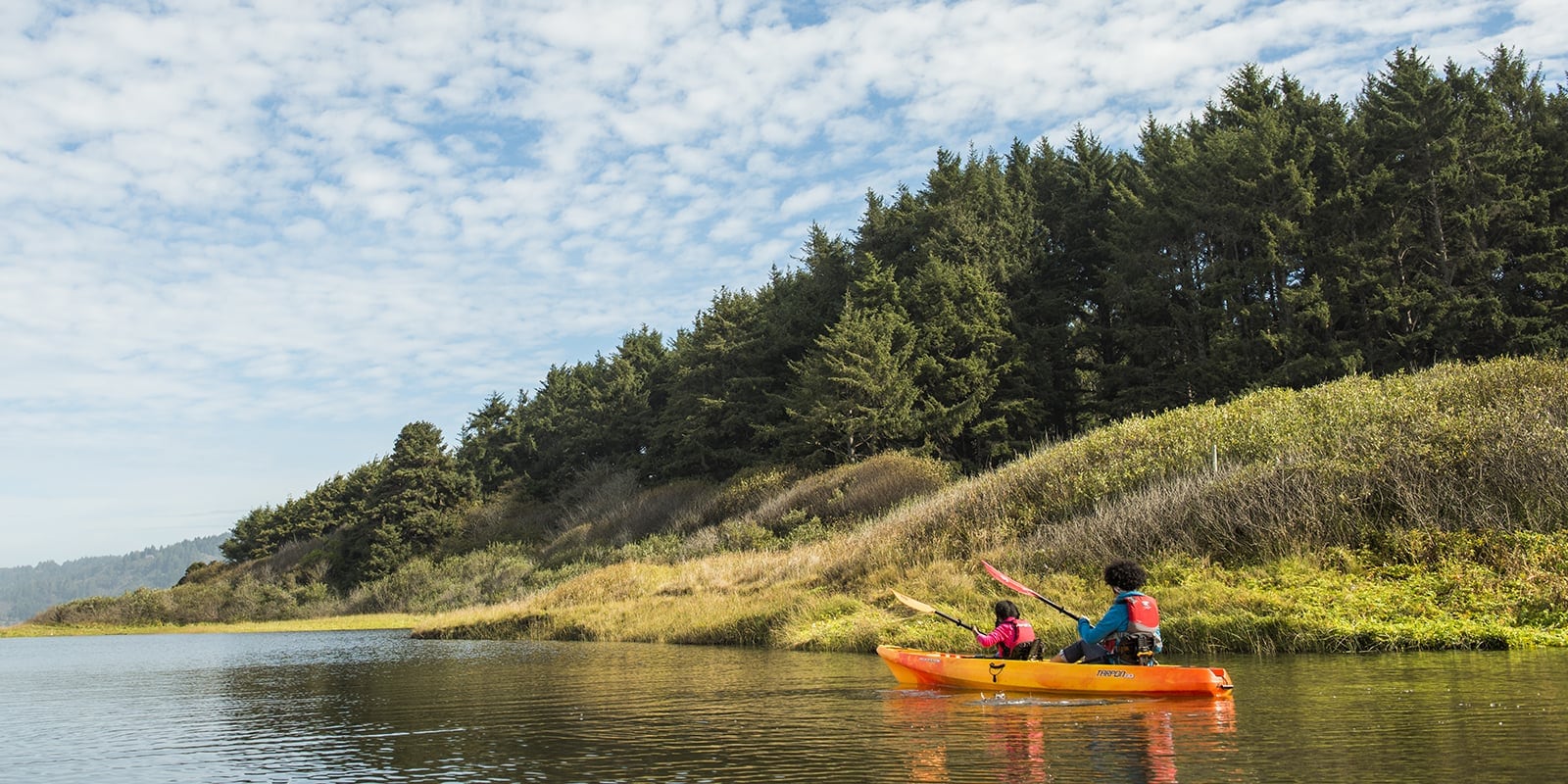
When you go kayaking, bring the kids along. With some forethought and organization, you can create a rewarding experience. Just remember to start small and keep stress levels down by ruling out surprises—except, of course, those of discovery.
Related reading:
Planning the Trip
Who Should Go
The spectrum of people "right" for paddling is as wide as the sea. However, be cautious. Never take a child on the water unless you are well experienced—or you have an experienced paddler with you. Plan on 1 adult for every child until all paddlers' levels are determined and you know and trust all members of the group. If you have enough adults, then your child can invite a friend or two.
Where to Go
You generally want to find calm water and minimal current unless you are very experienced and have the appropriate boats for the situation. Start on protected small lakes, bays and slow rivers in order to develop kids' skills and reduce stress levels. With every additional trip, your options broaden.
Destination tips:
- Choose places with lots of variety.
- Know what you are getting into. Study tides, currents and boat traffic with the kids ahead of time. When these conditions are encountered, your kids are proud to call them out and you all feel safer together.
- Know to the best of your ability where bathroom breaks will be. This is especially important with young children.
- To find a kid-friendly paddling destination, talk to experienced paddlers or the paddling experts at your local REI. You might also try your local paddling association, as well as for your state parks commission or park service websites.
Length of Trip
Be conservative when deciding how long to be out. This way, if you exceed your expectations, you all win. Half an hour to an hour is sufficient for all first trips regardless of age. For babies and toddlers, it may mean just a few moments of sitting in the cockpit at the water's edge.
One rule of thumb is to plan your trip in short loops about one-third the usual distance you would travel with your adult counterparts. Generally, the older the child, the more time you can spend on the water. Also, consider the child's:
- Familiarity with water
- Experience with boats and paddling
- Age or level of maturity
- Swimming ability
- Physical strength
- Coordination level
Build Skills Beforehand
Is your trip months from now? Consider signing yourself and the kids up for swimming and kayaking lessons. Swimming lessons are often offered at community pools. You'd be surprised how quickly kids learn to feel comfortable scrambling in and out of a boat practicing a wet-exit or roll. See the REI Expert Advice article, Getting Started Kayaking, for a few basics.
For another layer of training, try fun workouts with your kids. Go for some long runs (we call them "crossings" by pretending we're paddling from one island to the next). Back at home, lift weights or do pull-ups and push-ups together to enhance the push and pull of your paddle stroke.
Family Boat Options
Kayak or Canoe?
To decide, consider where you'll be paddling, the age and ability of your child, and the trip goals. Other variables include comfort levels, seat choice, paddling opportunities for the kids and the need to reach a destination. Don't sacrifice the process for the goal—let all ages paddle at least part of the time.
Typically, children ages 4 to 7 will do fine sitting in the bow of a kayak but will not provide much propulsion, so your distances are limited. For children under 7, a canoe is an excellent choice. Canoes are stable and offer lots of gear and wiggle room for this age group. A large canoe can easily accommodate 2 or 3 kid riders plus adults.
For more information on canoe types, read How to Choose a Canoe.
By the time children are about 8 years of age, many are ready to paddle the bow of either a kayak or canoe. Most are also capable of learning and executing paddling skills.
Make sure to practice wet-exits, braces and other safety techniques in whatever boat type you choose. See How to Do a Wet Exit from a Kayak and How to Edge and Do a Brace Stroke in Your Kayak to get started.
Colder waters: Go with a decked kayak or a canoe with a spray deck (a cover made of waterproof fabric). Have your child sit in the bow or in the middle (with one adult in the bow and the most experienced adult in the stern or rear of the boat) until the child is experienced enough to handle a single in colder waters. The middle compartment of most kayaks is made for gear and not children, so it doesn't come with a spray skirt and tends to take on splash. However, on calm waters, sitting in the middle is fine.
Warmer waters: In warm-water places such as Baja, Hawaii or the Florida Keys, or on calmer inland freshwater in the summer, a sit-on-top kayak becomes an attractive option. With some creativity, these craft can fit up to 3 small children. You can even find inflatable kayaks if you don't want to invest in a carrier or have limited storage space. (Note: Sit-on-tops are not appropriate for exposed crossings or great distances from shore).
For more information, read How to Choose a Kayak.
Duff or Paddle? Single or Double?
Your children's ages, sizes, physical abilities, paddling experience and other qualities will determine whether they come along in a single or double, and as a paddler or duffer.
Duffing, or riding in the boat's center compartment, is a great beginning place for all young paddlers. Though duffers may not be helping to propel the boat, they are learning about the feel of the boat.
Approximate age recommendations:
- Duffer in kayak or canoe: 8 and younger.
- Bow paddler in double kayak or canoe: 8 and older.
- Bow rider/paddler in double kayak or canoe: 4 to 7 years old.
- Single small kayak: 10 and older (if skilled).
- Single medium kayak: 14 and older (if skilled).
- Single small canoe: 14 and older (if skilled).
Paddle Sizes
The paddle is your intimate connection with the water, so how it feels is important. Kayak paddles come in various sizes for children—consider ones that are about 200 cm long with a narrow shaft. For canoe paddles, rest the handle on the child's foot; the blade should be about nose height.
Safety Gear
PFDs (Personal Flotation Devices)
Don't skimp on safety. It's the law for all people in small craft to wear a PFD. Find a U.S. Coast Guard-approved model and follow the rules for usage and sizing. PFDs are sized for infants (8-30 lbs.), children (30-50 lbs.) and youth (50-90 lbs.). On an infant PFD, the neck pad is critical for keeping the child's head positioned correctly in the case of capsize. In addition, always secure the crotch strap.
For details, see the REI Expert Advice article, How to Choose PFDs (Life Jackets) for Kids.
Tip: Babies and toddlers sometimes "hate" their PFDs. If possible, prepare youngsters ahead of time at home. Offer a reward for keeping it on or make a game of it. Explain its purpose without creating a scare.
Lines and Floats
Lines and floats may be used in rescue situations. It's critical to know the safety techniques that accompany them, such as the aforementioned wet-exit (a technique in which a paddler leaves the cockpit and then climbs back into it, usually under forced conditions such as a capsize or emergency situation).
Do not over-rely on these items, or on books or videos, to substitute for safety—take classes to practice!
Safety line and float gear includes a:
- Paddle float for each adult
- Throw-bag for each adult
- Tow line for each boat.
Warning: Never tie or tether a child to the boat. This creates more danger than protection.
Selling the Trip to the Kids
As with any activity, the more you talk about kayaking with zest, the more likely your kids will share your enthusiasm. For younger kids just getting used to the idea of paddling, take the boat(s) out onto the lawn or driveway (with a soft under-cushion), and let them gently play in it.
Other tips:
- Research your trip with locally relevant field guidebooks, laminated animal charts, and tide and current charts. These can be a favorite conversation starter with budding scientists.
- Personalize the trip to the kids' interests. Involve them in packing and deciding what to do while on the watery trail. Let them bring a friend if appropriate.
- Emphasize tradition, if you can. Get out maps and photos of your past trips, and tell stories about the adventure.
Packing for the Trip
If you know how to pack for yourself, you'll probably know how to pack for the kids. Be clear about who is in charge of packing what. Split the packing responsibilities right down the middle along with the other adults. Involve the kids in this part of the adventure.
Tips: Kids age 7 and older often like to be in charge of their own packing. Give them a list to follow, but discreetly let them know that you'll double-check their bags later. Praise their efforts. Have them keep their pack near them in the boat for access to a coat or snack.
Food and Hydration
Consider healthy, easy-to-bring items: smoked salmon, hard-boiled eggs, apples, mangoes, fresh red peppers, dried fruits and nuts (pine nuts and pumpkin seeds are rich in calories and pack well), cheese, dried veggies like carrots and tomatoes, and nutritious cookies and bars.
Hydration is important, too. Keep a water bottle close at hand and make a conscious effort to drink enough throughout the day. The exertion of paddling, combined with sunlight reflecting off of the water, can increase fluid requirements more than you might think.
Water pillows carry the most water for paddle craft because they can be filled to capacity and still fit easily under the seats, where you want to keep the weight.
Clothing
Layering with water-resistant, breathable fibers (e.g., rashguards, merino wool, polyester, weather-resistant shell) is the secret to comfort. Bring extra pants for kids under 7 years old who, no matter what, always seem to get filthy and wet. Don't bother with cotton unless you're in extremely warm conditions.
Tip: Always store clothing in waterproof dry bags strapped tightly to the inside of the boat. Ensure there are no loose loops or ropes to snag a paddler.
Some essentials for kids:
- Wide-brimmed hat for rain and sun (waterproof, breathable "sombreros" are perfect). These are tough and work well for rain or sun.
- Mid-calf to knee-high waterproof boots, which work even in warm weather. Sandals may be OK in areas that are free from foot hazards such as barnacles or broken glass.
- Raingear that fits well
- Sun-protection clothing (UPF rated)
- Bathroom necessities
Remember that you generally bring the same gear for one night as you would for a week. For day paddles or very short paddles near your car and/or other facilities, you can perhaps forego some items.
For more clothing tips, see the REI Expert Advice articles, What to Wear Kayaking or Clothing for Cold-Water Paddling.
Other Packing Suggestions
For 5 to 9 year olds (in addition to the adult list):
- Binoculars or a monocular (a monocular is easier for kids to use)
- Books
- Fishing pole
- Notepad and pencil
- Tiny pop-up tents for longer days and overnights
For all ages:
- Personal water bottles (avoid disposables) and water pouches for all, containing more water than you think you'll need.
- Sunglasses that are well-liked and fit well.
- Emergency whistles.
- Seat pads or short seats for low center of gravity.
- Spray decks and skirts (covers the open compartment areas).
- Tow/throw rope.
- Personal maps and compasses.
- Songbooks.
- Tarps for picnics or rain.
- Umbrella for sun/rain on the duffer.
Day of the Trip (Pre-launch)
Always review the procedures for a wet-exit with adults and children alike before putting in. Make sure to go over examples of what might happen, and don't rush. You want all questions to be answered ahead of time.
Leave ample time to relax and reconnect once the boats are loaded before pulling away, including making sure that the kids have gone to the bathroom and put on their sunscreen. Offer a handful of gorp; it's easy to forget that loading a boat uses up calories, too, and you don't want to start the trip hungry.
What to Do While on the Water
Go slow: Go about one-third your normal pace and don't get separated. Always be within voice of all children and adults in the group. If you have extra adults, it's fine for them to separate from the group, but the rougher the water, the closer all boats should be, though don't crowd either, particularly in currents and high waves.
Teach: Talk with your young paddler about the water's action while showing the correct response. This can include such techniques as drawing into an eddy, bracing against a wave and navigating the currents.
Provide rules: Be clear and simple about rules. No standing, no leaning, etc. Make the kids enumerate the rules and know the consequences when protocol isn't followed.
Empower: Let the slowest paddler lead, then switch. This can become a game and adds a great deal of interest for the kids. If you are paddling a double with a young or inexperienced one, take your time and let him or her take breaks. Let the little duffers paddle once in a while, too. A few minutes are likely all they'll want, but they'll feel useful and gain practice.
Enjoy: Take lots of breaks and enjoy the scenery. Avoid criticism of performance unless safety is a factor. Always praise good paddling. Provide tips, demonstration and practice, but save serious instruction for later, on shore, so as to not spoil the moment. Enjoy the shore, as it is just as important as the water on paddling trips.
If Things Don't Go as Planned
All kinds of things can crop up while afloat that you might not have anticipated. So go with the flow, keep your spirits up and stick with it. Don't let the whining duffer get you down. Boredom is perhaps the worst enemy of kids who are not used to having to generate their own fun—especially the duffers, who might benefit from paddling for a few minutes.
Try spicing up the day with a game like tag or follow the leader. Sing a tune, assign a navigator or hand out treats. If pure exhaustion is the cause of distress and changing to a different paddle or changing the paddle stroke doesn't help, then take a break if possible. Offer to do most of the paddling for a while, if not for the duration of the trip. If the tired paddler is in a single kayak, don't rule out offering to tow.
Finally, reward the kids with whatever you promised them earlier in the day, such as dinner at their favorite restaurant or an extra hour on the phone with friends to share the experience. If you're camping, then don't forget the s'mores!