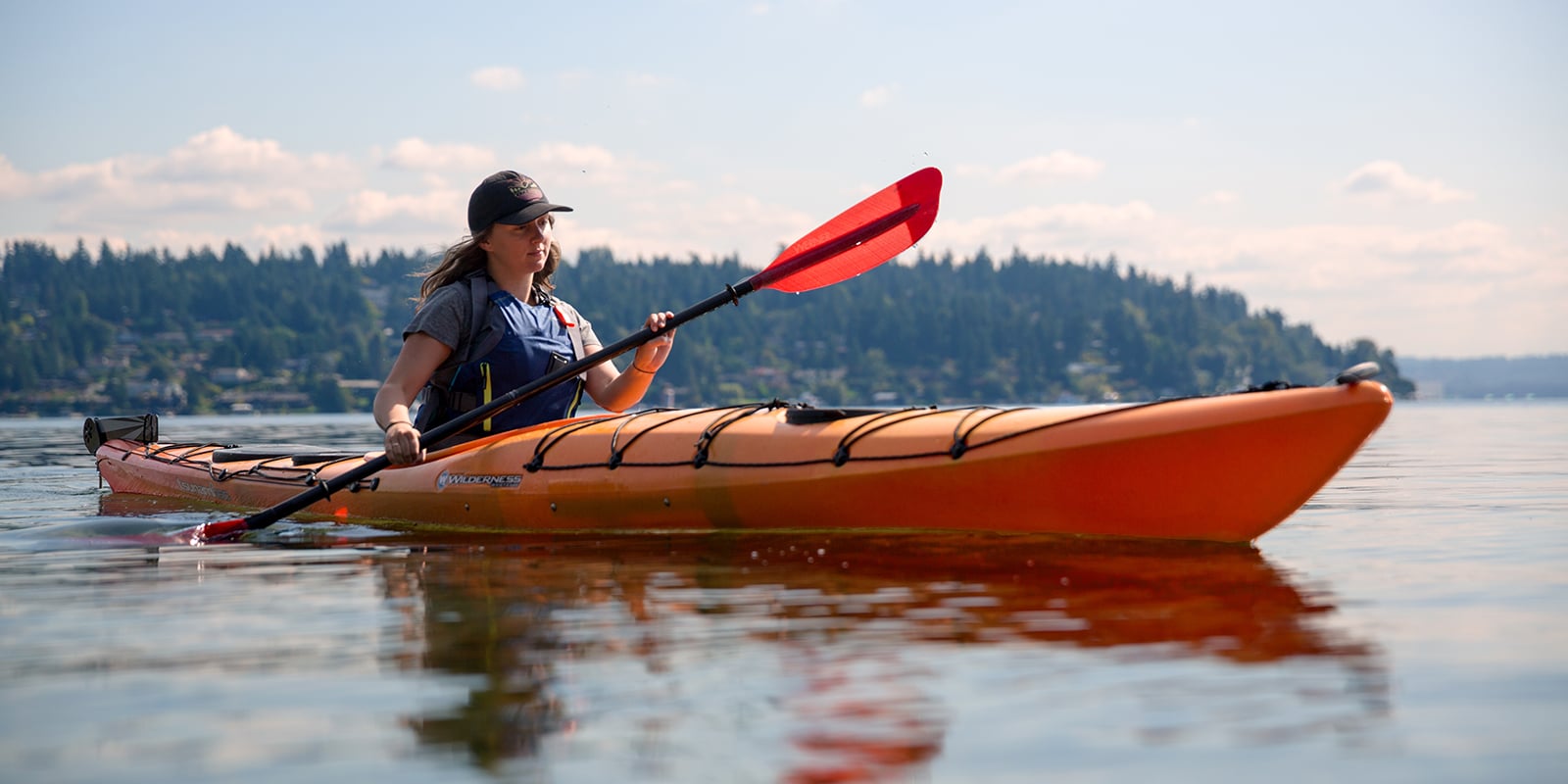
It's an iconic image of outdoor exploration: a kayak glides across a glassy stretch of water, its bow knifing through the mist and its wake shimmering in reflected light. If that sort of thing calls to you, we're here to help with a guide on how to kayak. With some thoughtful preparation, you can slip into the cockpit and put paddle to pond.
Chances are you're not going to buy a boat immediately, though it's certainly an option, and REI can help with that. As you're able to, consider other ways to get started kayaking:
- Borrow a kayak from a friend. It's even better if your friend is also an expert paddler who can take you out and teach you the basics.
- Rent a kayak. Go to an on-the-water outfitter so you don't have to mess with transporting the boat. You'll get the bare minimum amount of gear and instruction, but it's a low-cost way to dip your toes into the sport.
- Sign up for a tour. You get boat, gear and fundamentals all in one package. Options range from the parks department at your local lake to a guided kayaking trip in an exotic locale.
- Sign up for a class. Like a tour, everything is provided. An introductory class through the parks department or a private company at your local lake, river or marina offers more in-depth instruction than a tour, so it's the better option if you plan to take up kayaking in earnest.
Kayak Gear and Clothing
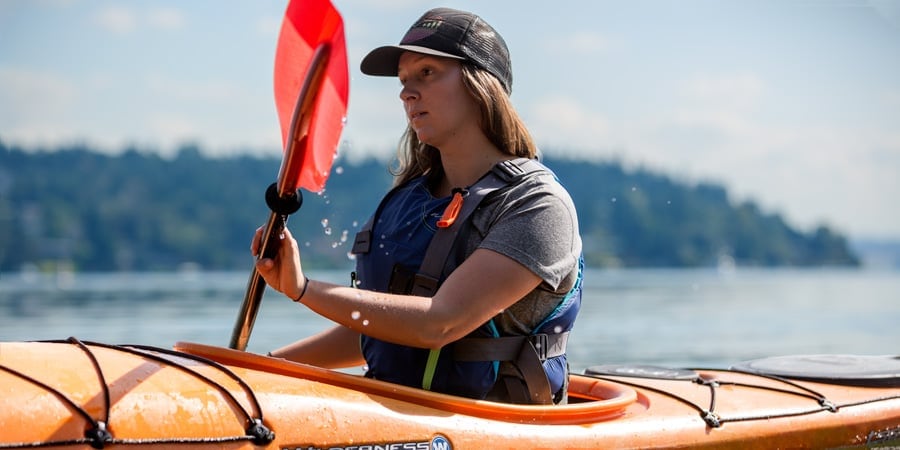
This article assumes you're in a classic kayak: one with a cockpit and a hatch or two for stowing gear. If the weather and water are warm, your friend or guide might put you in a wide, stable boat without a cockpit.
Essential kayaking gear: Anyone who provides a boat should also provide these items:
- Coastguard-approved PFD (Personal Flotation Device) that fits properly
- Paddle (make sure they check that it's the right size for you)
- Bilge pump
- Spray skirt (optional on warm, calm days)
Proper clothing: Bring the following for a warm-weather, warm-water outing:
- Swimwear or shorts (noncotton and nonbinding)
- Short- or long-sleeve rashguard top (any noncotton top will work)
- Neoprene footwear
- Sun-shielding hat
- Lightweight fleece jacket or vest (weather-dependent)
- Spray jacket or rain jacket and pants (weather-dependent)
If conditions are colder than 60 F (especially the water), a wetsuit is also required. For more details, read What to Wear Kayaking.
Personal items: If you know your Ten Essentials, then many of these should be familiar:
- Plenty of water
- Snacks for energy, plus a lunch for longer tours
- Sunscreen, lip balm and sunglasses (with a retainer)
- First-aid kit
- Signaling whistle
- Watch (so you can give yourself plenty of time to get back)
- Headlamp (in case you're too slow getting back)
- Dry bags (for things you don't want to get wet)
How to Adjust Your Kayak
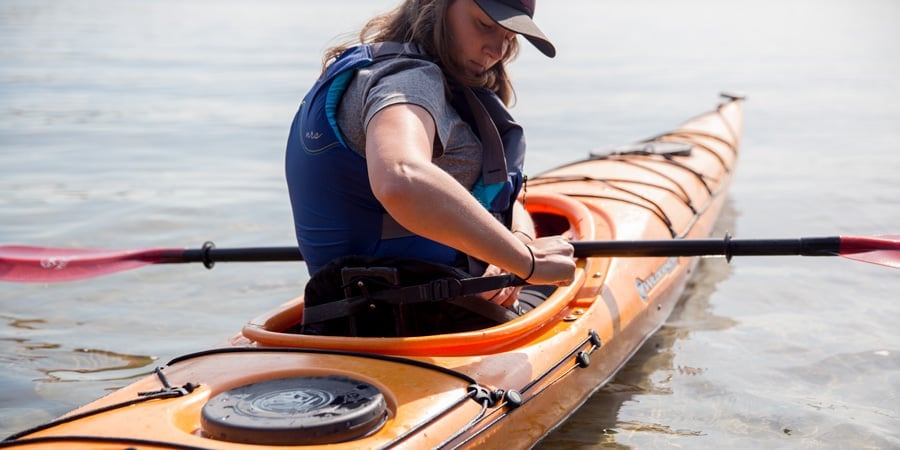
A well-adjusted kayak will be more stable and comfortable to paddle. Do your adjusting while the boat is sitting on dry land, and focus on three points of contact:
- Snug your butt firmly against the seatback. If your boat lets you fine-tune the angle of the seat or seatback, do whatever feels most comfortable. For balance and power, though, you want to sit more upright.
- Place the balls of your feet on the footpegs; then check to see if you have a slight bend in your knees. Most footpegs adjust by tilting them and sliding them along a track to preset stopping points. It's often easier to get out of the boat to slide the pegs.
- Make sure your bent knees are in firm contact with each side of the cockpit. This helps you control the side-to-side motion of the boat as you paddle. Your fit should be snug but not so jammed-in that you can't get out if you capsize.
How to Launch Your Kayak
Most trips start off with a launch from a gradually sloping shoreline. Take care to avoid dragging the hull, especially on rocky, sandy or cement surfaces:
- Get a friend to help you carry the boat to your put-in point. Set it down in shallow water, perpendicular to the shoreline. (If you're launching into a river or have a very long kayak, then a parallel launch might work better.) For a perpendicular launch, the bow should face away from the shore and the stern should be close to the shore (but fully afloat).
- Put one of your paddle blades under the deck line in front of the cockpit. (The shaft can stick out sideways like an outrigger.)
- Stand over the kayak, straddling the cockpit.
- Grab the cockpit and set your butt down on the cockpit seat, then lift your legs and slide your feet into the cockpit.
- Scoot your butt firmly back into the seat and settle both feet comfortably onto the foot pegs.
- Grab your paddle and use it to move your kayak past incoming waves and boat wakes. Then attach your spray skirt if you have one.
When it comes time to get out of your boat later, simply paddle into your launch position, set up your outrigger and reverse steps until you're straddling your kayak again.
To learn more, including how to get in from a dock, check out our How to Launch a Kayak article and video.
How to Hold Your Kayak Paddle
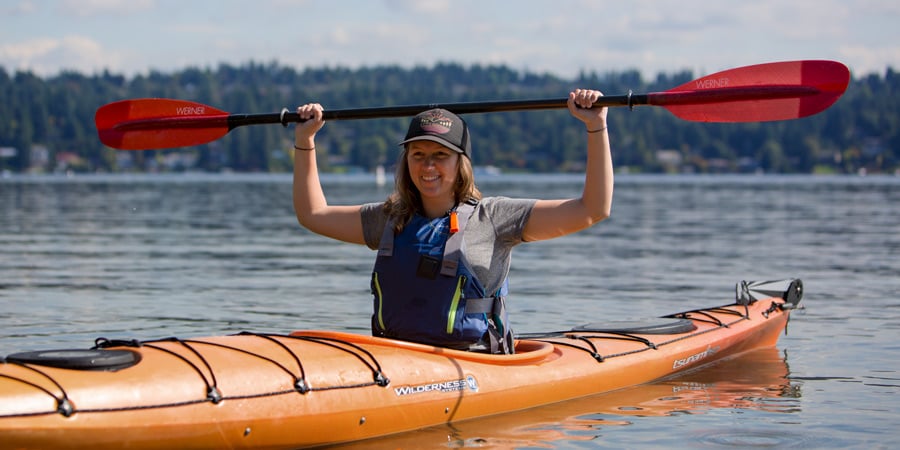
Start by grasping your paddle with both hands and centering your paddle shaft on top of your head. You hands will be in the proper starting position when your elbows are bent at 90 degrees.
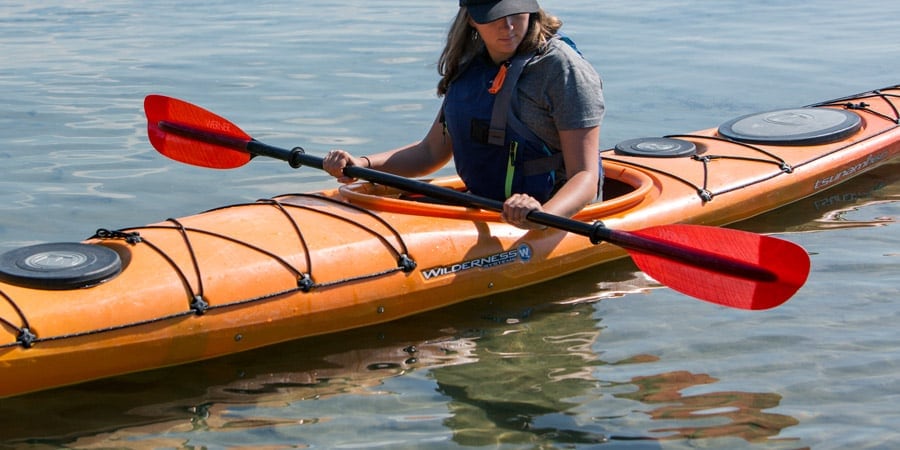
Now lower your paddle and orient it as follows so you're holding it correctly:
- Make sure the paddle blades are in line with each other. If you notice that the blades are offset from each other, your paddle may be "feathered." If this is the case, take a minute to adjust the blades back in line via a push-button or twist setting in the center of the shaft. (Feathered blades cut through wind better, but are trickier to use for first-timers.)
- Look at each paddle blade and make sure the longer edge of each blade is on the top. This is the correct position to help your blades move smoothly and efficiently through the water. (If your paddle blades are uniformly shaped, either side can be up.
- Make sure the scooped sides of your paddle blades are facing you: Blade curvature is subtle, so look closely.
- Place your large knuckles on top of the paddle shaft so that they are in line with the top of your paddle blades.
- Relax your grip. Make an "O" with your thumb and index finger, then lay your other fingers gently on the shaft. Gripping the paddle is unnecessary and tires out your hands more quickly.
The Basic Kayaking Strokes
There are many skills to consider when learning to kayak. Strokes and navigation are key.
The Forward Stroke
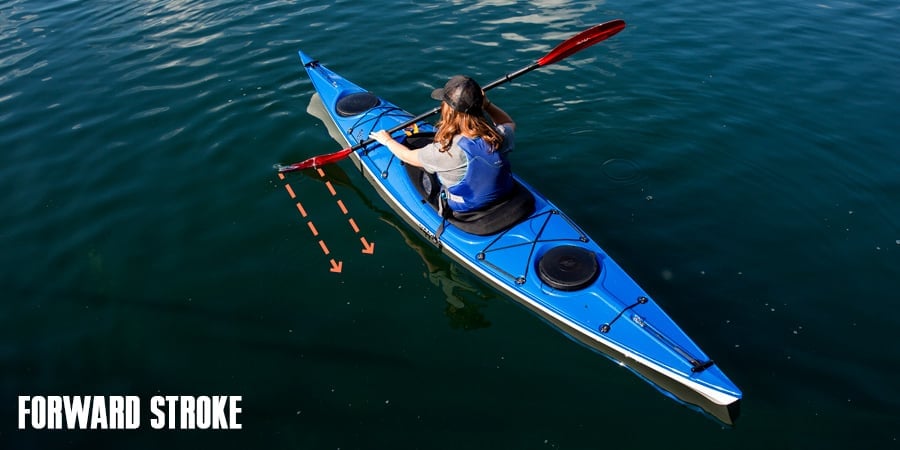
This is the stroke you do most of the time, so good technique pays dividends:
- The catch phase: Wind your torso and immerse your blade fully on one side of the boat next to your feet.
- The power phase: Rotate your torso as the blade moves behind you. Follow the in-water blade with your eyes and your torso will follow. Focus, too, on pushing against the shaft with your upper hand as you move.
- The release phase: When your hand reaches just behind your hip, "slice" the blade out of the water.
To repeat, you simply immerse the out-of-water blade next to your feet. (Your torso will already be wound correctly.)
Technique tip: To maintain the paddle shaft at a comfortable angle as you stroke, "check the time" on an imaginary watch on your upper wrist.
The Reverse Stroke
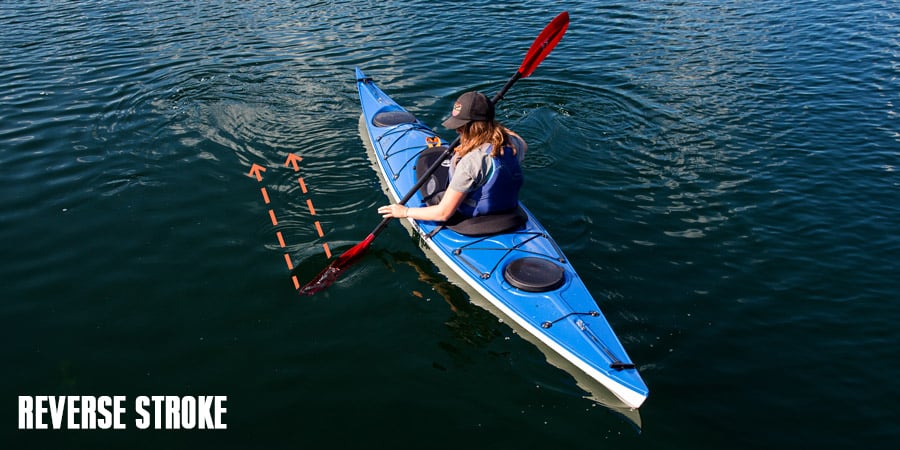
This is the basic braking stroke. It can also move you backward if your kayak is already stopped. It's the exact opposite of a forward stroke: You immerse the blade next to your hip; the push is done with your lower hand; and you slice the blade out of the water when it nears your feet.
The Sweep Stroke
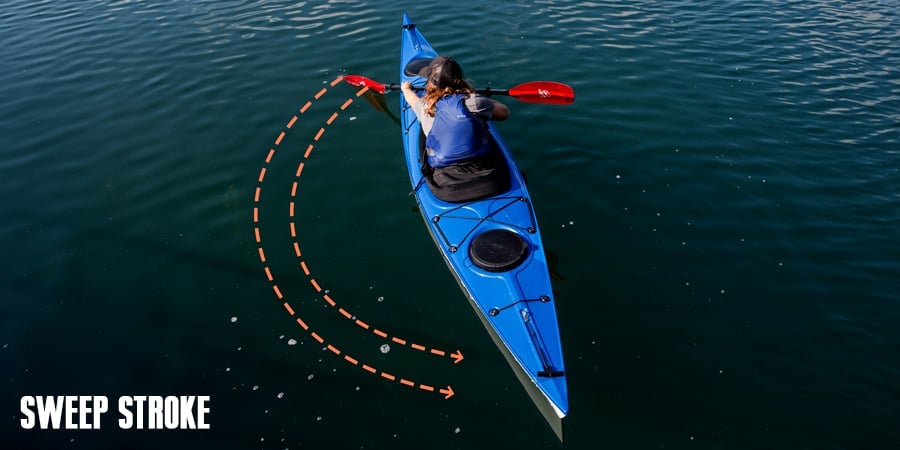
This is the basic turning stroke. If you do repeated forward strokes on the same side of the boat, you'll notice that the boat slowly turns the other way. The sweep stroke simply exaggerates this effect. The sweep is the same as a forward stroke, except that you alter the blade path so that it carves a much wider arc on the side of the boat. Sweep strokes on the right side of the boat will turn the boat left and left-side sweep strokes will turn the boat right.
Using Rudders and Skegs
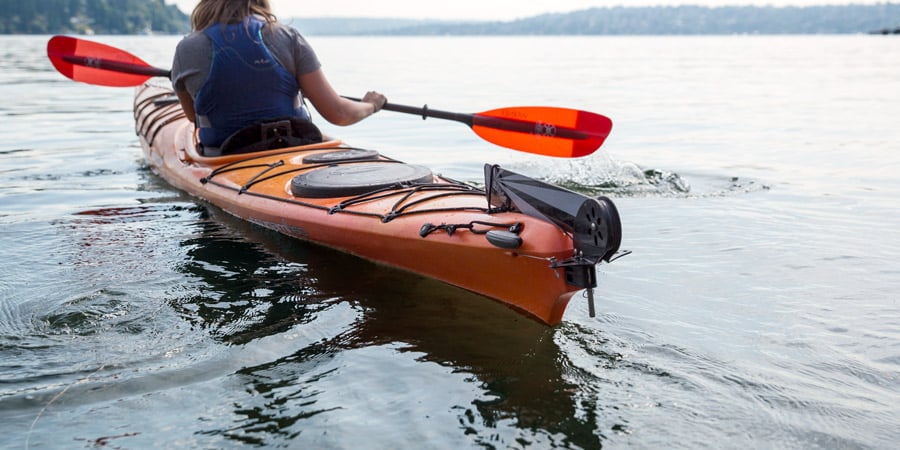
Rudders: If your boat has a rudder, it sits at the back of the boat, and you use your foot pedals to control whether the boat moves left or right. Push the foot peg on the right and your boat will turn right (and vice versa on the left).
Skegs: A skeg is a fixed-direction fin that drops down from the bottom of the hull. It is used primarily to aid with tracking (keeping your boat traveling straight), especially in windy conditions (rudders can also play this same role).
Novices often use both rudders and skegs incorrectly and often forget to pull them up in shallow water, which can cause damage. For this reason, it's simplest to leave them undeployed. Paddling without your rudder encourages you to learn better paddling technique more quickly. And if it's so windy that you need a skeg or rudder, you really shouldn't be paddling without an experienced guide who can explain how to use them properly.
Safety Precautions for Kayaking
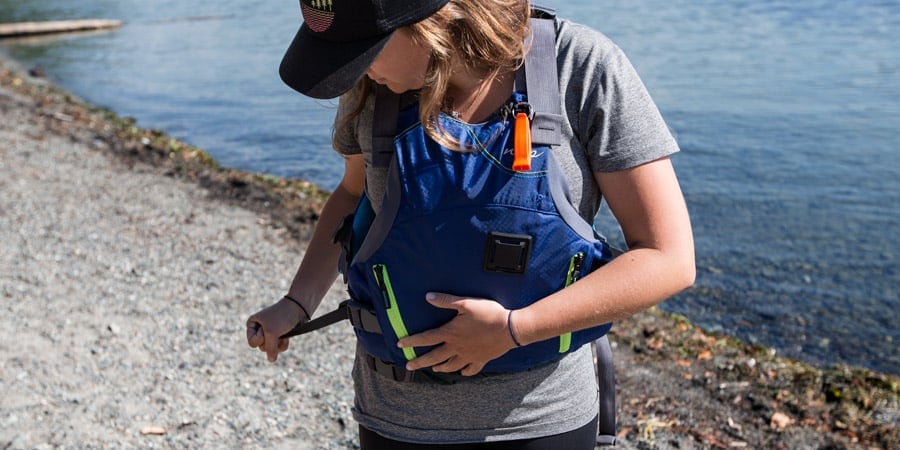
Any time you head out on the water, bringing the essential gear and clothing is important. A few additional safety measures are also in order on a non-guided tour:
- Bring a paddling buddy. When no guide is along, you should always go with another paddler who can summon help or provide assistance.
- Make a togetherness pact. A buddy who paddles off out of sight or earshot won't be much help.
- Know your distance limit. If you haven't had rescue training, never paddle farther from shore than you're easily able to swim. (Near-shore areas are more interesting anyway.)
- Do your hazard research. Ask a knowledgeable local paddler about places to avoid, as well as currents, tides and weather forecasts.
- Know your water temp. You should always dress for a capsize—at a minimum, that means some sort of wetsuit when the water is 60 F or less.
- Check your PFD. Make sure it fits tightly and is only loose enough so that it won't interfere with your breathing. If temps heat up and you need to remove a layer, paddle to shore first—never remove your PFD on the water.
- Be cautious about using a spray skirt. Don't wear one unless you know how to properly pop it off and do a wet exit.
- Don't forget your whistle. The universal distress signal is three long blasts.
If you plan to kayak in the future, consider taking a rescue class. And classes that cover navigation, tides, currents and surf can help you avoid trouble in the first place.
Tips for Your First Time Kayaking
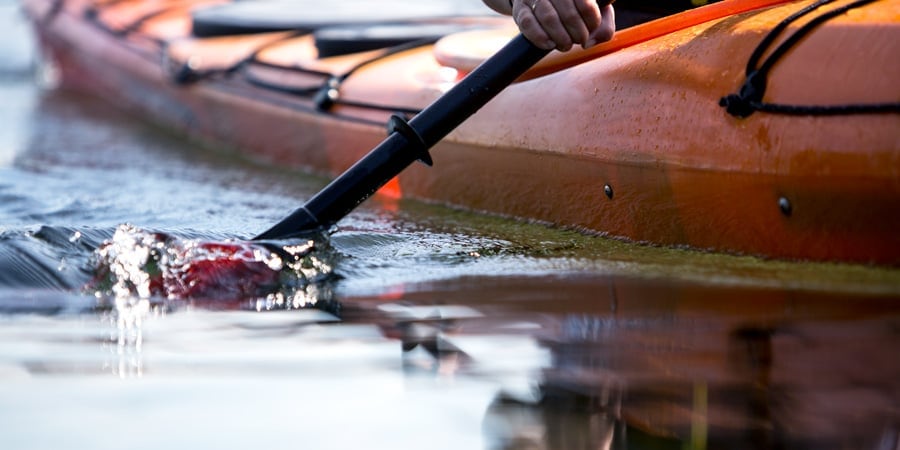
Planning your first non-guided outing? Make things easy on yourself:
- Choose a small, calm body of water. Lakes or ponds with little or no powerboat traffic are ideal.
- Find a gently sloping sandy beach to launch. Steep, mucky and rocky shorelines will be more challenging.
- Go on a sunny, windless day. You'll keep complications low and comfort high.
- If it's breezy, start out by paddling into the wind. Paddling into a headwind on your way back is a struggle; paddling with a tailwind is, well, a breeze.
- Plan on an outing, not an expedition. For an optimum fun to fatigue ratio, keep your paddling time under two hours.