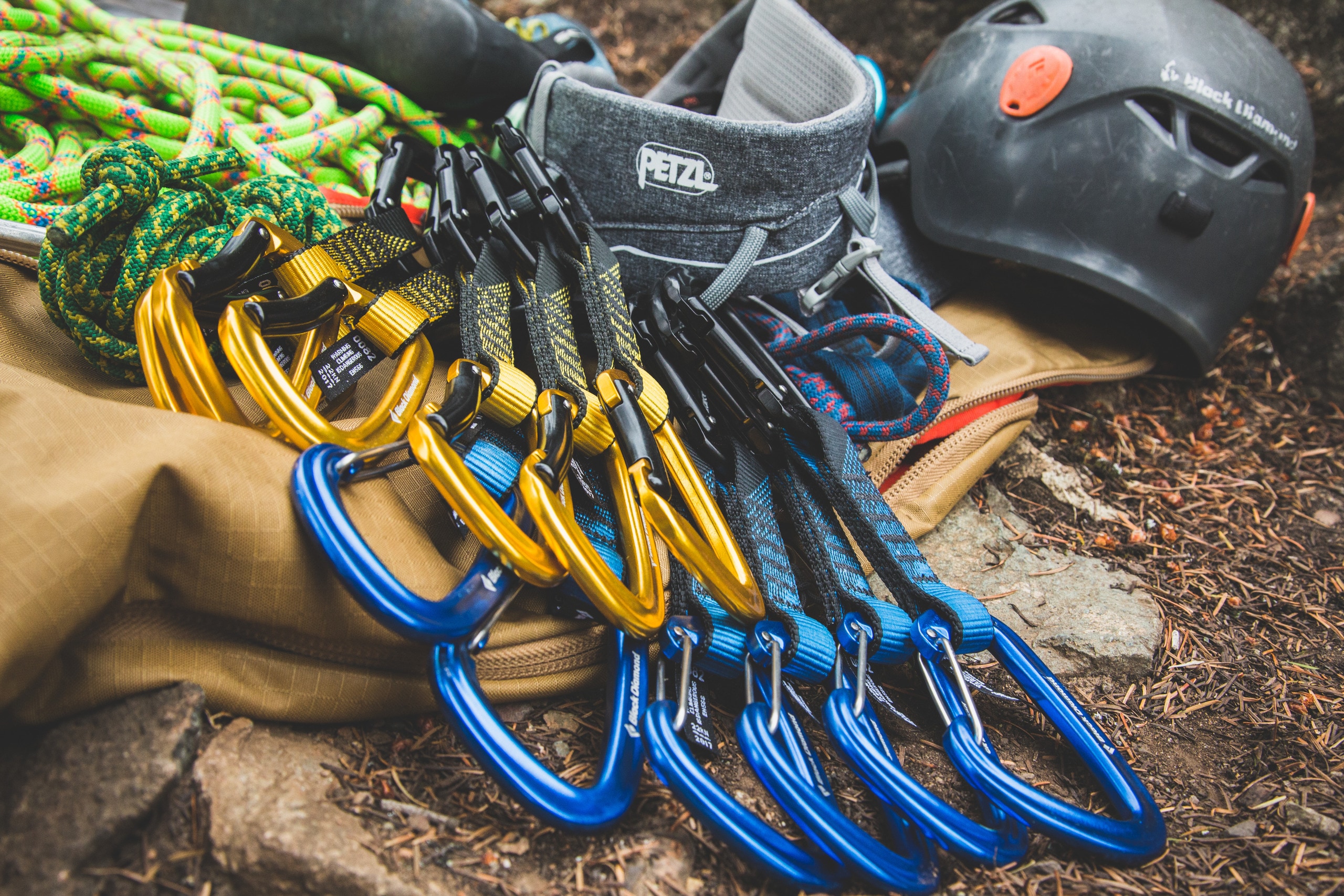
Different climbing tasks require different kinds of carabiners. To choose and use them properly, you must first understand the differences between them. There are several main areas to consider:
Once you understand the differences, think about your needs. What type of climbing you do and how you'll use the carabiner will determine what carabiner you buy.
Carabiner Shapes
Carabiner Shape | Pros | Cons | Best For |
|---|---|---|---|
Asymmetric D |
|
| General climbing; most commonly owned shape |
Pear (HMS) |
|
| Belaying, rappelling, anchor points |
D Shape |
|
| Most kinds of climbing; racking trad gear |
Oval |
|
| Aid climbing; carabiner-brake rappels |
Asymmetric D Shape
By far the most popular design out there, asymmetric D carabiners (sometimes called offset D or modified D carabiners) work like regular D's, but they're slightly smaller at one end to further reduce weight. Asymmetric carabiners generally have larger gate openings than regular Ds, which makes clipping them even easier. But they don't have as much inside room as similarly sized Ds or ovals. Asymmetrical carabiners make up the vast majority of the carabiners that most climbers own.
- Pros:
- Large gate opening
- Strong and light
Cons:
- More expensive than other shapes
- Not as strong as the D shape
Pear Shape
Similar to the asymmetric D shape, pear-shaped carabiners have large gate openings to allow easy clipping of ropes, knots and gear. Pear-shaped carabiners are used primarily for belaying and rappelling, but also can be used at anchor points for top roping or multipitch climbing.
You'll sometimes hear these called HMS carabiners, and some are even marked with HMS on the spine. HMS indicates that the carabiner is designed with a wide, more symmetrical top that works well with a Münter hitch.
Pros:
- Large gate opening
- Designed specifically for belaying and rappelling
Cons:
- Heavier and more expensive than most other shapes
- Not as strong as D and asymmetric D shapes
D Shape
D-shaped carabiners are excellent for most kinds of climbing. They hold loads off-center toward the stronger, non-gated side, so a smaller, lighter D carabiner can be just as strong as a larger oval.
Pros:
- Strongest shape
- Larger gate opening than oval shape
Cons:
- Smaller gate opening and heavier than asymmetric D shape
- More expensive than oval shape
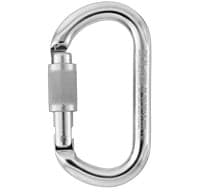
Oval
The original style, they're versatile and affordable, though not quite as strong as other shapes. Oval carabiners have smooth, uniform top and bottom curves to limit load shifting. They offer more gear-holding capacity than D-shape carabiners and their symmetry permits them to be used for carabiner-brake rappels.
They're ideal for aid climbing because they center loads at their curve; runners won't shift under load.
Pros:
- Uniform shape limits load shifting
- Hold more gear than D-shape carabiners
Cons:
- Smaller gate opening and heavier than other shapes
- Not as strong as other shapes
Carabiner Gate Types
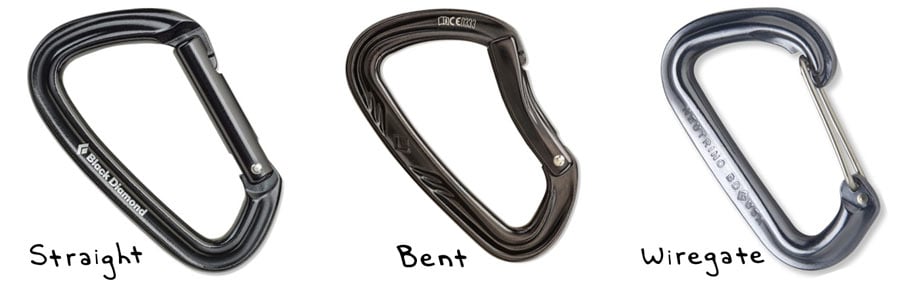
Straight-Gate Carabiners
Standard straight gates are strong, durable and easy to use. They are very common and are used for a variety of purposes. Carabiners with straight gates are found on quickdraws and are frequently used for racking gear, such as cams and stoppers. As the name implies, they're perfectly straight from pivot point to end. Like most other types, they're spring-loaded to open easily when pushed, but close automatically when released.
Some straight-gate carabiners are also keylock carabiners. A keylock carabiner has a smooth notch where the nose of the carabiner and the gate interact. This keeps the carabiner from hooking and catching on your harness gear loop, bolt hangers and other slings, any of which can be quite annoying. You'll likely pay a little extra for this feature, but it's a nice upgrade.
Pros:
- Durable and easy to use
- Can feature a keylock nose for snag-free clipping
Cons:
- Heavier than wiregate
Bent-Gate Carabiners
These strong, durable gates have a concave shape that makes clipping a rope quick and easy; they are generally reserved for the rope-end of quickdraws.
Like straight-gate carabiners, some bent-gate carabiners are also keylock carabiners.
Bent-gate carabiners typically have an asymmetric shape.
Pros:
- Make clipping the rope easy
- Durable
- Can feature a keylock for snag-free clipping
Cons:
- Heavier than wiregate
Wire-gate Carabiners
Wiregate carabiners use a loop of stainless steel wire for a gate, which decreases overall weight and eliminates the need for extra parts found in conventional gates. Wiregate designs also allow for larger gate openings. They are less likely to freeze up than other gate styles in cold, wet weather.
Although wiregates don't appear as strong as conventional styles, most are. Also, due to the lower mass in the gate itself, wiregates are less likely to vibrate open during a fall. (This is called gate lash. For more about gate lash, see below.)
Pros:
- Lightweight
- Help reduce gate lash
- Less likely to freeze shut
Cons:
- Can be less durable than solid straight and bent gates
Locking vs. Non-Locking Carabiners
Locking carabiners have gates that can be locked in the closed position to provide extra protection against accidental gate openings. They feature either a manual (a.k.a. screw-lock) or auto-locking system.
- Screw-lock gates require the user to manually screw the sleeve onto the gate to lock it.
- Auto-lock carabiners automatically lock whenever the gate is closed.
Non-locking carabiners are lighter, quicker to clip or unclip but can accidentally open. Ideal for racking gear or for quickdraws.
Locking carabiners, though heavier than non-locking models, are the only choice for use with a belay/rappel device. You should also consider using them at belay stations and at critical protection placements. They offer a more secure attachment and enhance your peace of mind.
Pros:
- Locking gate adds security
Cons:
- Heavier than other styles
Carabiner Size, Weight and Strength
Carabiner Size
Carabiners come in a variety of sizes. Large carabiners are typically easier to handle and easier to clip (they have larger gate openings), and they can hold more gear inside. They are commonly used with belay and rappel devices. Smaller carabiners are lighter and take up less room on your rack, but they can be harder to clip.
Gate open clearance, provided in millimeters, is something you may want to pay attention to when looking at the size of a carabiner. This number refers to the width that the gate can open, plus the depth and shape of the bottom of the carabiner below the gate. Generally the smaller the carabiner, the less clearance it offers.
Too little gate-open clearance may lead to your finger getting stuck between the gate and the carabiner body while clipping; too deep a clearance can also make the carabiner difficult to clip. An ideal amount makes clipping the carabiner easy.
Carabiner Weight
In general, the less weight you carry with you as you climb, the better. But lighter carabiners are not always best. Superlight carabiners are often smaller, which can make them harder to use when you're clipping the rope or a bolt. Also, lightweight carabiners often use narrower rod stock, which can mean lower gate-open strengths and shorter lifespans. Narrow carabiners can also cause more rope wear, since the narrow ends can act like edges, biting into your weighted rope as it slides past.
Carabiner Strength
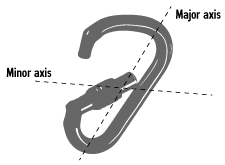
Carabiners are rated for strength in three directions: lengthwise (major axis), sideways (minor axis) and while open (major axis open or "gate open"). These ratings are typically marked on the spine of the carabinerAll climbing carabiners pass UIAA and CE standards, which means they are plenty strong enough as long as you use them correctly. Gate-open strength and minor-axis strength are where you see the most variation.
Here's how you might use strength ratings: If you've narrowed your search to a few different carabiners that will work well for your style of climbing, look at the strength ratings as one of the final decision points. If one carabiner provides everything you need and is stronger than the others, then you might as well go with that one. Keep in mind that smaller and lighter carabiners are generally weaker than bigger, heavier ones, but not always.
A note about gate lash: The dynamics of just about any climbing fall can cause gate lash, which can reduce a carabiner's overall strength to its open-gate strength, creating a higher likelihood that the carabiner could break. It can occur when:
- A gate's inertia overcomes the spring tension holding it in place
- A gate collides with another object
To protect yourself against this type of carabiner failure, choose carabiners with specific gate designs (such as a wiregate) and/or stiff spring tensions. You can also opt for carabiners with locking gates and/or high gate-open strengths (REI provides both gate-closed and gate-open strength ratings on the product page Specs tab). Ask an experienced REI salesperson for recommendations.
Which Carabiner To Use
Once you understand how shape, gate type, size, weight and strength affect performance, it's helpful to think about how you'll be using the carabiners.
Features that make a carabiner great for one type of climbing might not make it so great for another. For example, small wiregate carabiners can be great for racking gear to keep your rack light or for making lightweight trad quickdraws, but they won't be as easy to clip as larger, heavier carabiners.
Most experienced climbers develop a preference for carabiners of a certain size and shape and with a certain gate type. If you're just starting out, here are some general recommendations:
| Use | Type of Carabiner |
| Belaying and rappelling | Large pear-shape locking carabiner |
| Sport-climbing quickdraws | Asymmetric D carabiners with straight gates, bent gates and/or wiregates |
| Trad-climbing quickdraws | Asymmetric D carabiners with wiregates |
| Racking trad gear | Asymmetric D, D or oval carabiners |
Once you've narrowed down your search, it may be helpful to visit your local REI or other climbing shop. Grab a few models and get a feel for how they fit in your hand, how easy they are to clip and unclip, and how smoothly the gates work. For locking carabiners, try locking and unlocking the gate a few times (with one hand). Choose models that feel good, operate smoothly and are easy to work with.
Your safety is your responsibility. No article or video can replace proper instruction and experience. Make sure you practice proper techniques and safety guidelines before you climb.