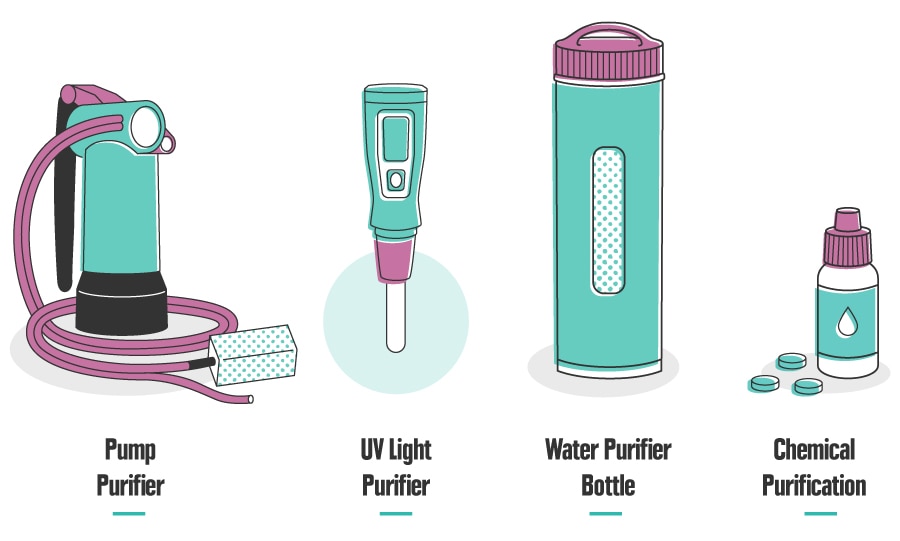
Water quality can vary widely outside the United States, and it is particularly suspect in developing countries. So what is the best method of water treatment for international travel? In most cases, the recommended strategy involves using a method (mechanical, electronic or chemical) designated as a water purifier, which eliminates viruses as well as protozoa and bacteria.
Water-related illness is typically linked to 1 of 3 types of invisible-to-the-eye pathogens (disease-carrying pests). Caused by animal or human contamination, principally via fecal matter, the following trio of bad boys is potentially lurking in just about any lake, river or stream outside the U.S. and Canada:
Of the portable water-treatment methods offered at REI, any designated as a "purifier" will rid water of all 3 threats. Pump or gravity-based devices commonly called "filters" reliably sift out protozoa, cysts and bacteria but are not effective against miniscule viruses. Water can also be purified (the technical term is "disinfected") by some chemicals and chemical-based devices.
Handheld water filters designed for backcountry travel are more correctly called "microfilters." They are more exacting than household tap "filters" by removing very fine particles down to 0.4 microns in size. However, they do not trap super-fine particles as well as industrial-grade "ultrafiltration" and "nanofiltration" methods.
Microfilters physically separate protozoa and bacteria from water by pushing water through an internal "filtering media" — a ceramic cartridge or a cluster of hollow-fiber tubes.
These media look solid to the eye, but they contain microscopic pores (typically 0.2 to 0.4 microns) that water can penetrate, but protozoa, cysts and bacteria cannot. Microbiologists call this process "size exclusion." The filtering media basically acts as a microscopic colander that strains bugs out of the water.
Viruses, however, are tiny enough to slip through even these pores. Because the risk of viral contamination in North American wilderness waters is considered low, filters are quite sufficient for most domestic backcountry travel. But in less developed international locales where surface water is exposed to all manner of human and animal activity (such as remote villages, primitive farming communities and heavily concentrated population centers), treating water with a purifier is a must.
When a colleague's daughter began making plans for a 10-country, 4-continent educational tour, he asked me for guidance on water treatment for international use. Eager to keep a coworker's family member healthy (he's one of my supervisors, after all), I consulted with several members of REI's product-selection team, various water-treatment manufacturers and medical contacts. Here's our consensus thinking on purifiers available at REI.
Many of us like this miniature light saber. It uses ultraviolet light to deactivate the unseen cooties (viruses included) that could be lurking in water. Short-wave UV light (specifically, UVC, which transmits "germicidal" attributes) zaps, or "disrupts," their DNA, rendering them unable to reproduce and thus cause illness. This is what my coworker's daughter took on her trip, and she returned healthy and well-pleased with its performance. The SteriPEN is typically my first-choice water-treatment item for backpacking trips, but every person has different preferences. It may or may not be the right item for you.
Pros:
Cons:
Tips:
This uses a 2-step approach: 1) mechanical filtration followed by 2) chemical treatment (drops of a chlorine solution). Some cautious wilderness land managers even advocate this 2-stage process as the most failsafe approach to backcountry water. MSR recommends filtering first, then applying the solution. The company also states that the Sweetwater solution is formulated to be effective only with the Sweetwater's borosilicate filtering medium.
Pros:
Cons:
Tips:
MIOX (short for mixed oxidant) is an inventive, battery-operated device brews up an electronically charged salt-based solution (essentially chlorine) that, when poured into water, neutralizes any pathogens. Test strips can be used to determine if the right concentration of the solution has been applied to the water.
Pros:
Cons:
Tips:
The only pump devices that perform as chemical-free purifiers are found in the popular First Need series (XL, Trav-L Pure and Base Camp). First Need units feature a proprietary, carbon-treated filtering media, described as an electrostatically charged "structured matrix." Only its manufacturer (General Ecology) fully comprehends what's going on inside the First Need's tangled web of sci-fi fibers. (It's a combination of microfiltration and a process known as "adsorption," which causes suspended matter, such as viruses swimming in water, to adhere to a filtering material, all without chemicals.)
Pros:
Cons:
This squeeze bottle is equipped with a replaceable cartridge connected to the straw-like sip tube. When the bottle is squeezed, water is pushed through a 3-stage treatment process: 1) a filter, using pleated glassfiber with 1-micron pores, 2) tiny beads of iodinated resin, to deactivate viruses and 3) carbon molecules, to promote clean-tasting water. It is designed for single-person, on-the-go use, typically day trips only.
Pros:
Cons:
Chlorine dioxide tablets (found at REI under the brand name Micropur) meet EPA guidelines for effectiveness against harmful waterborne microorganisms, including viruses and hard-shelled Cryptosporidium.
Pros:
Cons:
Tips:
If no other option is available to you, and you have access to a pan and a heat source, you can always boil the water. Among medical professionals, this process is called "heat disinfection." It is a foolproof treatment method.
Pros:
Cons:
Tips:
Important: Read the instructions that accompany any water-treatment product you select. Read them carefully, then follow them. For example, do not immediately drink treated water if your chosen method recommends (as several do) a dwell time of between 5 minutes and 4 hours.
Notes on chemical contamination and other urban hazards: Herbicides and pesticides can be absorbed by filters equipped with a carbon element or counteracted by some purifiers that employ a chemical component. With bioterrorism agents, it depends on the size of the organism. Anthrax, MSR Corp. reports, is a bacteria that can range from 1 to 8 microns. Thus it would be captured by all filters carried at REI. High concentrations of chemicals and heavy chemicals, though, cannot be reliably removed by portable filters or purifiers. Always avoid collecting water from water sources near agricultural activity, heavy industry, mines or their nearby tailing ponds.
Notes on product availability: REI's product selection varies from time to time. Any of these products could drop out of our product assortment at any time. Sometimes a particular item REI stocks may be temporarily unavailable due to product issues with individual manufacturers. And new products may be added before we have a chance to update this article. We apologize if any of these circumstances complicates your efforts to acquire the water-treatment system that you prefer.
View the Centers for Disease Control and Prevention (CDC) guidelines for international travel.
The remainder of this article is likely to interest only a very small group of readers. We include it simply to verify that we did our homework on this subject.
To be legitimately marketed as a purifier, any mechanical device or chemical treatment is expected to meet or exceed the U.S. Environmental Protection Agency (EPA) Guide Standard and Protocol for Testing Microbiological Water Purifiers. Such devices or chemicals must destroy 99.9999% of bacteria, 99.99% of viruses and 99.9% of protozoa.
These percentages reflect a "logarithmic" reduction (or "log reduction," as water technicians call it) of organisms in the water. If water, for example, is spiked with a concentration of 10,000 units of something, a 1-log reduction would leave 1,000 units remaining—a reduction of 90%. Here are the results water purifiers must achieve to meet the EPA Guide Standard:
| Starting concentration | Finishing concentration | Log reduction | Percentage destroyed |
|---|---|---|---|
| 10,000 | 1,000 | 1-log | 90% |
| 10,000 | 100 | 2-log | 99% |
| 10,000 | 10 | 3-log | 99.9% |
| 10,000 | 1 | 4-log | 99.99% |
| 10,000 | < 1 | 6-log | 99.9999% |
In most cases a fairly substantial quantity of pathogens must be ingested in order to cause illness, a factor that makes the stringency of the EPA Guide Standard quite encouraging.
"You don't get sick when you take in just one organism," California-based water specialist Dr. Howard Backer told REI.com. "Sometimes dozens or hundreds have to be consumed in order to cause infection. And even if a person becomes infected, it's not the same as getting sick."
Not everyone reacts the same to waterborne pathogens. "Your own underlying health factors can determine how you respond to them," says Dr. Backer, who advises a backcountry travel service. "If, however, you are chronically ill, you are HIV-positive or your immune system is compromised for some other reason, you would be a fool not to treat your water in any situation, and especially overseas."
The EPA—specifically, the EPA Office of Pesticide Programs—takes an interest in water purifiers only because some purifiers use a chemical to kill (or "inactivate") microorganisms that the agency considers to be a public health threat. This is because the EPA is responsible for monitoring pesticide use in the United States.
The EPA, however, does not test, approve, certify or endorse water filters or purifiers. The authoritative, 2,300-page textbook Wilderness Medicine (edited by Dr. Paul Auerbach) points out that the agency only assigns registration numbers to these products. Registration does not indicate endorsement.
Dr. Backer is the author of the textbook's "Field Water Disinfection" chapter. In it he writes: "To be called a 'microbiologic water purifier,' the unit must remove, kill or inactivate all types of disease-causing microorganisms from the water, including bacteria, viruses, and protozoan cysts, so as to render the processed water safe for drinking."
Makers of water purifiers submit their products to independent labs for testing. Nonprofit NSF (National Sanitation Federation) International, based in Michigan, is one such lab. Mike Blumenstein, Senior Project Manager for NSF Engineering and Research Services, explained the lab's relationship with the EPA in an email to REI.com
"We collaborate with the EPA on multiple public health-related issues," he wrote. "As far as microbiological purifiers are concerned, we do not have any official collaboration with EPA. However, NSF does offer NSF certification for purifiers according to the requirements of the EPA Guide Standard and Protocols for Testing Microbiological Purifiers.
"Specifically, NSF Protocol 231 (NSF P231) helps ease concerns about microbiological contaminants in drinking water by establishing product safety and performance requirements for microbiological water purifiers. Based heavily on NSF P231, NSF Protocol 248: Emergency Military Operations Microbiological Water Purifiers describes the procedures to test individual water purifiers (IWPs) that remove or inactivate microbiological contaminants from virtually any fresh water source likely to be encountered during military exercises and deployments. P248 is intended for field type, short-time use devices; P231 is intended for long-term devices, such as plumbed-in or pitcher-style devices."
Thus labs may "certify" that a purifier performs according to the EPA standard, but the EPA itself does not certify, "approve" or "endorse" products.
To maintain competitive balance in the marketplace, it is not unusual for manufacturers of chemical-free products (examples: First Need purifiers and the UV light-based SteriPEN) to seek lab certification for their devices. Doing so indicates that their products conform to the EPA Guide Standard, like chemical-based purifiers. But, again, the EPA does not certify, approve or endorse any water-treatment method or device.

The EPA Guide Standard involves testing various water-treatment technologies with a variety of "test" or "challenge" waters numbered #1 through #5. Water #1 is "General Test Water" which, Blumenstein states, "is essentially tap water with no residual disinfectant."
Challenge waters (those #2 and higher) are spiked with far more organisms (such as protozoa and bacteria) than would ever be encountered in the field. This is done to facilitate analysis of the pathogen's "log reduction."
Blumenstein says challenge waters are specific to the technology being examined. All challenge waters include higher or lower pH (depending on the technology), total organic carbon (which could include contaminants such natural organic substances such as pathogens, insecticides, herbicides and other agricultural chemicals) above 10 milligrams per liter, turbidity above 30 NTU (Nephelometric Turbidity Units) and total dissolved solids at approximately 1,500 milligrams per liter.
Because colder water is more difficult to disinfect, challenge waters are also cooled to (4°C, or 38°F). Water #1 is comparatively warm (20°C, or 68°F).
Here are the waters used and the types of technologies to which each applies:
As mentioned earlier, to meet the EPA Guide Standard, a technology must achieve a designated "log reduction" in the organisms as defined in the protocol. A purifier, therefore, must destroy 99.9999% of bacteria (a 6-log reduction), 99.99% of viruses (4-log) and 99.9% of protozoa (3-log).
Wow.
On your next overseas trip, raise a cup or treated water and offer a toast to these impressive technologies.
How are we doing? Give us feedback on this page.