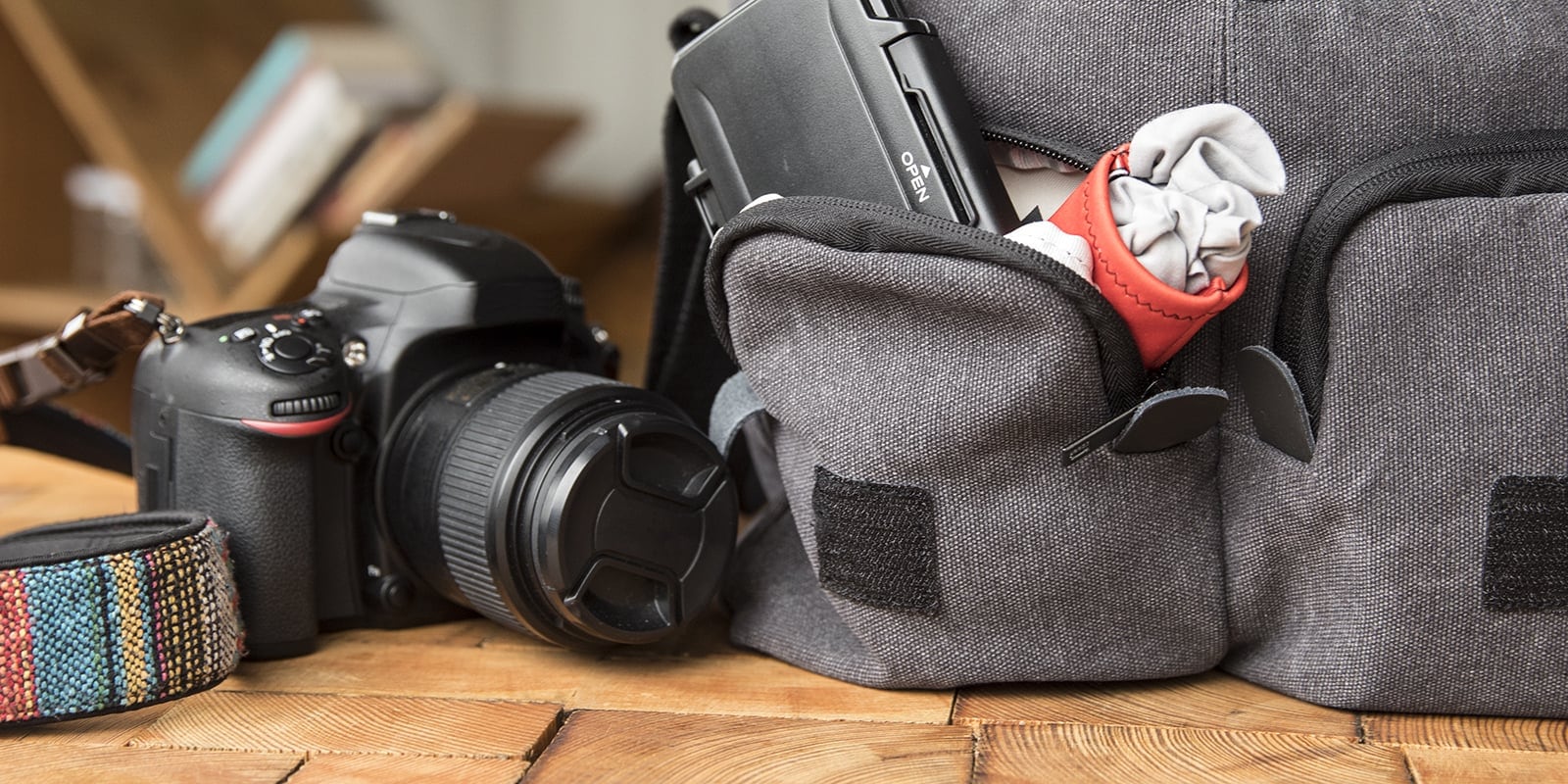
Camera bags come in all shapes and sizes to fit a variety of photography equipment. Besides making it easy to carry all your photography gear, a good camera bag will protect your equipment from getting knocked around and damaged by dust or moisture.
Types of Camera Bags
There are two basic types of camera bags: those designed for compact point-and-shoot cameras, and those designed for larger SLR cameras and lenses.
Compact Camera Cases
These cases can be small enough to hold just a camera. Others are large enough to hold a camera and accessories such as film or a cell phone.
- Closed-Cell Foam Cases—These styles are made with tough nylon or polyester materials and are padded to protect your camera. Some have an additional zippered pocket for accessories.
- Thermo-Molded Nylon Cases—These sturdy, molded cases are crush-resistant and less bulky than closed-cell foam cases. They also have a soft lining to protect your equipment from scratches or abrasion.
- Leather Cases—Leather cases typically have less padding than other models, but they're more stylish than the nylon or polyester versions.
Larger SLR Camera Cases
Some of these bags can be used for compact video equipment. Other styles are designed for active, backcountry use. All are constructed with rugged nylon or polyester and padded with closed-cell foam. Most have adjustable internal dividers that can accommodate a range of camera sizes.
- Rectangular Bags—Some of these cases can double as compact camcorder carriers by adjusting the internal dividers. Most have multiple pockets for accessories and a shoulder strap for carrying.
- Triangular Bags—These are designed specifically to fit an SLR camera and lens; most have room for film and flash. These bags have a shoulder strap, belt loop and top handle for multiple carrying options. Some have a chest harness. Certain styles are large enough to carry an extra lens, or have a weather-proof cover to protect from moisture.
- Fanny Packs—These styles are good for backcountry use, and can also be carried as shoulder bags. Some feature two detachable side cases for extra lenses and an overlap zipper to help keep out rain and dust. These packs are conveniently accessible—they can be worn in the front to serve as a handy in-and-out pouch when you're shooting or changing lenses.
- Backpacks—These packs are specially designed to carry up to two SLR cameras and seven or eight lenses, in addition to a flash, film and accessories. They feature internal and external pockets, as well as compression straps for lashing on extra gear such as a tripod or jacket. Some have high-tech suspension systems and an all-weather cover to protect from rain and moisture. Backpacks offer the best protection and are the most comfortable way to transport a lot of photography equipment for travel and other activities.
Other Considerations
Many serious photographers use two or three bags to carry and organize lenses, film and camera bodies.
If you'll be spending a lot of time around water, consider getting a waterproof bag to protect your gear in addition to a camera bag. You can choose from a simple three-roll closure waterproof dry bag or a hard-shelled waterproof box.