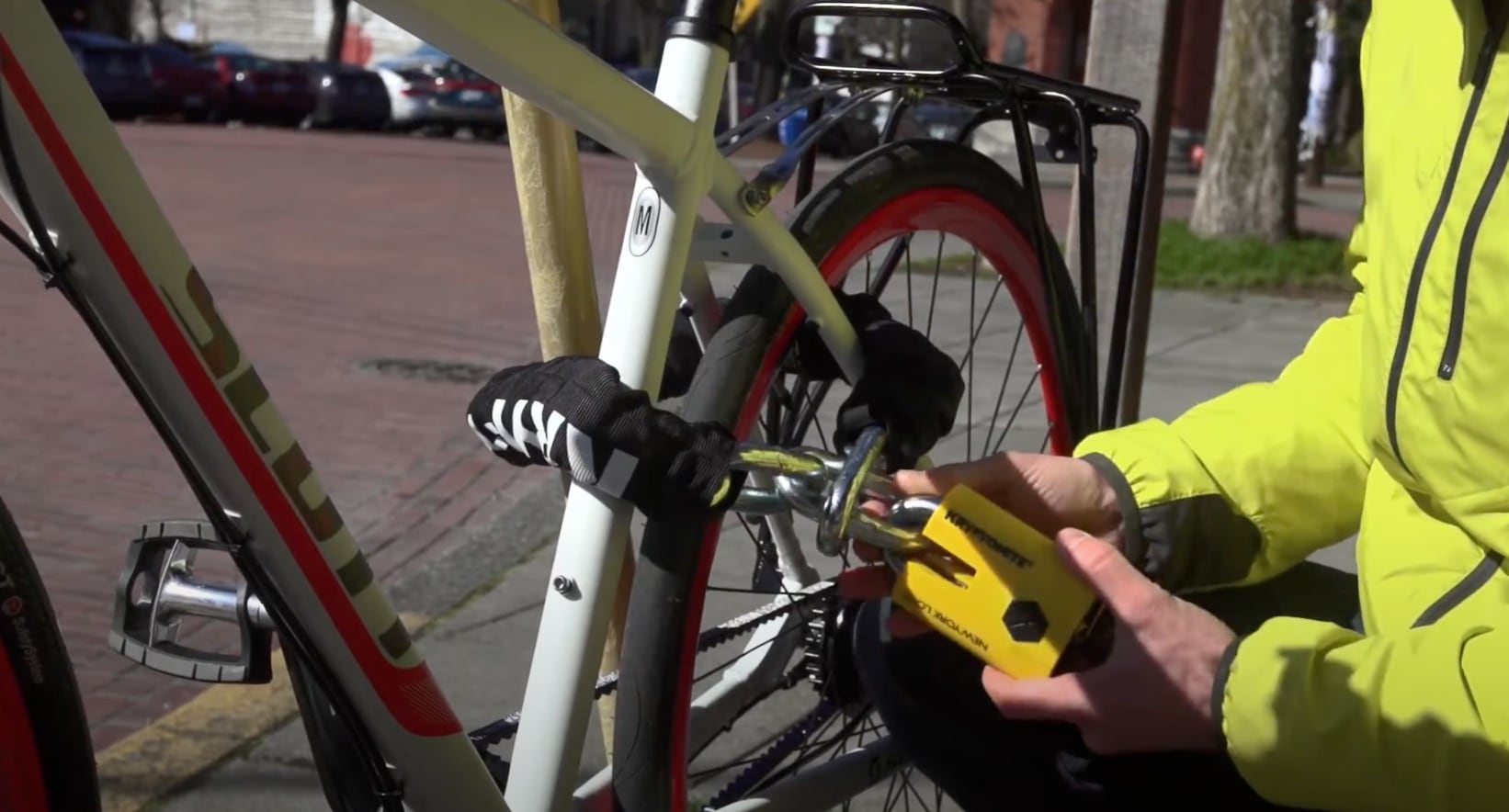
Let’s start with the bad news: No bike lock is 100% effective. Unfortunately, if given enough time and the right tools, a persistent bike thief can defeat any option on the market. The good news, however, is that you can reduce the risk of your bike being singled out by thieves with a sturdy lock and a solid locking strategy.
So, how do you find the most secure lock on the market? To help answer that question, we talked to REI Regional Shop Specialist and avid cyclist Jason Heckle. In addition to years of experience working in bike and ski shops, Heckle spent a decade traversing New York City on a bike. Luckily, he never once had his bike stolen. According to Heckle, the best bike lock is the one you’re most likely to bring with you—and use.
This article will cover:
- What to consider when buying a bike lock
- Four basic types of bike locks
- Keyed locks vs. combination locks
- Ways to protect your bike from thieves
What to Consider When Buying a Bike Lock
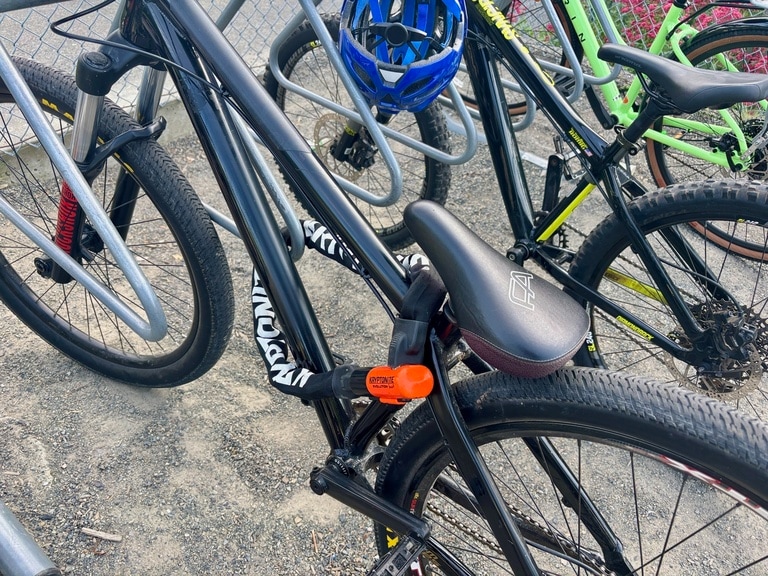
Ask yourself these questions when deciding which bike lock is best for your needs.
Where are you locking your bike? Of course, it’s always better to be safe than sorry. So, lock up your bike no matter where you’re parking it. That said, some areas of your community are likely to have higher bike theft rates than others. Major city centers, student areas (especially college and university campuses) and high-density urban areas tend to see the most thefts, according to research from BikeFair and BikeFinder. Brands like Kryptonite provide security ratings for their locks and often recommend their highest level for locking overnight in metropolitan areas. Poorly lit and low-traffic areas are also prime areas for theft, according to bike experts from Madison, Wisconsin.
How long will you be away from your bike? Think about the length of time your bike will be out of your sight. That translates into the amount of time a thief could potentially have to tamper with the lock. Do you plan to make a quick stop to grab coffee? If so, then a lighter weight and less expensive lock might suffice. Will you leave your bike for multiple hours during the day? If that’s the case, then you will likely want a heavier-duty option that can stand up to a thief who has more time to defeat the lock. Look for the highest-security lock if you leave your bike overnight in a major city center versus locking it up for 15 minutes in front of a cafe.
Consider weight and portability. There’s a significant trade-off when it comes to your bike lock's weight. “If it’s easier to carry and it’s lighter, it’s going to be easier to defeat,” Heckle says. “If it’s harder to carry and it’s heavy, it’s going to be the more secure of the options.”
How do you plan to carry the lock? Do you plan to stash it in a backpack, panniers or on-bike bag, or mount the lock to your frame? Some U-locks and many of the foldable varieties come with lock mounts. You might also consider a wearable lock, like the Hiplok Gold Maximum Security Wearable Chain Lock, which is still heavy but less cumbersome. No matter which option you choose, weight will likely be a factor unless you’re riding an e-bike that will do much of the heavy lifting (literally) for you, or locking your bikes up in the garage.
How much did the bike cost? While you never want to have your bike stolen, you’ll probably feel even worse if a high-value ride gets taken. If you’re riding a bike worth thousands of dollars, it’s probably worth investing in a higher-security (and likely more expensive) bike lock.
Of course, for bikes you’ll ride for long distances or high-intensity activities—like road, gravel or mountain bikes—carrying a heavy lock will impair your riding ability. If you have the means, you might consider investing in a second, less expensive bike to use for commuting and parking around town.
Another option is to make your expensive bike look a bit less flashy, not so appealing, Heckle says. Covering the brand name with stickers and decals or otherwise personalizing the bike will likely decrease its resale value and might make it easier to regain if it is stolen. These factors make your bike less attractive to thieves.
What do you plan to lock up to? Consider where you plan to ride your bike and what’s likely to be available to lock your bike up to. If you’re riding to the same place every day and can be confident that you’ll find a sturdy bike rack, then a tight-fitting (and therefore more secure) U-lock will probably work well. On the other hand, if you anticipate locking your bike to items with a larger girth (light poles, trees, etc.), then consider a chain lock or, if you’re in a lower-theft area, a cable lock.
Will time be an issue during the lock-up process? Some bike locks are faster to lock than others. “The bigger the lock, the easier it is to fit around things and around your frame,” Heckle says. “Chains fit around everything, and you can get a lot into them, but they can be heavy and awkward.” Tighter-fitting options like U-locks and foldable locks tend to be more secure because a thief has less leverage, but it may take longer to find just the right angle to fit around your frame and the lock-to object.
Does the lock come with a warranty or anti-theft protection? Some brands, including Hiplok and Kryptonite, offer lifetime warranties on specific locks. Kryptonite offers an optional anti-theft protection program that reimburses registered customers for a specific amount of money if their bike is stolen from thieves breaking a lock by force. Just be sure to read the fine print as some exceptions may apply.
Have more questions about which lock is best for your needs? No problem. Bring your bike along when you go to make a bike lock purchase at your local REI. The employees will be happy to show you the different options available and work with you to test the lock with your bike’s geometry.
Video: Bike Security
Four Types of Bike Locks
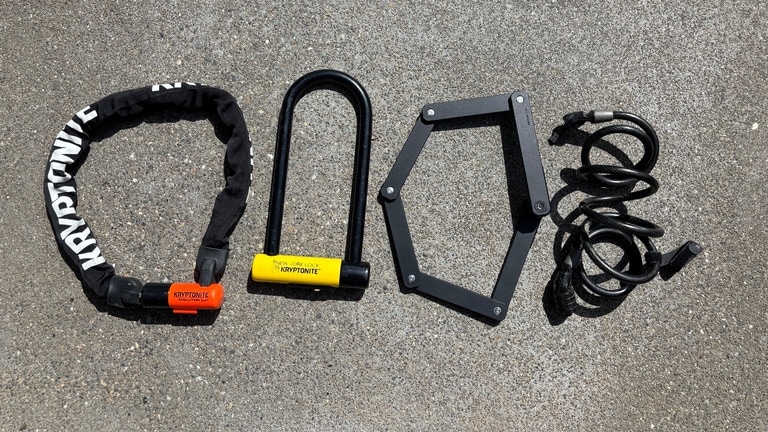
There are four primary types of bike locks, each with pros and cons. Here, we list them in order of what is considered most protective to least protective.
Lock Type | Pros | Cons |
|
| |
|
| |
|
| |
|
|
Chain Locks
Chain locks consist of a sturdy chain and an accompanying padlock (included with some models). Tough enough for high-crime areas, these bike locks use a specially designed chain link that resists hacksaws or chisels and makes the chain tough to leverage. Be sure to invest in a padlock that's just as strong since thieves can easily cut through thin locks, no matter how sturdy the chain. Some versions are long enough that they can be worn over the shoulder like a satchel. Others, like the Hiplok Gold Maximum Security Wearable Chain Lock, are designed to be worn like a belt.
Just keep in mind that chains are heavy and bulky. As a result, they may be better for locations like your home or workplace, where you can leave the lock behind whenever you take your bike.
U-Locks
Often made from hardened steel, U-locks look just like the letter they’re named after, with a lockable crossbar. New models now have a double deadbolt in each arm of the shackle. These locks provide a great defense against most thieves because their bulky locking mechanism resists hammers, chisels and the like. Its horseshoe shape, when sized properly to the bike, reduces the space in which a thief can insert a crowbar and leverage enough oomph to pop it apart.
U-locks come in various sizes. Size your lock so there’s as little gap as possible between your bike and what you’re locking it to. Small to medium models lock one wheel and your frame to a fixed object. Large models lock both wheels and your frame to a fixed object.
On the downside, U-locks tend to be harder to secure items with a wider girth, and they’re typically only big enough to secure one bike at a time. It may also require more time and finesse to lock your bike to something new. U-locks are also more difficult to carry on the bike itself. Many of them come with mounting brackets, but those tend to rattle or, in the worst cases, break. If you’re commuting with a pannier, backpack or another bag, you can toss your U-lock inside, but a good one will add noticeable weight.
Folding Locks
As the name implies, these locks can fold up kind of like an accordion, which makes them easier to carry while in transit. Some, like the ABUS Bordo uGrip 5700/110 Big Folding Lock, can be mounted to a bike’s water bottle bosses or with included straps. “They’re very compact when closed so they transport really well,” Heckle says. “And they do not take up a lot of space on your bike.”
Folding locks are generally made from hardened steel. Still, they tend to be a bit lighter than U-locks with similar security ratings. Some varieties unfold to a slightly bigger size than a U-lock, which makes it possible to secure your bike to unusually shaped objects.
That said, folding locks don’t offer as much length as a chain lock or cable lock. They also tend to be more expensive than other options.
Cable Locks
Cable locks include a cable, usually made from steel, and an accompanying padlock (included with some models). These locks are versatile, flexible and relatively easy to wrap around different sizes of lock-to objects (e.g., wider trees). Longer cable locks can be extended to secure multiple bikes. They also tend to be lighter than U-locks and chain locks, and coil for easier transport. Many have combination or key locks built in, while others require you to purchase a separate padlock.
The problem with cable locks is that most versions easily succumb to bolt cutters. They’re best as a secondary accessory lock or for low-crime areas because they help prevent “grab and run” crimes, as Heckle calls them, in which a thief simply takes a bike and runs off with it. In higher theft areas and when you plan to be away from your bike for longer than a quick bathroom break or coffee purchase, pair the cable lock with a heavier duty lock. For example, use a U-lock to secure your bike frame and a cable lock to protect easily removed bike parts like your seat and/or front wheel.
Keyed Locks vs. Combination Locks
Bike locks are secured using either a key or a combination. Both options have the same durability and lock strength, Heckle says, so choose the version that better fits your lifestyle.
Keyed Locks
Keyed locks require either a flat or cylindrical key to unlock. Notably, cylindrical keys got a bad reputation in years past when it was discovered some locks of this style could be picked with a ballpoint pen. Newer models have solved that problem.
Keyed locks often feature a small covering over the key insert hole to prevent dirt and liquid from clogging or freezing in the locking mechanism. Some keys feature a small light to make the lock easier to open in the dark. Of course, keys can be misplaced, though most come with one or two spares. Some brands like Hiplok and Kryptonite will send replacement keys for a small fee.
Combination Locks
Combination locks require the user to remember a specific three-to-four-digit code to unlock. The benefit: “You can’t lose the combination,” Heckle says. “You can only forget it.” If you choose a familiar number sequence like the day/month for a family member’s birthday or the last four digits of your phone number, it may be easier to recall a combination than to keep track of a key.
On the downside, the rotating combination dish can get gritty or iced over, which can make the numbers more difficult to twist.
Ways to Protect Your Bike from Thieves
As a bike owner, you want to make your bike too difficult or time-consuming to steal. Do this by always locking up your bike—and locking it up effectively.
Always lock bikes and bike accessories. “What is going to make your bike safer is locking it up every single time,” Heckle says. In many cases, he adds, thieves are just looking for an easy opportunity, so you need to be vigilant. If your bike is unlocked, all it takes is one opportunistic thief to hop on and pedal away. In the same vein, easy-to-remove accessories like bike computers, bike lights and handlebar bags may also tempt a thief. Take these items with you when you leave your bike.
Always lock your bike properly. Be sure to anchor your bike frame to a solid immovable object like a bike rack or lamppost. Also make sure that your bike can’t be lifted above what it’s locked to, like a street sign. A thief with the right know-how and/or tools may be able to take items attached to the bike frame like a wheel, seat or seat post. Consider locking these items too, with a second bike lock if needed.
Remember that dedicated thieves know a lot about bikes. They are looking for well-known brand names (Trek, Cannondale and Salsa to name a few) as well as high-quality components because these bikes are easier to resell. If you have a name-brand ride—and there are many reasons, including reliability and durability, to have one—you should be even more conscientious about always locking up your bike when you’re away from it.
Editor's Note: We updated this article on June 6, 2025, with new information on bike security, bike lock types and more.