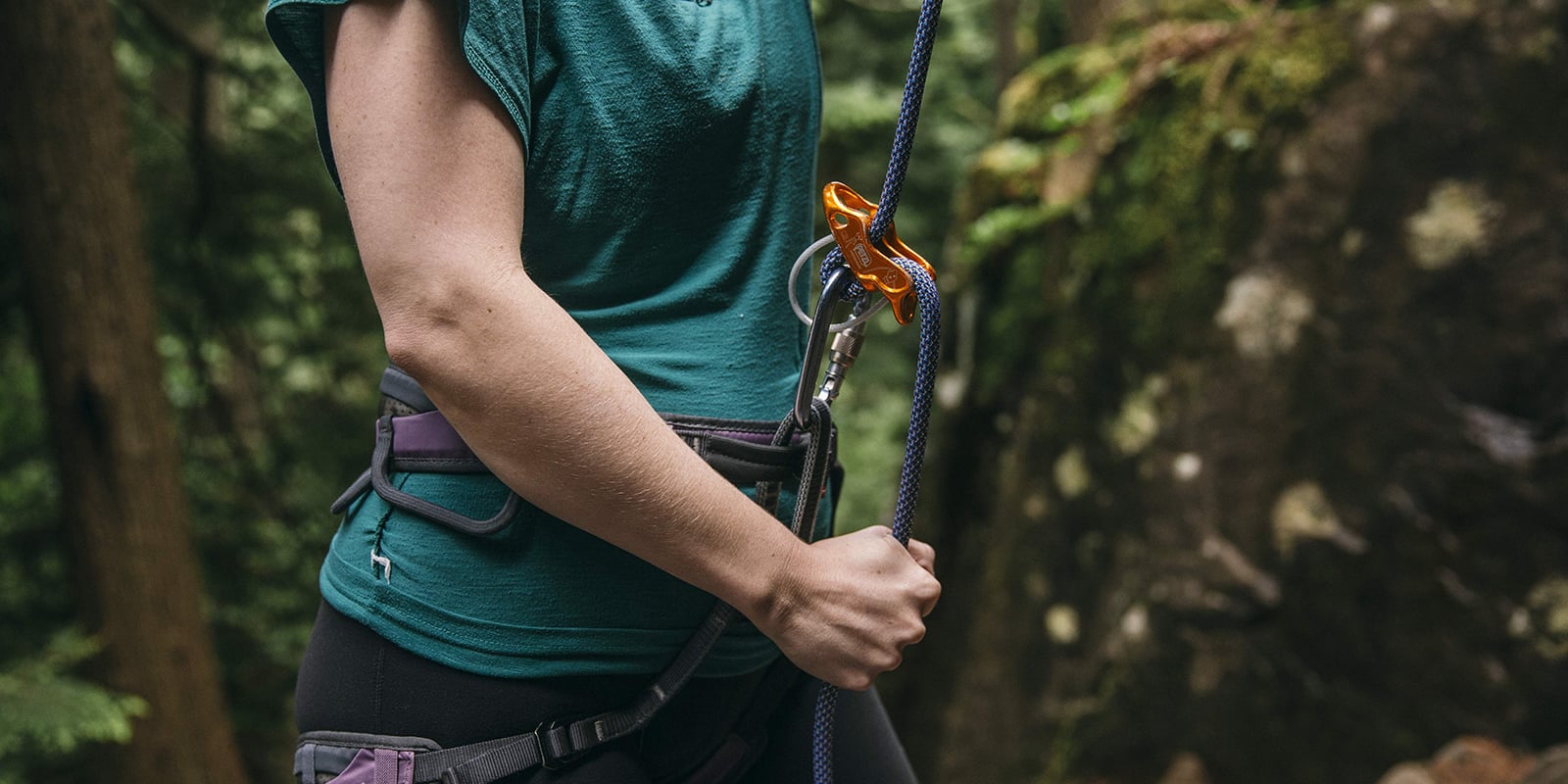
A belay device is essential for climbing safety. The device, plus the belayer's "braking hand" (which locks off the free end of the rope), helps keep tension on the rope and protects the climber at the other end. The belayer uses a belay device to manage rope slack as their climbing partner ascends, applying friction to the rope to catch a fall, lower a climber smoothly or hold them mid‑route. Many belay devices are also used for rappelling during descents.
Which one you choose depends on the kind of climbing you do.
Manual (Tubular) Belay Devices
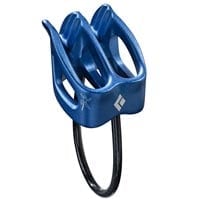
Best for: Multipitch trad climbing, sport climbing, gym climbing
These are very common and are suitable for any kind of climbing.
Manual braking devices (often called tubular devices) are the most basic and traditional type of belay device. They do not provide any assisted braking—the belayer is fully responsible for controlling the rope and stopping a fall.
The rope is folded and pushed through the device and clipped with a locking carabiner to the belayer or directly to the anchor. Friction caused by the bent rope's contact with the belay device slows down and stops the rope, helping to protect the climber. Some tubular devices have ridges or "teeth" to create even more friction.
When it's time to rappel, the dual slots found on nearly every tubular device accept two strands of rope for standard rappelling technique.
Some tubular devices can be set up as an assisted-braking device for belaying one or two followers on a multipitch climb. To learn more, see the section in this article on assisted-braking belay devices.
Advantages of tubular belay devices:
- Compact, light and easy to use
- Work with many rope diameters and can accommodate single or double ropes
- Ropes don't twist or kink
- Can be used for rappelling on two strands
Drawbacks of tubular belay devices:
- Some people, especially lightweight climbers, find tubular belay devices to be slow for rappelling
Assisted-Braking Belay Devices
Best for: Sport climbing, gym climbing, multipitch trad climbing
Assisted-braking belay devices (also sometimes called self-braking, self-locking, auto-blocking or auto-locking devices) are designed to lock down on the rope when a sudden force is applied to it to help the belayer catch and hold a fall.
There a couple different types of assisted-braking devices:
- Some provide assisted braking whether you're belaying a lead climber, top-rope climber or a follower on a multipitch climb.
- Others offer an assisted-braking mode only for belaying one or two followers.
Among the devices that provide assisted braking when belaying a leader, top-rope climber or follower, many use an internal camming mechanism to lock down on the rope when a climber falls. These devices tend to be heavier than other designs and they generally work only with a single line, which means you can't do a traditional rappel on two strands of rope like you can with a tubular device. Because of this, these devices are used mainly for sport climbing, either at the gym or outdoors.
Others in this group have a passive design that pinches the rope between the device and a carabiner to provide the assistance. These are typically lighter than those with a camming mechanism, versatile enough for any type of climbing and capable of being used to rappel on two strands of rope.
Devices that offer an assisted-braking mode only for belaying one or two followers are essentially tubular belay devices with an additional metal loop on the side. That metal loop allows you to attach the device directly to an anchor and set it up in assisted-braking mode.
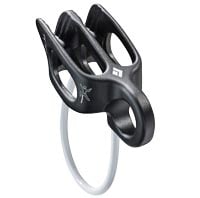
These devices share all the advantages and disadvantages of tubular devices, while also being able to belay one or two followers in assisted-braking mode. And, just because you can't use the assisted-braking mode to belay a lead climber doesn't mean you can never belay a leader. You simply use the device like you would a basic tubular device to do this.
As with any belay device, assisted-braking devices require that you always use proper belay technique and have your brake hand ready to lock off the rope. Be sure you read the manufacturer's information and fully understand how to operate the device before belaying or rappelling.
Advantages of assisted-braking devices:
- Help the belayer to stop the climber's fall
- Feed rope smoothly
- Assisted-braking devices with camming mechanisms make it easy to lower the climber in a controlled manner
Drawbacks:
- Don't work with all diameters of rope, so be sure to check the manufacturer's specifications
- Assisted-braking devices with camming mechanisms tend to be heavier than other devices
- Some only allow rappelling on a single strand
- Devices with camming mechanisms are not recommended for use with wet or icy ropes
- Tubular devices with an assisted-braking mode lock up under a load when rigged in this mode, making them difficult to use as lowering devices
Figure 8 Belay Device
Best for: Search and rescue, caving, rappelling
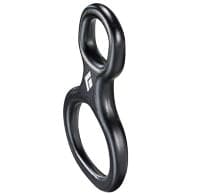
Figure 8 devices are primarily used for rappelling, however, they can be rigged to belay a leader or a top-rope climber. Shaped like the number eight, they have one larger and one smaller hole. When rappelling, you feed a bight (bend) of rope through the large hole and loop it around the outside of the small hole till it rests on the "neck" of the figure 8. The small hole is clipped to your belay loop on your harness. Figure 8s are frequently used for search and rescue, caving and rappelling.
For belaying, different devices recommend different ways to rig the rope through the device. It's imperative to read the instructions included with your figure 8 to learn the proper way to set it up.
Advantages of figure 8 belay devices:
- Efficient and smooth for rappelling
- Dissipate heat from friction efficiently
- Can be used with just about any rope diameter
Drawbacks:
- Require more attention and more force from the belayer's hand than other belay devices
- They put a twist in the climbing rope, which can make rope handling difficult
Your safety is your responsibility. No article or video can replace proper instruction and experience. Make sure you practice proper techniques and safety guidelines before you climb.