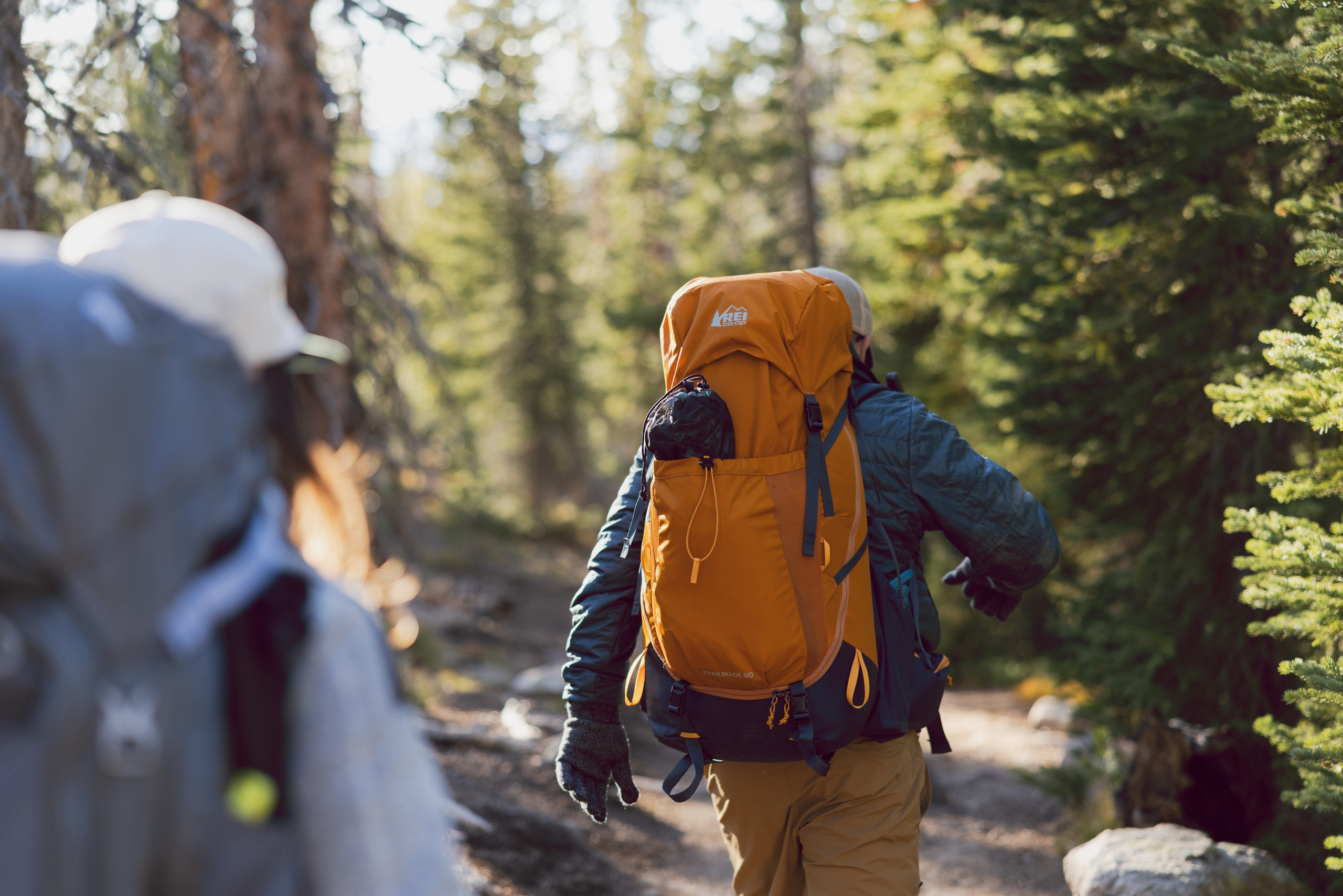
A backpack is a wonderful thing—your ticket to the planet's most remote, off-the-grid wilderness treasures. The right backpack should fit your body, of course, but also your gear assortment and your personal approach to backpacking. This article is dedicated to helping you achieve a good match on all fronts.
Before we break down the basics of backpack selection, here are a few notable trends you'll encounter when surveying current backpack choices.
Internal frames dominate: Body-hugging internal-frame designs have made traditional external-frame models nearly obsolete. The appeal of internal frames lies in their ability to keep loads stable and walkers balanced on unpredictable terrain. Their narrow profiles also allow arms to swing freely and minimize pack-snag when you're pushing through brush. External-frame packs, very good at transporting heavy loads on trails, still exist, but in small numbers.
Think in liters: Most backpacks (even daypacks) have a number embedded in their names—the Gregory Z55, for example, or the REI Flash 65. The number identifies the pack's carrying capacity (aka volume) in liters. Because they are brief and easy to recall, liters have supplanted cubic inches as the standard unit for gauging backpack capacity.
Lower weight: Weight-reduction—both in packs and the gear they carry—has been a game-changing trend in gear design. So consider your existing gear assortment when researching packs. Does your backpacking gear predate the engineering advances made in the "Lightweight Movement" of the late 1990s and 2000s? If so, the bulk of these older items can fill up modern backpacks pretty quickly. In that situation our advice is:
Some questions to ask yourself:
Q: How many days is my typical backpacking trip?
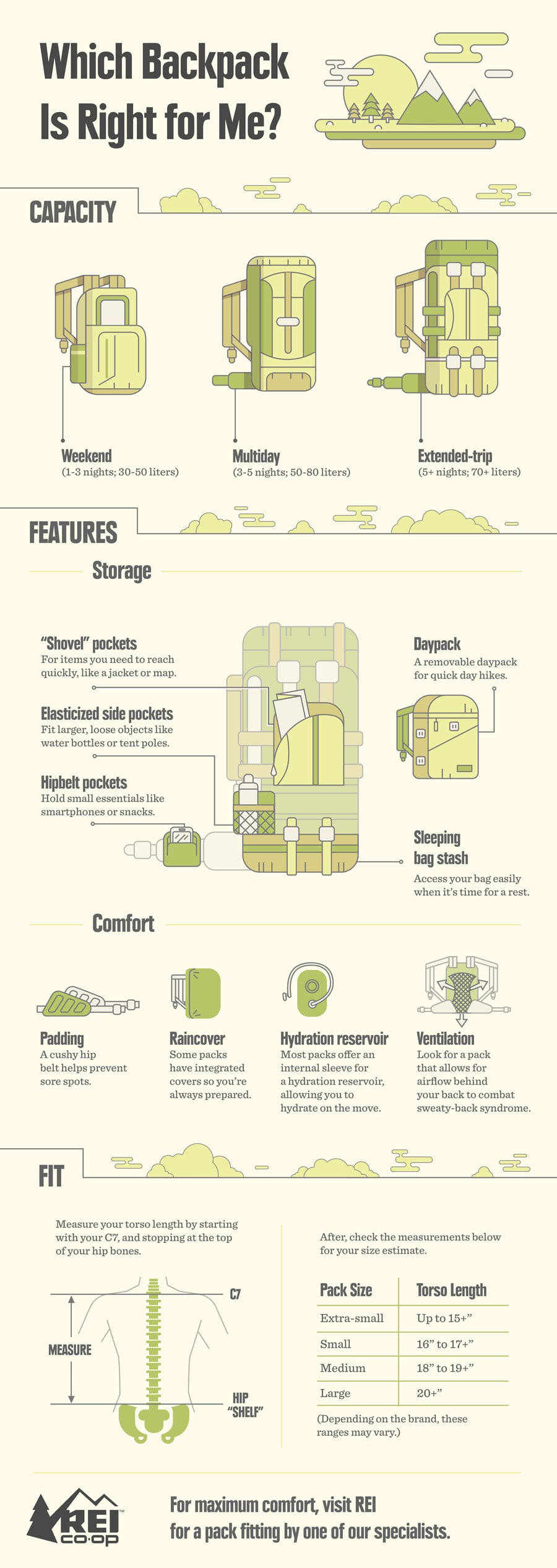
A: In recent years we find the majority of backpackers opting for shorter trips—overnighters and weekenders. REI addresses trip length by assigning backpacks into several broad categories:
These are generally suitable for trips covering 2 to 4 days (and thus 1 to 3 nights of backcountry camping) in mild to moderate 3-season conditions. The backpack assortment at REI.com also refers to this category as Weekend Trip packs.
Packs ranging from 40 to 75 liters for men, and 40 to 65 for women, are appropriate for such trips; the right size depends on the gear needs (and gear-toting savvy) of each individual. The more days you're out, the more capacity you typically need.
A multiday pack is also usually the preferred choice for:
If you routinely hike in the Sierras or other backcountry areas where portable bear canisters are required for food storage, test-fit a canister in your pack. For packs in the multiday category, you may need to upsize your initial liter count in order to accommodate a canister in addition to your other gear. You may need a 65-liter pack or larger for carrying a canister.
Shop REI's selection of multiday/weekend trip packs and women's multiday/weekend trip packs.
These are for outings that last 5 days or more. Most people need a pack capacity of 65 liters or more for such trips, though savvy ultralight specialists can certainly go long distances with a pack REI classifies as a multiday or ultralight pack.
An extended-trip pack is also usually the preferred choice for:
What if you take a wide range trips, from overnighters to extended trips? If you want to own just 1 pack, choose a larger model. This ensures that on most trips all your gear will fit inside the pack. It's a good practice to avoid attaching items on the exterior of a pack, reducing the chances that stray appendages on your load will get snagged on brush or a low-hanging limb. Lashed-on items potentially can negatively affect your balance.
Shop REI's selection of extended trip packs and women's extended trip packs.
This subcategory, found within the general backpacks assortment on REI.com, features selected models (GoLite, Granite Gear, the Osprey Exos series and REI Flash series) designed for use with other new-generation gear. They are engineered to offer high performance with low weight and minimal bulk.
A note on liters: Liter counts apply to a pack's medium size, the average of its size range. The packbag of the REI Flash 65, for example, varies by approximately 3 liters from size to size. The small version offers roughly 62 liters of capacity, the medium 65 and the large 68. This is typical of all brands of packs. Some brands vary by as many as 5 liters between sizes. Packbags are simply constructed to correspond to the size of the frame.
Q: What time of year do I plan to backpack?
A: Summer? Stick with the guidelines outlined above.
If you explore in the chillier portions of spring and fall, or if you regularly spend extended time at high elevations (above 8,000 feet/2,434 meters), a larger-capacity backpack often comes in handy. Larger packs can more comfortably accommodate extra clothing, a warmer sleeping bag or a sturdier tent (which typically includes extra poles).
Winter camping, naturally, calls for a larger pack for the reasons just mentioned.
Q: How much room do I need for my typical gear assortment?
A: It depends. If you:
Q: What do I need to carry in order to remain safe and feel comfortable?
A: Start by eyeing REI's printer-friendly backpacking checklist.
Please realize that this checklist is intentionally extensive. Rare is the person who would carry every item on this list. A pack containing every item could weigh 50-plus pounds.
The goal of the checklist is to cover a wide assortment of items commonly carried by a variety of backpackers. You might not carry gaiters, for example, but other backpackers would not step out on a trail without them.
Below we offer some charts that show how much space some common backpacking items occupy inside a pack. We also apply 3 different gear philosophies—ultralight, lightweight and a kitchen-sink approach we call "deluxe"—to a trio of core backpacking items (tent, bag and sleeping pad).
These REI-produced comparisons illustrate how your approach to gear choices can impact the bulk and weight inside your pack. Here's the mindset behind each methodology:
Sample gear-toting approaches:
| Ultralight Gear | Packed Size (in.) | Lbs./Oz. | Liters Occupied* |
| Tent: Big Agnes Fly Creek 2 | 6.5 x 19 | 2/2 | 4.4 |
| Bag: Mountain Hardwear Phantom +32°F regular | 7 x 10 | 1/7 | 3.7 |
| Pad: Therm-a-Rest NeoAir regular | 4 x 9 | 0/14 | 1.2 |
| Total liters | 9.3 |
| Lightweight Gear | Packed Size (in.) | Lbs./Oz. | Liters Occupied* |
| Tent: REI Half Dome 2 HC | 6 x 21 | 5/0 | 11.7 |
| Bag: REI Lumen +25°F regular | 9 x 20 | 2/11 | 13.1 |
| Pad: Therm-a-Rest ProLite regular | 4.1 x 11 | 1/0 | 5.2 |
| Total liters | 30.0 |
| Deluxe Gear | Packed Size (in.) | Lbs./Oz. | Liters Occupied* |
| Tent: Marmot Limelight 3 | 8 x 22 | 5/15 | 13.5 |
| Bag: REI Radiant +10°F regular | 11 x 17 | 2/15 | 15.1 |
| Pad: REI Trekker regular | 4.75 x 21.25 | 2/8 | 8.2 |
| Total liters | 36.8 |
| Other Backpacking Gear | Packed Size (in.) | Lbs./Oz. | Liters Occupied* |
| Rain jacket: Marmot PreCip (men's) | 6.5 x 4.5 | 0/13 | 1.5 |
| Fleece top: REI Windbrake Thermal (women's) | 7 x 6 | 1/0.2 | 3.1 |
| Water bottle: 32-fl.-oz. REI Nalgene (empty) | 7.87 x 3.62 | 0/6.2 | 1.2 |
| Stove: Jetboil Flash Cooking System (without fuel) | 7.5x4.5x4.1 | 0/15.25 | 1.3 |
| Cookset: GSI Pinnacle Dualist | 6.4 x 5.9 | 1/4.7 | 2.5 |
| First-aid kit: Adventure Medical Day Tripper | 7-1/4 x 5 x 2 | 1/4 | 1.3 |
| Food canister: Bear Vault BV500 | 12.7 x 8.7 | 2/9 | 11.8 |
* Exterior volume
Q: Which approach is considered best?
A: Every person is different, and each of these approaches is appropriate for someone. In general, we at REI favor going as light as permitted by your own interpretation of comfort and convenience. Is a spacious sleeping bag worth an extra 8 ounces on your back? It may be, if you're a "shifty" sleeper. Others may choose differently—and everyone will be right.
Worth noting: The liter capacities shown in our charts for compressible items (bag, tent, pad, clothing) reflect their size in rolled-up or compressed states. Steve Nagode and Scott Smith of REI's Quality Assurance Lab both avoid packing such "soft and squishy" items inside stuff sacks. Instead, they advocate stuffing them loosely inside a pack. The idea: Fill up every iota of air space inside a pack.
"With stuff sacks, you wind up with a bunch of soft 'rocks' to put inside your pack," Nagode says. "I'd rather fill up all the space inside my pack and keep it as small as possible." Others, of course, may prefer the low-chaos/easy-organization of the soft-rocks approach. Experiment with your own gear and decide which method most appeals to you.
For more guidance on pack-loading techniques, please see the REI Expert Advice article on How to Load a Backpack.
For anyone more familiar with calculating pack capacity in cubic inches, here are 2 conversion tables to assist your thinking:
| Liters to Cubic Inches | |
|---|---|
| Liters | Cubic In. |
| 10 | 610 |
| 40 | 2,441 |
| 50 | 3,051 |
| 55 | 3,356 |
| 60 | 3,661 |
| 65 | 3,967 |
| 70 | 4,272 |
| 75 | 4,577 |
| 80 | 4,882 |
| 85 | 5,187 |
| 90 | 5,492 |
| Cubic Inches to Liters | |
|---|---|
| Cubic In. | Liters |
| 100 | 1.6 |
| 1,000 | 16.4 |
| 2,000 | 32.8 |
| 2,500 | 41 |
| 3,000 | 49.2 |
| 3,500 | 57.6 |
| 4,000 | 65.5 |
| 4,500 | 73.7 |
| 5,000 | 81.9 |
| 5,500 | 90.1 |
| 6,000 | 98.3 |
While it's good to size up packs according to their capacity and your usual trip length, nothing is more important than choosing a pack according to your torso length. No matter how little or how much gear you're carrying, you want your pack to fit your frame comfortably.
When it comes to fit, the right backpack is one that offers:
It's best to know your torso length before you begin shopping. To determine it, find a flexible tape measure, enlist the assistance of a friend and follow the directions provided in the REI Expert Advice article on Finding Your Torso and Hip Size. Your torso length is the distance between your C7 vertebra (the most noticeable protrusion on your upper spine) and the rear "shelf" of your hips.
Once you know your torso length, check the specs of a pack that interests you. See if it available in multiple sizes (small, medium, large) or if it offers a single size with an adjustable suspension that can be modified to fit your torso. The following chart is a general approximation of how manufacturers size their packs:
| Men's and Women's | |
|---|---|
| Pack Size | Torso Length |
| Extra small | Up to 15½" |
| Small | 16" to 17½" |
| Medium/Regular | 18" to 19½" |
| Large/Tall | 20"+ |
What about waist size? A variety of packs available at REI offer interchangeable hipbelts, so it's also useful to know your waist measurement. (The majority of a backpack's weight, 80% or more, should be supported by your hips.) To find your size, take that flexible tape measure and wrap it around the top of your hips, the "latitude line" where you can feel your iliac crest—those 2 protruding bones on the front of your hips.
Most backpack hipbelts accommodate a pretty wide range of hip sizes, often from the mid-20s to the mid-40s, so most people do not need to switch out hipbelts. Some people, however, need an option. For example, backpackers with narrow waists sometimes find they cannot make a standard hipbelt tight enough and need a smaller size. REI carries replacement hipbelt parts for select packs from REI, Osprey and Gregory, so REI pack-fitters can custom-fit your torso size with your waist size.
Experiment with the straps and settings on your pack to personalize the fit. Some ideas:
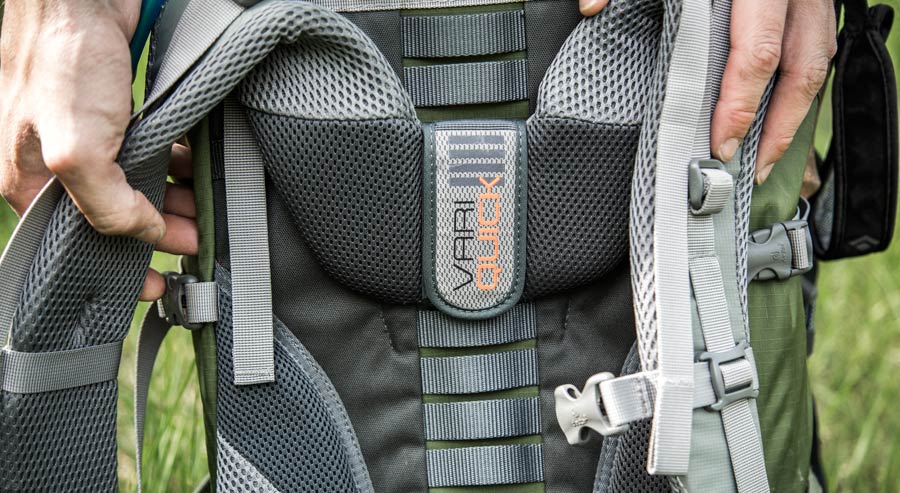
Adjustable suspensions: On some packs, the shoulder harness can be repositioned (often using a "ladder" system of adjustment points) to provide a better fit. This is a nice feature for backpackers who have "in-between" torso lengths—almost medium, not quite large, for example. The drawback: The components that make a harness adjustable (such as the extra webbing of a ladder system) add weight to a pack. Comparable fixed-suspension packs weigh less.
Adjustment points: As mentioned earlier, the weight of a backpack should rest primarily on your hips. Your back, shoulders and upper pectoral region will share in the task secondarily. To optimize comfort and stability, tinker with the various adjustment straps found on most packs:
Heat-moldable hipbelts: Many Osprey packs feature an IsoForm Custom Moldable Hipbelt. All REI stores are equipped with heating units (small ovens) that allow you to customize the shape of the hipbelt in a matter of a few minutes. It's a nice option.
Women-specific backpacks: Women-specific designs are engineered to conform to the female frame.
Youth-specific backpacks: These packs typically offer smaller liter capacities and include an adjustable suspension to accommodate a child's growth. Several brands designs packs for youth; REI offers 3 models:
Women's backpacks, with their smaller frame sizes, often work well for young backpackers of either gender. So do small versions of some men's packs.
Fitting tip: If you can visit a store, throw some weight into packs that interest you and try them on. REI stores are equipped with weighted bags that can create a basic approximation of how a typical pack load might feel. Every brand fits a bit differently and offers different support features. It's wise to try on at least 3 models and spend some time with meandering around the store with them on your back. It's not quite the same as walking on a trail, but you'll at least be able to tell if you and the pack are compatible.
How easy is it to locate and dig out an item you need? It depends on a pack's configuration.
Top-loading openings are pretty standard. Some items not needed until the end of the day should be among the first items loaded deep into that black hole your empty pack presents. Panel-loading packs still exist, but mostly in smaller-volume packs.
Side zippers, front zippers or front panels are extras (not found on every pack) that make it possible to probe a top-loading pack's interior without excavating the entire pack from the top. The only negatives: Such extras can add a few ounces to a pack, and it can be argued that they add a potential weakness/breaking point in the pack cavity's design.
Sleeping bag compartment is a zippered stash spot near the bottom of a packbag. These almost disappeared entirely from packs for a few years, purged in an effort to save weight. Enough backpackers howled in dismay that they have returned on many models. They're useful primarily to people who shun a stuff sack for their bag and instead just shove their bag loosely into the bottom of their pack, 1 fistful at a time.
Pockets: They're relatively scarce on modern internal-frame packs. Here's what you might find on some models:
Top lid: Many packs offered a zippered top lid where most backpackers store quick-access items: sunscreen, insect repellent, camera, snacks, map, route description. Some lids detach from the main pack and convert into a hipbelt pack for day-trip excursions from a backcountry base camp.
Attachment points: If you frequently travel with an ice axe or trekking poles, look for tool loops that allow you to attach them to the exterior of the pack. Rare is the pack that does not offer at least a pair of tool loops.
Hips are considered the human body's best load-carrying platform. They are part of the pelvic girdle, one of the body's biggest bone structures, and are supported by the largest muscle group—the quadriceps and hamstrings of the upper legs. Unlike the centuries-old tumpline, which uses the head and spine to transport large loads, a backpack permits people to maintain an upright posture and normal stride when carrying a load.
Backpack designers use a variety of techniques to channel pack weight to the hips. Is one significantly superior? In my observations, no one design clearly overwhelms another, though I have found packs that use a peripheral rod to offer a nice blend of focused weight-bearing and flexibility. I'm just grateful I'm not toting a backpack from the mid-20th century, when wood-frame rucksacks (the vintage, German-rooted term for backpacks) hung on hikers' shoulders and the only hip attachment was a strap or webbing that simply clipped around the waist. Yikes.
Here are some load-support terms or technologies in common usage:
Aluminum stays: Flat support rods, typically 1-inch wide, that more or less parallel the spine, forming something close to a V-shape at the hipbelt. Stays have been used in backpacks for decades and are still considered a prime load-supporting technology. Occasionally more expensive (and lighter) carbon fiber is used in place of aluminum.
Crossing (X-shape) stays: Lends a touch of flexibility to a pack's back panel.
Framesheets: A thin, stiff layer of plasticized, semi-rigid material that supports the packbag while also preventing the contents from poking a hiker in the back. Some framesheets are also reinforced with aluminum stays to provide even more substantial support. Framesheet materials include:
Peripheral rod or hoop: Small-diameter tubular rods (made either of aluminum or Delrin nylon) are used to support the perimeter of the pack bag to prevent sagging. It’s similar to an external-frame approach, just on a smaller scale. It does a good job of focusing pack weight on hips.
Spring steel: Used in smaller-capacity packs (less than 50 liters), spring steel features excellent shape retention—it quickly springs back into shape. It is especially useful in packs that offer a tensioned-mesh back panel for increased air circulation. (See more in the ventilation section below.) It is also less inclined to fatigue over time than other metals used in backpacks. Its weakness: relatively low "yield strength." Spring steel yields (bends) fairly quickly when exposed to heavy weight. For larger-capacity packs that offer a tensioned-mesh back panel, Osprey switches from spring steel to a metal alloy.
So while load-support techniques vary, all seek to efficiently focus pack weight on the hips while keeping weight low. "Everybody is trying to find the ideal lightweight design that permits outstanding load transfer onto your hips while still permitting articulation," notes REI pack designer Barrett Willet.
How low can you go in pack weight and still retain a degree of support that makes a load reasonably comfortable?
"I tend to error on the side of people who say, 'Give me a more rigid structure in the pack and I'll accept the slight weight penalty that comes with that,' " Willet says. "I would rather have a pack that weighs a few ounces more but does a better a better job of transferring the load to the hipbelt. That means your body is being stressed less because your bones are carrying more of the structure than your muscles."
Hydration: Nearly all packs offer an internal sleeve into which you can slip a hydration reservoir (almost always sold separately) plus at least 1 "hose portal" through which you can slip the sip tube. It's nice if a pack has 2 portals (and most do), giving you the choice of routing the tube out the left or right side of the pack.
Ventilation: A drawback of internal-frame design: Much of the pack rides on your back, minimizing air flow and accelerating sweaty-back syndrome. Designers have addressed this in a variety of ways—ventilation "chimneys" built into back panels, for example. As mentioned earlier, a few packs have engineered a permanent air pocket between you and the pack, using a trampoline-like design sometimes called "tension-mesh suspension." Your back rests against a mesh-only back panel, and the mesh provides improved breathability. The frame-supported packbag rides along a few inches away from your back. This design is found on selected packs from Osprey, Deuter and Gregory and the daypack-size REI Venturi 30 and 40. (Note: Some of these models are available only at REI.com.)
Materials and durability: Ultralight packs tend to use ultralight materials, a factor that lightens your load but puts the pack's durability at risk. REI's Willet concedes the weight-vs.-durability conundrum creates a tricky balancing act for gear designers, a factor he mulled at length when fashioning REI's low-weight Flash pack series.
"We're not trying to be the lightest thing in the world," Willet says. "We don't want to make somewhat disposable products, something that requires significant customer education before they put an item to use. We want to make gear that people use and not have to baby it along."
Materials (mostly nylon) used in REI packs range from lightweight 140 denier (140D) to super-rugged 840D. In Flash packs, the main body fabric is 140D with 210D double-ripstop used in high-abrasion areas such as the pack bottom. Extended-trip packs feature 840D fabric on bottom panels.
"Heavier materials are available," Willet says, "but 840D is enough. If you're going for a drive, do you need a car with 700 horsepower?"
In the future, Willet says more packs will be using polyester-based recycled PET. "We're finding we're not sacrificing anything in using recycled PET other than a little bit of a higher cost," Willet says. "It's a good fabric."
Padding: The race to lower pack weight has sacrificed some padding in hipbelts and lumbar pads. If you keep your pack weight low, this is usually not an issue. But overloading a lightweight pack with a fairly minimalistic hipbelt and lumbar pad can sometimes cause sore spots on your hips and lower back. If you tend to go a little heavy in your loads, you may want a cushier hipbelt.
Climbing packs: REI carries a handful of packs designed primarily as climbing packs. Most, though, have modest capacities (45 liters or less, usually) that are appropriate only for day trips or overnighters. Common distinguishing characteristics (not found on every pack) include:
Summit pack: Earlier this article mentioned a detachable top lid as a desirable feature when planning day trips out of a backcountry basecamp. Another option: Carry a featherweight summit pack. I'm a fan of the REI Flash 18, a 10-ounce sack with shoulder straps. Turn it inside-out and it becomes a stuff sack. Clever.
Rain cover: Pack fabric interiors are usually treated with a waterproof coating (typically polyethylene). Yet packs have seams and zippers where water can seep through, and the fabric's exterior absorbs some water weight during a downpour. The solution is a pack cover, which could be a plastic garbage bag (cheap but clumsy) to a more customized pack cover. If you expect rain on your trip, this is good item to carry. An alternative: bundling gear internally in waterproof "dry" stuff sacks. Dry sacks are sometimes a better option in windy conditions; a strong wind gust has the potential to abruptly peel a cover right off a pack.
I have been fortunate to demo a wide variety of packs that REI offers. Pack models come and go pretty swiftly, so I'll simply offer up some personal observations on brands that made an impression.
Deuter: I'm a fan. I've worn a couple of long-haul models from this Germany-based company and, other than one squeaky connection point between a shoulder belt and the harness (it eventually vanished), I have been well-pleased with the comfort of the ride.
Osprey: Solid and comfortable. I've carried midsize and big-honker models and came home satisfied. The huge-capacity pack had more straps than I can ever imagine using. (I never figured out the purpose of some of them.) But overall the impression was favorable. I once wore an Osprey with the hipbelt heat-molded for my hips. I can't say the experience was revelatory, but the pack rode very comfortably.
Arc'Teryx: I once carried one of the company's the universally praised large capacity packs (no longer available at REI.com). One of its features was the Arc-Teryx Load Transfer Disc Belt. I confess I never quite figured out how to optimize the belt, though (based on many glowing product reviews at REI.com) a slew of other contented owners had. This shows that just because a pack might not work perfectly for one person, it nevertheless might work beautifully for dozens or hundreds of others.
REI Flash series: When the route is long but time is short, I find that I can toss my fair-weather lightweight gear package into a Flash pack (usually the REI Flash 65) and crank out a satisfying weekend dash into the backcountry. For one overnighter I went superlight and chose the REI Flash 50. I logged a terrific 32-miler (plus a peakbagging sidetrip) wearing what felt like a daypack. This is why it's nice to have more than 1 backpack: my Flash gear package is my specialized setup for trips where the time commitment is short and the weather forecast is benign. I'm all set to travel far while traveling light.
Debbie Peterson, a pack specialist at REI Reading (Mass.) whose advice is reflected throughout this article, points out that the perfect pack for one person may not suit another. "I have worn an old Gregory for years and I love the extra padding and plastic stay that goes through the hipbelt," says Peterson. "I hike with a friend who has an Osprey. Halfway through a hike we switched packs because we are the same torso length. I hate how her Osprey feels on my back because I like the Gregory's extra padding, and she hates my Gregory. It all comes down to fit and what feels good on your back."
Technical contributors to this article include REI pack designer Barrett Willet, REI pack developer Ramsey MacDonald and pack specialist Debbie Peterson of REI Reading (Mass.).
Last updated: Dec. 2009
In This Article
Related Categories
How are we doing? Give us feedback on this page.
Find REI on:
Facebook
Twitter
YouTube
MySpace
Flickr