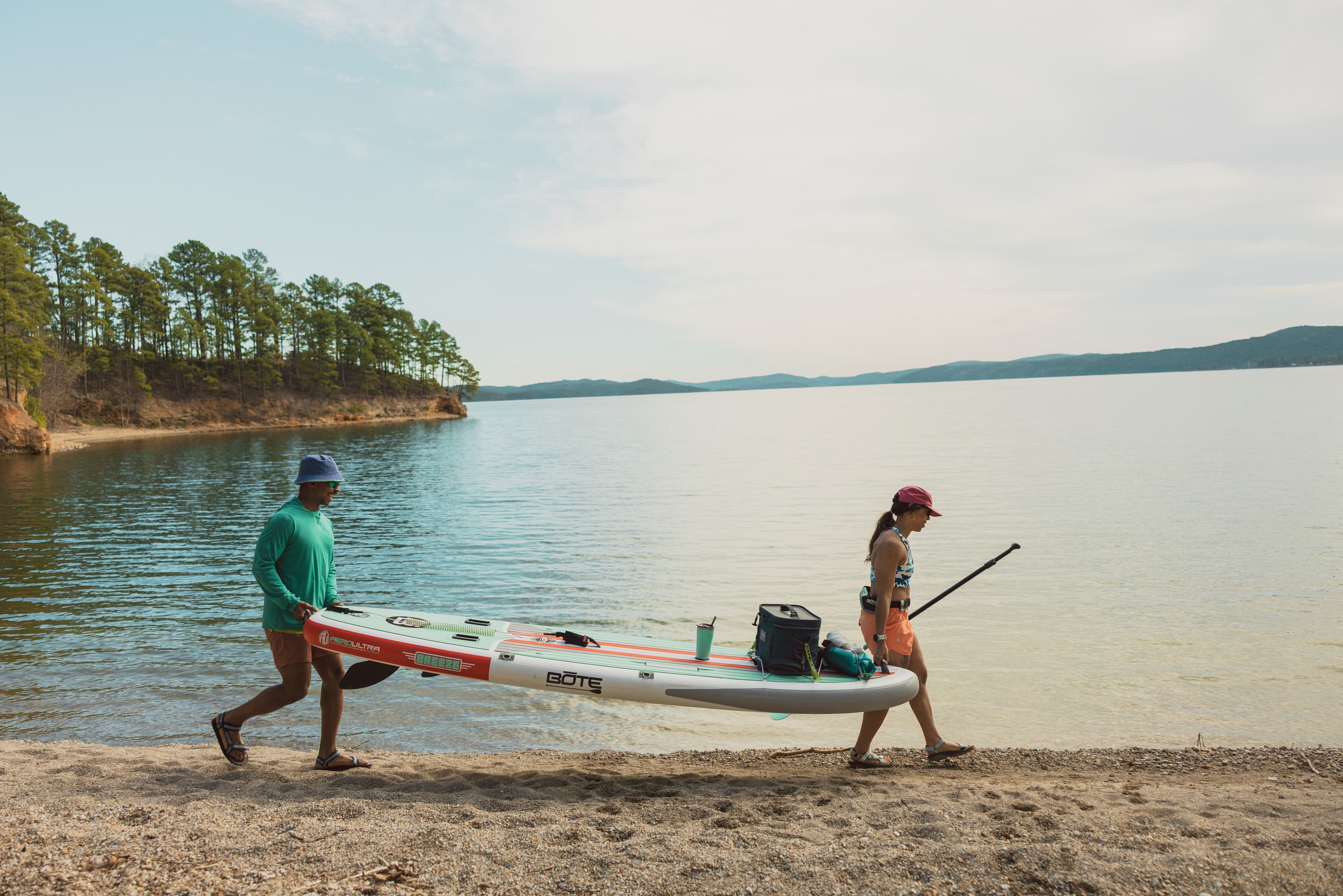
Stand up paddle boarding (SUP) is a choose-your-own adventure watersport: You can relax, explore or burn calories—and picking the right board makes every outing better. Whether you’re looking for an easy float on a calm lake, catch waves in the ocean, try SUP yoga or go on a fast-paced paddle to get a workout, there’s a paddle board to match your adventure. Whatever your ambitions, having the right SUP that fits your needs is key to enjoying your time on the water.
For this article, I spoke with REI retail specialist Gary Call, an avid SUP racer based in Southern California. I also drew upon my own experience of stand up paddle boarding in Alaska, Maine and Colorado, as well as leading SUP tours around Boston. In this buying guide, we'll help you choose the right paddle board for your activity type, skill level and budget. This article covers:
Editor’s note: We updated this article on Nov. 6, 2025, to add new information on SUP hull types, the right board features for different activities, how to understand SUP volume and weight capacity and other SUP features like decks.
Video: How to Choose a Paddle Board
Hull Types & Activity
The hull, or body, of a paddle board plays a big role in determining how the board performs in the water. Most SUPs have what’s called a planing hull or a displacement hull. You’ll also find models with a hybrid design that combine the best attributes of each design.
Beginner paddlers can enjoy either hull shape, but if you plan to use the board for specific activities, there are differences that make each shape better for some than others. Because of this, consider how you plan to use your board to help you decide whether hull type best suits you.
Hull Type | Best For | Performance Traits |
Planing |
|
|
Displacement |
|
|
Hybrid |
|
|
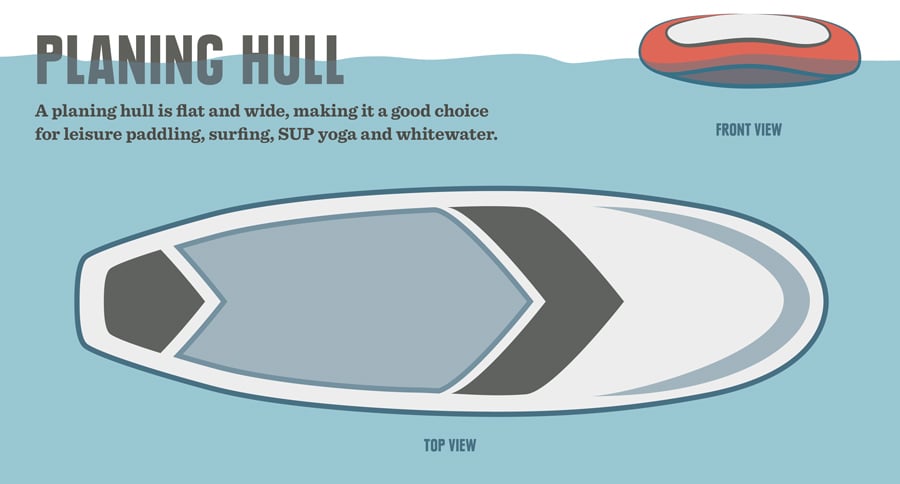
A planing hull is a flat and wide paddle board body, similar to a traditional, long surfboard. It is designed to ride on top of the water and be very maneuverable. Boards with planing hulls are a good choice for leisure paddling, surfing, SUP yoga and whitewater.
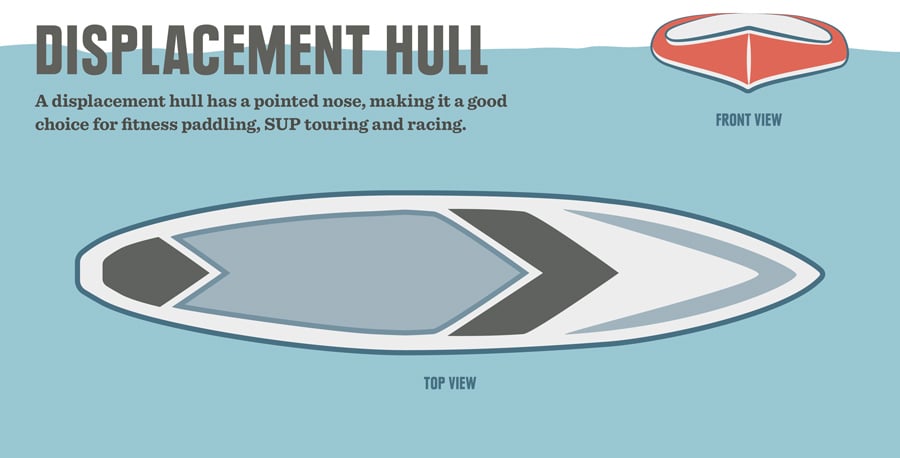
SUPs with displacement hulls have a pointed front end, called a nose or bow, like that of a kayak or canoe. The hull cuts through water, pushing the water around the nose to the sides of the SUP to create a fast, smooth ride. They’re easier to paddle than planing hulls, allowing you to go longer distances at faster speeds. They also track straight but are generally less maneuverable than planing hulls.
Choose a board with a displacement hull if you prioritize paddling efficiency and speed. They’re ideal for fitness paddling, SUP touring/camping and racing.
Hybrid hulls combine aspects of both planing and displacement hulls. It blends the design of a long-distance SUP, like a displacement style bow that cuts through water more easily, and combines it with a wider, flatter body like that of a planing hull for better stability. With a hybrid board, you can paddle across a range of water environments, from calm, flat water to choppy waves.
Inflatable vs. Solid Boards
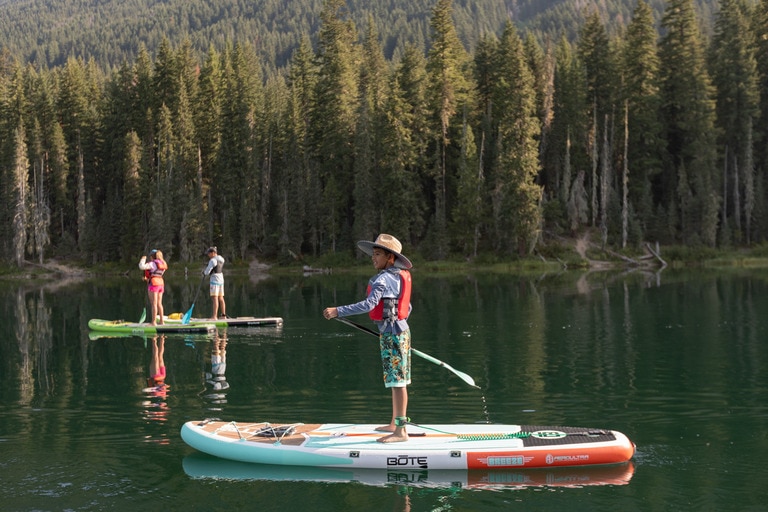
SUPs of all hull types are available in two different construction styles: inflatable or solid.
Paddle Board Style | Pros | Cons |
|
| |
|
|
Inflatable SUPs
Inflatable paddle boards feature PVC exteriors with drop-stitch construction that create an air core. They come with a pump for inflating the board and a storage bag. A quality inflatable SUP is designed to be inflated to 12-15 pounds per square inch and should feel very rigid when fully inflated. That rigidity means a smoother glide on the water, and a more stable boat that won’t feel like a sagging trampoline deck. The technology for inflatable SUPs has evolved significantly over the last decade, creating more durable and higher quality boards.
The benefits of an inflatable board are numerous:
They’re generally less expensive than solid boards. That lower price point makes them a great choice for beginners or people easing into the sport.
They’re compact, portable and easier to transport. Inflatable boards are compact when deflated and can be rolled up and stored in your closet, the trunk of a car or even checked on an airplane. The storage bags come with backpack straps for easier carry. And because they’re portable, you can even hike one into a remote lake.
They don’t require car racks to transport. Much like transporting a kayak, SUPs need to be securely attached to the roof of your car so they don’t become dangerous flying objects on the road. As California-based REI employee Gary Call says, “SUPs act like kites on top of cars anywhere above 5 miles per hour.” If you’re not ready to invest in tie-down car racks, which can cost as much as a good SUP, an inflatable board is a great alternative.
They’re better suited for paddling whitewater. Like a raft or inflatable kayak, an inflatable SUP can handle bumps against rocks and logs better than a solid board.
The soft surface is ideal for yoga: You don't have to get an inflatable for SUP yoga, but they tend to be a bit softer than solid boards, making them more comfortable for yoga poses.
Solid SUPs
Most solid paddle boards have an EPS foam core that's wrapped with fiberglass and epoxy. This is a fairly lightweight, durable and affordable construction. Carbon fiber is a lighter and stiffer option, but it's also more expensive. Plastic SUPs are more affordable, but they are very heavy and lack the performance of other materials. Some SUPs incorporate lightweight wood for a beautiful appearance.
Here are some of the benefits of solid SUPs:
Performance is a priority: Solid boards offer the best performance on the water. They travel faster, smoother and with less effort than an inflatable.
You want a more custom fit: Solid SUPs are available in a larger variety of sizes and finely tuned shapes than inflatable ones, so you're more likely to find one that fits you just right.
Stability is important: A solid board is a tad more rigid than an inflatable board, which can provide a more stable feel, especially when riding waves. Solid boards tend to ride lower in the water, which can contribute to stability.
Storage isn’t an issue: If you have ample room to store boards, then a solid board is a fine choice.
You have a vehicle that can transport it: Just like a kayak or canoe, solid paddle boards require vehicles that can safely handle their length during transport.
SUP Volume and Weight Capacity

A paddle board should work for your unique size so you feel supported. If the board is too small for you, it can feel unstable. If it's too big, it won't travel efficiently through water.
The volume and weight capacity—determined by its length, width and thickness—are two factors that affect how stable you'll feel and how easily the board will travel. (See the SUP Length, SUP Width and SUP Thickness sections of this article to learn more.)
Volume
A board's volume, measured in liters, tells you how well it will float with weight on it. Most full-sized paddle boards range from 170 to 280 liters in volume.
A higher volume board will support more weight and feel more stable. Maneuverability may decrease as volume increases.
Lower volume boards are generally less stable, especially if you are at or near the weight limit.
Weight Capacity
Each paddle board has a rider weight capacity, listed in pounds. Knowing weight capacity is important because if you exceed it, the board will ride lower in the water, making it harder to paddle. When thinking about weight capacity, consider the total amount of weight you’ll bring on the board; factor in your body weight and the weight of any gear, food, drinking water or companions like dogs or kids.
Volume and Weight Capacity as It Relates To Hull Type
Most planing hull boards are very forgiving since they’re designed to sit higher on the water. If you're within the weight capacity, you’ll be able to float better and paddle more easily.
However, with displacement-hull SUPs, volume and weight capacity are more significant. SUP makers spend a lot of time determining the most efficient position for displacement boards to be in the water. If you overweight a displacement board and cause it to sink too low, it will drag and feel slow. If you're too light for a board, you won't sink it enough and the board will feel heavy and difficult to control. The best capacity for a displacement-hull SUP is one that hits a middle ground within the range of weight you’re likely to put on your board (not only how much you weigh, but also any gear or additional passengers who may frequently come along).
SUP Dimensions
Finding the right dimensions for your stand-up paddleboard can make your experience significantly more enjoyable. A wider board adds stability with increased weight, while a longer board works better for storage capacity and longer voyages. Above all, the dimensions of your board are meant to provide a balance between stability and maneuverability.
SUP dimensions refer to the volume and weight capacity of a board. Volume and weight capacity are determined by the length, width and thickness of the board. SUP manufacturers combine these three dimensions in different ways to achieve different performance characteristics (see the SUP Length, SUP Width and SUP Thickness sections below to learn more).
SUP Length
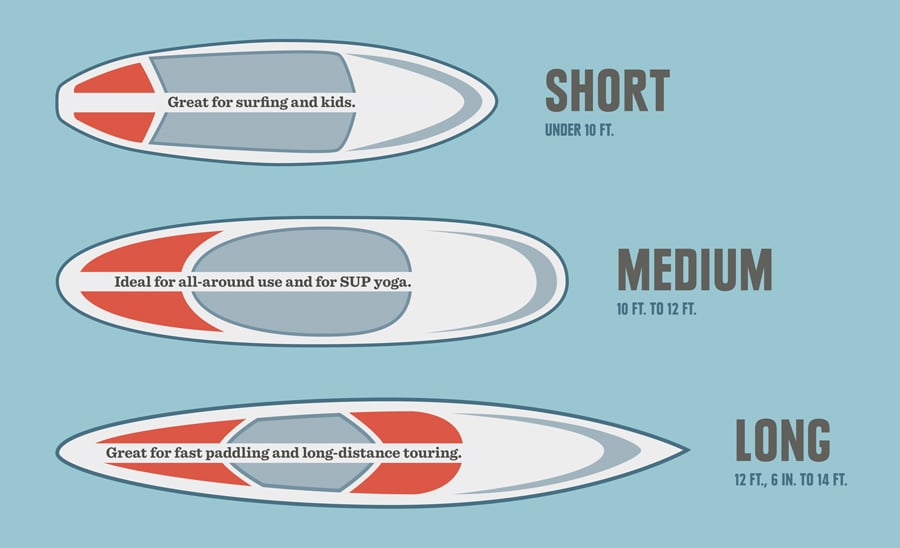
The length of a board plays a major role in determining how the board handles. In general, longer boards are faster than shorter boards, but shorter boards are more maneuverable. Keep in mind your intended use when deciding what length SUP to buy:
Short boards (under 10') are great for surfing and/or kids. These boards almost always have a planing hull. Short boards are more maneuverable than long boards, making them great for surfing waves. Boards designed specifically for kids are typically around 8' long.
Medium boards (10' to 12') are ideal for all-around use and for SUP yoga. Most of these boards sport hybrid or planing hulls, but sometimes you'll find a displacement-hull SUP at this length.
Long boards (12'6" and above) are great for fast paddling and long-distance touring. Most are displacement-hull SUPs. They're faster than short and medium boards and they tend to track straighter. If you're interested in paddling fast or touring long distances, you'll want a long board.
When choosing a length, it's helpful to understand how it relates to volume and weight capacity. A longer board can increase the volume and capacity, which can make it feel more stable and allow you to carry more on the board (width and thickness are also factors in volume and capacity; see the SUP Width and SUP Thickness sections of this article).
SUP Width

Width is another factor that affects how the board handles. SUPs range in widths from about 25 inches to 36 inches.
A wider board is more stable than a skinny board, but also can be slower. Too wide for you, and it can be difficult to paddle. When choosing the width of your board SUP should be, think about the type of paddling you do (i.e. short or long paddles, in flat water, on rivers, or on the ocean), your body type and ability level:
Type of paddling: For long tours or trips with lots of cargo, choose a wider board for added storage and stability. For SUP yoga, consider a board that is 31 inches wide or more so you have room for poses. Narrower boards are faster and more maneuverable, making them the choice among racers and surfers.
Body type: Try to match the width of the SUP to your body type. In general, smaller paddlers may find narrower boards easy to paddle and balance on. Larger paddlers may want wider boards for added stability.
Ability level: Experienced paddlers may be comfortable on a narrower, faster SUP, while those newer to the sport may want a wider, more secure board.
SUP Thickness

After finding a board with the length and width that makes the most sense for you and your paddling style, consider a third factor: board thickness.
The thickness of a stand up paddle board affects the overall volume and weight capacity. Between two boards of the same length and width, the thicker board has more volume than the thinner one. The higher the volume, the more weight that board can support, and the more stable it will feel.
Here's how you might use thickness: Say you've determined you want a long, skinny displacement board for cruising fast on flatwater. If you're a small person, choosing a narrow board will keep the overall volume of the board lower so that you're properly weighting the board for the most efficient performance. If you’re a bigger person, choosing a thicker board will increase the overall volume of the board, keeping you out of the water enough to maneuver well.
The Parts of a SUP
Stand up paddle boards are composed of nine main parts:
Hull: Body of the board.
Nose: Front point of the board, which is rockered upwards to a certain degree to cut through waves.
Tail: Back point of the board. This is where the leash is attached.
Deck: Top of the board.
Deck pad: A lightly padded area where you can sit, kneel, or stand to paddle.
Rails: Side edges that provide the thickness of the board.
Handle: Generally located in the center of the deck pad, this allows you to pick up and move the board.
Fins: Located at the tail underneath the board, fins help you with tracking through the water and stabilizing in currents.
Leash: Attaches you to your board if you fall overboard.
SUP Deck
The deck of a paddle board is the top surface of your board, including where your feet (or knees) will stabilize you on the board, and where you’ll store your gear.
Deck pad: This texturized rubber or foam surface gives you a slightly cushioned area to stand or kneel. This deck pad will also provide traction for your feet as you paddle, find your yoga pose, or pull yourself up onto your board after a swim. Deck pads are available in several designs like diamonds or chevrons to siphon water away from your feet for better traction.
On-board storage: Most SUPs come with a small storage area, usually made from a bungee cord strung through four D-rings. These bungee areas can be helpful for holding a spare paddle or PFD, but aren’t the most secure if you tip over with your board. Consider using a dry bag or clipping your waterproof items to the D-rings around your boat. For long-distance paddles, use webbing straps in a criss-cross formation through the D-rings of your boat to hold your gear together. Make sure to disperse the weight of your gear as evenly as possible for a smoother paddle. Some boards may even come with accessory mounts to attach a cupholder or phone stand as alternative mini-storage.
Here's how you might use different decks: If you plan to fish a lot, you may want a design with a dugout deck, where you can store your tackle and your catch. (These look like SUP-kayak crossovers.) If your feet or legs need more cushion to keep from aching, look for a thicker, more comfortable deck pad so you can stay out on the water longer.
SUP Fins
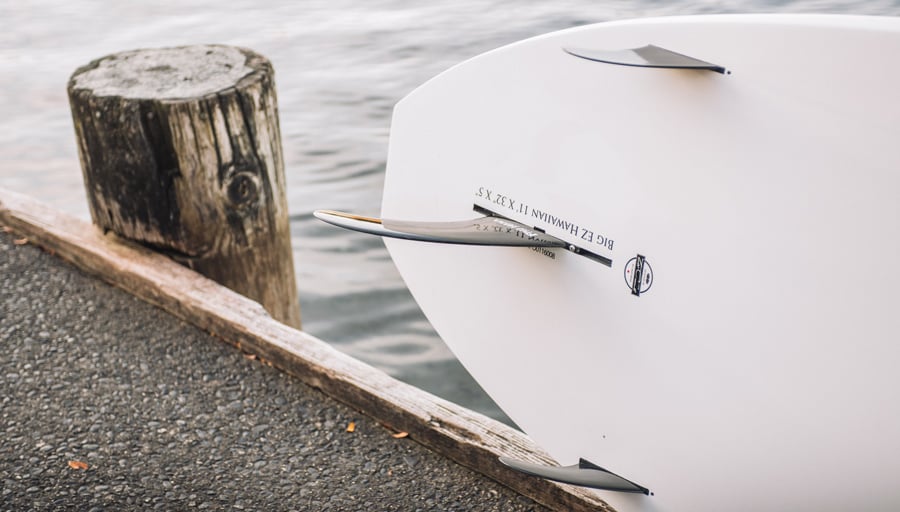
Most paddle boards sold today include kits with paddles, pumps and fins, either “permanently” attached or detachable. Some may even include multiple fins for different paddling conditions.
Fins add tracking and stability to a paddle board. In general, larger fins with wider bases and longer front edges will track straighter and provide more stability than smaller fins. On the other hand, a smaller fin provides better maneuverability. Most fins are removable, so you can swap out fins and take them off for storage.
There are many different options for how fins are configured on the bottom of your SUP. Some popular SUP fin configurations include:
Single fin: Many SUPs include a single fin placed in a finbox and secured with a nut and screw. The finbox has a channel for the fin to slide back and forth in. The single fin provides good tracking and minimal drag, making it a good choice for flatwater paddling.
3-fin setup: Also called a thruster, this setup promotes straight tracking on flatwater and offers good control in surf. All three fins are usually about the same size.
2+1 setup: This configuration includes a larger center fin with a smaller fin on each side of it. This is a common setup on SUPs designed for surfing.
Fins for inflatable boards: Inflatable SUPs can have any of the fin configurations already listed. What sets them apart is that they feature either flexible rubber fins attached to the board or detachable semi-rigid fins.
SUP Paddle
A SUP paddle looks a bit like a stretched-out canoe paddle with a tear-drop-shaped blade that angles forward for maximum paddling efficiency. The correct length paddle will reach up to your wrist when you stand the paddle up in front of you and raise your arm above your head.
According to Gary Call, an avid SUP racer and REI retail specialist based in Southern California, and Wendell Nelson, an REI store manager in the LA area, a SUP paddle is a more important purchase than the actual paddle board. Call compares the importance of a well-matched paddle to that of ski boots—you can test out all sorts of different skis for different conditions, but at the end of the day, you want to own a pair of ski boots that work well, stay comfortable and provide the support you need to stay on the slopes. SUP paddles are no different: You will paddle a hundred strokes before you adjust your foot placement. If your arms are sore from paddling with a wrong-sized paddle, you’ll want to head back to land, no matter how comfortable and stable your board might be. Put simply: You can buy the best board out there, but without a good paddle you won't get very far.
You can learn more about how to choose SUP paddles in this article, but here are the basics:
Length: Finding the right size paddle is key to maintaining proper paddling form and efficiency. There are great adjustable-length SUP paddles available if you want flexibility or the ability to share, but keep in mind, sand, silt and saltwater can damage the adjustability features.
Material:The materials used in SUP paddles determine weight and stiffness. Generally, a lightweight paddle is preferable because it saves your arms from extra fatigue, but keep in mind that you usually pay more for lightweight paddles.
Blade size, shape and offset: A paddle blade’s size, shape and offset (how much it angles forward from the shaft) determine how the blade moves through water. Choose a blade based on the type of paddling you do, your body type and personal preference. In general, the larger you are, the bigger you'll want your blade to be.
Transporting SUPs to Water
Most SUPs have a carry handle located at the center of the board. This makes carrying the board straightforward. If you’re carrying your SUP with a buddy, each of you can grab one end of the SUP (avoid carrying by the bungee cords) and make your way to the water.
Here's how to carry a paddle board:
Stand the board up on its side so the deck of the board is facing away from you and the nose is facing forward.
Tuck your paddle between the board and the arm that is carrying the board. This will leave you with a free hand and fewer items to catch on other objects.
Reach over the top edge of the board to grab the carry handle and lift.
Be ready for wind. A strong crosswind can toss your board around when you pick it up. If you can, point your board into the wind while carrying it.
If it’s difficult, consider a cart. Several SUP manufacturers have produced carts with wheels, like those for kayaks, to transport your board to the water more easily and adaptively.
For more tips on transporting SUPs, check out our article, How to Transport a Stand Up Paddle Board.
SUP with Dogs and Kids

When you’re feeling confident with your paddling abilities (and stability) on your board, it opens up a new world to explore with your dog and kids. The difficulty level will increase when you bring a companion on board, but the key to a successful paddle with your canine or children is growing their confidence step by step.
Make sure your board’s weight limit can handle your companion.: If you are already close to your board’s weight limit, it will be much more difficult to paddle with an extra body. When considering a board and if your goal is to paddle with a partner, make sure you account for that in the length, width and volume that contributes to the weight limit.
Keep them in a PFDs.: Slips and tumbles off a paddle board can happen any time, but especially with kids and dogs. Read more about choosing child PFDs in our article, How to Choose PFDs (Life Jackets) for Kids.
Practice on shore and in shallow water.: Familiarize kids and canines with your SUP on dry land. For dogs, rewarding a good sit/lay/stay on a beached paddle board will reinforce positive interaction with the board. (Make sure you have good treats on hand!) Graduate to sitting on a paddle board in shallow water with your SUP companion to make sure they’re comfortable with balancing. Start with small trips out and back while everyone gets used to the motion.
SUP Extras and Accessories
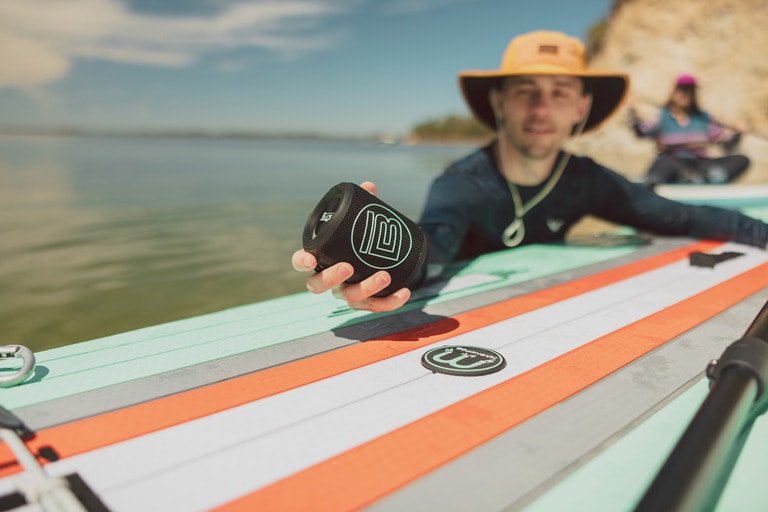
Depending on how you plan to use your SUP, you might want to look for a board with extra features, such as:
Bungee straps/tie-downs: Sometimes located on the front and/or rear of the board, these stretchy straps or tie-down spots are great for securing dry bags, clothing and coolers.
Attachment points/mounts: Some boards have specific attachment points for fishing-rod holders, seats, cameras and more. These accessories are typically sold separately.
Inflatable seats: Some boards feature one or more inflatable seats. These seats attach to your board via webbing straps at tie down locations in the middle of the paddle board’s deck, giving you a comfortable seated option if conditions are choppier, you want to fish from your board or you prefer sitting.Tandem paddle board: If you want to paddle with your kids, a first-time paddler, or even your best canine companion, a double-seater or tandem SUP might be a great option. These boards are generally longer and wider to accommodate two paddlers.
After purchasing a SUP, you need just a few more key pieces of equipment to enjoy paddle boarding. These include:
PFD (Personal Flotation Device): The U.S. Coast Guard classifies stand up paddle boards as vessels (when used outside the narrow limits of swimming or surfing areas), so it is required that you wear a PFD. Learn more in our article, How to Choose PFDs. Note that the regulations also require you to always carry a safety whistle and have a light available if you are paddling after sunset.
Proper clothing: For cool conditions where hypothermia is a concern, wear a wetsuit or dry suit. In milder conditions, wear shorts and a T-shirt or bathing suit—something that moves with you and dries quickly. Packing extra layers in a dry bag is always a good idea.
Emergency/repair kit: Keeping a repair kit for your board (usually with an extra bungee cord, patch kit for rips or punctures and extra valve cover to keep water from entering an inflatable board) is a wise idea. A small emergency first aid kit is also smart; you may bump or scrape your limbs on the water, too!
Dry bag: Keeping your keys, phone, repair kit and extra layers in a dry bag is a smart move. Most dry bags can clip to a D-ring or the bungee cords on your board; if not, use a carabiner to attach it to your board.
Leash or other paddle board accessories: Typically sold separately, a leash tethers your SUP to you, keeping it close by if you fall off. Your SUP is a large flotation device, so being attached to it can be important for your safety. There are leashes designed specifically for surf, flatwater and rivers; be sure to purchase the correct one for your intended use.
Car rack: If you have a solid board or you want to transport a fully inflated board, you’ll need a way to transport your SUP on your vehicle. There are specific SUP racks designed to go on the crossbars of your roof rack, or you can use padding, such as foam blocks, and utility straps to secure the board to the roof of your vehicle. Make sure you do not try to attach your paddle board to a car just by running utility straps around the board and through your windows; SUPs act like kites on top of cars, and can fly off easier than you think! Learn how to transport SUPs safely in our article, How to Transport a Stand Up Paddle Board.
Our Experts
Gary Call, an REI retail specialist and avid SUP racer based in Southern California, spends as much time in the waves with his dogs, grandkids, and SUP buddies as he can.
Josette Deschambeault Rolfe, a former program supervisor for local experiences based in New England, led SUP tours around Boston, paddled the Inside Passage and guided rafting tours in Southeast Alaska, and ran whitewater rivers all around the American West on SUPs and rafts. When she’s not on the water, she’s looking for the next great campsite with her husband and dog.
Michaela Jones, a program coordinator for local experiences, taught kayaking through the University of Maryland prior to joining the co-op staff. She is an American Canoe Association Level 2 kayaking instructor.
Joe Pasteris, longtime REI Expert Advice editor, is now a freelance writer based in Vermont.