It's a wired, wired world out there. If you plan to explore it with your must-have gadgets like a cellphone, tablet, action cam and more, you need to figure out how to plug each of them into the local power grid. Because so many countries—and even regions within countries—developed their own electricity standards, it's safe to say that diversity reigns out there.
Here are the steps to figure out if you need an adapter or converter while traveling:
- Verify the plug type that fits outlets at your destination.
- Get the correct adapter plug for that outlet. This isn't needed if you're headed to a destination that has U.S.-compatible outlets.
- Verify the voltage in the outlets at your destination.
- Verify the voltage input on each of your devices. Look for this info on its cord, plug or somewhere on the device itself.
- Get the correct voltage conversion accessory: This isn't needed for dual-voltage devices (many are) or if your single-voltage device matches your destination's voltage.
Before you go, check with your travel company or lodging providers:
- Ask about specific electricity needs at your destination.
- Ask if plugs (or voltages) used in nearby regions or businesses differ from the outlets at your lodging.
- Ask if they provide appliances like hair dryers, which can be challenging.
World Plug Types

Your first challenge is to be sure that you can plug your device into the wall outlet. The good news is that more than 50 countries around the world have outlets that accept U.S.-style "A" plugs.
In places where the plug type differs, you'll need an adapter plug that has the correct prong configuration for outlets at your destination.
According to the International Electrotechnical Commission (IEC), there are 14 different plugs (Type A through Type N) used around the world.
Plugs and Electrical Information for Common Destinations
Country | Plug(s) | Voltage | Frequency |
Africa | |||
Botswana | D,G,M | 230 V | 50 Hz |
Egypt | C,F | 220 V | 50 Hz |
Kenya | G | 240 V | 50 Hz |
Namibia | D,M | 220V | 50 Hz |
South Africa | C,D,M,N | 230 V | 50 Hz |
Tanzania | D,G | 230 V | 50 Hz |
| |||
Asia and Southeast Asia | |||
China | A,C,I | 220 V | 50 Hz |
India and Nepal | C,D,M | 230 V | 50 Hz |
Indonesia | C,F | 110 V, 220 V | 50 Hz |
Japan | A,B | 100 V | 50 Hz, 60 Hz |
Thailand | A,B,C,F | 220 V | 50 Hz |
Vietnam | A,C,F | 220 V | 50 Hz |
| |||
Australia and New Zealand | |||
Both countries | I | 230 V | 50 Hz |
| |||
Europe | |||
Croatia, Germany, Greece, Netherlands, Portugal, Spain | C,F | 230 V | 50 Hz |
France | C,E | 230 V | 50 Hz |
Italy | C,F,L | 230 V | 50 Hz |
| |||
Iceland and Scandinavia (Denmark, Finland, Norway, Sweden) | |||
Denmark | C,F,E,K | 230 V | 50 Hz |
Iceland, Finland, Norway, Sweden | C,F | 230 V | 50 Hz |
| |||
Ireland and the United Kingdom (England, Scotland, Wales) | |||
All countries | G | 230 V | 50 Hz |
| |||
South America and Central America | |||
Argentina | C,I | 220 V | 50 Hz |
Belize | A,B,G | 110 V, 220 V | 60 Hz |
Brazil | C,N | 127 V, 220 V | 60 Hz |
Chile | C,L | 220 V | 50 Hz |
Costa Rica and Ecuador | A,B | 120 V | 60 Hz |
Peru | A,B,C | 220 V | 60 Hz |
Below are some common plug types:

To research the plug(s) you need for any destination worldwide, check out the IEC World Plugs List, which is broken down country by country. For countries that list multiple plug types, advice from your travel company or lodging provider can narrow your choices. Or you can play it safe and get adapter plugs for all the listed plug types for a country.
Universal outlets: Some hotels and other businesses have outlets designed to accept plugs from multiple countries. If your lodging has a universal outlet that's compatible with your native plug, that can forgo your need for an adapter plug. If your itinerary takes you to a nearby business or another hotel that doesn't have that type of outlet, though, you still need to get an adapter plug.
Adapter Plug Shopping Tips
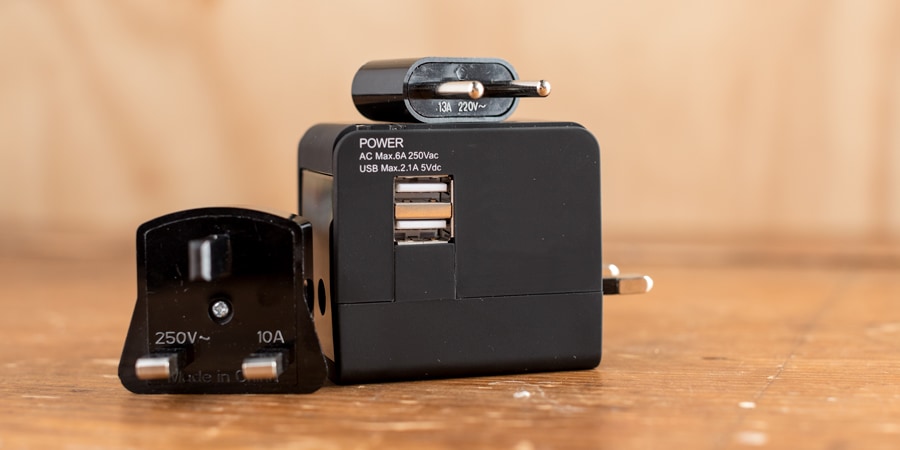
Buy adapter plugs before you leave. Why chance it that you won't find what you need at your destination, and why waste precious travel time on a quest for adapters? If you forget, though, big international airports are a good place to look for them.
Pay attention to the back side of adapters. You have to be able to plug your device into the back side of an adapter plug. Some might have an outlet designed to accept a few different plug types. Some adapters also include USB ports.
Examine adapter plug sets and universal adapters carefully. Don't assume a set of adapter plugs or a universal adapter will cover you everywhere. Double-check that they have the specific plug or a setting that works where you're going.
Strategies for multiple devices: To plug in more than one device at the same time, you can buy an adapter plug for each device and plug each one into a separate outlet. Or you can buy a single adapter plug and a power strip with multiple outlets. Though it's bulkier and pricier, a multi-outlet surge protector is even better, because it adds a level of protection for places with less stable electrical grids.
World Voltages
The world runs in two voltage ranges: 110-127V or 220-240V. If your device falls within either range, variations within that range won't be a problem for short-term use. If the local power is 110V, for example, and your device lists its input at 125V, it will work. If you're planning to live in a country for several months or more, then replacing your device with one purchased locally (for an exact voltage match) is worth consideration.
Your next step is to check the voltage (V) at your destination(s). That info is also on the IEC World Plugs List, listed in the "Electric Potential" column.
Now check the voltage requirements for each of your devices. Look for the input voltage (typically in tiny type) on the plug or power cord; it might also be on the device itself. You can also consult the user's manual. A lot of devices nowadays, like tablets, laptops and cellphone chargers, are engineered to run within either voltage range.
If you see "Input: 110-240V," then your device has dual-voltage capability and no voltage conversion is needed.
Voltage Conversion Accessories
If you have a single-voltage device—and that voltage differs from the voltage level at your destination—then a voltage conversion accessory is the solution. This is where things get tricky, though, and some additional terminology is in order:
Electronic Devices
Most of your gadgets fit this definition—they operate with circuits, chips or electronic motors. Examples include cellphones, laptops and digital cameras.
To convert voltage for an electronic device, you need a voltage converter that is classified as a "transformer." A transformer converts voltage in a way that electronic devices can handle. A simpler (non-transformer) converter does not.
High-Wattage Devices
Wattage (W), a measure of electric power, is not a concern unless you bring a high-wattage device like a hair dryer, heating pad or coffee pot.
Look for the wattage rating (typically in tiny type) in the same places as the voltage rating: on the plug or power cord; it might also be on the device itself. You can also consult the user's manual. As a last resort, you can calculate watts (W) by multiplying voltage (V) by the amp (A) rating because most devices do list amps. High-wattage devices will use 1200W or more.
To convert voltage for a high-wattage device, you have to use a voltage converter that has a wattage rating greater than the wattage rating of that device. If a converter or transformer is described as a "dual-watt" accessory, it will probably handle the load, though you should double-check its high wattage setting to be sure.
Low-wattage circuits: Some countries limit bathroom circuits to 5-10W maximum. If you learn from your travel company or lodging staff that your destination is one of those countries, then ask if they provide a hair dryer or whatever device you planned to use. If not, either plan to forgo that device or to buy one locally.
Additional Power Questions
What about Hertz (Hz) ratings? This measures the frequency at which electric current alternates. The world runs in one of two electricity frequencies: 50Hz or 60Hz. It's not a concern unless you have a clock or a device where the clock function is critical. Most devices are designed to accommodate a range of frequencies; the power label on that type of device will say "50-60Hz."
What about outlets that are grounded (have 3 holes) or polarized (have 2 different-size holes)? Just as electricity standards differ throughout the world, so do regulations relating to these safety features that guard against the electric shock. By always using an adapter plug that precisely fits your device's plug on the back and the foreign outlet on the front, you'll enjoy the greatest possible protection for you and your device.