A good-fitting sports bra minimizes breast movement, prevents excessive bouncing and doesn't distract you from pursuing your favorite activity. But a bra that doesn't fit well can be a drag—it can lead to soreness, chafing, pain or even soft tissue damage. For some women, such pain or discomfort can also be a real barrier to exercising.
Sports bra fitting is not an exact science, but we'll give you tips on how to find the right sports bra for your size and activity. Because bra sizing is inconsistent across brands with no universal standard, make sure you try on several brands, sizes and styles in a store until you find the one that feels right for you. An REI sales associate at your nearest store can help you, or contact us via live chat or by phone.
How to Find a Sports Bra for Any Activity
To find the proper level of bra support, first consider the type of activity you'll be doing. Sports bras are designed to provide three levels of support—low, medium and high—depending on the impact level of the sport. The higher the impact (more bouncing, jumping or intense movement), the more support you'll likely need. Many brands categorize their sports bras by impact level, making it easier to sort out.
For high-impact activities such as running, mountain biking or aerobics, you'll want more support to prevent excessive breast movement, which can lead to pain and discomfort. For low-impact activities such as yoga or walking that involve less intense movements, you may not need as much support. Women with larger busts, however, may want to consider having more support even when doing low- or medium-impact activities. Ultimately, the best sports bra will be one that fits well, feels comfortable and suits your personal style and preferences.
Support | Activity | Typical Features |
|---|---|---|
Low-impact activities:
Ideal for A/B cups |
| |
Medium-impact activities:
|
| |
High-impact activities:
Ideal for D cup or largerfor most activities |
|
You may need several sports bras for different activities - some with more support for high-impact activities such as running and less constrictive bras for low-impact activities such as yoga or walking. Rotating between several sports bras can also extend their use.
How to Find Your Sports Bra Size
Sports bras may fit slightly snugger than your everyday bras, but your size is likely the same. Do not size down in your sports bra purchase. Calculate your bra size each time you purchase a new sports bra. Your bra size will change several times over your lifetime. Body changes such as weight loss or gain, pregnancy, hormones and aging will affect bra size.
If you haven't measured yourself lately, we provide a basic guideline below. Consider it as a starting point.
You'll need a soft tape measure to get started. Wear a non-padded bra that doesn't change the shape of your breasts—or measure while not wearing a bra.
1. Measure your rib cage
Measure around your rib cage just under your bust. Round down to the closest inch. This is your rib cage measurement, which you'll need to figure out your band and cup size.
2. Figure out your band size
Take your rib cage measurement from step 1 and read across the chart below to find your band size.
Sports Bra Band Size Chart
| Rib Cage Measurement | Band Size |
|---|---|
| 25" - 27" | 30 |
| 27" - 29" | 32 |
| 29" - 31" | 34 |
| 31" - 33" | 36 |
| 33" - 35" | 38 |
| 35" - 37" | 40 |
| 37" - 39" | 42 |
| 39" - 41" | 44 |
3. Figure out your cup size.
This is a two-step process:
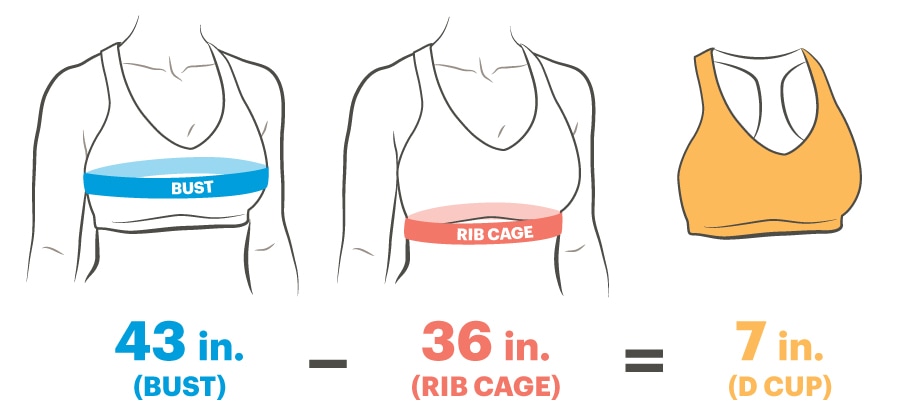
- First, measure around the fullest part of your bust. Keep the tape straight across your back. Round up to the nearest whole number. This is your bust measurement.
- Now, subtract your rib cage measurement (step 1) from your bust measurement (step 3). The difference in inches is your suggested cup size. If you're between sizes, round up.
Sports Bra Cup Size Chart
| Bust Size Minus Rib Cage Size | Your Cup Size |
|---|---|
| 3" | AA |
| 4" | A |
| 5" | B |
| 6" | C |
| 7" | D |
| 8" | DD |
| 9" | E |
| 10" | F |
Measurement guidelines provided by Brooks.
Here's an example:
[Bust measurement 43 inches] - [rib cage measurement 36 inches] = difference of 7 inches, so D cup.
How to Ensure a Sports Bra Fits Well
Now that you've figured out your estimated band and cup size, it's time to try on several different brands and styles of sports bras to test the fit. If possible, do this in person at a store.
If you're shopping online, we recommend viewing the size chart attached to the specific bra that you are interested in to know what size may work for you. (On REI.com, you'll typically find each brand's size chart next to the bra.)
Your sports bra should fit slightly snugger than your everyday bra, but you should be able to breathe deeply and comfortably.
Here are tips to make sure your sports bra fits:
1. Start by fitting the band
The band of the sports bra does most of the work in supporting your breasts so make sure it sits snug around your rib cage (not on breast tissue). For the best fit, you should be able to fit two fingers between your body and the band but not more.
Raise your hands over your head and turn sideways in a mirror. If the band is higher in the back (rides up or isn't level) or your breasts poke out below, it's likely too big. Try a smaller band size. If you have a hook-and-loop closure, try a smaller hook.
Tip: Wider bands typically provide more support than narrow ones. Hook-and-loop closures allow greater support and a customized fit.
2. Next, adjust the straps
Your straps should feel secure and comfortable and provide minimal stretch to reduce up-and-down movement. You should be able to fit two fingers between the straps and your shoulders.
If the straps dig into your skin, they're likely too tight. If the straps slip off your shoulders or you get a lot of bounce, the straps are likely too loose.
Tip: Adjustable straps provide greater support and a customized fit. Wider straps better disperse weight and offer greater comfort than narrower ones. Thinner straps generally provide less support but they're easier to conceal. Read more about strap styles below.
3. Check the cups
Your breasts should be centered and fully contained in the cups. Scoop your breasts into the cups and center them. If you see wrinkles or gaps in the fabric, the cups are likely too big. If your breasts spill outside of the bra, the cups are likely too small—or the style of bra is the wrong cut for your breast type. For the greatest support, your breasts should be completely covered.
4. Test the support
Test the bra's support by jumping or running in place. Your breasts should feel secure and supported. If there's too much movement up and down or side to side, keep looking for a better-fitting bra.
The search for the right bra can be a daunting one. Read how one woman looked long and hard for the right one.
How to Prevent Chafing
Bra chafing—when your bra rubs against your skin in uncomfortable ways—can be painful. You can prevent chafing by ensuring that you get a proper sports bra fit. Make sure there is no chafing under the band, underarm openings or under the shoulder straps.
Chafing results from friction, which can be caused by a number of factors such as a poor fit, an older bra, excessive sweating, sensitive skin or exercising in hotter climates. Chafing can also be an issue on longer workouts.
Here are some ways to deal with chafing:
Ensure a good fit
- Retire an older bra
- Apply an anti-chafing balm before wearing your sports bra
- Find the bra with the softest band
- Rotate different styles for high-impact activities
Sports Bra Construction
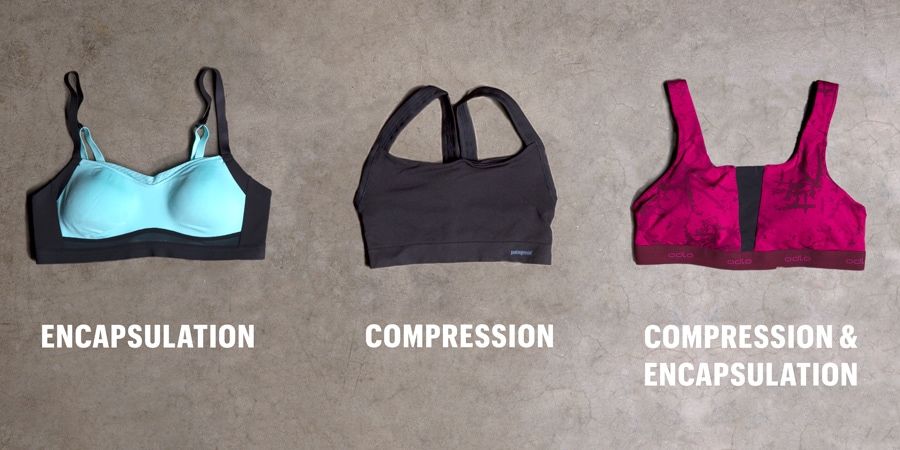
Sports bras minimize breast movement through several approaches.
Encapsulation sports bras: These bras use individual cups to surround and support each breast separately. There is no compression in these bras (most everyday bras are encapsulation bras) making them generally best for low-impact activities. Encapsulation bras provide a more natural shape than compression bras.
Compression sports bras: These bras typically pull over your head and compress the breasts against the chest wall to restrict movement. They do not have cups built into the design. For A-B size cups, compression sports bras without adjustable bands or adjustable straps can work for low- to medium-impact activities. For C-DD cups, compression sports bras should have adjustable bands and straps for proper fit and can provide medium to high support.
Compression/encapsulation sports bras: Many sports bras combine the above methods to provide support and natural shaping. These bras offer more support than compression or encapsulation alone, because each breast is supported individually in the cup and also compressed against the chest wall. For A-B cups, these bras may have adjustable bands or straps and are good for low to high impact. For C-DD cups, these bras should have adjustable bands and adjustable straps for proper fit and are excellent for high impact.
Sports Bra Features
Adjustable straps offer the most customized fit and are often found on encapsulation or encapsulation/compression-style sports bras. Bras with adjustable straps may also last longer since you can tighten the straps as the bra ages and stretches over time.
Back closure: While most sports bras are pulled on over your head, some have a back closure with hooks. In addition to being easier to get on and off, this type of sports bra allows you to further adjust the fit. When fitting a new sports bra, use the loosest hook. That way, when the bra inevitably stretches out, you can still tighten it up and the bra will last longer.
Underwire: Underwire in a sports bra supports each breast individually and can help to minimize movement. The underwire should lay flat against your rib cage, below the breast tissue, and should not poke or pinch.
Wicking fabrics move moisture away from your skin and keep you comfortable. All sports bras will be made from wicking fabrics—polyester or even wool blends.
Sports Bra Strap Type
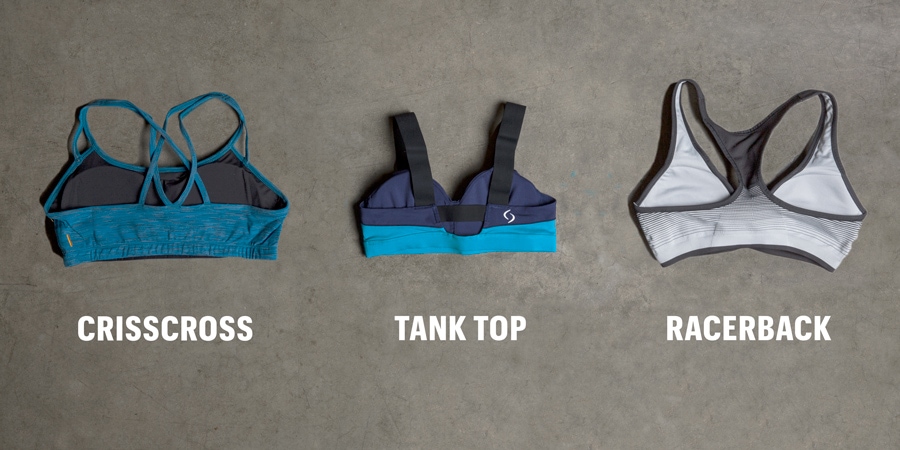
Regardless of the strap type you choose, keep in mind that thin straps generally provide less support than wider straps, but thin straps are easier to conceal.
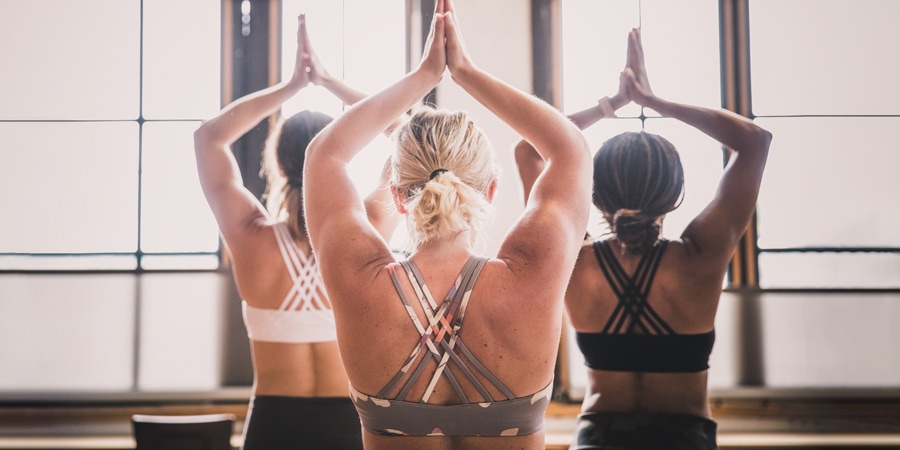
Crisscross: These straps crisscross in back and are more often found on low- or medium-support bras. Crisscross straps provide less support compared to other strap styles. The straps are often adjustable so you can fine-tune the fit. Depending on the style, crisscross straps can hide nicely underneath a sporty tank top or make their own fashion statement.
Tank top: This strap style is most similar to an everyday bra. The straps are often adjustable so you can fine-tune the fit. Bras with tank top straps often have a back closure, which offers additional adjustment. Some tank top bras are designed to allow the straps to be crisscrossed for versatility.
Racerback: Sports bras with a racerback have shoulder straps that come together between your shoulder blades to create a Y shape. Racerback bras provide good support for medium- to high-impact activities and allow for a full range of motion. Some people may not like racerback straps because they feel it puts too much pressure near their necks. Racerback straps hide well underneath a racerback tank top.
Combination: The straps on these sport bras can be adjusted or converted between styles, whether worn in a vertical, crossback or other configuration.