What matters most when choosing a snowboard? Other than the graphics (a big deal, we know), it's compatibility. How well a snowboard meshes with your riding style and experience level impacts the fun factor you will enjoy when riding it.
The better you understand yourself as a rider, the more success you'll have choosing the right snowboard for you.
Three key factors are:
Every rider is different, and to each individual 1 of these factors may significantly outweigh the others. But all 3 merit some thought as you mull over your snowboard options. This article goes over the details of each consideration:
Seek out a snowboard well-suited for where and how you usually ride. Traditionally snowboards and skis have been categorized by ability level: beginner, intermediate or advanced. No more. Today, snowboards should be selected to be compatible with the terrain a boarder usually rides.
Accordingly, REI categorizes snowboards as follows:
All-mountain: Designed for exploring any terrain, from groomed runs to untracked backcountry to the park and pipe. This category is sometimes also referred to as all-mountain/freestyle. Because of their versatility, the vast majority of boarders (perhaps 90%, and 99% of novices) ride all-mountain boards.
Freestyle/park: These boards are made for the halfpipe, rails, boxes, jumps, spins and tricks—the right tool for anyone who wants to push their limits within terrain parks. These boards (true twins or directional twins) are often lighter and shorter than other snowboards and sometimes more flexible. Some manufacturers lump freestyle and all-mountain boards into the same category.
Note: Many freestyle/park boards are designed with rocker (also known as reverse camber), which indicates an upturned nose and tail. Rocker is usually beneficial in the park (though not in the halfpipe), making it easier to navigate boxes and rails. Rocker is a relatively new and fast-evolving technology that is explained in detail later in this article.
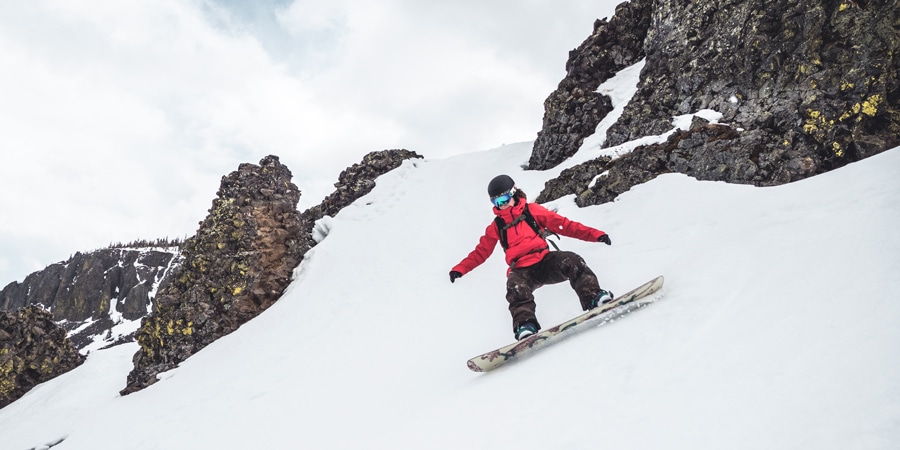
Freeride: For riders principally attracted to off-piste (backcountry) terrain plus traveling fast on groomed runs. Freeride boards are designed for directional (downhill) riding only. They are typically stiff and not intended for terrain parks or jibbing (which is riding on snowfree surfaces, such as rails and logs).
Powder: Often considered a subset of freeride boards, powder boards typically offer a wide nose and often feature rocker. Rocker allows powder boards to float almost effortlessly in soft snow.
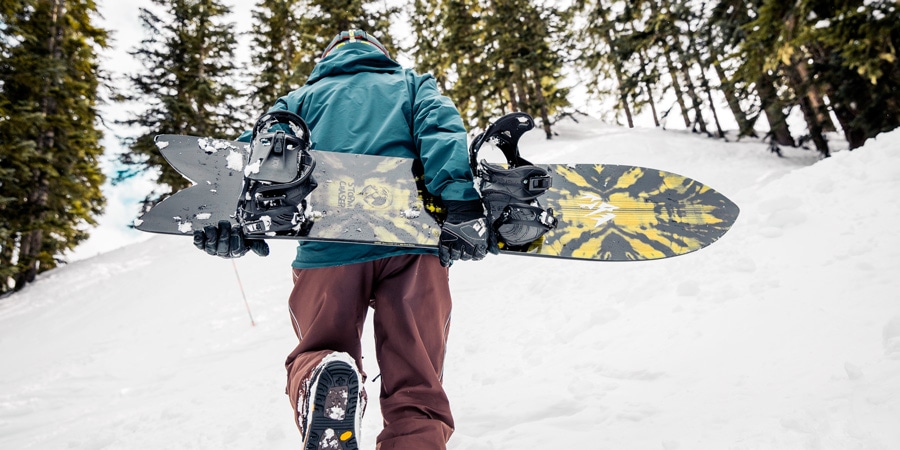
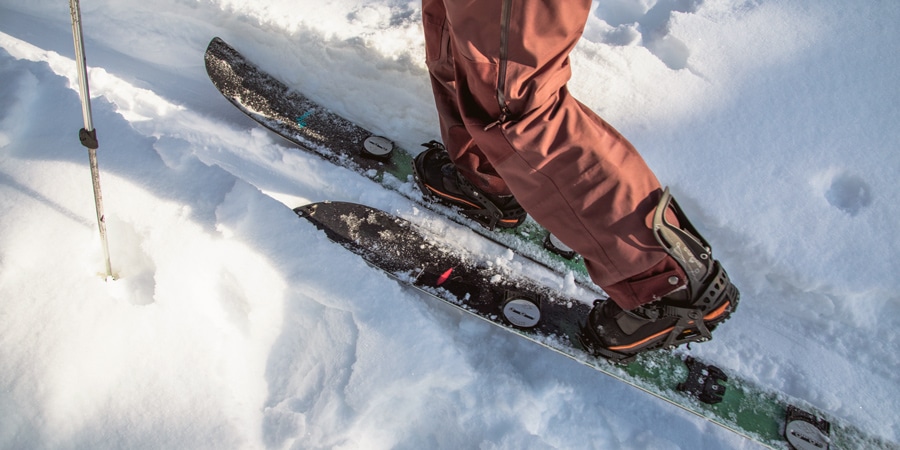
Splitboards: Engineered for self-propelled backcountry freeriders, splitboards can split in half to accommodate uphill climbs, then be reconnected for downhill rides. Traction-boosting climbing "skins" must be attached to the 2 separate boards while making uphill treks.
Other specialty boards (wides, women's and kids) are explained in the Types of Snowboards section below.
Snowboards offered at REI start around $300 and move up. Lower-price boards exist, though they typically lack the craftsmanship or performance attributes found in a higher-quality board. Thus at the risk of initially appearing pricey to shoppers, REI specializes in higher-quality boards, believing they deliver riders with a better overall experience and a longer-term value.
"My first experience with snowboarding was horrendous because the rental board I was using was sub-par," says Dane Tullock, a former snowboard instructor who today is a snowsports specialist at REI Boston. "A true baseline board, or one that is not properly suited to a person, can really adversely affect a beginning rider's experience.
"Many times it's a disservice to recommend low-end boards to new riders even though they have cost concerns," Tullock says. "It's likely they'll be back in 1 or 2 seasons to buy a more advanced board. So typically I'll encourage new riders to look into boards that they can grow into as their skills improve, even if that means deferring a purchase until they can afford a better board."
In general, higher-price boards include quality materials, more sophisticated designs and subtle refinements that boost performance and longevity. Bargain boards may look fine inside a discount store, but cost-saving shortcuts used in their construction usually become apparent on a mountain.
Low-cost foam-injected cores, for example, can keep a board's price down but also diminish its responsiveness. (Note: REI does not sell boards that use foam-injected cores.) An extruded base costs less but typically lacks the durability of a sintered base. A sintered base, of course, is higher maintenance, requiring regular waxing.
Some additional points to consider:
"Almost everyone can tell the difference between entry-level boots and high-end boots," says Pat Kennedy, a snowsports whiz at the REI in Bellingham, Wash. (near Mt. Baker Ski Area, an under-the-radar boarder's paradise). "Be sure you love your boots; sore feet can ruin great days. Save money on the board and put a little extra into boots and bindings."
As explained earlier, snowboards today are categorized by terrain preferences (all-mountain, powder, freeride, whatever) and no longer by ability level (beginner, intermediate, advanced). Your experience level, though, can influence your snowboard choice.
Experienced riders are informed riders who over time have learned what matters most to them in a board. These are the people who benefit the most from fussing over a snowboard's performance characteristics and technical details (many of which are explained later in this article). If you are an experienced rider, seek out a board that offers design features most compatible with your strengths, tendencies and quirks.
If you are a novice or casual rider, your primary objective is to pinpoint your usual riding style (and most often it is all-mountain). From that point you can choose pretty freely among the choices offered within that category and expect to be satisfied with your selection.
A few pointers for people who are new to snowboarding:
Preparing for your first time on a board? Be ready for a challenge and stay positive. "The learning curve for snowboarding can be steep, and many new boarders find their first few times on the slopes to be challenging," says Tullock, a former resort instructor.
"Snowboarding can be difficult until you learn how to use and control edging. The difficulty is even more pronounced for people who have skied prior to trying snowboarding. The dynamics are vastly different. A skier has independent leg movement and is always facing downhill, torso aligned with feet. Snowboarding requires riders to frequently put their torsos at a 90° angle to their feet. That creates a completely different experience. New snowboarders, particularly people who have previously skied, often lean downhill and dig in a downhill edge. You'll frequently see them doing face-plants in the snow.
"I try to prepare customers for this, and when I see them again I usually hear something like, 'You were right. It was a real bear the first few times. But I stuck with it and now I love it.' I often suggest that novices take at least 1 lesson from an instructor connected with the American Association of Snowboard Instructors (AASI). That results in happier boarders."
REI salespeople are a good resource for hashing over your goals, gear options, budget and skills. If you need some one-on-one time with someone who shares your interest in snowboarding, visit an REI store or give our phone team a call (800-426-4840).
The following sections discuss additional factors that may play into your decision.
The assessments below describe the primary use of each board type, though most are not so strictly specialized that they cannot be ridden elsewhere on a mountain.
"Some boards can easily adapt to different terrain, depending on the skills of the snowboarder riding them," says Rob Krystofiak of REI Portland (Ore.), whose love for boarding spans more than 2 decades and has led him to ride faraway slopes in Chile and France. "Many boards have a combination of characteristics that can meet a range of rider demands."
All-mountain boards can adapt to just about any terrain. They may be directional (for riding regular, with the sidecut shifted toward the tail of the board) or twin tip (for riding regular or switch). See the Snowboard Shapes section later in this article. Their flex is forgiving, though not necessarily soft.
These directional boards are for anyone who seeks out backcountry terrain, riding in the steeps, chunder or powder, all at decent speed. (Chunder refers to irregular, sometimes large clumps of snow such as snowcat�debris.) They also perform well during fast top-to-bottom resort runs. They are usually at the stiff end of the spectrum and sometimes have tapered shapes (meaning a narrower tail) to increase carving performance. They deliver stability for high-speed cruising on hardpack and quick edge-to-edge control on technical terrain.
A note to freeriders: Whenever heading into the backcountry, even if just for a few powder turns in a resort's sidecountry before returning in-bounds, these points are essential:
These twin-tipped boards are easy to maneuver for tricks, aerial rotations and riding switch. Park boards are generally the softest and most maneuverable of all boards to accommodate jibbing. (Boards that perform well in the pipe are usually stiffer, which allows them to power through transitions.) Freestyle/park boards often feature heavy-duty edges and base treatments that can take a beating when riding rails, boxes, tree trunks and other snowless surfaces.
The National Ski Areas Association has created a "Smart Style" initiative to boost safety and a friendly atmosphere on freestyle terrain. It consists of 4 points:
While all snowboards excel in deep snow compared to skis, there are a few styles dedicated to riding in fresh, deep, unconsolidated snow. Powder boards generally offer directional shapes and usually have set-back mounting positions that put the rider's weight closer to the board's tail. Some powder boards feature an extra wide directional tip and a tapered shape, a combination that provides exceptional flotation. Other boards have a swallow tail, which drives the tail down while it keeps the nose floating on top of the bottomless fresh. Many powder boards are designed with rocker (reverse camber) to increase flotation.
These backcountry-specific boards split into a left and right half in order to permit climbing on untracked slopes, then can be reattached to ride downhill. Special, movable binding interface plates allow you to tour side-by-side with your telemark and randonee/alpine touring companions to access remote powder. You'll need climbing skins and a split kit, usually sold separately.
These expansive boards are wider from edge-to-edge at binding mounts to accommodate riders with larger feet. Some riders who covet an extra-large footprint for enhanced powder flotation may also take an interest in wide boards.
Men's boards are usually offered in the following widths:
Wider boards for women are gradually emerging. Women with a boot size of 10 or higher can take a look at the mid-wide Burton Feather.
The most common board modifications for women are narrower waists and softer flex. REI views its selection of women-specific boards as one of the most extensive available at any retailer. Some taller women, particularly those with a boot size of 9 or higher, may still find it useful to at least look at some boards in the men's category.
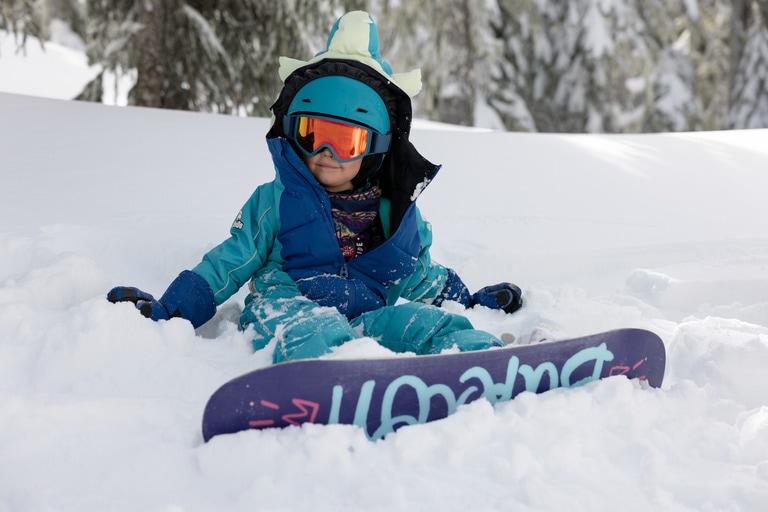
Kids grow fast, but as a parent, don't be tempted to buy an adult board hoping your child will grow into it. An oversized board can be unmanageable for your child and actually slow their development as a snowboarder. REI offers a Junior Snowsports Trade-In Program: Get 20% off new gear with every gently used like-item. For complete details, discuss the program with an REI sales specialist or call 800-426-4840.
Directional board: These all-mountain and freeride boards are wider at the nose (to enhance flotation), feature a sidecut that is shifted toward the tail (making it easier to initiate turns and carve) and a stiff tail. Overall, it results in a powerful, speed-friendly shape that excels on groomed runs.
True twin: The tips and tails of these soft, forgiving boards are the same size and the board is symmetrical. A centered stance makes it easy to ride them regular or switch. They're ideal for tricks and terrain parks.
Directional twin: They feature similar size tips and tails, but the tip is more flexible than the tail. Combined with a symmetrical shape, they are suited for all-mountain and freestyle/park riders.
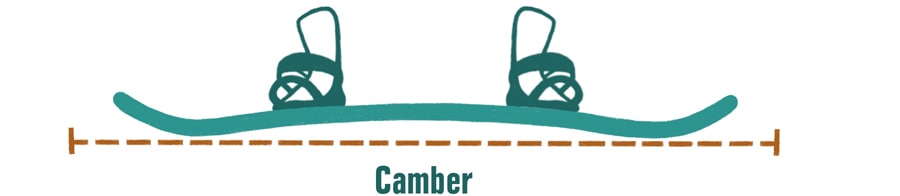
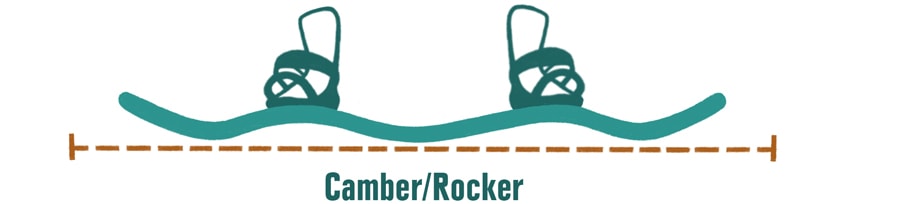
Camber (also known as positive camber or traditional camber) refers to the amount of space beneath the center of a snowboard when it is placed on a flat surface and its weight (minus a rider) rests on the tip and tail. This platform is the shape of traditional snowboards.
Camber creates powerful-feeling boards that can turn with precision. How? When a rider's body weight is applied, the board is flat to the snow and the full length of its edge makes contact with the snow. The result is a lively, stable, responsive ride that performs especially well on hardpack or groomed runs—where the majority of boarders ride. Yes, it is possible to jib on cambered boards. They are valued more, though, for their ability to track straight, power out of turns and provide lots of pop. They are often preferred by experienced, speed-oriented riders.
Rocker (aka reverse camber) is a recent and very popular innovation that creates the opposite shape in a board. When placed on a flat surface, a snowboard with standard rocker rests only on its center portion, similar to the way a rocking chair's curved floor rails rest only partially on the ground. The board's upturned nose and tail rise off the snow.
This design excels in powder, preventing tips and tails from sinking in soft snow so the entire board can float easily. Rocker-equipped boards also significantly reduce a rider's chances of catching an edge, enabling a more jib- and rail-friendly experience.
Boards with rocker are softer than cambered boards and often appeal to novice riders. Yet experienced riders can still coax powerful rides out of rockered boards.
Is one approach preferred over the other? Among some riders, this is a debate that has no end. Rocker, though, has flourished in popularity. Many nuanced variations of rocker have surfaced in recent years as manufacturers scramble to appeal to diverse rider preferences. They require a category of their own:
This is REI's catch-all category for platform designs that employ "alternate" camber or, much more commonly, modified rocker. Here is a look at just a few of the varieties:
Traditional snowboard sizing involves standing a board on its tail and ensuring that its tip reach somewhere near a rider's chin.
Freeride or backcountry riders may seek out longer boards (extending to eye-level and higher) because they float better in powder, are usually more stable at high speeds and do a better job of holding an edge in icy conditions. Park and recreational riders�usually prefer shorter boards (below the chin and above the shoulders) that are�easier to turn and spin.
A new sizing approach, matching boards to the weight of riders, has gained widespread acceptance. Most boards today include a weight chart that identifies recommended lengths. Links to charts can be found on individual snowboard product pages at REI.com. In point 1 of the selection process, to the right of the "Choose Your Color/Size" box, look for the green link, "Size Chart."
Both sizing techniques have merit, and different people may have different preferences.
Dustin Kingman, an REI product information associate editor and snowboarding zealot with more than 2 decades of experience, favors the tip-to-face approach. "Some shorter people carry higher-than-average body mass and by going by the weight chart alone, those people could wind up on boards a lot longer than they need," Kingman says.
Your usual riding style may also play a role in what length you choose. "In general, longer boards are faster and better suited for downhill and backcountry riding," says Dane Tullock of REI Boston. "Shorter boards turn easier and are better for park and terrain riding."
The widest points on a snowboard are at its tip and tail; the narrowest—at its waist.
Waist widths range from narrow to wide, and your choice of width can have performance implications. Yet your primary concern when pondering waist width is to ensure your boots don't overhang its edges. Otherwise you are vulnerable to the dreaded bane of toe and heel drag.
The best way to gauge appropriate width is to visit a store in person, place a board on the floor (a carpeted section) and step aboard, preferably while wearing your snowboard boots. Toes and heels should come close to a board's edge up to the point of adjacency. Overhanging should be avoided.
About those performance implications:
Narrower waists: Quicker and easier to turn. A good choice for novices and park riders.
Wider waists: Extra surface area creates more contact with the snow, offering stability and better flotation in powder. They're just not as nimble as narrow-waist boards.
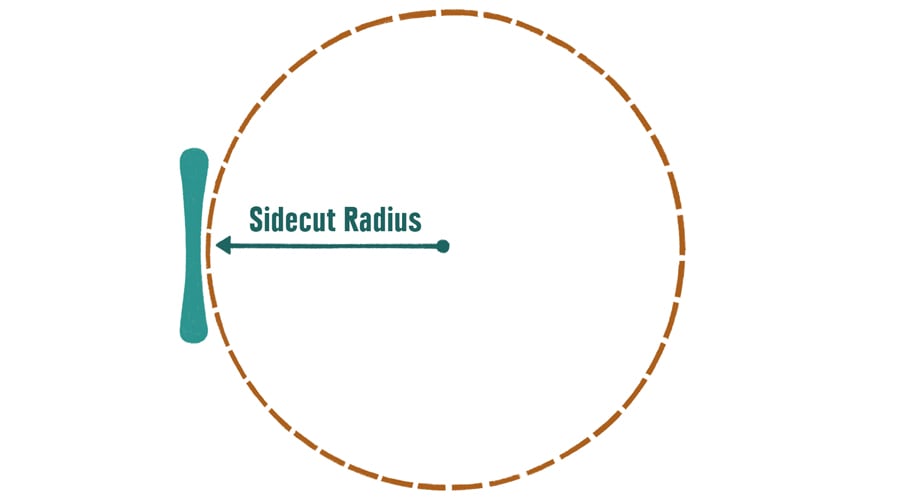
This specification, sometimes known as sidecut or turning radius, indicates a board's turning ability. Bottom line: The smaller the number (a measurement shown in meters) the quicker a board will turn.
Sidecut is the arc or curve created by the edge of a board. Imagine if that arc was extended until it formed a circle. A line drawn from the center of that circle back to the edge of the board determines its sidecut radius.
What kind of sidecut radius is better for you?
The edge of a snowboard features a metal strip running along its sidecut. This edge bites into snow and provides control and steering. A snowboard's "effective edge" is the section that actually touches the snow or ice throughout your descent.
Which is right for you? In general:
Edges need to be routinely sharpened for optimal grip while riding groomers or in the pipe. Deliberately dulled edges are best for jibbing and rail riding.
Some recent edge technologies have added extra bite into edges, usually adding small contact points at or near binding mounts. Examples: GNU's Magne Traction (which adds serrations in small edge sections); Burton's Pressure Distribution Edges (PDE); Arbor Grip-Tech Sidecut.
These designs offer edges that bubble out about a half millimeter near the bindings, creating a faintly wavy sidecut that has been described as "tri-radial" (3 different radii). The benefit: extra edge hold (without changing how the board feels), particularly when you need to cleanly slice through icy hardpack.
Choosing and refining stance characteristics (which involves width, angle, setback vs. center, and other considerations) is ultimately a matter of personal preference. These topics are reviewed in a companion article, Installing Snowboard Bindings.
Snowboards come equipped with some type of binding interface, most often as dual clusters of bolt holes on either side of the board's midpoint. Your options:
Most snowboards are composed of layers of wood, woven fiberglass and possibly other performance-enhancing materials. Slanted sidewalls box all components into place between the topsheet (which displays a board's graphics) and its base. The layers between the topsheet and base usually can only be seen if a board was cut in half and a cross-section of its interior was viewable.
This widely used layering approach is known as sandwich construction. Cap construction excludes sidewalls and simply wraps the topsheet around a board's edges. This is a less-expensive method of achieving similar though perhaps less-exacting results.
Three construction factors substantially influence a snowboard's performance characteristics and price: the flex of its fiberglass weave, core materials and base.
Flex refers to the give (receptiveness to twisting) a board exhibits. A board can flex 2 ways:
Longitudinal flex is along its length, which is of greater importance to most boarders. Torsional flex refers to flex across its width.
How can you test for flex when at a store?
What do these test twists tell you?
What makes a board softer or stiffer? Primarily, it's the weave and weight of the fiberglass cloth used to wrap the board's core. Manufacturers most commonly use 1 of 2 weaves:
Biaxial: A 2-way, horizontal-vertical grid pattern. This results in a softer, more forgiving board that can turn easily at slower speeds. This is the board type usually favored by beginners and park riders. It is often a lower-cost board.
Triaxial: A 3-way grid pattern. The extra reinforcement creates a stiffer board, the type often preferred by experienced riders seeking better control and stability at higher speeds. Stiffer boards (commonly found in the freeride category) quickly transmit a rider's energy to the board, are faster onto an edge and are more precise once there. Triax boards usually start around $400 and go up.
Other points of interest:
Wood (beech, poplar, even bamboo) is the material of choice for virtually all high-quality boards. It is long lasting, lively and proven. Wooden cores can be selectively reinforced with different types and weights of fiberglass, carbon fiber, aramid fibers or metals to improve or enhance specific performance characteristics, such as stiffness.
Some economically priced snowboards use synthetic materials rather than wood, while select high-end boards use high-tech cores such as honeycombed aluminum. Bargain boards typically use injected foam, though REI chooses not to carry such boards due to foam's low-grade performance and unpredictable durability. Manufacturers are frequently secretive about the exact composition of their core technologies.
Two common types of bases exist, both made from melted polyethylene (PE) beads (for extruded bases) or powder (for sintered bases):
The difference between extruded and sintered bases comes in production. Think of the 2 as cheeses. Extruded bases are the equivalent of spray-can cheese, formed into thin sheets. Sintered bases are more like a fine, custom-sliced cheddar.
Note: The material used to create and repair snowboard bases is routinely called P-Tex, but that is just a brand name of one type of polyethylene. Not all snowboard bases are made of P-Tex.
If you have read this far, your head may be spinning from information overload. Maybe what an industry insider shared with us will help simplify your thinking when it comes to a really important factor: price.
Snowboard prices are routinely determined by 3 key construction factors:
| Construction factor | Lower-cost board (to $400-$450) | Upper-range board ($400+) |
| Fiberglass weave | Biaxial | Triaxial |
| Core | Softer, simpler design | Stiffer, technical design |
| Base | Extruded | Sintered |
Beyond these basics come the bells and whistles—rocker, camber, mixed camber, stance options, high-tech edges, carbon inlays, eye-dazzling graphics, you name it. Prices climb well beyond $499. Most higher-price boards fall on the stiffer end of the continuum, though some high-end, park-specific boards use a biaxial weave.
So we circle back to where this article started. What is your riding style? If you're an all-mountain type (and our guess is that 90% of riders are) and you are a casual or occasional rider, you probably do not need a jazzed-up high-price board. But you still need a quality board crafted to meet average to above-average performance expectations. A quality board with a lower price point might work just fine for you. Or, if you can afford to splurge, it's fun to own the latest and greatest gear, and long-term you might benefit, skill-wise, from the subtle extras upper-tier boards offer. (Just make sure you choose equally superior boots, because comfortable feet is every boarder's No. 1 priority.)
It's a little like shopping for a quality car that offers 3 different option packages. Each one will deliver reliable transportation. So how much pizzazz do you need? One offers crank windows; the next features power windows; el supremo includes every add-on and wingding known to man. Each has advantages, yet each one has the basics to get you to your destination safely and comfortably.
It's the same with snowboards: The basic ride may vary a bit, but whatever your choice you're unlikely to steer yourself wrong.
How to Choose Snowboard Bindings
How to Install Snowboard Bindings
Technical contributors to this article include Patrick Kennedy, REI Bellingham (Wash.); Rob Krystofiak, REI Portland (Ore.); Dane Tullock, REI Boston; Adam McVay, REI snowsports product specialist; Dustin Kingman, REI product information specialist; Jake Darro, snowsports specialist, Burton Snowboards; and Daniel Sorcinelli, snowsports specialist, K2 Snowboarding.
Last updated: Nov. 2009
In This Article
Videos In This Article ![]()
Related Items
How are we doing? Give us feedback on this page.
Find REI on:
Facebook
Twitter
YouTube
MySpace
Flickr