
In the early 2000s, skis and snowboards all featured a traditional cambered design. But then a technology called rocker came along and it forever changed ski and snowboard construction. Its popularity has generated lots and lots of rocker variations aimed at improving skiing and riding performance on just about any terrain or type of snow.
What exactly are camber and rocker? Camber and rocker describe the curve of a ski or snowboard when you look at them from the side. Skis and snowboards with camber have midsections that arch off the snow slightly when unweighted, while skis and snowboards with rocker have midsections that rest on the snow and tips and tails that curve up.
- Benefits of camber: Camber provides springiness and good edge control while carving turns on hard snow.
- Benefits of rocker: Rocker provides superb flotation in soft snow and easy turn initiation.
- How to choose camber and rocker: Today there are cambered skis, rockered skis and blends of the two. Choosing what's best for you requires thinking about what terrain you like to ski or ride in.
What Is Camber?
Camber puts springiness (or pop) into skis and snowboards and gives skiers and boarders good edge control while carving turns. For years, skis and snowboards used cambered designs exclusively, and camber is still a popular choice. When placed on a flat surface, a cambered ski or board has an uplifted waist (midsection) while the contact points rest on the ground near the tail and tip/nose. The area where the ski or board arcs upward by a few millimeters is known as camber. When a skier or rider applies body weight and presses into the skis or board, the camber flattens, creating continuous edge contact with the snow.
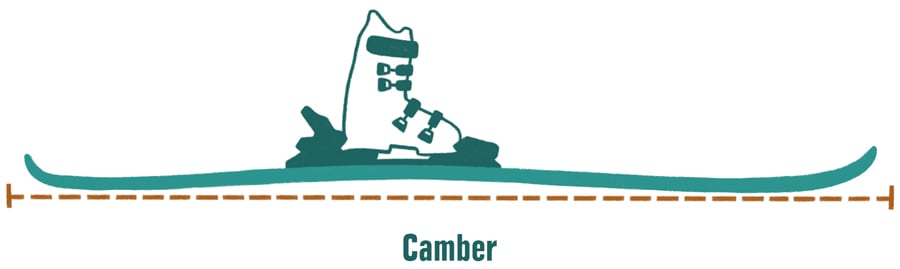
Cambered skis and boards offer several advantages:
- Control at high speeds: Racers use cambered skis and boards for the precision and security they provide at high speeds.
- Grip on hard snow: The continuous edge contact provided by camber creates good edge hold on hard snow, such as the groomed slopes of a resort.
- Stability while turning: The good edge hold that camber provides creates a stable feel while turning.
What is Rocker?
Rocker is essentially the opposite of camber: It's a balanced, continuous arc that curves up from the center of the ski or board, a shape that resembles the floor rails of a vintage rocking chair (hence the term "rocker"). A board or ski's contact space is directly below the rider, located close to the feet. In some circles you'll hear rocker referred to as reverse camber, negative camber or alternate camber.
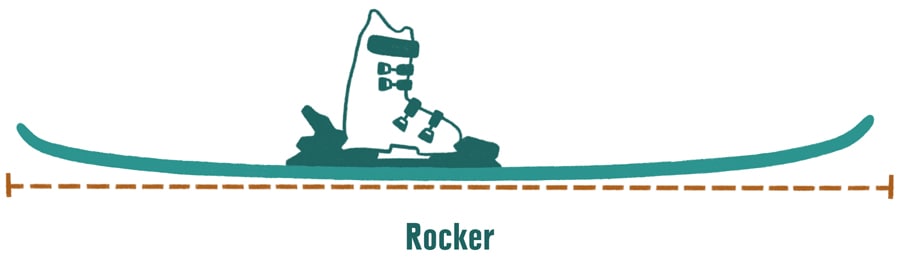
Rocker offers skiers and snowboarders several advantages:
- Improved flotation in powder: The early-rising tips and tails on skis and nose and tail on a snowboard help skiers and riders stay on top of soft snow.
- Greater maneuverability: Fully rockered skis and boards that are made to stay afloat have a shorter effective edge. Less edge contact with the snow permits easier, more nimble turning.
- Enhanced park experience: Without all the spring that comes with camber, it is often easier to slide rails on rockered skis or a rockered snowboard. The risk of catching edges is reduced as well. Rockered skis and boards are nice for riding switch, too.
How to Choose Between Camber and Rocker
So, which to choose—camber or rocker? It's not really an either/or proposition. Shortly after rocker came onto the scene, ski and snowboard manufacturers realized camber and rocker could be combined to address specific performance needs. Today, most skis and snowboards use some combination of underfoot camber and tip and tail rocker in their designs to enhance performance on certain types of terrain and snow.
When shopping for skis and snowboards on REI.com, you'll see that skis can be filtered into four ski camber/rocker options: standard alpine, tip rocker, tip and tail rocker, and full rocker. For snowboards, there are five board profiles: camber, rocker, flat, camber/rocker, and flat/rocker. To learn more about these ski camber/rocker types, see our article, How to Choose Downhill Skis. And to learn more about snowboard camber/rocker types read our article, How to Choose a Snowboard.
To choose the amount of camber and/or rocker that's right for you, it's helpful to consider the terrain you ski or snowboard on and your experience level.
How to choose camber or rocker based on your usual terrain preference:
- Groomed slopes: Cambered skis and boards are popular here for their stability at speed and reliable edge control. Skis and snowboards with a mix of rocker and camber perform well, too, and can make getting through chopped up snow or crud a bit easier. Fully rockered snowboards can do well on resort slopes, but they falter a bit when conditions are icy, when edge control becomes more important.
- All-mountain: For snowboarders who roam freely from groomers to sidecountry and backcountry, rockered boards are an excellent choice for their ability to turn easily and quickly. The extra float they provide in powder is one of their most popular advantages. Snowboards that combine camber and rocker are also popular in varying conditions. For skiers, a popular combination is a rockered tip (for easier turning and good flotation for skiing off-piste in powder), cambered or flat midsection (providing some edge control), and possibly a flat or low-rise tail (for skiers eager to hold speed). Shop REI's selection of all-mountain skis, all-mountain wide skis, and all-mountain snowboards.
- Powder: This is where fully rockered skis and boards were originally designed to rule. Their early-rising tips/noses and tails easily float in the soft stuff and are much less likely to catch an edge. Rockered snowboards allow you to ride more centered over your bindings in deep snow, which greatly reduces back leg burn. Skis and boards that combine rocker and camber do well here, too, and are versatile for use in other conditions. Cambered snowboards can ride powder, though usually using a setback stance. Shop REI's selection of powder skis and powder snowboards.
- Park/pipe: Some skiers and snowboarders like the stability of cambered skis and boards when executing jumps in parks. The camber design traditionally gives you more consistent pop off jumps. However, rockered skis and boards simplify the task of transitioning from nose to tail. For jibbing, rockered skis and boards are popular for avoiding hang-ups on boxes and rails. Pressing into a rail is much easier with a rocker design. Shop REI's selection of freestyle skis and freestyle snowboards.
How to choose camber or rocker based on your experience level:
- Snowboarders and skiers of all skill levels can benefit from rocker. Yet recreational riders, progressing riders and people who haven't been on the slopes for years can enjoy an almost immediate boost from using a ski or snowboard that features some amount of rocker.
- For advanced riders, rocker and its constantly evolving combination with camber works for them, too. Designers have concocted all types of nuanced rocker variations that address specific rider needs. Expert-level skiers and boarders can fine-tune their ride by seeking out the rocker mix that best suits their needs.
Shop REI's selection of skis and snowboards.