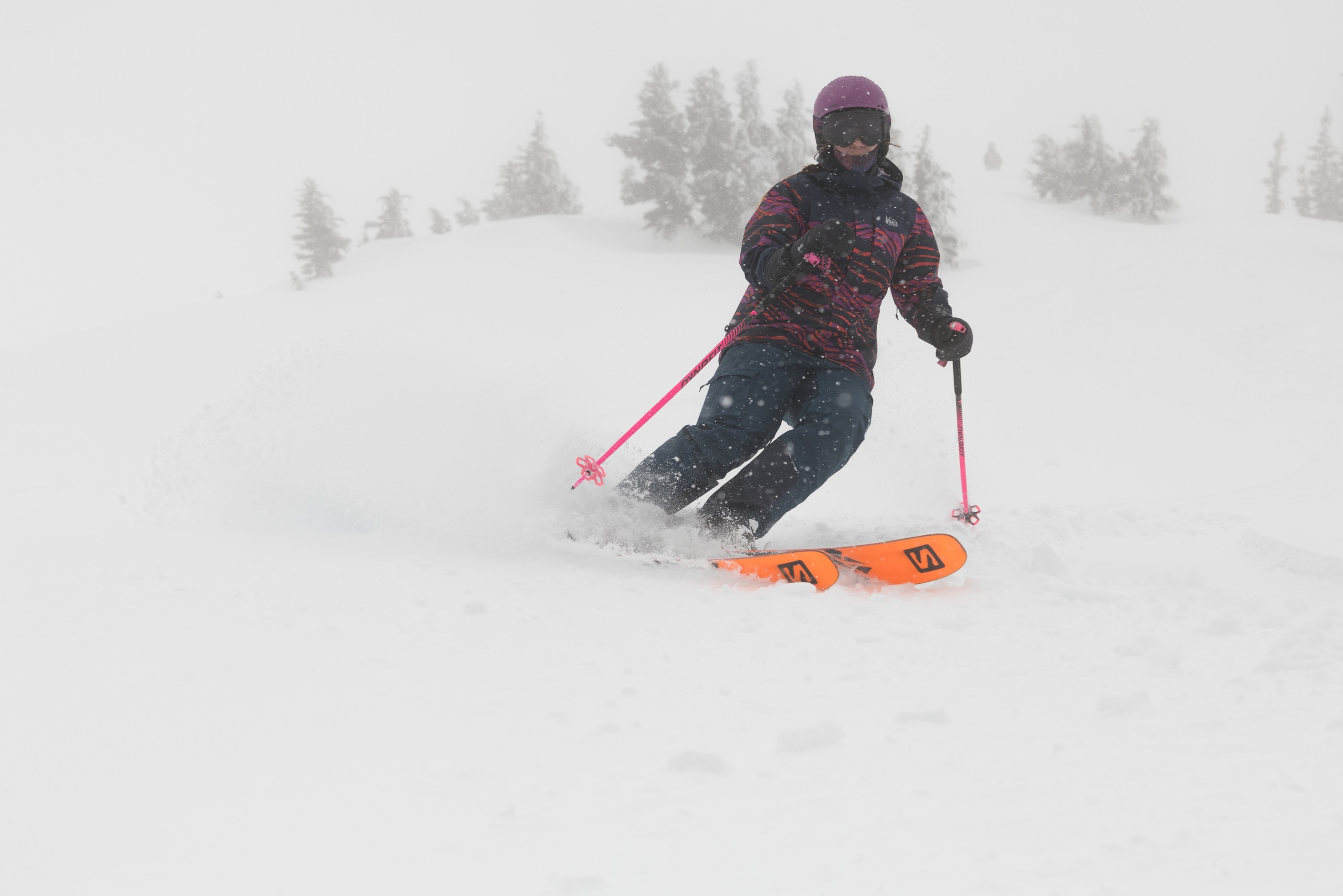
Ski poles are important for helping you propel forward, maintain balance and time turns while skiing. Choose the right pair will depend on the type of skiing you're doing, as well as your skiing style and personal preferences. In this guide, we break down the key factors to consider when selecting ski poles, including finding the right length. While we'll cover some basics of ski poles for cross-country skiing, this article will focus mainly on poles for downhill or backcountry skiing.
Types of Ski Poles
When choosing ski poles, start by considering the type of skiing you'll be doing. We'll cover three basic uses: downhill skiing, backcountry skiing and cross-country skiing.
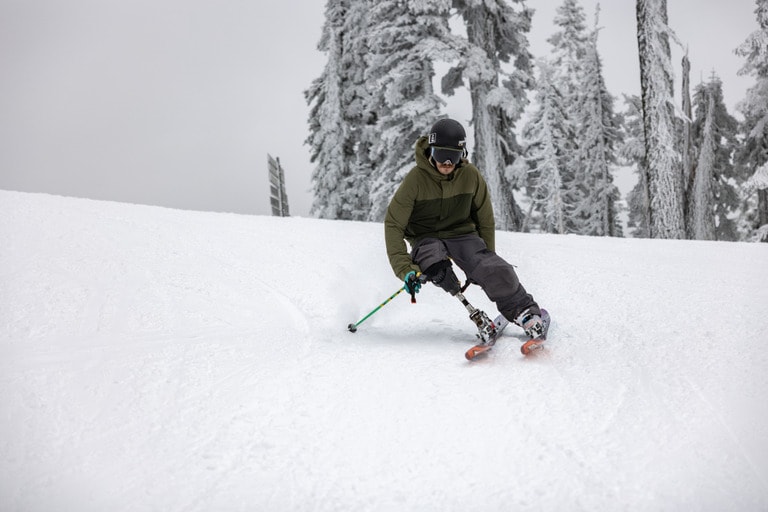
Downhill ski poles
These ski poles help you maintain balance or initiate movements like turns while alpine skiing. The shafts are typically made of aluminum, though some skiers may prefer lighter (more expensive) carbon fiber options. Most downhill ski poles come in fixed lengths, but adjustable models are also available. Ski poles are also available in kids' sizes.
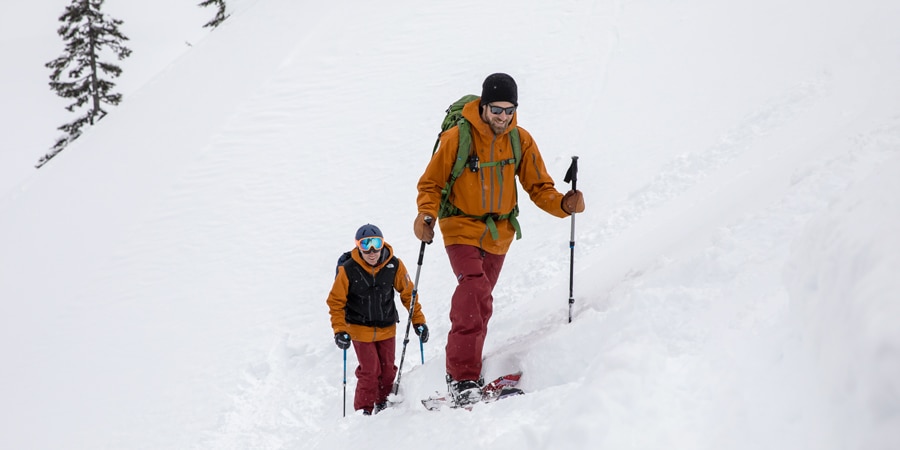
Backcountry ski poles
A standard pair of fixed-length downhill ski poles can work in the backcountry, but many backcountry skiers prefer telescoping poles that adjust using locking mechanisms. These allow you to extend your poles for uphill travel (skinning) or shorten them for the descent. Backcountry snowboarders often look for poles that collapse down short enough to be lashed securely to the outside of a backpack for their descent. For more info, read our Beginner's Guide to Backcountry Skiing.
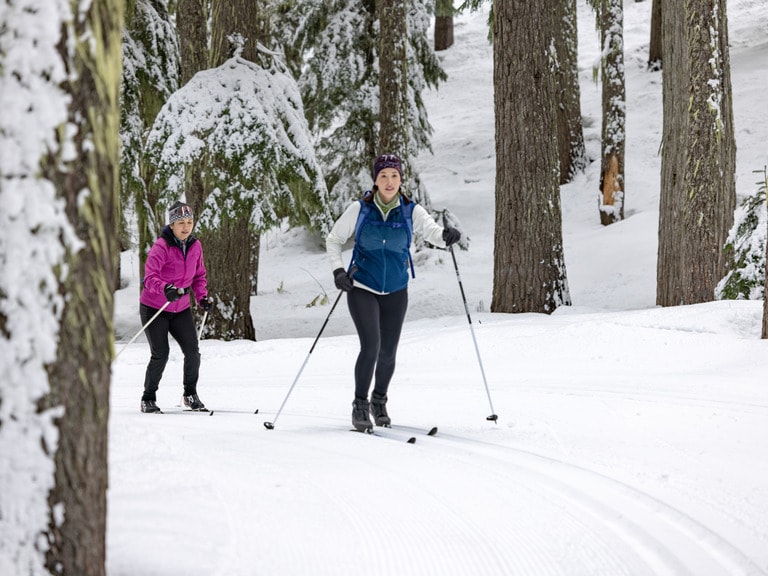
Cross-country ski poles
These poles are generally longer than downhill ski poles. For classic cross-country skiing, skiers typically size poles so they reach from the ground up to their armpits. For race and performance classic skiing, you may want to size them a few centimeters longer. For skate skiing, you can go longer even still—the poles should reach from the ground up to a point somewhere between your chin and lips. For more info, read our in-depth guide to Cross Country Ski Gear.
Ski Pole Fit
To find the right length for downhill ski poles, start by wearing shoes or standing in your ski boots. Hold the poles upside down so the grips touch the floor. Grab the ski pole just underneath the basket so that the top of your thumb touches the basket. Your elbow should form a 90° angle.
If the angle is less than 90°, try a shorter pole. If the angle is greater, get a longer pole. Most poles are sized in 2" increments. If you're in between sizes, go with the shorter pole.
Consult the manufacturer's sizing chart or use this handy chart to help you find the right ski pole length:
Downhill Ski Poles Sizing
| Skier Height | Pole Size (in.) | Pole Size (cm) |
| 3 ft. 6 in. and under | 30 in. | 75cm |
| 3 ft. 8 in. | 32 in. | 80cm |
| 3 ft. 10 in. | 32 in. | 80cm |
| 4 ft. | 34 in. | 85cm |
| 4 ft. 2 in. | 36 in. | 90cm |
| 4 ft. 4 in. | 36 in. | 90cm |
| 4 ft. 6 in. | 38 in. | 95cm |
| 4 ft. 8 in. | 40 in. | 100cm |
| 4 ft. 10 in. | 42 in. | 105cm |
| 5 ft. | 42 in. | 105cm |
| 5 ft. 2 in. | 44 in. | 110cm |
| 5 ft. 4 in. | 46 in. | 115cm |
| 5 ft. 6 in. | 46 in. | 115cm |
| 5 ft. 8 in. | 48 in. | 120cm |
| 5 ft. 10 in. | 50 in. | 125cm |
| 6 ft. | 50 in. | 125cm |
| 6 ft. 2 in. | 52 in. | 130cm |
| 6 ft. 4 in. | 54 in. | 135cm |
| 6 ft. 6 in. and over | 56 in. | 140cm |
Park and pipe skiers should generally go with shorter poles (by at least one 2" size) as these are less likely to get hung up on the walls of the halfpipe.
Ski Pole Materials
Carbon: Lightweight and stiff, shafts made of carbon fiber are more expensive but great for skiers seeking high performance.
Composite: These shafts are constructed from a mix of materials such as aluminum and carbon; they offer a balance between weight and durability.
Metal: Durable and more economical, poles made of aluminum shafts are typically heavier.
Wood: Less common today, some ski poles—like the Grass Sticks Original Ski Poles—are made of bamboo, considered a fast-growing renewable resource. They're lightweight, durable and flexible.
Pole Straps
Most ski poles feature a flexible nylon wrist strap that serves multiple purposes.
- During turns, if you lose your grip, the strap helps keep the pole where you planted it.
- If you fall, the straps keep your poles with you and not buried in the snow far upslope.
To use wrist straps correctly, insert your hand up through the bottom of the strap loop, then your thumb and hand grip over the strap and around the pole.
Tip: When trying on wrist straps in a store, wear ski gloves to ensure they'll be easy on/off when you're on the mountain.
Some downhill ski poles now have detachable straps—tearproof loops that click in and out of the grips for fast transitions.
Pole Baskets
The basket is the plastic disk (sometimes shaped like a snowflake) near the bottom of a ski pole. Its purpose is to keep your pole from sinking too far into the snow.
Basket basics:
- In powder conditions, use a bigger basket.
- On groomed slopes or hardpack conditions, use a standard basket.
Some poles come with interchangeable baskets or additional pole snow baskets can be purchased separately.
Telescoping Poles
Telescoping poles are used by ski mountaineers or backcountry skiers. These can be lengthened for uphill climbs or shortened for alpine descents. Some models can also be extended and vertically joined together for use as an avalanche probe.
If you choose telescoping poles, make sure they adjust from waist height for downhill skiing to just above your armpit for effective striding.