Did you ever wander into an REI outerwear section and feel like you're lost in a wilderness of nylon and polyester? Understanding some key terms and the basics of rainwear technology will help you navigate to a rain jacket or a pair of rain pants that keep you dry and comfortable—and fits your budget.
When it comes to price, you're paying for all of the research, development, testing—and ultimately the performance—of the fabric in that rain jacket. Top-tier rainwear can cost several hundred dollars, so some pre-purchase research is a savvy move.
Want to really geek out on rainwear? For an in-depth look at the complicated science of fabric technology, check out our Rainwear: How it Works page. The fabric care section there is definitely worth a read because proper care is the key to performance. Every rain jacket needs regular maintenance to keep on keeping you dry.
For recommendations, read our guide to the "Best Rain Jackets: Staff Picks."
What Level of Weather Protection Do You Need?
Any jacket offers some level of water resistance. Understanding terminology will help you determine what degree of protection a specific jacket has, and how to find the right rain jacket or rain pants for your activity or adventure.
Waterproof vs. water-resistant
We call a jacket "waterproof" when its water resistance is sufficient to keep out driving rain. Though companies disagree on test standards, you can trust that any gear that a major brand designates as "waterproof" can stand up to a serious squall.
Waterproof/breathable: This type of performance rainwear keeps rain from reaching your skin, while also transferring sweat to the outside world. If you're planning any activity that gets limbs and lungs pumping, this is your kind of gear because both precipitation and perspiration can soak you.
Water-resistant: Also breathable, a water-resistant jacket can handle light rain for a short time—windbreakers and featherweight jackets, for example. If precipitation lingers or starts coming down sideways, these won't be up to the task.
Waterproof/nonbreathable: Think rain slicker or rain poncho. If you simply need to keep the rain out while sitting or standing around, this gear works fine and is inexpensive. If you exert any energy, though, your rain slicker will be slick inside, too. And it won't take much wind to make a poncho largely ineffective.
Windproof vs. wind-resistant
Just as "water-resistant" relates to "waterproof," "wind-resistant" becomes "windproof" when test results exceed an established threshold: 60+ mph, for example, is the spec for all REI Co-op jackets.
Windproof jackets: Windproof jackets are made from materials that don't let wind pass through them. Any waterproof jacket is also windproof. That makes sense when you consider that a barrier designed to block driving rain would also block the wind that's pushing the rain. You will also find jackets with windproof technology, typically some type of laminate, that are only considered water-resistant.
Wind-resistant: Essentially the same as a water-resistant jacket, this is often an ultralight garment that easily stuffs into a pocket. Made for short trips and optimistic forecasts, it won't offer much protection in a full-fledged storm.
3-in-1 Jackets
A step beyond rainwear, this design combines a rain jacket with a fleece jacket or an insulated shell. The inner component typically zips into the rain jacket, offering you the option of wearing either piece on its own.
Types of Weather Shells
Though often used interchangeably with the word "jacket," "shell" can also refer to pants, parkas and ponchos. It's a word that focuses on the fabric makeup more than the garment style. Becoming familiar with the following types of shells will help as you consider your weather-protection choices.
Hard shell: This is an alternative term for waterproof/breathable gear. As you might imagine, fabrics in most hard shells are generally stiffer than those in soft shells, though brands are developing more supple hard-shell fabrics. Hard shells aren't insulated, so your warmth will come from an underlying base layer and midlayer.
Soft-shell jackets: Compared to hard shell jackets, soft shell jackets are made from stretchy materials and offer a lot more breathability and freedom of movement. They're best for high-exertion activities like snowshoeing, cross-country skiing, climbing, ski touring, mountaineering or cycling, where perspiration is the greater concern. Soft shells aren't usually fully waterproof so you may have lesser protection from rain, wind and cold compared with a hard shell.
Hybrid shell: This term gets applied to a variety of constructions. In a soft/hard-shell combo, more waterproof and windproof fabrics might be on the front and top, while more breathable, flexible fabric is on the sides, back and underneath sleeves. Or you might find a traditional soft or hard shell with a more durable fabric on its outer face or in high-wear areas.
Waterproof insulated jackets: Typically filled with down or synthetic fill for warmth, most puffy jackets are also water-resistant and breathable. If the jacket has a waterproof/breathable fabric, then you enjoy an elevated level of protection. It has to be seam-sealed, though, to be considered fully waterproof.
What Breathability Means
Breathability in waterproof/breathable rainwear is the game changer. No one wants to play outside in a wearable sauna. The key to avoiding that fate is "moisture vapor transfer." Breathability is the ability of a rain jacket or other garment to allow sweat vapor to escape.
Transferring sweat vapor through a shell happens in part because the warm, moist air inside is attracted to colder, relatively drier air outside. The efficiency of that vapor transfer process helps determine how dry or clammy you feel, and improving that efficiency has been the focus of outdoor brands for decades. You'll hear all sorts of competing claims about performance, which really just means that Gore-Tex® rainwear is not your only option any more.
Today's rain jackets breathe much better than their predecessors, though we have no universal test standard, nor independent certification body, that measures breathability performance.
Some brands are also including a low level of "air permeability," the scientific term for classic breathability. They market this approach using different terminology, but generally tout better or faster breathability. The tradeoff is that a more direct air exchange also lets out warm air. So these jackets require a warmer insulating layer than you would wear under a traditional waterproof/breathable shell.
Waterproof/Breathable Technologies
The key component of your rainwear fabric is a coating or membrane that does the technological trick of blocking rain while also allowing sweat vapor to escape. Because it's relatively delicate, a membrane will be bonded to a protective fabric to create a laminate.
Almost all rainwear is made using either a laminate or a coating, though the exact materials in each will vary.
Laminates vs. Coatings
The following chart offers key details about the makeup of each. It also provides widely accepted assessments about performance, weight and price, though some products will be exceptions to these guidelines.
| Laminate | Coating | |
|---|---|---|
| Think of it as: | Wallpaper glued to a wall | Paint spread on a wall |
| Made from: | Expanded polytetrafluoroethylene (ePTFE), polyurethane (PU) or polyester membrane | Many formulations of polyurethane (PU) |
| Waterproof performance: | Best | Good |
| Breathability: | Best | Good |
| Durability: | Best | Good |
| Weight: | Lightweight | Ultralight to lightweight |
| Price: | Highest | Lowest |
Durable water repellent (DWR)
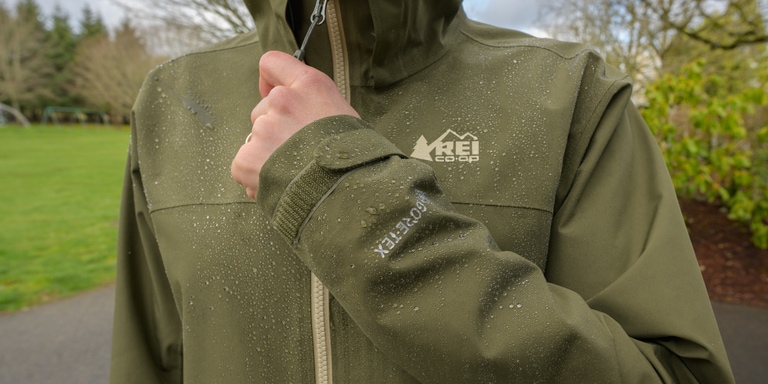
Photo credit: George Orozco
Most outerwear, including all waterproof/breathable rainwear, has an added durable water repellent (DWR) finish. When a jacket's outer fabric is "water repellent," precipitation literally beads up and rolls off. (Note that this isn't the same as a fabric being "water-resistant," which is an overall assessment of its ability to prevent water penetration.)
Often overlooked after purchase, maintenance of the DWR finish is critical if you want your high-tech jacket to keep working its magic. Smoke, dirt, sweat, oils, sunscreen and lotions over time can clog the rain jacket's pores and compromise the DWR coating. When the DWR wears off, a jacket's surface fabric can get wet. When water soaks through, you can feel cold, wet and clammy. The underlying membrane or coating will still keep water out, but the soaked surface fabric slows the movement of sweat vapor to the outside. The clammy lining might even cling to your skin, making it feel as though the jacket is leaking.
Interestingly, nonflourinated DWR finishes used today tend to wear out more quickly than older DWR products but with proper care can maintain performance. Regularly reapplying a DWR treatment should be part of your rainwear maintenance routine. When rain stops beading up or when a wet surface fabric gives you cold spots, we suggest you apply a new coating with a wash-in or spray-on DWR wash. For more details, see our Rainwear: DWR Care article.
Rainwear Layers
For protection, a jacket's membrane or coating is sandwiched inside additional layers. An outer layer stands up to abrasion and repels rain, while an inner layer protects against both body oils and wear-and-tear from the inside of the jacket.
The three types of construction used in rainwear are a 2-layer, 2.5-layer and 3-layer design. Here is a brief primer:
2-Layer: The Quietest
The membrane or coating layer is applied inside an outer fabric layer to form a single piece of material. A loose-hanging liner is added inside that to protect the membrane or coating. Because it's quieter (less "swishy" as you walk), 2-layer construction is favored for urban and travel rainwear. Regardless of intended use, this design is found in moderately priced jackets.
2.5-Layer: The Lightest
This is where the term "layer" can be confusing. Like 2-layer and 3-layer constructions, this design uses a lightweight yet durable outer fabric as its first layer. The second "layer" is actually a polyurethane laminate or coating applied inside that first layer. Finally, a protective sheen or print (a "half layer") is laid down over that second layer.
While 2.5-layer designs aren't as durable as 3-layer laminates, they are lightweight, flexible, packable and generally more affordable. These are great for active pursuits where packability and weight savings are priorities. Some wearers think 2.5-layer jackets feel clammy, though "dry-touch" prints are changing that perception.
3-Layer: The Most Robust
No coatings are used here, just a membrane tightly sandwiched between a rugged face fabric and a liner. Generally, the most durable and breathable construction, 3-layer designs are used in rainwear intended for the harshest backcountry environments. These jackets will also command a premium price.
The following chart provides rough assessments about performance, weight and price, though some products will be exceptions to these guidelines.
| 2-Layer | 2.5-Layer | 3-Layer | |
|---|---|---|---|
| Waterproof performance: | Good | Good | Best |
| Breathability: | Good | Good | Best |
| Durability: | Better | Good | Best |
| Weight: | Midweight | Ultralight to lightweight | Lightweight |
| Price: | Moderate | Lowest | Highest |
Rain Jacket Features
While the technology in the fabric is the biggest factor in the cost of rainwear, construction details also play a role. Jackets with a robust feature set will reflect that in their price. Weight is also affected, so you might see a jacket with a top-tier fabric but few extra features, especially pockets, if ultralight design is the goal.
Seam taping
Because construction requires so many seams, a true rain jacket must be fully seam taped in order for it to be fully waterproof. Since all waterproof jackets are made this way, you don't have to consider seam taping as part of your buying decision.
Don't assume a jacket is fully waterproof based solely on finding seam tape in the hood and shoulders, though: It's a common practice on water-resistant jackets. Also, don't assume lack of seam taping indicates poor quality in a soft-shell or other water-resistant jacket: seam taping isn't used because it would simply add complexity that's not required for the intended use.
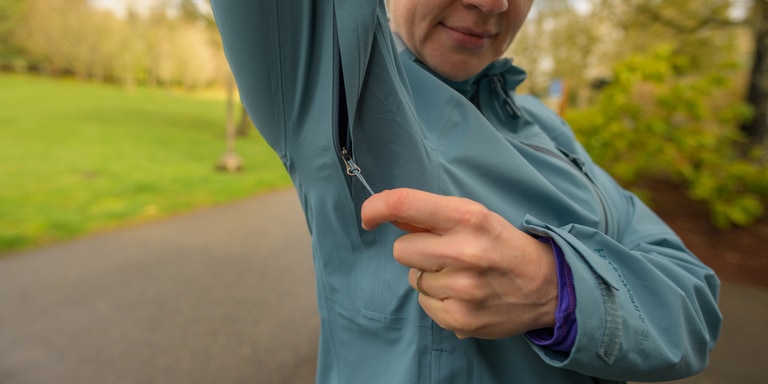
Photo Credit: George Orozco
Zippers
From the front opening to pockets to pit zips, most jackets are loaded with zippers. Keeping water from seeping through zippers requires a rubberized coating or a storm flap. Coated zippers, also called laminated zippers, are harder to zip up and down. They also need a cover, often called a zipper hut or zipper garage, to shield the tiny opening at the end of the zipper track. The trend is away from full flaps in order to save weight, though coatings will eventually wear down and be less effective.
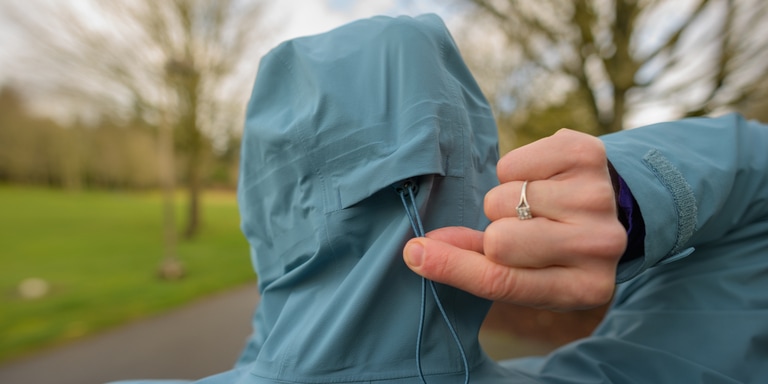
Photo credit: George Orozco
Hood design
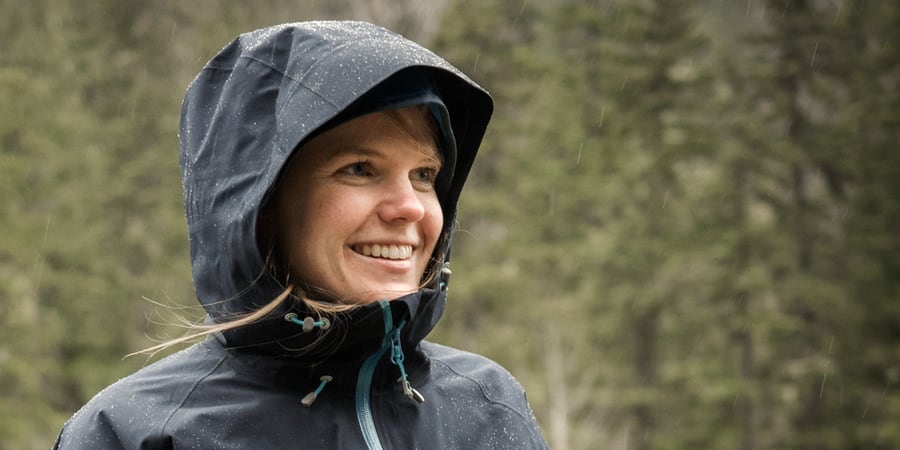
Most hoods have brims and adjustments on the sides and in back in order to fine-tune the size of the opening. Jackets without those adjustments are intended for more casual uses. Some jackets also have hoods that zip off or roll and stow in the collar.
Vents
Because even the most breathable rainwear can get overwhelmed during strenuous activity, almost all backcountry rainwear has pit zips (underarm vents). Some jackets go a step further, having mesh liners in torso pockets that can double as additional vents.
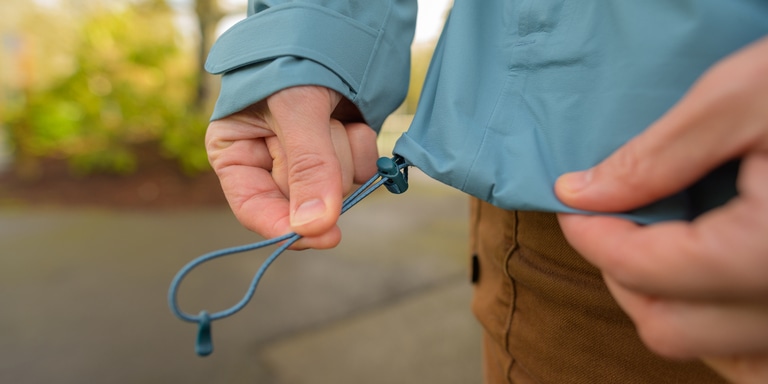
Photo credit: George Orozco
Adjustment features
In addition to the hood adjusters noted above, jackets often have a drawcord at the bottom hem. Longer jackets might have a drawcord at the waist. Most technical rainwear will have wrist closures that adjust. All of these adjustments let you create tight closures to keep rain, wind and cold from sneaking into the openings of your jacket. The adjustments can also be loosened to increase overall jacket ventilation.
Pockets
Pockets, especially if they have waterproof zippers, will add to the price of a jacket. Some jackets have so many pockets that you might be tempted to forgo your pack. Other jackets have hand pockets placed above the hipbelt and away from the shoulder straps, so that you can access them while your pack is on.
Many jackets now include a pocket with a cord port that lets you listen to your phone or music player. And travel jackets sometimes hide pockets under storm flaps or along seams, where pickpockets are less likely to find them.
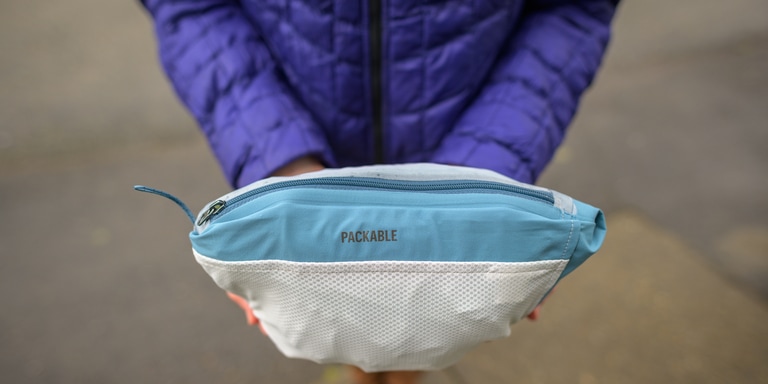
Photo credit: George Orozco
Packability
Ultralight, non-bulky fabric always makes a jacket easier to pack. A few jackets go further, designing a pocket to double as a storage pouch. If a jacket has this feature, or comes with its own stuff sack, it is designated as "packable" in the REI.com specs.
Editor's note: We updated this buying guide on June 13, 2025, with new information and photos.