Electronic Devices in the Outdoors: An Overview

Electronic Devices in the Outdoors

What electronic gadgets make sense for your off-the-grid outdoor activities? Potentially several, from a GPS (for navigation and data gathering) to a satellite text messenger (some can be paired with a smartphone to send short texts—“Pretty sunset 2nite; wish U were here” —from deep in the boonies). And the list goes on.

Here are snapshots of outdoor-minded electronic devices available at REI (and please review our ethics and etiquette of using them in the outdoors):

GPS Receivers

GPS Receiver

A GPS can enhance lots of activities: geocaching; hiking/backpacking, backcountry skiing, snowboarding and snowshoeing; running; cycling; paddling; driving.

Useful for:

  • Displaying your current location in the form of a coordinate, which you can plot on a paper map.
  • Following routes you’ve plotted in advance; tracking routes you’re traveling; returning to your starting point.
  • Pinpointing the location of a geocache.
  • Tracking data such as current elevation, elevation gain and distance traveled.
  • Following turn-by-turn directions while driving (available on selected models).

Potential pitfalls:

  • Can initially seem complex and daunting. (Solutions: frequent practice; keep the user guide handy; solicit advice from friends or REI staffers; take a class.)
  • May not be able to connect to satellites when under a thick tree canopy or deep within a narrow canyon.
  • Becomes inoperable if batteries run out or unit gets crunched by a rock; this is why you must know basic map-and-compass skills where no batteries are required.

GPS Units vs. Smartphones

Why not just use a GPS-enabled smartphone? Because dedicated handheld GPS receivers feature:

  • Stronger reception; direct connection to satellites from nearly any location on earth (smartphones must be with range of a cellphone tower).
  • Longer battery life (on average, about 15 hours per set of batteries).
  • Rugged construction that resists hard knocks and foul weather.

If you’re an experienced geocacher and search for caches only in urban areas, a smartphone may be sufficient for your needs. Ultimately, though, a GPS offers a more refined experience that usually is more satisfying to a regular geocacher.

For tips on selecting a GPS receiver that’s right for you, see the REI Expert Advice How to Choose a Handheld GPS Receiver article.

Shop REI’s selection of GPS receivers.

Mobile Phones (Satellite Phones, Smartphones, Cellphones)

Smartphone with Case

Mobile phones, dependent on cellphone towers, rarely work in the remote locations where people hike, climb and paddle. How do you get in touch if you need to talk to a friend or have an emergency to report?

Satellite phones (satphones) are chunky, heavy, expensive and unnecessary in urban areas where cell towers are abundant—all reasons why recreational adventurers rarely carry one into the backcountry, either. Yet no device beats a satphone if you are standing deep in Nowhere Valley and absolutely, positively have to talk to someone.

Satphones permit person-to-person voice exchanges and data transfers from locations far beyond the reach of terrestrial signals. The best-known names in the category are Iridium (which operates a constellation of 66 low-earth-orbiting satellites providing global, pole-to-pole coverage) and Globalstar (with 48 satellites covering, with a few gaps, North and South America, Europe, Australia, the Middle East, northern Africa, southern Alaska and parts of Russia and Asia.).

  • Satphone pros: You can make a call from nearly any remote location. However, like GPS units, satphones work best when afforded a clear, wide-angle view of the sky.
  • Cons: Bulk, weight and cost. Satphones run $500+; calls range from 60 cents to $2 per minute. If, despite all that, you still crave the dependable connectivity of a satphone, you can also consider renting one (available from a variety of providers).

Smartphones and basic cellphones perform well in urban centers where cell towers are plentiful. However, they are unreliable at best in wilderness areas or remote parks. You may want to carry one on a maybe-it-will-work basis; on rare occasions a cellphone will surprise you with its reach. Never depend on one to function when you’re deep in the backcountry.

  • Smartphone pros: Smartphones (and similar devices such as tablets) are technological marvels that are constantly evolving. Apps and customized programs can benefit both serious adventurers and recreational explorers. Map apps are particularly intriguing.
  • Cons: Smartphones are tethered to cell towers and for now remain primarily urban or frontcountry tools.

Many national parks contain cell towers in areas of high visitor density, including one famously installed near Old Faithful in Yellowstone National Park. Such installations stir vigorous debate about their appropriateness. Introducing such technology permits swifter responses in emergency situations, but does it compromise a park’s wilderness character? That’s a contentious topic, and the argument has no foreseeable end.

To gauge cellphone reception at a remote location, you could try this review site for cellphone reception. Enter, for example, Yosemite National Park in the site’s search box. (Yosemite Valley contains 5 cell towers, installed where park radio equipment has stood for years.)

See our suggested using electronics respectfully section later in this article.

Satellite Text Messengers

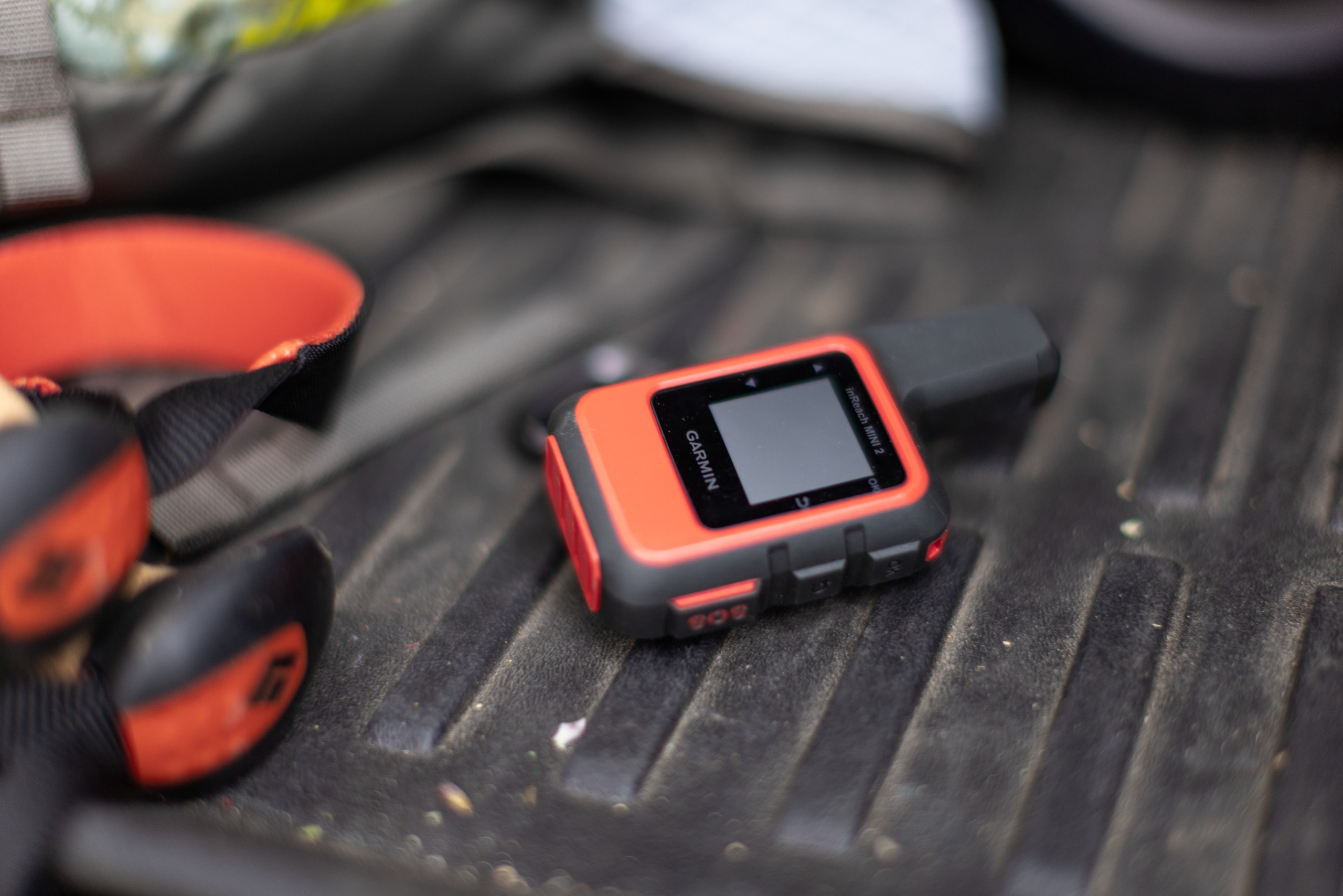
Satellite Text Messenger

You’re deep in the mountains. Your cellphone can’t get a signal. You don’t have a satphone. Yet you want to get a message (emergency or nonemergency) to someone. A good option: a subscription-based satellite text messenger.

SPOT, a subsidiary of Globalstar, created this product category when it introduced the SPOT Personal Tracker in 2007. (FYI, SPOT = Satellite PersOnal Tracker.) It could send simple, pre-programmed “I’m OK” messages to loved ones at any time. Or, by pressing its SOS/911 button during life-threatening emergencies, it could transmit an injured person’s GPS coordinates to an emergency-response center.

The device gave wilderness explorers without a satphone keep-in-touch access to the civilized world. Newer products have only improved on the concept, and even 2-way text communication is now possible, a big step forward achieved by the DeLorme inReach GPS Communicator.

Below is a comparison chart of the texting capabilities of satellite messengers available at REI in fall 2011. Other functions are explained in detail after the chart.

1-way texting
(sends preprogrammed messages)
1-way texting
(sends "live" messages)
2-way texting
(sends and receives "live" messages)
SPOT II Satellite GPS Messenger Yes No No
SPOT Connect Satellite Communicator plus any smartphone Yes Yes;
up to 41 characters
No
DeLorme Earthmate PN-60w GPS with SPOT Connect Satellite Communicator Yes Yes;
up to 41 characters
No
DeLorme inReach plus Android-based smartphone only (available fall 2011) Yes Yes;
up to 160 characters
Yes;
up to 160 characters

Which devices use which satellite constellations?

  • Iridium (DeLorme inReach) = global coverage.
  • Globalstar (SPOT) = extensive coverage on 5 continents (including the entire continental United States and its coastal regions) with some gaps.

All devices offer these functions:

  • SOS/911: For life-threatening or critical emergencies only, when self-rescue is not possible.
  • Help: Nonemergency assistance requested from personal contacts.
  • I’m OK check-in: Notifies designated recipients that all is well.
  • Route-tracking: Marks waypoints viewable on Google Maps.

Here’s how they work:

Note: A prototype for the new DeLorme inReach communicator was still in development at the time this article was written.

SOS/911: When activated, a distress message (with your GPS coordinates) is transmitted to a 24/7 response center, the GEOS International Emergency Response Center in Houston, which is a private entity. For SPOT subscribers, GEOS attempts to contact your first 2 emergency contacts designated in your contract. If those contacts are unavailable, the center uses your GPS location to notify local emergency responders—police (911), highway patrol, Coast Guard, search and rescue personnel, even a U.S. embassy or consulate for signals from an international location. A distress signal is transmitted every 5 minutes until the unit’s batteries are depleted.

Help: SPOT uses a hand-to-hand icon to represent this function. “Help” is intended for use in emergencies that are not life-threatening. It’s up to the user to determine whether or not a situation is life-threatening.

  • SPOT Connect: If you own a smartphone (any smartphone) and have downloaded a SPOT app, you can pair the phone and SPOT Connect, the compose and send a "live" text message of your own creation no longer than 41 characters or 2) send one of up to 14 prewritten preinstalled help messages (120 characters max) to your designated personal contacts. Your contacts will also receive your GPS coordinates, if obtainable. This message is repeated every 5 minutes for 1 hour or until cancelled. If your contacts do not receive text messages, they will receive an email message that includes a link to Google Maps, which shows your location.
  • SPOT II: A preprogrammed “help” message and your GPS coordinates are sent to your contacts and repeated every 5 minutes for an hour or until cancelled. For an additional fee, SPOT offers SPOT Assist services where it will relay your help message and coordinates to “professional services.”

Note: Accidentally activating the SOS/911 function was an issue on the original SPOT Personal Locator. On the SPOT II, the SOS and Help buttons are covered by shields to prevent this. On the SPOT Connect and DeLorme inReach, unintended activation is a low risk but still possible.

I’m OK check-in: Allows you to notify friends and family that you’re off the grid but still in good shape.

  • SPOT Connect: Same deal as with Help: Send as many as 50 contacts a “live” text message of up to 41 characters. Or send them a prewritten message (choose from as many as 14 messages, each as long as 120 characters). Note: You can also update Facebook and Twitter accounts with these messages.
  • SPOT II: Sends a preprogrammed message to as many as 10 contacts.

Route-tracking: Creates a breadcrumb trail of GPS waypoints which can be viewed in real time by friends on a public page or reviewed once the trip is finished.

  • SPOT Connect and SPOT II: Acquires GPS coordinates every 10 minutes during a 24-hour span (or until cancelled); sends them to your SPOT account and permits your contacts to view your progress on a SPOT Shared Page or SPOT Adventures Live Map.

Fees and Contracts

Annual coverage plans (subject to change): SPOT: $99/year; DeLorme basic: $9.95/month ($119.40/year). Additional plans and options available. Seek out the manufacturers for details.

Texting, including “live” texts (subject to change): SPOT Connect: 10 cents per message (if purchased in a 500-message bundle). DeLorme inReach: TBD.

Some customer reviews indicate that fees, payment calendars, cancellation policies and other fine-print topics of subscription plans can be a point of contention. Others, meanwhile, seem to comprehend plan requirements and are satisfied customers. Before signing a contract, read it thoroughly and make sure you understand the agreement.

Shop REI’s selection of satellite messengers (note: this category does not include DeLorme PN-60w).

Personal Locator Beacons (PLBs)

Personal Locator Beacon (PLB)

A PLB is an advanced search-and-rescue instrument typically carried by hard-core mountaineers and experienced backcountry skiers/snowboarders whose adventures involve high levels of challenge and risk.

Rarely is a PLB carried during a typical summer backpacking trip, although if the trip involves off-trail travel to difficult, rarely visited alpine zones, a personal locator beacon would be worth considering.

How PLBs work:

  • You register your PLB with the National Oceanic and Atmospheric Administration (NOAA) and are assigned a Unique Identifying Number (UIN).
  • When activated during an emergency, your PLB communicates with an international network of government satellites and your information is relayed to the Air Force Rescue Coordination Center at Tyndall Air Force Base in Florida, where search and rescue procedures are initiated.

Size and weight vs. satellite text messengers:

  • PLBs are marginally larger and heavier; about 6 inches long and 9 ounces in weight.
  • The SPOT II logs in at roughly 4 inches and 5 ounces; the SPOT Connect is 3 inches and 5 ounces. The DeLorme inReach is 5 inches (some of that is antenna only) and estimated to weigh 7.5 ounces (based on a preproduction prototype).

PLB performance vs. satellite text messengers:

  • Both deliver optimal results when afforded a clear view of the sky.
  • PLBs transmit your UIN and GPS data to satellites via a 406 MHz signal, a frequency lower than the signal used by SPOT messengers. A low-frequency signal can more easily penetrate clouds and tree cover. PLBs also operate at higher wattage, boosting signal strength. A separate homing signal (121.5 MHz) helps rescuers pinpoint your location.
  • PLBs are equipped with lithium batteries which can operate up to 35 hours.
  • PLBs are often equipped with an LED strobe light to aid a victim’s visibility.
  • PLBs offer no customized texting options or 2-way messaging.
  • PLBs are more expensive initially but require no subscription fees.

Note: PLBs are different from avalanche transceivers, which are used at close range on mountain slopes to locate a submerged avalanche victim.

Learn more about PLBs in the REI Expert Advice article Choosing and Using a Personal Locator Beacon. We also offer an Expert Advice article on How to Choose an Avalanche Transceiver, which explains how those devices work.

Shop REI’s selection of personal locator beacons.

Two-way Radios

Two-way Radios

Two-way radios have been used for decades and remain practical devices for maintaining voice contact between groups in a wilderness setting. A hiking group often includes people with varying abilities and pacing, so hikers gradually get spaced out along a trail. Or a group of paddlers takes different lines.

Two-way radios may seem like comparatively low-tech contraptions in a world of smartphones, but they do a decent job of keeping group members in touch—as long as huge distances or radical topography does not come between the radios.

Manufacturers sometimes boast eye-popping range of use—we’ve seen claims as high as 25 miles. Due to all the variables that can affect radio performance in the outdoors, from dense forests to hilly terrain, REI believes that the realistic range for any 2-way radio is about 2 miles or less.

That estimate could rise, maybe by a lot, if certain conditions come into play:

  • Flat, obstruction-free terrain. Radio waves travel most easily when no physical impediments exist. Good locations for optimal 2-way radio performance include high, barren, isolated hilltops, a lakeshore or on a boat in calm water.
  • Higher wattage. Radios rated as 1- or 2-watt typically transmit a stronger signal.
  • Size. Big antennas are capable of catching more radio waves. If you want to keep your radios compact, look for models where the radio’s body and antenna are about the same size.

For more details, including a discussion of FRS and GMRS channels, see the REI Expert Advice How to Choose Two-way Radios article.

Shop REI’s selection of two-way radios.

Music Devices

Music is a personal preference that in shared outdoor spaces should be enjoyed privately. Toward that goal, REI carries a nice selection of tiny, lightweight, high-performance headphones. If you crave music, please wear them and let those around you enjoy the natural sounds of birds chirping, bees buzzing and leaves rustling.

REI also offers a few external speakers. Enter “portable music systems” in the search box at the top of this page to view REI’s current assortment. External speakers can be a nice companion for an isolated camper or a solo cyclist or kayaker out in empty spaces. As always, be mindful and courteous of others in your vicinity who prefer the peaceful ambience of natural sounds.

Shop REI’s selection of headphones and portable music systems.

Photography and Videography

Helmet cams are popular and can be attached to helmets, bikes, suction cups or even held in your hands. REI carries a broad assortment of outdoor cams, accessories, camera bags and tripods.

For minimizing the weight and bulk of still-photography equipment while still maintaining a high degree of creative control, consider the emerging micro four-thirds system cameras. They offer interchangeable lenses, above-average sensors, are noticeably smaller and lighter than a standard digital SLR and produce splendid images, comparable to what can be achieved with good-quality, entry-level DSLRs.

Photographers still debate whether the format, which occupies a middle ground between DSLRs and point-and-shoots, will attract enough of a following to sustain its existence. The format seems like a great option for weight-conscious outdoor types, and one model used by REI’s photo department has been well-received by our pros. REI does not sell the cameras, but leading manufacturers include Panasonic, Olympus and Sony.

Shop REI’s selection of helmet cameras, camera accessories, camera bags and tripods.

Batteries

Lithium Batteries

This is just a guess, but whoever invents the inexhaustible battery will rule the world. The demand for long-lasting portable energy is massive and endless.

For devices that use household batteries (AA, AAA, even CR123), what’s a good choice? The REI Expert Advice article How to Choose Batteries offers more details than you likely want to know about batteries. But here are a few of the article’s worthwhile conclusions:

  • No perfect battery exists. But lots of people are busy trying to develop something close to one.
  • Rechargeable batteries are a good option. An estimated 3 billion single-use batteries are sold each year; most are tossed into landfills. But rechargeables have a downside: When not in use they “self-discharge” their energy much more quickly than alkaline batteries.
  • Among rechargeables, precharged NiHM (nickel-metal hydride) batteries are best-of-breed. They’re also marketed as “hybrid,” “ready-to-use” or “low self-discharge” batteries. They feature a low self-discharge rate, making them suitable for headlamp or flashlight use for a multiday trip, and they can be recharged 150+ times.
  • Alkaline batteries make excellent backup batteries. Even if you’re using rechargeables, carry some alkalines as spares.
  • Lithium batteries are popular for use in high-drain devices such as cameras. Lithium cells are excellent, but before using them in a device such as a headlamp, check your device’s instructions. Occasionally lithium batteries are too powerful for electronic circuitry and could fry your gadget.
  • Fuel cell batteries are on the horizon. They are among the batteries of the future. So are thin-film polymer batteries and batteries modified by nanotechnology. Stay tuned.

We offer 2 handy comparison charts for rechargeable batteries and single-use batteries. They’re the CliffsNotes version of the article.

Battery Chargers/Solar Chargers/Portable Power Devices

A key point to keep in mind when pondering a battery charger:

Solar Battery Charger

The power output of the charger must be greater than or equal to the battery rating of your electronic device. This will require a little research on your part:

  • Check your device’s manual; look for technical specifications.
  • If your device came with a wall-outlet charger, look for its voltage rating or “DC output.” Make sure your portable power supply, shown in milliAmps (mA) and volts (V), can deliver at least the same amount of power.

Solar Chargers

This ever-evolving technology offers much promise. People sometimes expect more out of solar chargers that they can deliver at this stage of their development, but each new design keeps outperforming the last.

Weight-conscious wilderness travelers are attracted to scroll-style or fold-out solar collectors. Typically these systems require 8-10+ hours of sunlight to attain a full charge. How does that translate into usage? A common estimate: 1 hour of solar collection yields about 10 minutes of mobile phone usage.

Want to operate a laptop way off the grid? You’ll need a larger collector, one that fuels a rechargeable energy block which in turn powers other devices. An example of such a unit is the Goal Zero Sherpa 50 Adventure Pack. At 3.5 pounds for all components, you’ll probably think twice about stuffing this in your backpack for a 5-day trip, but this favorably reviewed unit seems well-suited to car camping and travel to remote areas.

What items can solar collectors power? Small, low-weight collectors can be used to juice most handheld items: mobile phones, batteries, game units, MP3 players, GPS receivers and headlamps. Larger collectors can usually accommodate small to medium devices such as a tablet, laptop, small TV, air pump or mini fridge.

Learn more about portable power devices in the REI Expert Advice How to Choose and Use Portable Battery Chargers article.

Shop REI’s selection of portable power devices, batteries and battery chargers or search for “solar chargers” at REI.com.

Protective Cases and Sleeves

Protective Cases for Electronics

All of the devices mentioned in this article are vulnerable to dings, dirt and drops when exposed to the elements. Accordingly, REI carries a slew of customized sleeves, cases and bags for protection.

A few pointers:

  • Understand a bag or case’s protective claims. Waterproof means watertight, i.e., submersible. Most cases, though, are simply water-resistant, which is enough protection for a typical rainstorm. But if you place a gadget in a water-resistant case and drop it in a stream, you could have problems if you fail to rescue it within a few seconds.
  • Hard cases are intended to create a tortoise-like shell around their contents. This is a good choice for sensitive gear or anything with a screen you want to keep unscratched.
  • Smartphones have their own category of smartcases, which shield the devices from grit while still allowing touchscreen sensitivity through thin but durable clear-plastic screens. Tablet cases offer the same benefit.

Shop REI’s selection of electronic cases or search for “waterproof cases” on REI.com.

The Ethics and Etiquette of Using Electronics in the Outdoors

Requesting an Emergency Response/Rescue

Devices such as satellite text messengers or smartphones can do much to boost our sense of security and peace of mind when we are separated from civilization. They also raise the possibility that one might summon an emergency response for when no real emergency exists.

We at REI can’t emphasize enough the need for personal responsibility and self-education when you step into the wilderness. Requesting search-and-rescue assistance is serious business that should never be made for minor incidents where self-reliance and self-rescue can resolve the issue.

If you have broken a femur, yes, that qualifies as an emergency. If, however, your trail has too many mosquitoes for your tastes, do NOT attempt an emergency call. Just because you CAN contact a ranger or emergency-response personnel does not mean you SHOULD. Be knowledgeable, be prepared, be resourceful and be accountable.

So, which devices described in this article are best for emergency situations?

  1. Satphones. If you can see the sky, you can make a call. In their current configurations, though, few outdoor types carry a satphone because they’re costly, bulky and a bit weighty.
  2. Satellite text messengers. Being able to exchange information with a victim, even in a text format, is a huge boon for search-and-rescue personnel and quite comforting to friends and families of adventurers.
  3. Personal locator beacons. Powerful and dedicated to a single purpose: initiating a rescue. A good choice for highly adventurous risk-takers.

Using Electronics Respectfully

Some people view electronic gadgets as incompatible with a wilderness experience and view them as an intrusion in the backcountry. People accustomed to a technology-saturated culture may consider such an outlook unusual and archaic. It’s not.

Knowing this, we ask that everyone please be mindful and respectful when using electronic gadgets within view or earshot of other people. The colors and changing light cast by your mobile phone or the hiss and thump seeping from a set of amped headphones might diminish another person’s experience.

We encourage everyone to follow a cellphone code of conduct for the outdoors:

  • Don’t jabber within earshot of others who have come to an outdoor space in search of peace and quiet.
  • If you have an urgent need to talk, keep your voice low and make it brief. If it’s going to take a while, move far away from others.
  • Turn off the ringer; use the vibrate function only.
  • If no urgent calls are expected, just turn your phone off.

Whenever you use an electronic device outdoors, please use it judiciously.

Thanks.

Back to Top

How are we doing? Give us feedback on this page.

FREE U.S. STANDARD SHIPPING on orders of $50 or more.

Shop THE REI ANNIVERSARY SALE May 18–28. Plus, members SAVE 20% on one full-price item with coupon code REIANNV. Details

  • Join REI today!
  • REI Membership
  • REI member benefits include an annual refund (typically 10% on eligible purchases).
  • Join REI today!
  • Sign up for REI Gearmail®
  • and get 15% off selected items!
  • Store Locator
  • Locate an REI store near you.
  • Find a Store

Find REI on: FacebookTwitterYouTubeFlickr