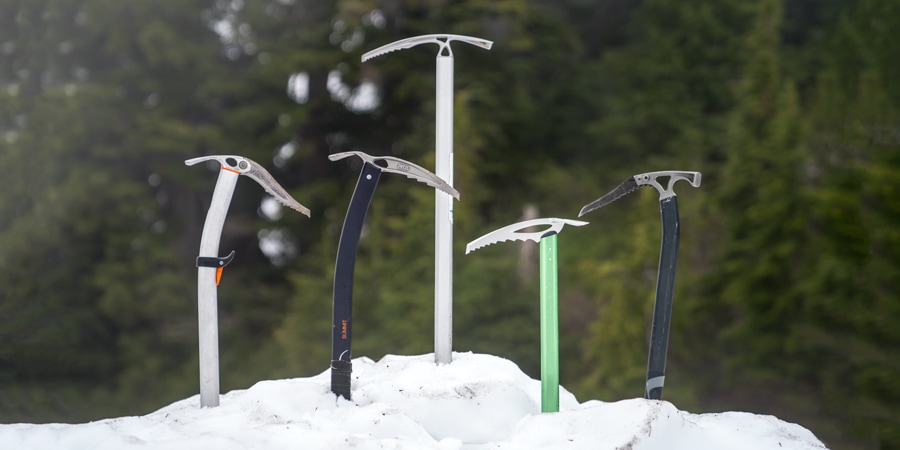
Of all the tools a mountaineer carries, the ice axe is perhaps the most iconic. It's also the central piece of gear in REI's origin story: Our founders, Lloyd and Mary Anderson, formed the co-op after struggling to find a quality ice axe anywhere in the U.S.
If you're getting your first ice axe for a high-altitude adventure, you do need to think about the type of outdoor activity your axe will support. You also need to measure properly to get the correct length and to familiarize yourself with the parts of an ice axe.
Below are the main activities ice axes support, along with key axe features for each:
Classic mountaineering: Most ice axes are used for summiting snow-covered peaks that have glaciers and crevasses. Features include:
- Classic length (sized from the base of the thumb to the ankle)
- Straight aluminum shaft; or a curved shaft if routes involve lots of steep terrain
- Comfortable grip is a plus
- Steel head with a classic-curve pick
Scrambling: Ice axes are also used in climbing where there might be some snow or ice, and routes involve heading straight up steeper terrain, perhaps using both hands and feet, as opposed to travel on low-angle terrain or traversing across steep slopes. Features include:
- Classic length; or up to 10cm shorter if axe use is minimal
- Straight shaft; or curved shaft if axe will often be gripped mid-shaft and used like a claw
- Steel head with a classic-curve pick
Hiking/backpacking: Ice axes are also used in situations when one might be traveling on a trail that has (or might have) some sections covered by snow or ice. (Thru-hikers often carry an ice axe early or late in the hiking season.) Features include:
- Classic length; or up to 10cm shorter if axe will only be taken off your pack for brief traverses or scrambles of steep snow-covered chutes
- Either straight or curved shaft is fine
- Comfortable grip is a plus if the axe will be used often
- Steel head with a classic-curve pick; or an aluminum head if axe use is minimal
Ice axes for ice climbing: These are designed for climbing frozen waterfalls, icefalls or ice-covered slabs of rock. In this article, we're focused on mountaineering axes, but it's helpful to know the differences while you shop: Compared to classic ice axes, ice-climbing axes are shorter, have bent shafts and a head that has a different design from a classic ice axe. Axes for vertical ice (> 60° slopes) are referred to as "ice tools" and are used in pairs, with climbers on belay.
Choosing the Right Ice-Axe Length
Ice axe sizes state the distance from the tip of the axe to the top of its head; sizes are listed in centimeters because ice axes originated in Europe.
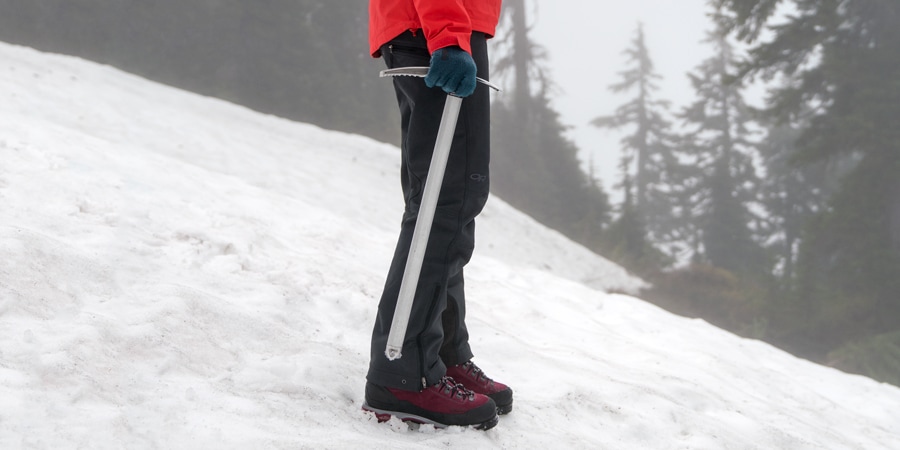
Here's how to find your correct axe size for a classic mountaineering axe:
- Have someone help you, so that you can concentrate on standing properly while that person carefully checks the length.
- Grasp the head of the axe, with the adze forward and your thumb resting on it.
- Stand facing forward in a relaxed yet upright position (your arm holding the axe head should be at your side); let the spike of the axe dangle toward the ground.
- On a properly sized axe, the tip of the spike should be even with your ankle, or an inch above it.
Note: If you're doing this at home (rather than a climbing shop), hold an imaginary ice axe head at your side and have your helper measure the distance from the base of your thumb to your ankle.
Reasons to Choose a Shorter Ice Axe
The main reason most people choose a shorter axe is to save weight. Going shorter (by up to 10cm) is OK if you anticipate a lot of travel on steep terrain, or your route will require minimal ice axe use. Avoid getting an ice axe shorter than 60cm, though, because its spike will be dangerously close to your vital organs during a self-arrest.
Ice-climbing axes are an exception to the "not less than 60cm" rule because climbers must repeatedly swing their axes to penetrate a wall of ice, and a shorter axe is more comfortable to use that way.
Reasons to Choose a Longer Ice Axe
You might consider getting a slightly longer (and heavier) axe if you'll predominantly use it to build snow anchors, to probe for cornices and crevasses or to travel on low-angle snowfields. A longer axe, though, can be unwieldy to use during self-arrest because the spike can catch in the snow and send you and your axe flying. Avoid getting an axe longer than 70cm unless you're tall enough to measure out as needing an axe that size.
Parts of an Ice Axe
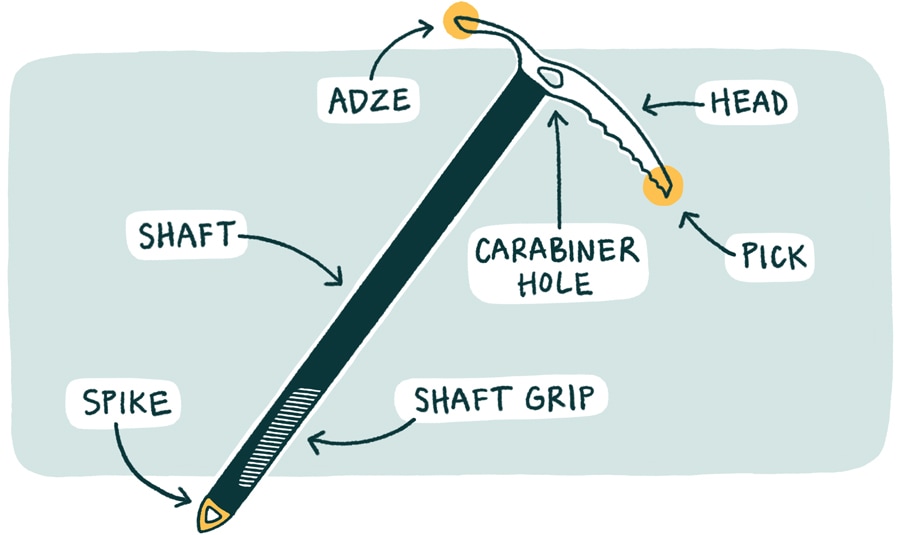
When you shop for an ice axe, you'll need to know its basic components:
Head: Composed of the pick and adze, the head is almost always a strong steel alloy. An ultralight aluminum head only makes sense on an axe that spends most of its time in your pack, and is only there "just in case" you encounter unexpected snow or ice.
Pick: This is the pointed end on the head of the ice axe. It's used for hooking and swinging into snow or ice, the key maneuver for a self-arrest. Most picks have a classic curve. (Reverse-curve picks are found in ice-climbing axes because they are angled better for ice-wall penetration.)
Adze: This broad, hoelike feature is predominantly used to cut steps or seats in snow or ice. (In axes for ice climbing, the adze is often replaced with a hammer.)
Carabiner hole: This hole in the head of an ice axe is used to affix an ice-axe leash or sometimes to clip a carabiner (and some leashes attach via a carabiner).
Shaft: Almost all shafts are made of aluminum now because it's lightweight and strong.
- Straight shafts are ideal for general mountaineering because they let you use the axe as a supportive cane on low-angle terrain and they plunge cleanly into the snow when you need to self-belay or use the axe as an anchor.
- Curved shafts have a slight bend that provides clearance that keeps your hand off the snow when placing the pick into the snow. Curved staffs are best for steep terrain. (Ice-climbing axe shafts have a pronounced curvature for a more ergonomic swinging motion).
Shaft grip: Makes grasping the shaft and swinging the axe more comfortable and secure.
Spike: This is the sharp bottom point of the axe that penetrates snow and ice. It is used to provide a secure support when you're walking or to make it easy to plunge the axe into snow for a belay or rescue. A few non-mountaineering axes save weight by not having a spike, instead cutting the shaft at an angle so that it can perform a similar function.
Ice Axe Leashes
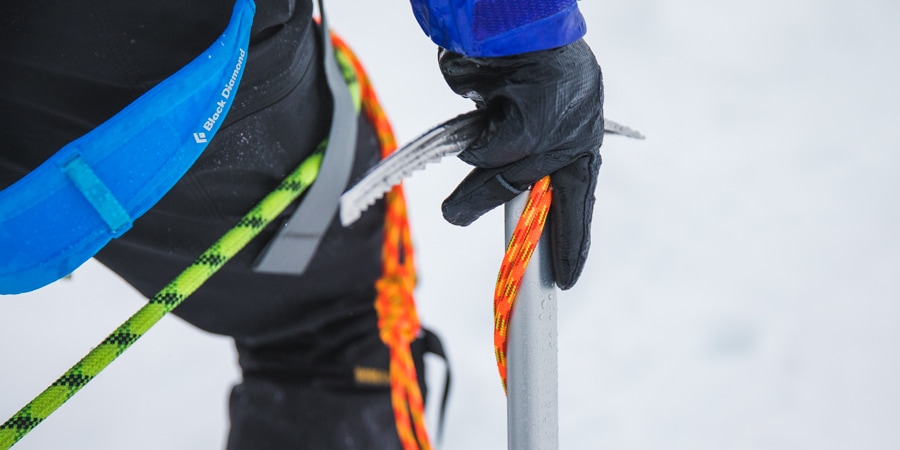
Sold separately, a leash helps secure the ice axe should you drop it. A leash is invaluable because losing your axe would put you at serious risk on glacier crossings and steep, snowy sections of a climb. It is considered mandatory by many guide services and climbing instructors.
Some climbers choose to go leashless in certain places because there are also risks in being tethered to a sharp tool that could injure you during a fall. That makes the most sense in terrain where a dropped axe would come to rest in close proximity to you.
Many ice-axe makers sell premade leashes that fit their tools perfectly. You can also make your own leash from either 5mm to 7mm Perlon cord or 1" webbing.
Important: Reading this article does not make you a mountaineer. Be sure to get competent ice-axe instruction and thoroughly practice using an ice axe before relying on one in the field.