What concerns many novice backpackers or hikers even more than bears and blisters is, "How do I go to the bathroom in the woods?" Rest assured, it's something humans have been doing for millennia. Before you go, make sure you do the following first:
- Learn about Leave No Trace ethics. One of the best things you can do for your fellow campers is to leave the ground as clean or cleaner than you found it.
- Find out if there are any regulations on human waste in the area where you're going. Some high-elevation, sensitive or heavily traveled areas require people to pack out solid human waste.
Beyond that, there are some important guidelines to follow, so let's dig right in.
Video: Pooping in the Woods
How to Pee in the Backcountry
Choose a place that's well away from your trail or campsite. A group may choose to designate more than one location. When choosing your specific spot, keep the following in mind depending on where you are:
- Small bodies of water: Never go directly into a small pond, stream or lake. Always move 200 feet (about 70 steps) away from a water source.
- Large bodies of water: If you're in a rafting group camping along a very large river, Leave No Trace recommends peeing directly in the water; the river volume will dilute it, and the camping area avoids getting over-saturated.
- Alpine areas: Up high in mountain goat territory, peeing on a rock surface is recommended. Goats are attracted to the salts in urine, and may dig up fragile vegetation to get the salt.
Additional Bathroom Tips
- If you're squatting to pee, find a soft spot of earth that absorbs quickly (pine needles are good) so you won't get splashed. A wide stance helps you stay balanced. Make sure your pants, boot laces, straps, etc. are well out of the way and pay attention to which way the ground slopes and make sure you're uphill so any stream runs away from you.
- If there's not much privacy where you are, you can also squat with a lightweight sarong, towel or hiking skirt wrapped loosely around you. Or, if you're hiking with someone, that person can act as a lookout and warn you of any approaching hikers (and vice versa).
- A pee funnel let's you pee standing up and can be helpful in cold or rainy weather, or in a desert or alpine area where there's little to no privacy. Practice at home before your trip. Rinse it if possible, and carry it in a plastic bag.
- On a day hike, you can carry a couple wads of toilet paper or tissue and a small zip-top plastic bag. Put the used toilet paper in the bag and dump the paper in your toilet when you get home.
- While backpacking, some prefer to "shake dry" or use a bandana as a "pee rag." Tie the bandana to the outside of your pack to dry it out, and rinse it when you can.
- If you're sleeping in a tent and don't want to go out in the cold of night, you can use a bottle (in conjunction with a pee funnel if needed) that you designate for this purpose (definitely practice this at home first). Close the bottle and place it just outside your tent. In the morning, dump it out in the bushes away from camp.
- See our article on Backpacking with Your Period for information about dealing with menstrual supplies.
How to Poop in the Backcountry
Before you head to your outdoor rest stop, make sure you have the supplies you need with you and know the proper techniques to follow.
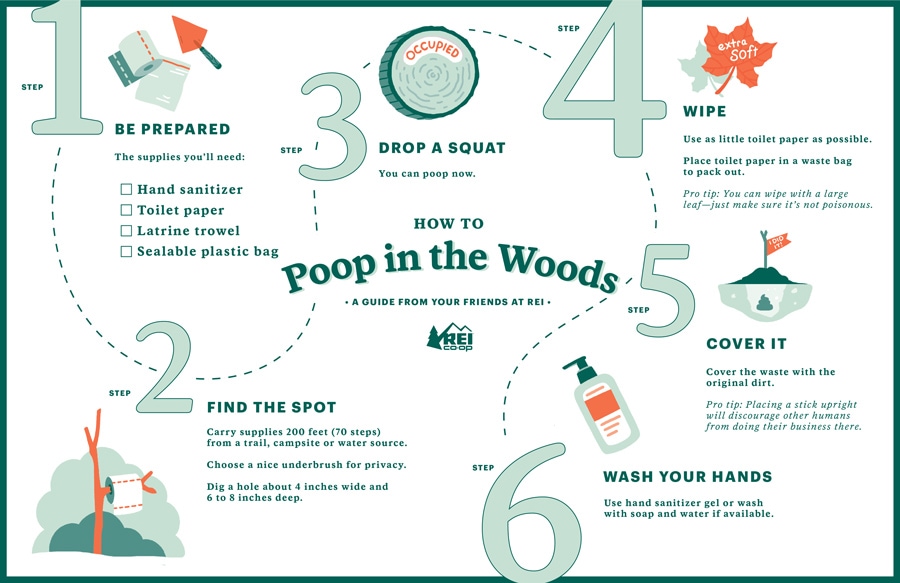
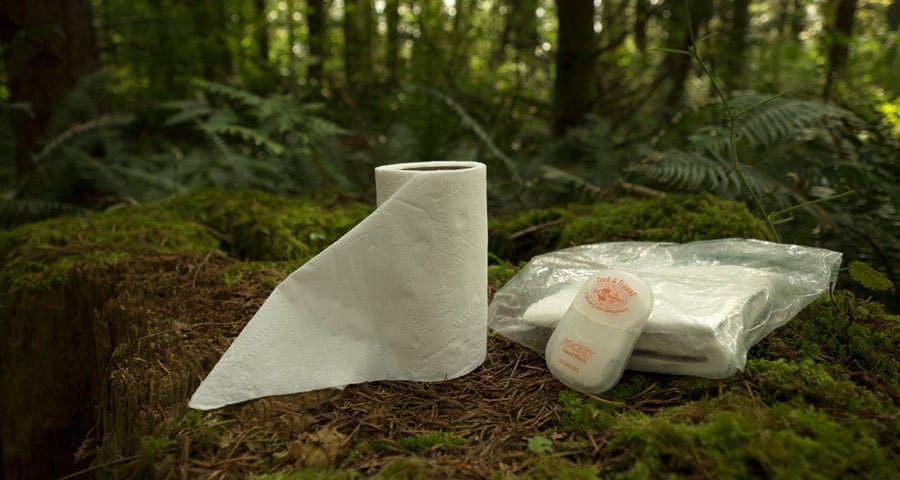
Supplies: In addition to the basics—toilet paper and hand sanitizer—you'll want to bring along the following as needed:
- Sealable plastic bag: The preferred practice now is to pack out your used toilet paper (and even if it's not required, it's still the best practice for lowering your impact on the land). If you want to disguise the contents, you can line the bag with aluminum foil, cover it with duct tape or draw permanent marker designs.
- Camp trowel: Many are very lightweight and can be helpful for digging a cat hole.
- Solid waste bags or containers: Some high-elevation, sensitive or heavily traveled areas require people to pack out solid human waste. If so, you must bring human waste disposal options. There are a few different kinds: some are simple plastic bags known as "blue bags," others are sealable, double-layer bags containing gel for absorption. Carry out the bags in your pack; they're supposed to be leakproof, but place them in another plastic bag to be safe. If you're able to carry bigger gear (such as when vehicle camping or river rafting in undeveloped areas), a bucket lined with a large compostable bag and a closable lid makes an inexpensive portable solid-waste toilet.
Find an appropriate spot:
- Carry your supplies 200 feet (70 steps) from a trail, campsite or water source. Choose underbrush for privacy if you like, and notice your surroundings to make sure you can find your way back to your camp or trail.
- If possible, find loose, rich soil and a sunny site. Both of these conditions help decompose waste more quickly. Use a trowel, stick, rock or boot heel to make a hole about 4 inches wide and 6 to 8 inches deep.
- If the ground is too hard or rocky to dig, try lifting a rock and use that spot. Replace the rock when you're done. Or carry your waste out in a bag.
Managing toilet paper:
- Use as little toilet paper as possible. To reduce your use of TP, you can wipe off with natural objects such as large leaves (make sure they're not poisonous), smooth stones and even snowballs. Make sure you have your chosen item handy beforehand.
- Place TP in a waste bag to pack out. (Places where burying your TP is allowed are becoming scarce—only do it if your cat hole is sufficiently deep and you're absolutely certain land managers say that it's acceptable practice.)
- Pre-moistened wipes can be nice to use on occasion, but don't drop them in the hole; they need to be packed out in your waste bag (as do menstrual supplies).
The cover-up:
- Cover the cat hole with the original dirt and completely fill the hole. Tamp it down with your foot. Place a rock or branch over the space to discourage digging critters. You can place an upright stick in it to discourage the next humans in need of a hole.
- Lastly, use some sanitizer on your hands and rub vigorously, paying attention to fingers.
Backcountry Hygiene Tips
Unwashed hands can lead to intestinal ailments during or after your trip. Here are some tips to keep your hands clean in the backcountry, when water may not be readily available:
Personal hygiene tips:
- Carry hand sanitizer gel (or wipes, which must be packed out). Always use it after you poop and before handling food. Soap and water and the physical act of rubbing can be a more thorough way to wash hands. But the rubbing action with sanitizers may have the same result.
- While backpacking, it's a good idea to thoroughly wash your hands at least once a day with soap and water.
- Dry your hands with a different towel or bandana than you use for drying dishes.
Keeping the environment clean:
On longer outings, you may enjoy a full-body wash, or at least going for a swim. Here are some tips to keep water sources clean:
- Never lather up directly in a lake or stream. Not even with biodegradable soap—it can harm aquatic life.
- Use a portable camp sink (or cooking pot) to carry bathing water far (at least 200 feet) from a water source.
- If you choose to use soap, make sure it's unscented and biodegradable.
- Before swimming, wash off any sunscreen and insect repellent from your skin; those chemicals can badly pollute a small pond or stream.
- After washing, pour your dirty water on dirt, rather than on plants or lichen-covered rocks.
- Consider carrying a small, fast-drying pack towel.