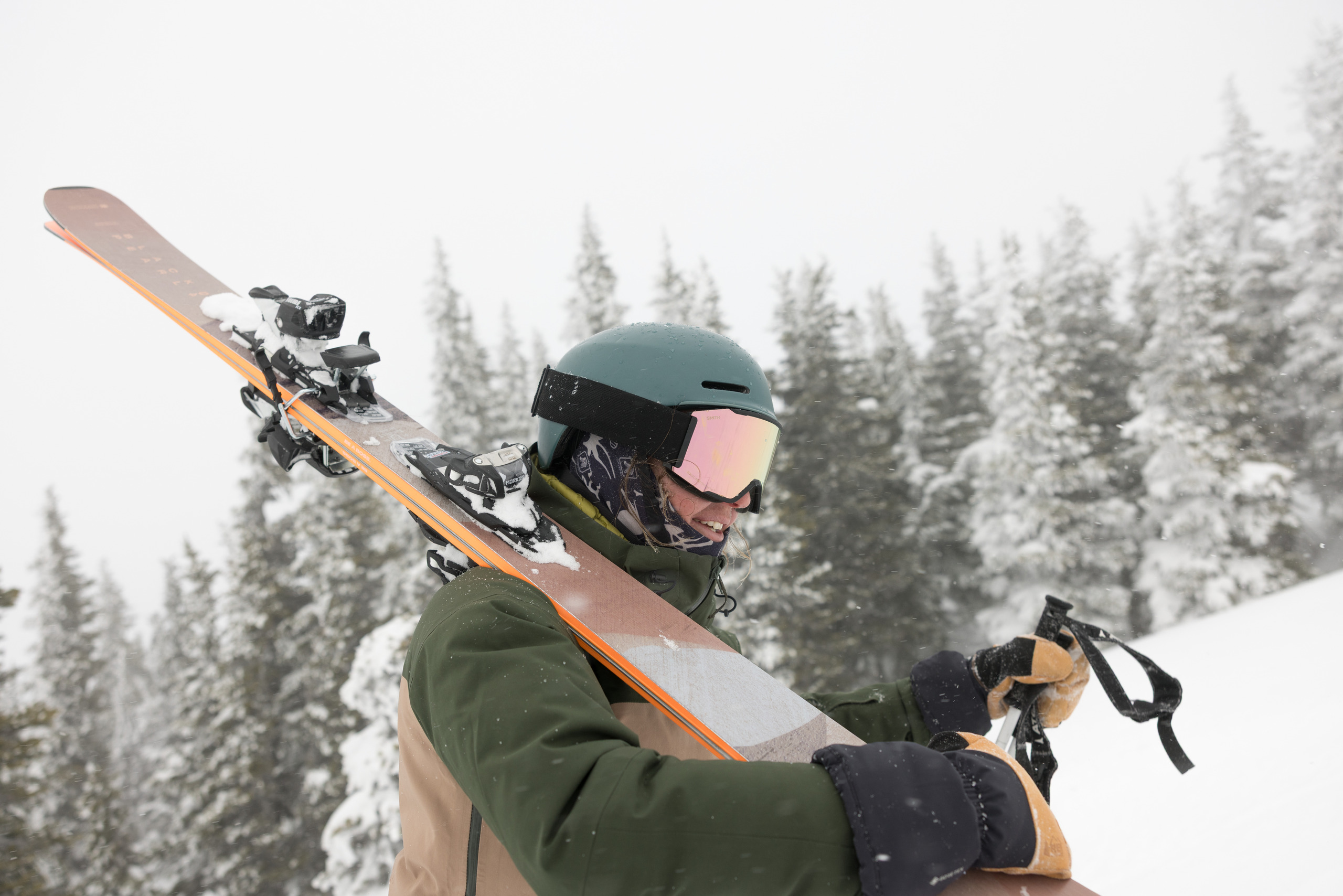
At high altitudes, the air is thinner and filters less ultraviolet (UV) rays. The sun's reflection on snow is brighter and more intense. Wind can make your eyes tear and blur your vision. Ice particles can get into your eyes, as well as twigs and branches when you're dropping through the trees.
Ski goggles and snowboard goggles can help protect your eyes from these on-mountain hazards, making your outing a lot more enjoyable.
Shop a selection of ski goggles and snowboard goggles at REI.com. And get our picks in our tested gear review of the Best Ski Goggles.
Video: Goggles: How to Choose
Lens Shapes of Ski / Snowboard Goggles
Lenses are usually either flat or spherical. REI lists this information in the product specs on REI.com. Be aware though that some manufacturers use proprietary terms on their own websites to describe these three basic shapes.
Cylindrical lenses: The lens curves left-to-right across your eyes and face, but the lens surface is vertically flat (between the nose and forehead). Cylindrical-lensed goggles are priced lower and work fine, but the flatness can cause more glare and slightly reduces peripheral vision.
Spherical lenses: This lens, too, curves across your eyes and face, but it also curves vertically. Curved spherical lenses give better peripheral vision, less distortion and less glare, but the cost is higher. The larger the lens, the better your peripheral vision becomes.
Toric lenses: Newer to the market are toric lenses, which curve both horizontally and vertically like spherical lenses. The vertical curvature, however, is more subtle than the horizontal one.
Ski / Snowboard Goggles Ventilation
When warm air from your body heat meets cold air from the outside temperature, condensation can form and your vision is compromised. Goggles use a variety of approaches to avoid fogging.
Double-layered lenses are found on virtually all goggles since they do not fog as fast as single-layered lenses. Sealed properly, they create a thermal barrier (like storm windows) that is more resistant to fogging.
Anti-fog coatings are integrated into virtually all mid-level to high-end goggle lenses to help deter fogging. Anti-fog products can be used on lower-end goggles without a coating or on old goggles that are starting to fog.
Vents: The top, sides and bottom of goggles are the keys to help control fogging. Wider vents generally create better ventilating airflow than smaller venting holes. The trade-off? Your face may get cold, particularly in extreme climates.
Fans: A few high-end goggles include small, battery-operated fans to help disperse moisture. Fans with different settings can be adjusted for standing in a lift line, riding the gondola or going down the slope.
Visible Light Transmission and Lens Color
Your lens color serves to filter and emphasize the colors in your vision. The amount of light that reaches your eyes through the lenses is called the visible light transmission (VLT). Visible light transmission – measured as a percentage – is affected by factors such as the color, thickness, coatings and material of the lenses. You can typically find a goggle’s VLT in the products specs.
Lighter lens tints have a higher VLT because more light passes through the lens. Yellow, gold, amber or rose-colored lenses all offer increased VLT and make good choices on cloudy, socked-in days.
Darker tints have lower VLT because less light passes through the lens. Brown, black, gray and lenses all offer reduced VLT and thus excel on bluebird days.
Clear lenses are appropriate for night skiing.
Learn more about VLT and tints in this article, "Understanding Goggle Lens Colors."
Additional Lens Features of Ski / Snowboard Goggles
UV protection: Virtually all goggles sold today offer 100% UV protection from all three types of ultraviolet rays—UVA, UVB and UVC. Remember, even when it's cloudy, UV rays are bouncing off of the snow. (And yes, you can still get sunburned in winter. Read our article that busts myths about winter).
Interchangeable lenses: These let you easily swap out different colored lenses to suit changing light conditions. Many goggles with interchangeable lenses include two lenses for bright-light and low-light conditions.
Polarized lenses: A polarizing filter's primary function is to reduce glare from sunlight on snow or water.
Photochromic lenses: Snow goggles with these lenses automatically change tint level according to conditions and UV intensity. The more sun and UV rays, the darker the lenses become. If it's snowing or overcast the lens stays lighter. Indoors, they always stay light no matter the light intensity. Photochromic tech doesn’t work immediately, which means you can be skiing a shaded tree run, then pop into the sunshine and struggle to see because your goggles didn’t adjust in time.
Mirrored lenses: Mirrored lenses have a partial or full lens coating on the outside of the outer lens. This reflects more light and thus allows in less light (by between 10% and 50%) than non-mirrored lenses.
Digital display: Some styles offer advanced technology that may pair with GPS and Bluetooth to display navigation, performance and smartphone information within the goggles in real time.
Ski / Snowboard Goggles Frames and Fit
Make sure to get goggles that fit your face. The fit should be snug (not tight) and comfortable. Some models are best suited for smaller or larger faces; you can often find frames in small, medium, large or XL sizes. Women's and kids' sizes may be available, too.
Other fit considerations:
Low bridge fit: Skiers and snowboarders with higher cheekbones or lower nose bridges might consider goggles in a low bridge fit, which are designed to create a more customized fit. Brands like Smith add extra foam padding and adjust a goggle's frame shape to create a better seal and prevent gaps where wind or snow can get inside. Smith and others offer a range of models in low bridge fit.
Helmet compatibility: Most snow goggles are designed to work with ski or snowboard helmets, but it's still important to try goggles together with your helmet to ensure a comfortable and flush fit. There should be no space between the top of your goggles and the helmet. Make sure the helmet fits snugly against the goggles—without hindering your vision or pushing down on the goggles. Many brands design their goggles to pair seamlessly their own helmet models, so check their pairing recommendations too. For more tips, read our article, Helmets for Skiing or Snowboarding: How to Choose.
Strap adjustments: Most goggles have a single, sliding clip to make adjustments. Others may have an open/close buckle with sliding clips on each side for adjustments.
Padding: This keeps the goggle from pinching your face. Foam should be thick enough to cushion your face but not be so thick that it promotes fogging. High-end goggles may use two or three layers of thin padding to enhance venting.
Eyewear compatible snow goggles: If you wear prescription glasses, look for goggles designed to fit over your glasses, also referred to as OTG (over the glasses) styles. These goggles have space to accommodate glasses while avoiding pressure on your face from the temples and nosepiece. (Tip: You can use an anti-fog treatment on your eyeglasses to help keep them clear under the goggles.)