Essential Riding Skills

By REI staff

You've just been smoked by your buddy who's been biking since the dawn of the pneumatic tube. You've had the proverbial sand kicked in your face. Will you ever win? Fear not, defeated one. Learn the Art of Cycling and you'll be a two-wheeled Charles Atlas in no time.

Riding is an art. The following topics are covered in this article:

The Art of Balance

Without getting too New Agey, there is a center point between you and the bicycle. It's determined by your frame size, your body shape and the grade of the trail or road. Call it the Holy Trinity, so to speak, of the cycling set.

The Platform

Before finding your center, you first need to know how to position yourself on the bike. The base of any position is the platform. Your pedals should be at 3 and 9 o'clock; your feet should be level. This is the best position for your feet unless you're negotiating tight corners.

From this position:

  • You are centered on your bike and well-balanced.
  • Reacting is a simple process of shifting your weight forward, back, or side to side.
  • You have maximum pedal clearance to avoid rocks and roots.
  • Instead of abusing your rear end, spine, neck, and shoulders, your legs can absorb shocks the terrain presents.

The Angles

With your platform established, place your hands on the handlebar grips. Assuming you've got your bike fitted properly, from the sitting position you should have a 45-degree bend in your back. (This is true for mountain and road bikes—this angle becomes more pronounced when you lower your hands to the drops on a road bike and more relaxed if you're riding a town-and-trail type bike.) Your elbows should be bent at a 90-degree angle and knees from 30 to 50 degrees. And—like a batter staring down a pitcher—your chin should be roughly parallel with the top tube and your eyes level and looking straight ahead. You should be seated unless going over rough terrain. From the platform position it's a simple matter to move from sitting to a raised position (floating a few inches about the saddle) with your legs acting as shock absorbers.

The Grip

Now drum your fingers on the grips. Feel how relaxed you are? This is how loose your hands should be while riding. This is true while climbing, descending or clearing obstacles. A proper grip will automatically inform the rest of your body and keep you fluid and ready for anything that comes your way.

The Center

Now that you've got your feet in the proper platform position and your body loose and ready, it's time to find your center. But first, find a slight incline, preferably paved, and begin coasting down it.

Stand up on the pedals and shift your weight forward. Feel the shift in your balance? Shift your weight back. Again, you should feel a difference in your center of balance. Do this back-and-forth shift in smaller and smaller movements and then do the same thing from side to side. This will help you find your center. Now, before you run out of room, apply the brakes!

You can find your center more easily while standing on the pedals than while sitting. This is because your center of gravity is higher while standing and you have more leverage. Now try the same steps as above, this time while sitting. Got your center? You should be able to maintain it for about a second.

A second is all you get because your center is more a region than a specific point. That region changes as you go up or down a hill or if the wind is blowing or if you've got an empty or full stomach. There are thousands of variables. But with practice you'll learn to find your center region and make adjustments to stay in it. Got it? Then it's time to learn the art of pedaling.

The Art of Pedaling

This subject is covered in greater detail in the How to Climb Hills article. But here are the basics.

You've just started making a pedal stroke with your left foot. As the left foot pushes down and hits bottom, the natural inclination is to transfer power to the right foot and start the right-foot stroke. Think again. Your work with your left foot has just begun; you're actually not finished with that first stroke.

As your left foot bottoms out on its stroke, act as if you're scraping some nasty business off the bottom of your shoe. This adds power to the bottom and back of the stroke and gets the foot ready to pull on the pedal. As the left foot is scraping its way back, transfer power to the right foot. Now, as the right foot is completing its downstroke, pull up with the left foot. Your left foot should be pulling as your right foot is pushing.

But wait! You're still not done with the left-foot revolution. As your left foot comes to the top of its revolution, act as if you're stepping over that nasty business you were just scraping off. This will squeeze a last bit of energy from your left-foot revolution and get it ready to power through the next revolution.

As you concentrate on getting one foot to do a proper revolution, you'll feel like you're pedaling with just one foot. But as you get used to the power transfer and make the transition effortless, you'll be able to get both feet moving in a smooth circle. Push-scrape-pull-step-push-scrape-pull-step until the square boxes you used to make are nothing but a memory.

Try This: Pedal with just one foot and try to get the push-scrape-pull-step motion down, so that you're delivering a smooth circle full of power. Do this a hundred times. Now do it with the other leg. Once you feel comfortable doing this with both legs individually, start using them both.

The Art of Shifting

A rapid cadence (or pedaling rate, measured in revolutions per minute) helps keep the feet moving smoothly. Anywhere from 75 to 80 revolutions is considered a good pedaling rate; pros aim for a rate of 90 rpm.

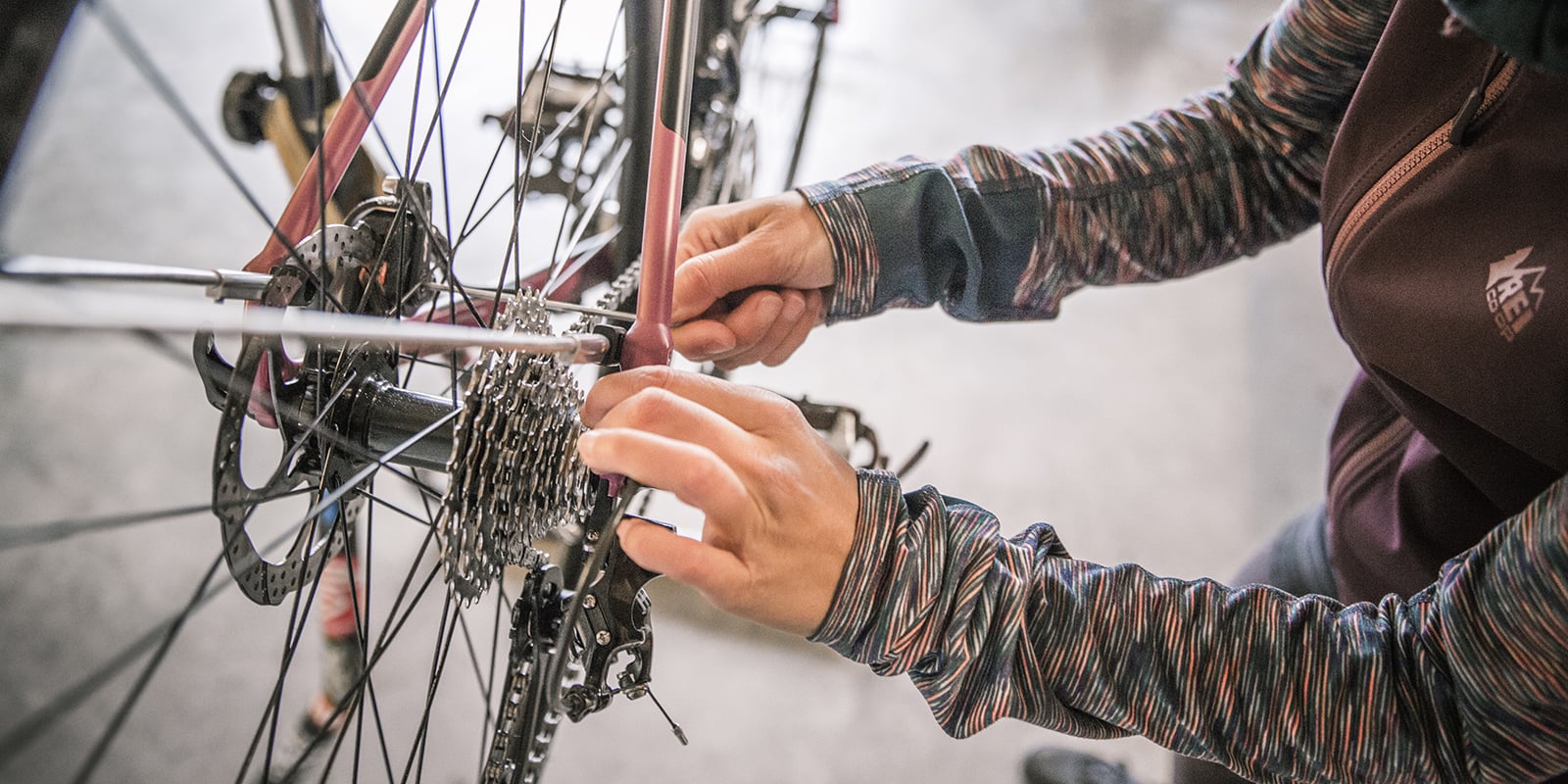
Utilizing your full gear range is the key to keeping a steady cadence. Your bike features two sets of gears. The ones up front are called chainrings; the ones in back are part of the rear cassette and are called cogs.

  • Small Chainring—Found mainly on mountain and town-and-trail bikes, this ring is used for climbing steep trails and hills.
  • Middle Chainring—This is the small chainring on many road bikes and is used for climbing or tight cornering situations. On mountain bikes and town and trail bikes, it's the all-purpose chainring, good for street or trail. It's also the chainring that works best with all of the cogs.
  • Large Chainring—On a mountain bike, the large chainring is used mainly for descents or to pick up speed on the flats. It serves much the same function on road bikes.
  • The Cogs—Numbering one through seven cogs (and even up to nine cogs) the rear cassette is responsible for the finer points of shifting. Say you see a slight rise coming on the trail. It's not big enough for you to go into your small chainring, but you know it will slow your cadence down. Time to shift to a larger cog.

    BEWARE: Try not to go from the large chainring to the large cog or the small chainring to the small cog. This results in undue wear on the gears and the chain.

The Art of the Line

Your ability to keep a line is mostly a game played out in your mind. If you don't believe you can keep a line in a tight pack or think you will hit an obstacle when trying to follow a line through rocks and roots, that's likely what will happen.

The ability to pick out a line is the result of practice, practice and practice. The more you practice, the more types of lines you'll be able to ride.

Road Bike—When in a pack don't get mesmerized by the tire in front of you. If you do, you'll become less observant of your surroundings and a crash is an almost certain result. Instead:

  • Keep looking ahead and to the sides.
  • Watch other riders and see how they're reacting to the terrain. You'll not only learn a lot—you'll pick up on problems earlier and stay in the pack.
  • Look for hand signals. Talk with other riders before starting the ride and learn what the hand signals are. Use them yourself if you're riding point and see something worth noting.

Mountain bike—A good line on the trail saves energy and ensures a good ride. By not doubling back after bungled turns or trying to clear unnecessary obstacles, your ride may become something of a Zen experience. Riders often speak of how they dropped into the Zone—a place where no move is wasted, when everything seems effortless and happens as if it were meant to be.

The scan method is the best way to pick out a good line.

  • Move your eyes from immediately in front of you to about 15 feet up the trail and back. Also look from one side of the trail to the other.
  • Get a look at the lay of the land. As you become experienced you'll quickly note the rocks you can clear or the best approach to a wet root.
  • Focus on the line you've picked out and stay with it.
  • Don't look at obstacles. They should be a thought in the back of your mind and nothing more.
  • Concentrate on the line; determine to stay on it. Once you've cleared a tricky part of the line, start scanning for the next part.

Try This: Take a roll of kite string and lay it out on an open lot or wide, grassy field. As you lay it out, make broad turns and sharp turns and even switchbacks. Get a stopwatch and time yourself as you ride the course. The important thing is to stick to the line, not to ride fast. Now, try to reduce the time it takes you to ride the course by 20%, then 30%. See just how fast you can ride it.

Next session, go to a favorite trail and pick out the best line over a tricky part of the trail. Now lay the string down over the line and practice as you did above. As you become more experienced, try more difficult lines. Do it when you're fresh, ready and alert, before you ride a whole trail. Master the good line and then you can work on endurance.

The Art of Cornering

Mastering the art of cornering will put you ahead of the game on trail, road or highway. The trick lies in knowing when to brake and when to pour on the power. In biking, power comes not only from your legs, but also from the momentum you've built up going into the turn. Keeping that momentum, then, is vital.

Perhaps you've seen pictures of racers on motorcycles going around a corner on the racetrack. Their bikes lean way over and their knees almost scrape the pavement. This lean is a way of using centrifugal force and gravity to keep as much momentum as possible on the turn. It works for both road and mountain bikes as well.

Here's how: While descending a hill you come to a fairly sharp corner. As you approach it get a feel for the lay of the land using the scanning method mentioned earlier. Find the line you want to use and get yourself set up to approach the line. You generally have two approaches you can use—the wide and the narrow.

Each approach works well. A narrow approach, though, is generally only for turns where you can keep an almost straight track through the turn.

On wide approaches, the trick is to carve the turn much like you would when skiing. The way you shift and place your weight as you head down the snow informs the turn you make. On a bicycle this is true as well, with the added complexity of the brakes.

Set Up:

  • Your feet should be in the platform position.
  • Your balance fore and aft should be in the middle of both tires.(Got your center?)
  • Get an idea of the line you want to ride and head for the beginning of that line.

Going into the turn:

  • Brake now, evenly and carefully. This is a critical part of your turn. You want to shave enough speed to take the turn, but you don't want to lose your momentum. You'll also need to watch your traction. Brake too hard and you could miss the turn entirely. As with cars, bikes are harder to turn when the wheels are involved in braking. And, as always, use your front brake judiciously. While it supplies most of your braking power, using it too much can throw you over the handlebars.
  • Now, shift your weight slightly to the outside of the turn. This should be nothing more than a quick, small movement. When you do this, the front wheel has an opposite reaction and will actually move into the turn.
  • Immediately after this first weight shift, lean your body in and drive down on the outside leg. This helps the rest of the bike line up with the front tire to grip the road or trail.
  • Lean on the inside side of the handlebar.
  • Keep your head and shoulders as level as possible.
  • You are now in cahoots with centrifugal force and gravity and in a position to carve nicely through the turn.

Once in the turn:

  • Drift is a natural part of cornering. Let your bike go a little and try to ride it out.
  • However, you may need to shave speed further. Be careful. Again, brake too hard and you could lose your traction, not to mention upset the balance you've created going through the turn. Your best way to shave speed, if you have to, is to feather the brakes with short, light applications.
  • You can also lower yourself over the bike to pick up momentum (decrease air resistance). This interplay between braking and momentum allows you to use centrifugal force and gravity to your advantage. It takes practice to know how much momentum you can carry through a corner. It also takes practice to know how little you can use the brakes and carry out a successful turn. Beginner daredevil types see the brakes only as a method to slow down. This couldn't be farther from the truth. Judicious use of the brakes will help you stay on the very edge of control.

Exiting the Turn:

  • As you approach the apex of the turn, look for your exit.
  • Just past the apex, grab as much of an aerodynamic shape as possible, or start pedaling hard. The key is to add momentum to pull you through the turn.
  • At this point, stay off the brakes.

At no time while cornering should you allow your rear tire to skid. This not only lessens the control you have, but if you're mountain biking it's a sure trail killer. On a road bike it's a good way to induce road rash.

The Art of Practice

Practice makes perfect. There is no substitute. The old cliché still holds true: If you fall off your bike, get back on and try it again.

How are we doing? Give us feedback on this page.

  • Shopping Cart 
  • Log In or Register | 
  • Store Locator | 
  • 1-800-426-4840
  • Sign up for REI Gearmail®
  • Get a coupon for 15% off one full-price item.
  • Details.
  • Continue
  • Store Locator
  • Enter your ZIP code to locate a store near you.