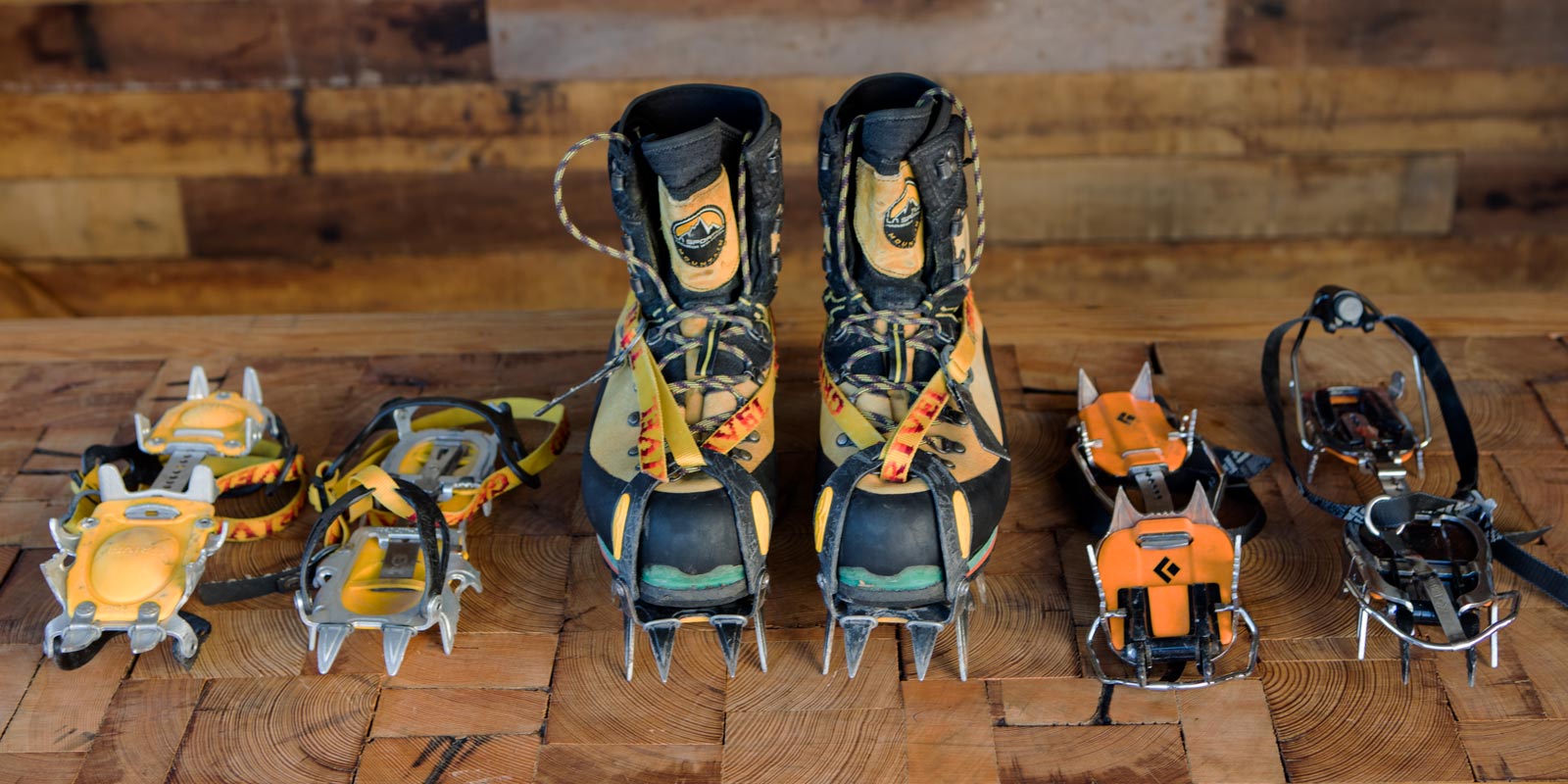
Crampons are a necessity to securely travel on snow and ice. With them, you can cross glaciers, ascend snow slopes, climb frozen waterfalls and scale ice-smeared rock.
Because most alpinists and ice climbers today wear leather or synthetic-leather boots (instead of plastic mountaineering boots), semi-rigid construction with horizontal frames are the rule. And, thanks to modern design and manufacturing technique, crampons have become lighter and better fitting.
The Right Crampons for You
Crampons are becoming more specialized by activity. Super-lightweight traction devices are made for everyday winter walking. More traditional crampons handle snow and glacier travel, technical hiking (when you bring along an ice axe) and mountaineering. Crampons designed for frozen waterfalls or mixed ice/rock routes are now increasingly technical.
Use this chart to help match the crampon to your activity.
| Activity | Materials | Frontpoint Type | Construction | Binding | Points |
| Snow walking | Aluminum or steel | Fixed horizontal | Flexible construction (i.e., spring center bars) | Strap-on | 8 or 10 |
| General mountaineering | Steel | Fixed horizontal | Semi-rigid | Strap-on, hybrid or step-in | 10 |
| Technical mountaineering | Steel | Fixed horizontal | Semi-rigid | Strap-on, hybrid or step-in | 12 |
| Waterfall ice and mixed climbing | Steel | Modular vertical | Semi-rigid | Hybrid or step-in | 14 or more |
Crampon Frames
Frame Materials
- Steel crampons are best for general mountaineering. Their durability makes them essential for technical, steep and icy terrain.
- Stainless-steel crampons offer corrosion resistance as well as the other benefits of steel crampons.
- Aluminum crampons can be ideal for approaches and ski mountaineering. Their lower weight makes them better on alpine climbs, but they will wear out significantly faster than steel if used on rocky terrain.
Frame Alignment
It used to be that you'd buy crampons with a vertically oriented frame to use with double plastic boots. However, since climbers have generally moved from plastic boots to insulated leather boots, crampons aren't required to be as rigid. Horizontally oriented frames are now the rule. Horizontal frames flex for walking and, because the steel or aluminum lays flat, your feet are closer to the ground than with vertical frames so you enjoy greater stability. The flat bars also repel snow efficiently.
Weight
Aluminum crampons are the lightest, but as you save weight you generally decrease durability and strength. For non-technical climbing, aluminum is a good choice—just avoid mixed rock-and-snow climbing in aluminum crampons.
Construction
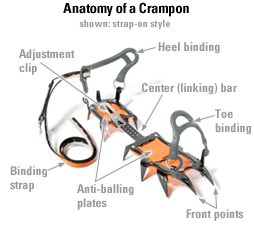
While hinged and rigid crampons are still available, the vast majority in use today are considered semi-rigid.
A semi-rigid design offers the advantage of good performance in the broadest of conditions. It provides sufficient flex for winter walking yet is rigid enough for moderate ice climbing. For example, I have used semi-rigid crampons to climb Telluride's Bridal Veil Falls since I needed something that could perform on the approach as well as on the technical climb.
On some models, an adjustment can be made to the linking bar (the bar between the toe and heel piece) that changes the crampon from a semi-rigid to a flexible mode—making it more comfortable for hiking and less likely to ball up with snow.
Semi-rigid crampons are easier to adjust than the old rigid designs and fit a greater variety of boot shapes. If you have a highly curved boot, you can get an asymmetrical center bar as an accessory to get a better fit. Or you can try a longer or flex (spring steel) center bar depending on the size and type of your boot.
Note: There are left and right crampons in a semi-rigid design. This is determined by the orientation of the center bar.
Types of Bindings
Crampons attach to most boots using one of the 3 binding types described below. If you wear overboots (for high-altitude or very cold conditions), make sure you try on crampons with these boots in place, as their extra rubber and fabric can affect crampon fit. Some manufacturers also make bail wires compatible with telemark boots.
Hybrid
Sometimes called mixed or semi-step crampons, hybrids feature a heel lever and toe strap. They require boots with a stiff sole plus a heel groove or welt to hold the heel lever. The toe strap, however, doesn't need a welt to fit securely. These are easy to put on with gloves since you don't need to clean out the toe welt and line it up—you just pull on the toe strap and throw the heel lever.
Step-In
In this system, a wire bail holds the toe in place while a heel cable with tension lever attaches the crampon to the heel. If the boot/crampon fit is right, this results in a very secure system. This is also the easiest style to put on with gloves and in snowy conditions. For a step-in binding, boots need to have rigid soles and at least a 3/8" welt or groove on the heel and toe. An ankle strap is also typically part of the system. Another advantage of a step-in system is that you can move the front bail to adjust the length of front points according to the type of terrain. Step-in crampons are recommended for use with ski mountaineering and telemark boots.
Strap-On
This style usually features a pair of nylon webbing straps per crampon. The beauty of this system is that it can be used with virtually any boot or shoe you have (just make sure the center bar is compatible with the flex of your boot or shoe). While these take longer to attach than other styles, they can be fit tightly enough for moderate ice routes. They are a great choice if you'll be using multiple boots with the same crampon. Strap-on bindings, however, aren't quite as precise as step-ins—you can get a small amount of movement between boot and crampon.
Points
Number of Points
Most crampons have 10 or 12 points. You want the points to be in the right place (under your instep and following the shape of the boot). You might need to adjust the front bails of the crampon to get the correct point extension. Nowadays, a few highly technical models have points with serrated sides allowing the crampons to grab even in places where a point doesn't penetrate the snow or ice.
As a crampon's end-use transitions from winter walking and mountaineering to overhanging mixed routes, its number of points (and rigidity) increases.
- Most 10-point crampons are ideal for ski touring and glacier travel. You can use these to climb volcanoes or traverse the Haute Route.
- Crampons for technical ice and mixed climbing have more aggressive frontpoints that are often adjustable and replaceable. These waterfall-specific crampons sometimes allow you to change the length of the front points on the body itself.
Waterfall-specific crampons allow front points to be configured as dual-point, monopoint or monopoint offset. Sometimes climbers change the droop angle of their crampons, with steeper droops set for dry tooling, when pulling in with the feet is necessary (like with climbing slippers on overhangs).
For general mountaineering, it is easier to walk with less frontpoint sticking out. For technical climbing, you'll want longer frontpoints. Most step-in technical crampons have different front bail positions, so you can adjust the toe position according to whether you are walking or climbing.
Frontpoints
This refers to the forward-facing points (or point) on crampons:
- Horizontal: These dual points are suitable for almost any alpine climbing or ice/snow climbing.
- Vertical: These dual points are preferred for steep waterfall and mixed climbs. These frontpoints slip easily into cracks and are adjustable and replaceable. Some technical-ice crampons have secondary frontpoints for added support and traction.
- Monopoint: This single point is popular for technical waterfall and mixed climbing. The specific demands of a technical waterfall or mixed alpine route (as well as the conditions) often dictate the type of crampon that's best suited for the task.
Modular vs. Non-Modular
Points are either modular (adjustable) or non-modular (fixed).
- With modular front points, you can replace the teeth or reconfigure them to support the type of walking or climbing you have planned. If you are doing a lot of mixed rock-and-ice climbing and think you'll need to replace your points eventually, get modular crampons.
- While non-modular points can be sharpened, they get shorter with wear. These one-piece forged marvels tend to be lighter than their non-modular cousins. Also, since there are no moving parts, you don't have to worry about screws coming loose.
Crampon/Boot Compatibility
Boot and crampon compatibility is essential for performance and safety. Your boot type ultimately tells you what options you have in binding systems. For example, ultralight strap-on crampons will work on ultralight hiking boots, but they are not suitable for mountaineering or ice climbing. A crampon strapped to a flexible-soled boot will not fit as securely as on a rigid-soled boot. Some considerations:
Determine what type of boot you have. Is the sole highly flexible, semi-flexible or rigid? Does it have toe or heel welts, or both? If you have highly flexible boots without toe welts, you may need a new boot if you are planning to wear them with technical climbing crampons.
What activities are you planning? For mountaineering or ice climbing, look at the toe and heel of your boot. You have several crampon binding options. For walking rather than climbing, consider less-technical crampons with a strap-on binding. If you want step-in crampons, keep in mind you need stiff-soled boots with thick welts or grooves at the toe and heel.
Match the flexibility of your footwear with the flexibility of the crampon. For highly flexible boots, get crampons with a flexible center bar that connects the front and back. You can wear aluminum crampons with sneakers (and strap-on bindings) for light mountaineering or glacier travel, just make sure the flexibility is similar.
Bring along your boots when shopping. This is a smart way to make sure a crampon fits. Make sure the center bar fits the boot for flex, shape and length. Climbers often make micro-adjustments, like adjusting the toe bail, to secure a seamless fit.
When in doubt, go with a strap-on system. This fits most footwear best, and it's always better to error on the side of getting a crampon that fits!
Crampon Accessories
Anti-balling plates: All crampons come with an anti-balling plate (usually made of ABS plastic) to prevent snow from sticking to the bottom of the crampon. This is important to keep you from losing traction. Anti-balling systems are highly recommended by the UIAA (the International Mountaineering and Climbing Federation).
Crampon cases and point covers: Protect your pack and yourself from sharp crampon points with rubber point covers or a crampon case which is typically made of rugged, puncture-resistant nylon. Cases make for quick and easy storage; rubber point covers are less bulky and less expensive.
Gaiters: In addition to a crampon case, consider a sturdy pair of gaiters to protect your lower legs and apparel from getting nicked by sharp crampon points.
Spare parts: You can buy alternative center bars for most crampons. These bars can make the crampon more or less flexible, or allow you to extend a crampon to fit bigger boots. If traveling to remote area, it's a good idea to bring along extra toe and heel bails, screws and center bar.
Crampon Care
Already own crampons? Read our important tips about crampon care.