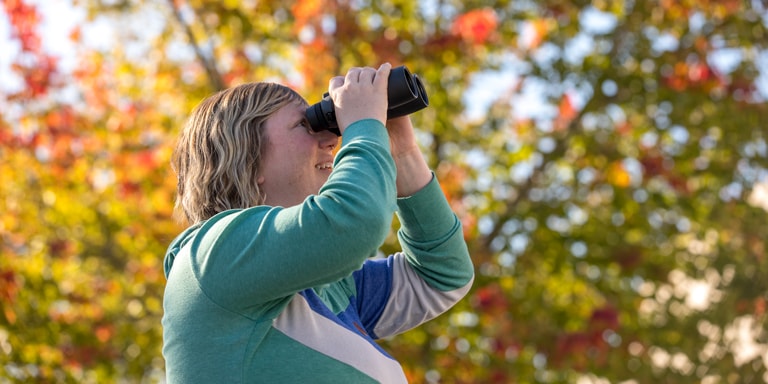
Considering that binoculars are designed to bring clarity to your outdoor experiences, it's amazing how confusing things get when trying to decide which pair of binoculars is right for you. The best way to evaluate the optical performance and ease of use for a pair of binoculars is to go to a store and look through several before you make a final choice. That said, here are a few key things we can help you understand when choosing the best binoculars for you.
How to Buy Binoculars
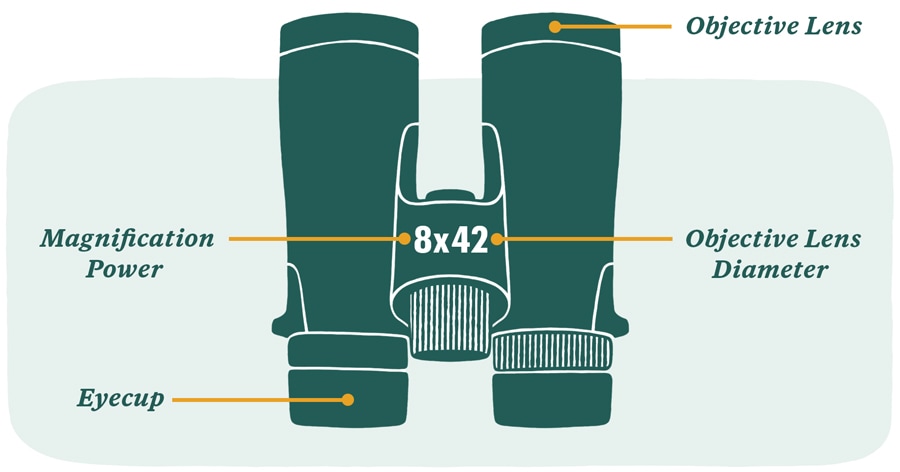
What do the numbers (specs) on binoculars mean? Model numbers on binoculars essentially tell you their strength (magnification power) and size (objective lens diameter). In 8x42 binoculars, for example, "8" is the magnification power and "42" is the diameter (in millimeters) of the objective lenses (the lenses closest to the object you're viewing). Objective lens size gives you an understanding of how physically big the binoculars are and how much light they can gather. When you understand what these numbers mean and how they affect your viewing, you'll know if you're choosing binoculars that will be good for birding, stargazing or using on a moving boat, for example. (Below, we'll go into more detail about binocular specs.)
Why are binoculars with similar specs pricier than others? It's what's inside that counts, and advanced optics are a big reason why the price of similar binoculars can differ by hundreds of dollars.
What additional features are important to consider when buying binoculars? Protective touches like rubber coating, as well as waterproof and fog-proof construction, factor into price, and depending on your intended usage may be well worth the upgrade.
How do I choose binoculars for specific uses? If you want binoculars for a specific primary purpose such as bird watching, whale watching or astronomy, the basic guidelines below can help narrow down your choices. Magnification and size are the starting point, but optics and features should also factor into your decision.

Binoculars for backpacking and hiking: Because size and weight in a pack are key concerns, you'll want compact binoculars with magnification of 8 or 10 and an objective lens diameter less than about 28 (8x25, 10x25, 8x28 and 10x28 are all fine choices). A pair with a rubber coating will be more durable, and models that are water resistant or waterproof will help with exposure to the elements.

Binoculars for birding: Assuming you're less concerned about size and weight, you can look at midsize and full-size models (8x32 and 8x42 binoculars are popular with birders). While 10-power magnification might seem helpful in looking at a small animal, an otherwise identical pair of binoculars with a magnification of 8 will have a wider field of view, which is key to locating birds. Water resistance is also a good feature, as are models that won't fog up when they go from a warm vehicle to cooler temps outside.

Binoculars for whale watching, wildlife viewing and safaris: Popular models include 8x32, 8x42, 10x32 and 10x42. Go with a higher magnification (10 rather than 8) when you're likely to be far from the animals. Choose midsize (32mm objective lens) rather than full-size (42mm objective lens) if you want something a little more compact. Water resistance is also good—go with fully waterproof models, though, for whale watching from a boat rather than shore.

Binoculars for paddling: If you're going to be out on the water on a canoe, kayak, SUP or whale-watching boat, you may want to stick with a lower magnification such as 8 or less, because a higher (10-power) magnification can make steady viewing challenging. Choosing a waterproof model is a good idea here, too, for obvious reasons. 8x32 is a popular size.

Binoculars for stargazing: Here's where you want to maximize magnification as well as the light gathering ability of full-size binoculars. 10x42 or 10x50 are options to consider; if you go with higher magnification, you'll need a tripod to hold the binoculars steady.
Understanding Binocular Specs
Size
For simplicity, binoculars are broken down into compact, midsize and full-size categories, based on the size of their objective lenses (the second number in model names). Note, though, that variations in optics, design and construction can still mean that models with the same size objective lenses will differ in size and weight.
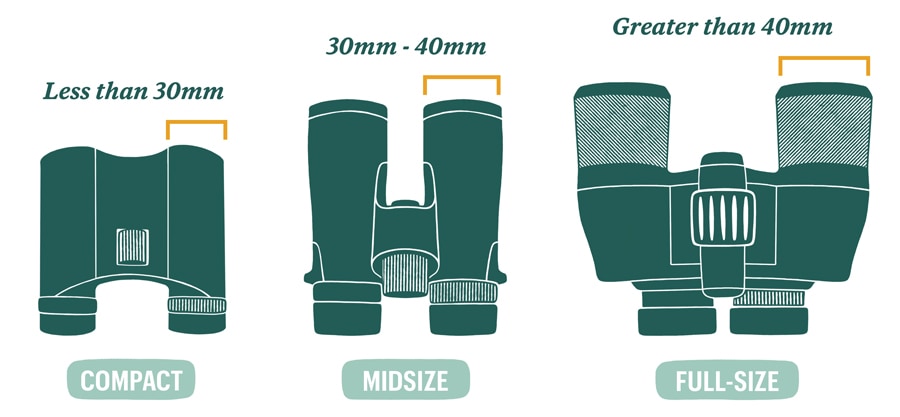
- Compact binoculars: Objective lens size is less than 30mm (8x25, 10x28, etc.)
- Midsize binoculars: Objective lens size is from 30mm to 40mm (10x30, 8x32, etc.)
- Full-size: Objective lens size is greater than 40mm (8x42, 10x50, etc.)
If the binoculars are going inside your pack, then lightweight compact models make sense. Midsize models can give you brighter images and be more comfortable to hold for long periods. That might change with larger full-size binoculars, which some people find too heavy to hold for extended periods of time.
Magnification Power
Most of the time, you'll be choosing between a magnification of 8 or 10, though you can also find models with lower or higher magnifications.
- 8-power binoculars: A wider field of view
- 10-power binoculars: A closer, more detailed look
An 8x25, 8x32 and 8x42 pair of binoculars all provide the same magnification: An object will appear 8 times closer than it would to your unassisted eye.
A note about zoom binoculars: Though this sounds like the ultimate solution, there are tradeoffs in image quality. If you're considering a pair of zoom binoculars, then compare them with a few single-magnification models before you make a final choice.
While it might seem that more magnification is always better, that's not always the case. Because magnification also amplifies the movement of your hands, binoculars with magnification powers greater than 10 make steady viewing difficult, so they would be a poor choice if you will be on a boat or other moving platform.
Field of View
Magnification power also has a direct effect on your field of view (lower magnification expands it; higher magnification narrows it).
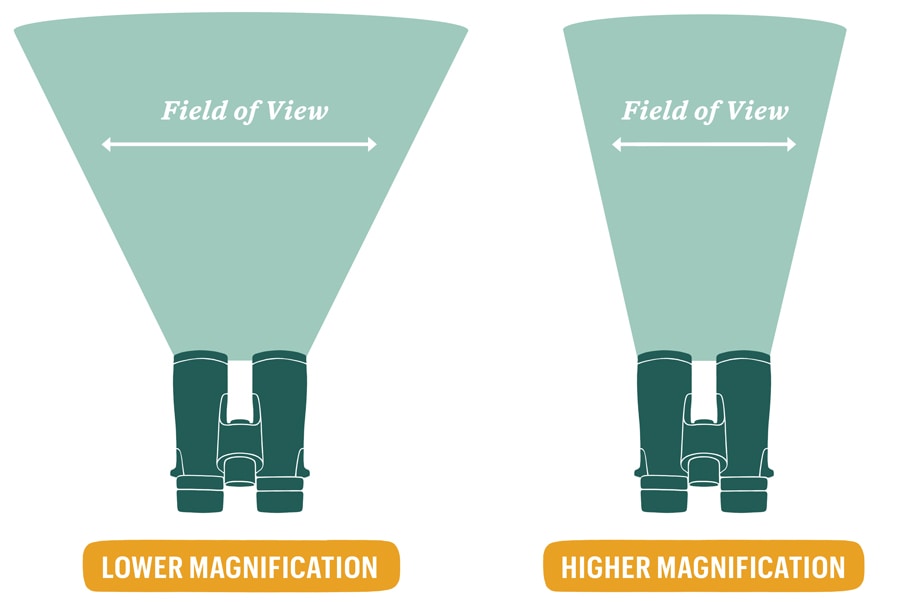
Having a narrower field of view can make it harder to locate small and/or moving objects (like birds) when you scan far away. That smaller field of view also lets in less light, so images will be slightly darker.
Because other factors, like eyepiece design, also play a role, the "field of view" spec is the one to check in order to get the true picture here. This spec states the width of the area you can view at a glance, 1,000 yards from where you stand.
Be aware that binoculars with otherwise identical specs can have dramatically different fields of view (as much as 90 feet wider at 1,000 yards). So, always check that spec whenever you're doing final comparisons.
Objective Lens Diameter
The diameter of the objective lenses plays a key role in how much light your binoculars can gather. For two pairs of binoculars that otherwise have exactly the same specifications, the pair with larger objective lenses will capture more light, providing a brighter image. (Binoculars with higher quality optics will also have brighter images.)
Exit Pupil
Simply put, a higher number means brighter images. A higher number indicates better viewing in low-light situations, and it will be easier to maintain a full image of an object if your hands move or shake.
Exit pupil size is calculated by dividing the diameter of the objective lenses by the magnification number. For 8x42 binoculars, 42 divided by 8 equals an exit pupil diameter of 5.25mm. It indicates the size of the shaft of light that reaches your eyes, whose pupils vary from about 2mm in bright light to 7mm in total darkness.
- For low-light situations, an exit pupil of 5mm or more is good: At dawn, dusk or with dense tree cover, having a high exit pupil number can make viewing easier.
- For bright daylight viewing, exit pupil size is less important because almost all binoculars offer exit pupils that exceed 2mm.
Eye Relief
Eye relief is the distance between an eyepiece and your eye while the whole field of view is visible. This is a key spec if you wear glasses.
If you wear glasses, look for eye relief of 11mm or more.
Most binoculars have adjustable eyepieces that allow you to set them to their maximum eye relief value (the stated spec). That is usually done by rolling down rubber eyecups or by twisting a collar to shorten the eyepieces.
Understanding the Optics of Binoculars
Lens Materials and Coatings
This is where advanced technologies (and a dizzying array of terms to describe them) come into play. The makeup of the glass and the coatings on the lenses that reduce reflection all add up to determine the clarity and brightness of your image. This is when test viewing is key. That will tell you what advancements your eyes can detect, and in turn, how much more you should consider paying for the image quality you want.
Prism Type
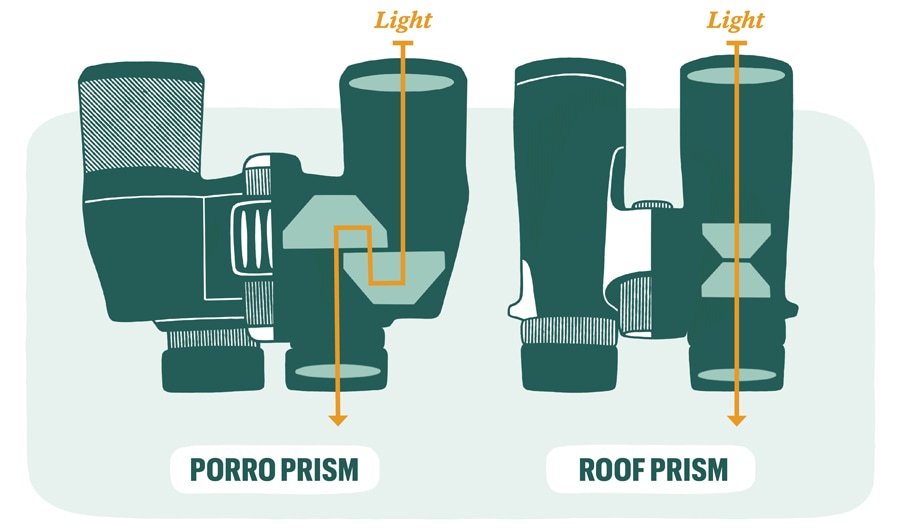
The prisms are the optical elements that direct the light from the image through the binoculars to your eyes. Older "porro prism" binoculars feature wide barrels in front that aren't aligned with the eyepieces. Newer "roof prism" models have eyepieces and objective lenses aligned. The difference in appearance doesn't tell you anything about the optical quality, but having roof prisms allows binoculars to be smaller and lighter.
Protection Features for Binoculars
Waterproof and Weather-Resistant Binoculars
If you'll be using your binoculars in a kayak, aboard a boat or on a trail in the rain, you'll want to look at waterproof or weather-resistant binoculars. Be aware, too, that manufacturers sometimes describe any level of water resistance as "waterproof," even though there is a distinction:
- Waterproof binoculars typically use O-rings to seal out moisture. They can survive a quick splashdown, but not extended submersion. (And most binoculars do not float.) Binoculars with this level of protection typically include "waterproof" in the model name.
- Weather-resistant (or water-resistant) binoculars are not fully waterproof. They can handle light rain, but not a deluge nor a dunking in a creek.
Rubber coating
While it won't provide full-scale crash protection, a rubber coating is still helpful to guard against minor bumps and bruises. It's a worthwhile feature for any binoculars intended to be used in rugged outdoor environments.
Fog-proof binoculars
Binoculars can fog up when you move from a cold to a warm environment. Not only is that annoying, it also can be potentially damaging if moisture gets trapped inside.
To counter fog, binocular makers purge the air inside and replace it with nitrogen, which has no moisture content and therefore won't condense. This protects against fogging up of the internal lens surfaces, not the exterior ones.
How to Focus Your Binoculars
Most binoculars have a central control that focuses both barrels at the same time. They also include a "diopter" adjustment ring to focus one barrel independently, allowing you to compensate for differences in vision between your eyes.
If you're wearing glasses, start by rolling the eyecups all the way down—or twisting them all the way down—before you begin.
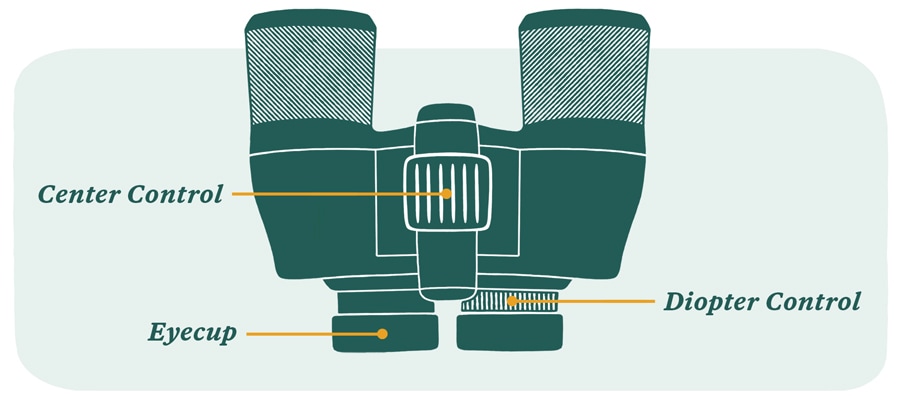
To focus your binoculars, do the following:
- Cover the right* lens with a cap and sharply focus the center control on a distant object.
- Switch the cap to the left* lens and sharply focus the diopter control on that same object.
- You're done; leave the diopter as is and use the center control for all focusing.
*If your binoculars have the diopter on the left lens, reverse where you place the lens cap.
How to Test Out Binoculars
To get a sense of focusing ease, how comfortable binoculars feel in your hands and their optical clarity and brightness, you need to visit a store where you can try out several of the models you're considering.
If the retailer doesn't have a test chart to view, then focus on a detailed object across the store. Pay close attention to the overall sharpness and brightness of the image, as well as the consistency of clarity and brightness from side to side in your field of view.