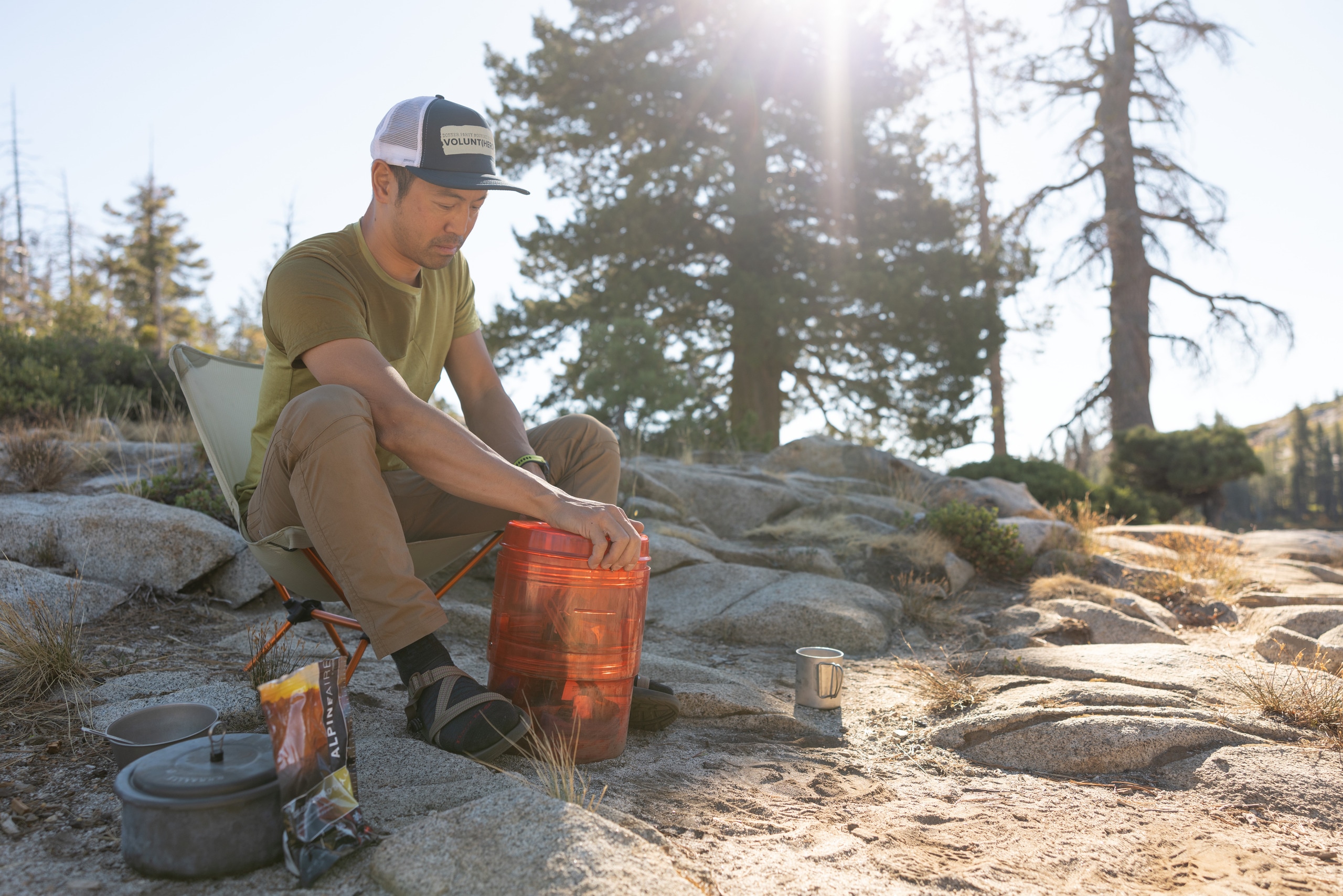
Hanging food in trees is the traditional method of storing food while camping in the backcountry. The better alternative is a bear canister—a portable, hard-sided food locker. Its purpose: Make food and scented items (including toiletries and trash) totally secure from bears, raccoons, rodents and other critters that are powerfully attracted to human food.
Video: How to Choose Bear Canisters
Bear Canister Pros and Cons
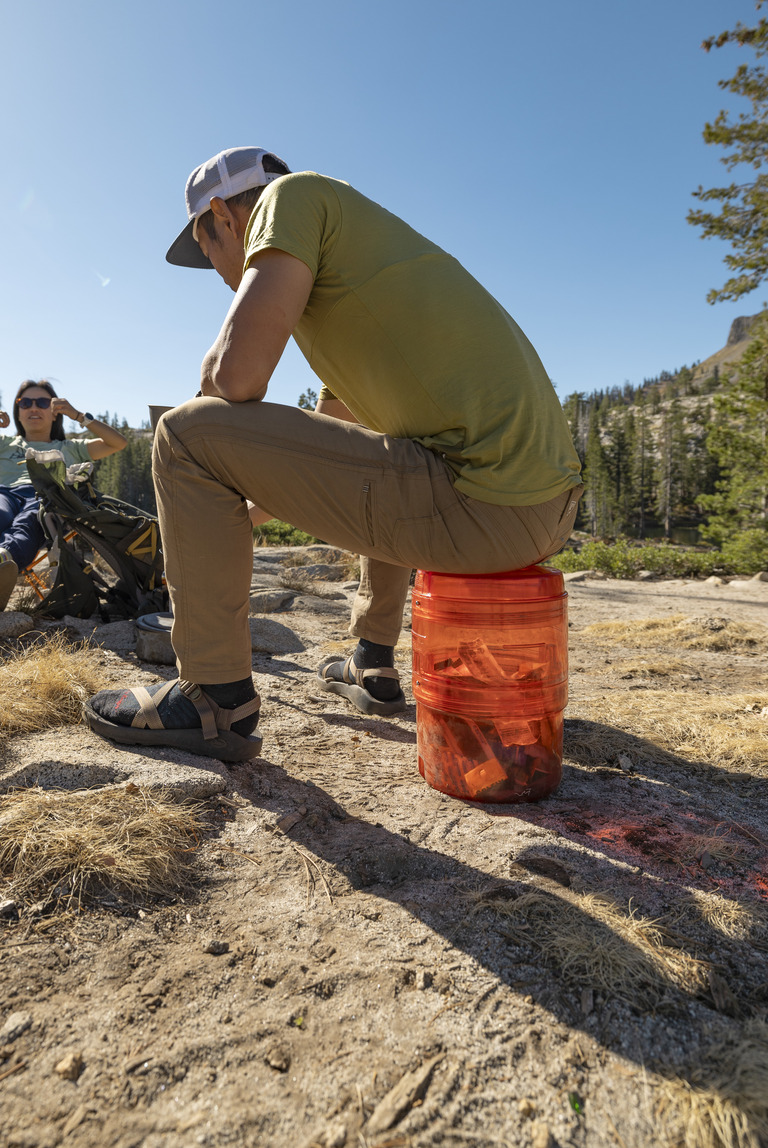
Upside: Canisters offer backpackers peace of mind by providing a simple, effective way to keep human food safe from animals. Using a bear-resistant food container doesn't require you to look for campsites near trees with high branches (to hang your food) or near permanent bearproof food storage lockers. Added bonus: A bear canister also doubles as a camp stool. Some are clear so you can see what food you stored inside.
Downside: Bear cans are heavy (2-3 lbs.), bulky and may not fit all the food and scented items you aim to carry on a lengthy backpacking trip. It helps to plan your meals in advance, choosing items that are compact and nutritious, in order to maximize weight and space.
Canisters typically hold 3-5 days' worth of food and toiletries for one person.
Why You Need a Bear Canister
Bears can sniff out human food with impressive efficiency. Consider: A bloodhound's nose is equipped with about 230 million olfactory cells (scent receptors). That's 40 times the number in humans. It is estimated a bear's nose is just as sensitive as a bloodhound (if not more so).
In backpacking's early days, people slept next to their food. Bears eventually grew bold enough to approach campsites and steal those stashes—while also scaring the daylights out of campers. People tried hanging food bags high over tree limbs, tying off the rope to tree trunks. Bears figured that out, too, snapping the line with their claws.
The counterbalance method came into vogue in the 1970s: two bags (stuff sacks, usually) of roughly equal weight and bulk tied together and suspended on a branch 20 or more feet off the ground at least 10 feet from the trunk. It's a time-consuming task that is rarely simple.
How do you retrieve it? Tie a loop on one bag, and use a long stick to snag it and pull both bags down. Some people tie a long strand of fishing line to one bag; fishing line dangles almost invisibly to the ground and allows a person to reel in the stash by hand.
Where permitted, counterbalancing is still the food-storage tactic of choice if no other option is available.
Bears—intelligent, resourceful and, when it comes to human food, relentless—have found ways to defeat even a superb counterbalance. Adults, for example, will send out cubs on thin limbs to chew the cord or snap the branch.
"Once bears get introduced to human food, they get hooked," says Harold Werner, retired wildlife biologist at Sequoia/Kings Canyon national parks. "They will go to great lengths to find more. They'll even take up residency at 11,000 feet if there's a campsite nearby that consistently attracts people and their food."
Required Usage in Some Parks
Use of an approved canister is mandatory in some national parks and wilderness areas. Always be sure to check with rangers when visiting bear country. This list includes:
- Yosemite National Park (entire backcountry except a few sites where food lockers are in place)
- Sequoia/Kings Canyon National Parks (selected areas; food boxes in place in numerous locations)
- Grand Teton National Park (entire backcountry except where food lockers are in place)
- Rocky Mountain National Park (all backcountry campsites below treeline)
- North Cascades National Park (selected areas)
- Olympic National Park (selected areas)
- Denali National Park (selected units)
- Glacier Bay National Park (all treeless areas)
- Gates of the Arctic National Park (most areas)
- Inyo National Forest, eastern and central Sierra Nevada, California (selected areas)
- Eastern High Peaks Wilderness Area, Adirondack Mountains, New York (between April 1 and Nov. 30, all areas)
Contact individual park and wilderness area administrators for up-to-date information. Some parks offer a canister rental program. SierraWild.org, a sporadically updated website jointly operated by the National Park Service, U.S. Forest Service and Bureau of Land Management, offers bear information and an overview map.
Some parks have taken their own approaches to food-storage issues. Examples:
- Great Smoky Mountains National Park provides food-hanging cables at nearly all its backcountry campsites.
- Lockers or bear poles are found at all of Glacier National Park's 63 backcountry campsites (where backpackers are required to make camp).
- Sequoia/Kings Canyon has lockers in place in several backcountry areas.
Before you travel to any wilderness area, it's smart to contact ranger or land manager in advance to learn if any food-storage regulations are in place
Tip: If a campsite has a permanent food locker, show your gratitude by not leaving trash, or anything, inside when you leave. Keep 'em clean.
Video: How to Pack a Bear Canister
Tips for Using a Bear Canister
- To ensure balance while hiking, carry a canister in the center of your backpack, close to your back and near your shoulders.
- Flip canisters upside-down when stashing them for the night. Thus rain won't seep into the Garcia model, and bears are less likely to gnaw on the twist-off lid of a BearVault (shown at right).
- Place canisters in a level, open area 100 feet from your campsite. Give them a splash of florescent paint or apply reflective stickers to boost their nighttime visibility.
- Don't stash a canister near a ledge or lakeshore. Otherwise an inquisitive animal may swat it somewhere undesirable.
Store your food-resistant canister on the ground hidden in brush or behind rocks, according to park officials.
- Air-sealed food packages tend to balloon out and their air bubbles fill up interior space. Consider picking out a few items you know you will eat early on the trip, poke a tiny hole in the top of the packaging and squeeze out excess air to reduce volume.
- SierraWild.org offers a list of canister-packing ideas.
- When in grizzly territory, consider sealing items in odor-negating barrier bags. Just take care not to touch the outside of the bags with odiferous items or hands. The Interagency Grizzly Bear Committee offers info on coexisting with grizzly bears.
Tip: BearVault's lid can sometimes be difficult (for humans) to open in cold weather. Try wedging an old credit card between the stop tab and the lid to make it slide open more easily.
Field Observations
In 2010, the International Journal of Wilderness published a study, "Wilderness Food Storage: Are Bear-resistant Food Storage Canisters Effective?"
Citing three surveys on canister usage, the authors arrived at this answer: "Canisters are extremely effective when used properly and conscientiously, but there is still room for human error, and that is the root cause of most, if not all, of the problems….compliance approaching 100% is likely necessary to avoid human-bear conflicts."
The authors noted that in Yosemite approximately 100 wilderness bear incidents are reported annually.
Once familiarized with human food, a bear's natural food-foraging habits are altered. Bears become increasingly aggressive in their pursuit of human treats, harassing campers in scary human-bear encounters. Such events lead to a death sentence for what are now "problem bears." Rangers are obliged to kill such bears due to safety concerns.
Kate McCurdy is a former wildlife biologist at Yosemite and was once the park's task force leader for its bear-management program. "It was my job to kill bears that become aggressive toward humans and their food," said McCurdy, now director of the Sedgwick Reserve near Santa Barbara. "That's not something I enjoyed.
"I heard people sitting at the grill in Tuolumne Meadows and laughing about losing food to a bear on an overnight trip," she said. "It gives them an exciting story to tell, but what they're really doing is changing a bear's behavior, and that's potentially deadly to the animal. Whenever I get to backpack, I've just learned to suck it up and live with a canister and the extra 3 pounds."
McCurdy said Yosemite's bears are such quick learners that many grew to recognize canisters and associate them with frustration and wasted effort, not a reward.
"Field crews began using them in 1991 and '92," she said. "We tracked a learning curve in how bears deal with canisters. At first, bears would spend an hour trying to break one open. Over time, it got down to 30 minutes, then 15. It grew more common that if a bear glances at a campsite and sees a canister, it's going to just keep moving. That's encouraging."
McCurdy's conflicts over the euthanizing of a food-altered bear in Yosemite, one with three cubs, are told in the book Ranger Confidential.
Yosemite periodically updates a page on its website with statistics on bear incidents. The park also dedicates a page to general black bear information.