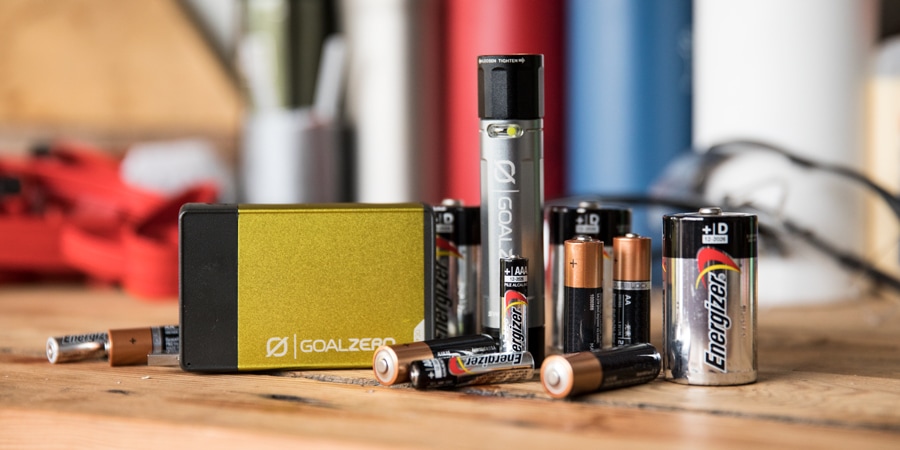
Batteries are portable storehouses of energy. They power our headlamps, lanterns, GPS devices, cameras, music players and more. The ideal battery will give you a balance of long duration, high performance, fair cost and low environmental impact. In order to get that, you have to know what you're looking for, which can be tough when you start digging into details about electrodes, cathodes and different metal types.
In this guide, we walk you through the options and include the pros and cons of different battery types as they relate specifically to outdoor users, like hikers, bikers, skiers and climbers.
Tips for Choosing Batteries:
- Figure out what size batteries you need: This is simple. If your gadget runs on AAA batteries, then that's what you need. You can look on the device itself for an indication of what battery size it takes, or consult the instruction manual.
- Decide between single-use or rechargeable batteries: Single-use batteries are cheaper upfront and have an excellent shelf life, but rechargeables can be used again and again, making them ultimately the more cost-effective choice.
- Get the right type of battery: Understanding how batteries work and knowing how alkaline differs from lithium and NiMH from lithium-ion will help you pick the best battery for your application.
If you're interested in portable solar chargers and rechargeable battery packs, see our article, Solar Chargers and Portable Power.
Figure Out What Size Batteries You Need
You don't need to know much about batteries to get the right size for your device. Figuring it out can be as easy as looking at the batteries currently in your device and replacing them with the same size (i.e. if there are AAA batteries in there, then that's what size you need to buy). If you don't already have batteries installed, look on the device for some indication or check the instruction manual.
If you want to know a little more about battery sizes, here's a quick primer:
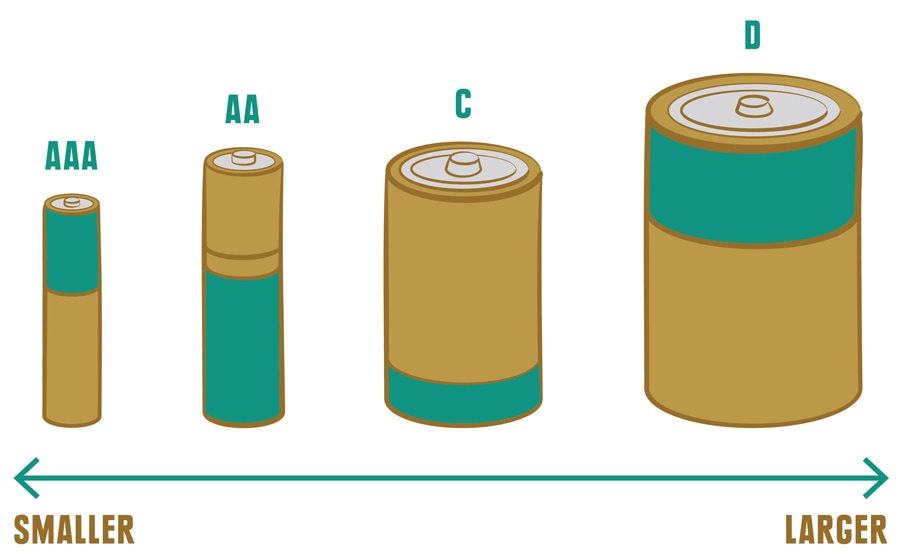
You're probably familiar with AAA, AA, C and D batteries. Those letters are indicators of size. Basically, the farther you get through the alphabet, the larger the battery (e.g. D is bigger than C). When you see a letter used more than once (eg. AA, AAA), the more times it's used, the smaller the battery (eg. AAA is smaller than AA).
Sizing for coin cell batteries (also called button cell batteries) works a little differently. These batteries typically include two letters followed by four numbers. The first letter indicates the chemical composition, while the second indicates the shape. The four numbers describe the size, with the first two indicating diameter and the second two indicating height. For instance, with a CR2032 battery, the C stands for lithium, the R specifies that the battery is round, and 2032 means that the battery is 20mm in diameter by 3.2mm high.
Choose Single-Use or Rechargeable
If you're shopping for common cylindrical batteries, like AAA, AA, C or D, you have the option of buying single-use batteries or rechargeable batteries (coin-cell batteries, like CR2032, are single-use only). Both have advantages and disadvantages; Here's a quick look at those:
Single-use batteries: These are what they sound like. When they run out of juice, you need to dispose of them (to find battery recycling options near you, visit Call2Recycle.org). The two main types of single-use batteries are alkaline and lithium.
Pros:
- Cheaper upfront cost than rechargeable batteries.
- Very low self-discharge rate (power loss when not in use) for a long shelf life.
- Widely available.
Cons:
- Require disposal after fully discharged.
Rechargeable Batteries: These batteries are built to be recharged over and over again, in some cases up to 500 times or more. The two main types of rechargeable batteries are nickel-metal hydride and lithium-ion.
Pros:
- Because they're rechargeable, they generate less waste than single-use batteries.
- They offer better long-term value than single-use batteries (the more you use them, the cheaper they get).
Cons:
- More expensive upfront cost than single-use batteries.
Get the Right Type of Battery
Once you've settled on the battery size and decided between single-use and rechargeable, you may find it helpful to understand a bit more about the different types of batteries. With a basic understanding of how batteries work and what's inside them, you can make more informed decisions about the right type of batteries for your needs.
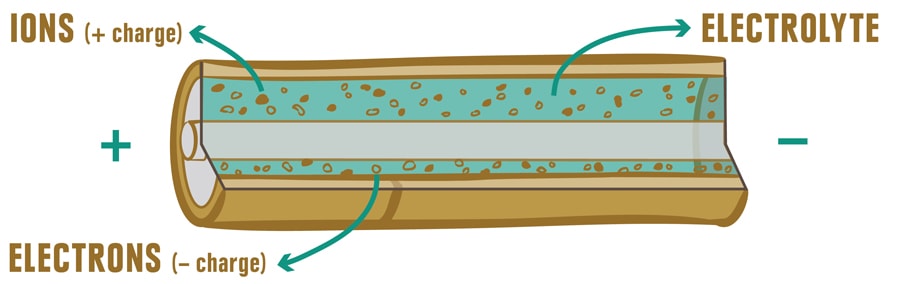
Battery basics: Common batteries, such as AAA, AA, C and D, have positive and negative terminals and two internal layers called electrodes that include a cathode (which transports a positive charge) and an anode (to carry a negative charge). All batteries also have some type of electrolyte—a substance that conducts electricity (a flow of electrons) between the battery's terminals. When you put a battery in a device, like a headlamp, the electrolyte, cathode and anode interact and a chemical reaction (basically oxidation) occurs. Ions (positively charged) and electrons (negatively charged) flow through the electrolyte, exit via the negative terminal and enable your device to function.
Over time, a battery's internal chemicals begin to degrade and interaction diminishes. Eventually they can no longer retain a charge and are considered "dead."
The mix of chemicals in a battery aims to provide some combination of the four holy grails of the elusive "ideal" battery—long life, high performance, reasonable cost and low environmental impact. Here's a closer look at the most common options available for single-use and rechargeable batteries:
Single-Use Batteries
Single-Use Alkaline Batteries
The most commonly used battery of all is an alkaline battery (meaning it contains an alkaline electrolyte, usually potassium hydroxide).
Best use: "Low-drain" devices such as LED headlamps, LED flashlights, toys, remote control devices, clocks and radios, and even moderate-drain items such as lights using incandescent bulbs. Alkaline batteries can be used in high-drain devices (digital cameras, for instance), though their life expectancy will be sharply reduced. Why? Even though alkalines have high initial energy capacity, high-drain devices exert such a substantial draw that energy swiftly gets drawn down.
Pros:
- Moderately priced
- Widely available
Cons:
- Perpetual cycle of use-disposal-replacement. Can possibly be recycled, but most wind up in landfills.
Nominal voltage: 1.5 (though it gradually declines to less than 1 volt as the battery discharges its energy).
Estimated shelf life (at 68°F/20°C): 5-7 years.
Single-Use Lithium Batteries
Lithium, an exceptionally light metal, gives lithium batteries the highest energy density of any battery cell. Thus, they can store more energy than alkaline batteries or any single-use battery of a comparable size. And they are superb performers in extreme temperatures, both hot and cold.
USE WITH CAUTION: Their higher voltage capacity makes lithium batteries too powerful for some devices and may damage circuitry. Read manufacturer instructions for battery recommendations for individual products.
Best use: High-drain devices (eg. digital cameras) and most (but not all) moderate-drain devices (eg. headlamps, toys).
Pros:
- Longest life (by far) in single-use category; in a digital camera, lithium batteries hypothetically may produce 100-200+ flash photos; alkaline batteries, 20-40+.
- Superior functionality in extreme temperatures, from well below zero to over 100°F.
- Very long shelf life.
- Light weight (approximately 30 percent lighter than equivalent sized alkaline batteries).
Cons:
- More expensive.
WARNING: Higher voltage may damage some devices. Read manufacturer instructions that accompany each device to determine if they can handle lithium batteries.
Nominal voltage: 1.5-3 (though it gradually declines as battery discharges).
Estimated shelf life (68°F/20°C): 10-15 years.
Comparing Single-Use Batteries
| Alkaline | Lithium | |
|---|---|---|
| Nominal Voltage | 1.5 | 3.0 |
| Estimated Shelf Life | 5-10 years | 10-15 years |
| Performance at 0°F | Poor/good | Very good |
| Best or Common Uses | Moderate-drain devices: Headlamps Toys Low-drain devices: Clocks Smoke detectors | High-drain devices: Digital cameras GPS Moderate-drain devices: Headlamps Toys |
| Distinctive Characteristics |
|
|
| Recyclable | Yes. To learn how and where, visit: www.call2recycle.org | |
What is the difference between lithium and lithium-ion batteries? Lithium batteries cannot be recharged. Lithium-ion batteries can.
Rechargeable Batteries
Rechargeable Standard Nickel-Metal Hydride Batteries
As the name suggests, a Nickel-Metal Hydride (NiMH) battery consists of:
- nickel (typically nickel hydroxide; used for the cathode/positive electrode)
- an alloy (a mixture of metals or metal mixed with other elements; used for the anode/negative electrode)
- potassium hydroxide (an alkaline) as an electrolyte.
NiMH batteries have replaced nickel cadmium (NiCd) batteries as the preferred cylindrical rechargeable battery. They offer higher energy capacity (up to 50 percent more) than NiCd batteries and avoid the high toxicity of cadmium. That said, standard NiMH batteries have largely been replaced by precharged NiMH batteries (see the Precharged NiMH batteries section below for more information).
Best use: High-drain devices (e.g. digital cameras, flash units) or devices that experience prolonged or continuous use (e.g. GPS receivers). Not recommended for items that are rarely used or infrequently inspected, such as smoke detectors or a flashlight in an emergency kit.
Pros:
- Delivers energy capacity at a more constant rate (technically, a flatter discharge rate) than single-use batteries—for example, the light from a headlamp using alkaline batteries starts brightly and progressively grows dimmer. With NiMHs, the light level remains stable due to the steady voltage delivered by rechargeable batteries.
- Delivers substantially more current (electron flow) than an alkaline battery, boosting its performance when servicing high-drain devices.
- No measurable "memory effect" (this is when a battery tends to "remember" to only store the amount of energy it delivered during its most recent discharge).
- Performs reasonably well in colder weather.
- Better long-term value than single-use batteries.
- Recyclable.
Cons:
- Fairly fast rate of "self-discharge" (loss of power when not in use)—idle NiMH batteries may lose between 1 and 5 percent of their stored power in a day, between 30 and 40 percent in a month (and potentially more in warm conditions).
- Moderately expensive initially.
- Must be charged before first use.
- Should be charged every 1-2 months.
- Energy capacity declines by 10-15 percent after 100-plus recharges.
- Performance may diminish if dropped or handled roughly.
Volts: 1.2 (steady voltage is generally sustained throughout a cycle, dropping to 1.1 before a charging cycle is complete).
Estimated number of recharging cycles: 150-500
Self-discharge rate: Loses 1 percent (or more) of stored power per day, roughly 40 percent per month.
Storage: Store fully charged at 60°F/15.5°C.
Tips:
- Higher capacity batteries will power a device for longer. The capacity of NiMH batteries is presented as milliamp hours (mAh). Look on the batteries themselves or the packaging to find the mAh rating.
- Can be recharged at any time, no matter what level of energy capacity they retain.
- For best performance, recharge whenever energy capacity drops 30- to 50-percent below its peak capacity.
- To begin a prolonged period of storage, all NiMH batteries first should be fully recharged.
- If left unused for long stretches, recharge standard NiMH batteries every 1-2 months.
Rechargeable Precharged Nickel-Metal Hydride Batteries
Also called "hybrid," "ready-to-use" or "low self-discharge" batteries, these NiMH batteries come precharged in their package so they are ready for action. They offer a very low self-discharge rate (power loss when not in use), which makes them very popular in the rechargeable category for cylindrical batteries (AAA, AA, C and D cells). For these reasons, precharged NiMH batteries have for the most part replaced standard, non-precharged NiMH batteries.
Best use: High-drain devices (eg. digital cameras, flash units) or moderate-drain devices that experience prolonged or continuous use (e.g. GPS receivers, headlamps). Its lower self-discharge rate also makes it suitable for some low-drain devices, like clocks and TV remotes.
Pros: Same as standard NiMH, plus:
- Can go straight from the package and into your device.
- Much lower self-discharge rate than standard NiMH batteries (making this design an excellent choice for headlamps or any device that may be actively used for a week, then left untouched for months).
Cons:
- Moderately expensive initially.
- Should be charged every 6-9 months.
- Energy capacity declines by 10- to 15-percent after a few hundred recharges.
Volts: 1.2 (steady voltage is generally sustained throughout a cycle).
Estimated number of recharging cycles: approximately 150-500
Self-discharge rate: Much better than standard NiMH batteries, roughly 10-20 percent over 6 months.
Storage: Store fully charged at 60°F/15.5°C.
Tips:
- Higher capacity batteries will power a device for longer. The capacity of NiMH batteries is presented as milliamp hours (mAh). Look on the batteries themselves or the packaging to find the mAh rating.
- Can be recharged at any time, no matter what level of energy capacity they retain.
- To begin a prolonged period of storage, all NiMH batteries first should be fully recharged.
- If left unused for long stretches, recharge precharged NiMH batteries every 6-9 months.
Rechargeable Lithium-ion Batteries
Lithium-ion batteries today are more commonly found in the form of a slab, block or battery-pack rather than in the cylindrical shape of AAA, AA, C or D. They are used extensively in smartphones, digital cameras, computers and other consumer electronics.
Best use: Notebook computers, smartphones, GPS sport watches, portable power devices, some bike lights.
Pros:
- Offers the lowest self-discharge rate (less than 10 percent in a month) of any rechargeable battery.
- High estimated number of recharging cycles (500-1,000+).
- Recyclable.
Cons:
- More expensive.
- Even if left unused, is negatively impacted by age.
Volts: 3.6 (with some variations).
Estimated number of recharging cycles: 500-1,000+.
Self-discharge rate: Very low, but age is the enemy of Li-ion batteries. Even if unused, the simple passage of time robs them of some energy capacity. The quantity of the loss varies according to the size and configuration of the battery.
Storage: Store at roughly 60°F/15.5°C, either fully charged or at 50 percent of capacity (opinions vary on this topic).
Tips:
- Recharge often, even if only a modest amount of energy has been drained.
- Avoid fully exhausting a Li-ion before recharging. Doing so won't ruin a Li-ion, but it is not viewed as a recommended practice.
- More charging cycles can be achieved if a Li-ion battery is recharged after shallow discharges (roughly 30 percent of capacity, which can be determined on devices that offer an energy capacity indicator or battery "fuel gauge"). If possible, avoid scheduling recharges after medium (50 percent) or full (90-100 percent) discharges.
Comparing Rechargeable Batteries
| Standard NiMH | Precharged NiMH | Lithium-ion | |
|---|---|---|---|
| Nominal Voltage | 1.2 | 1.2 | 3.6 |
| Typical AA Energy Capacity (mAh) | Very high (approx. 2,500) | High (approx. 2,000-2,400) | AAs/AAAs not widely available |
| Estimated Recharging Cycles | 150-500 | 150-500+ | 300-500+ |
| Average Rate of Self-Discharge | Poor (1%/day, 30%-40%/month) | Very good (20% per 6 months) | Excellent (< 2%/month) |
| Performance at 0°F | Good/fair | Good/fair | Good/fair |
| Best or Common Uses | High-drain devices: Digital cameras GPS Moderate-drain devices: Headlamps Toys | High-drain devices: Digital cameras GPS Moderate-drain devices: Headlamps Toys | Notebook computers Smartphones GPS Sport watches Portable power devices Some bike lights |
| Distinctive Characteristics |
|
|
|
| Recyclable | Yes. To learn how and where, visit: www.call2recycle.org | ||
Battery Tips
To get the most out of your batteries, follow these tips when possible:
- All batteries, even those designed to handle extreme temperatures, can experience a decline in performance when exposed to high or low temperatures. For hikers, climbers, skiers and other outdoor recreationalists, cold temps are often the biggest challenge. To limit the effects that the cold has on battery power, try to keep your device warm. You can do this by keeping your headlamp, smartphone, GPS or other gadget somewhere close to your body.
- Do not attempt to simultaneously recharge batteries of different capacities, different brands or different ages. Do not use batteries of different brands or different ages together.
- Remove batteries from devices if they will be left unused for months at a time. This prevents a device from exerting a tiny drain on the batteries even though the device is inactive.
- Remove single-use (nonrechargeable) batteries from a device when they are being powered by household AC current. Doing so spares the batteries from any tiny drain on their power reserves by the device.
- Do not store batteries, particularly single-use batteries, in locations where heat can become intense, such as car trunks, attics or garages.
- Avoid tossing batteries into a drawer, briefcase or bag where they may contact metal objects such as coins or paper clips. Doing so may cause a short or it could negatively affect a battery's polarity.
- Never put batteries into a fire. Doing so could cause them to rupture and spill their contents. Also: Avoid tossing them into a metal container where heat could build up.