Snowboarding may seem like a young person's sport, but the reality is that it can be enjoyed by people of all ages and abilities. There are lessons to be taken and lessons to be learned. The more you fall, the more you learn. The more you board, the better you become. It just takes practice, and what could be better than being in the crisp wintertime outdoors?
Types of Boards/Styles
There are 3 distinct categories of snowboarding—freeride, freestyle and alpine—but with several subcategories and an array of boards, it can get confusing. Some manufacturers promote their boards strictly as freeride, freestyle or alpine, while others classify their boards as freestyle/freeride, freeride/backcountry, carving/racing, wide board and/or small board.
The bottom line is, a snowboard of any category can be ridden wherever and however you choose. One added consideration is that most companies now emphasize width as much as length, and in any category there are wider or smaller boards. Width choices allow people with large feet to get a wide board so their feet are not hanging off the edges, while women and children usually need a board that is narrower.
Freeride
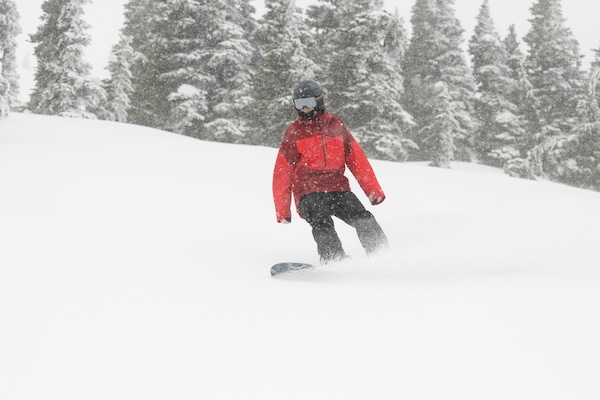
Freeriding, which is sometimes called all-mountain, is what most snowboarders do. Freeride boards are usually semi-rigid and use a soft binding and a soft boot. They are versatile for all types of snow and terrain, on- or off-trail. They are long and reactive with a moderately turned-up nose and tail. The boards are longer, narrower and stiffer than freestyle boards. They sustain speed in carving, but they still can handle a jump or powder. The shorter effective edge(the amount of edge that is in contact with the snow) makes them easy to turn, and the turned-up tail allows fakie (backwards) riding. They are good all-around boards.
Within the freeride category is backcountry snowboarding, which is sometimes called an extreme, big mountain or longboard. Backcountry boards have a directional shape with tip and tail having different characteristics. One difference is the scoop, or the degree of nose and tail upturn. This affects the amount of effective edge. The longer the effective edge, the more stable, but the greater the nose scoop, the easier it is to float in deep snow.
Freestyle
Freestyle boards are for someone who wants to do tricks, air, half-pipes or snow parks. They are sometimes called a jib or pipe board. A freestyle board is relatively short, which makes it soft for maneuvers and easy to handle. It's wide, which provides stability in landings and fits larger-size feet.
Freestyle boards have an even symmetrical flex pattern, a softer overall flex, and an abruptly curved tip and tail. They are great in a snowpark, but are still versatile for other terrain. The preferred shape is a twin-tip because the nose and tail are identical, and tips are turned up in both directions. The twin tip design means the board can "switch"—be ridden equally back-ward and forward. This design is popular with beginners. Once the boarder is more experienced, a stiffer board may be desired. A freestyle board usually has a stomp pad area where the rider puts the foot when getting off the lift.
Alpine
Alpine boards are intended for speed and include the freecarve and race board categories. Boots are usually hard with a plate binding. The alpine board is flatter with a square tail, stiff and narrower and more stable than either a freestyle or freeride board.
Freecarve boards are good for packed snow and medium or high speeds and give a quick response, but they also perform well in powder. Race boards are designed for competitions at high speeds and for carved turns. A giant-slalom board is symmetrical, while a slalom board is shorter and can be symmetrical or asymmetrical. An asymmetrical board—one side offset from the other—must be purchased with foot placement in mind. Before you buy one, know whether your left or right foot will be your forward foot.
For more information on snowboards, go to How to Choose a Snowboard.
Types of Bindings
Once you've chosen a board, you'll need to fit it with 1 of the 3 types of bindings: soft, step-in or hard. Your choice depends on the type of boarding you do and the type of boot you prefer. No matter which style you choose, your bindings should be customized to your preferred stance width, binding angle and canting.
Be aware that snowboard bindings do not release in a fall the way ski bindings do. Even when a rider wants to skate or glide by pushing off with a free foot, bindings must be released manually. On the plus side, injuries are less likely than they are in downhill skiing. With both feet attached firmly to the board, a rider's legs and joints are less likely to bend and twist at odd angles in a fall.
Most bindings fasten to the board in a pre-tapped binding configuration called a 4x4 mounting pattern, except Burton snowboards, which use a 3-D system. These mounting systems allow easy changes in the binding placement and stance angles.
For more information on bindings, go to How to Choose Bindings.
Types of Boots
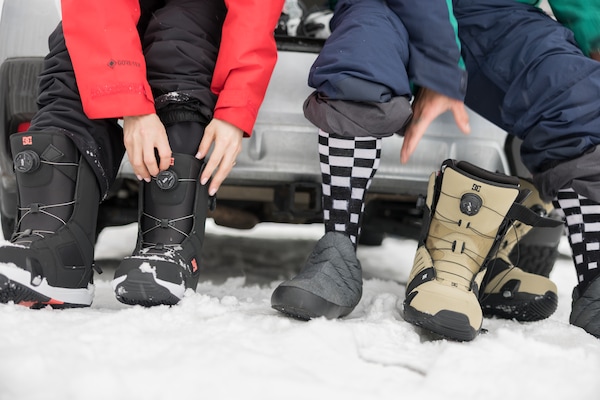
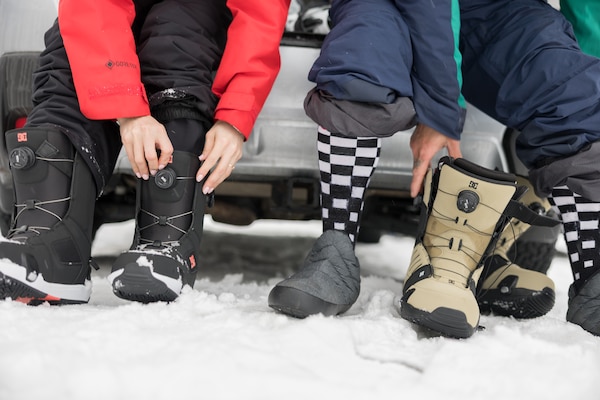
Just as there are soft, step-in and hard bindings, there are also soft, step-in and hard boots. Obviously, the type of boot you select should match your bindings (e.g., soft boots go with soft bindings). In addition, your boot should fit your riding style:
- Freestyle—performing tricks, catching air, cruising—usually means soft, short boots.
- Freerider—cruising the mountain, doing steep hills, hitting powder—requires a boot that is tall and stiff for good support.
- Alpine riding—riding at high speeds, carving—demands a hard boot for the most support and control.
For more information on boots, go to How to Choose Boots.
Learning to Snowboard
While it's possible to teach yourself to snowboard, REI strongly encourages you to take lessons, as they are the best way to learn. On your own, it's easy to pick up bad habits that will be much harder to change as you progress. The following guidelines are thus intended to give you a glimpse of the techniques involved before trying the sport. They can also be used as a handy refresher course, or they can be a basic introduction for those of you stubborn enough to go it alone.
Regular or Goofy?
First, decide if you are a regular or goofy rider. In simple English, that means do you ride with your left foot forward (regular) or your right foot forward (goofy)? Here's how to decide. Stand with your feet together, and have someone push you forward (do this before reading any further!). Which foot did you put forward to keep you from falling? That's the foot that should go forward on your board. Or try running and sliding on a slick floor in your socks. Again, which foot went forward? You may notice that the foot that stayed behind is your stronger side, the one you use to recover and keep you balanced.
First Time on the Mountain?
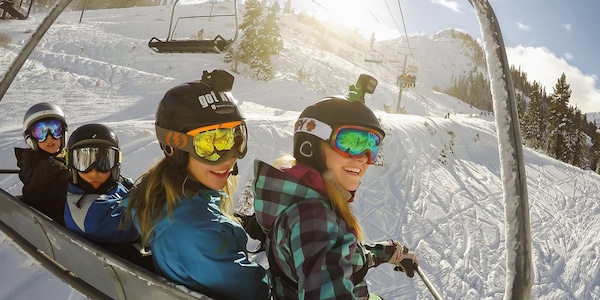
You'll most likely be riding up in a chairlift, which requires a little caution getting on and off. Here's what to do: Put your front foot in the front binding. Then strap the leash from the binding onto your front leg just above the top of the boot. Then you will need to skate to, on and off the lift. If you are nervous getting on a chairlift, tell the lift operator it's your first time. The operator can slow down the lift or even stop it for you.
If the mountain you're riding has a gondola, getting up is a cinch. Just carry the board or put it in the outside carrier if one is available. Some ski resorts may have a T-bar lift or two. Our advice is to avoid them, as they are trickier to negotiate than the other lifts.
Standing Up
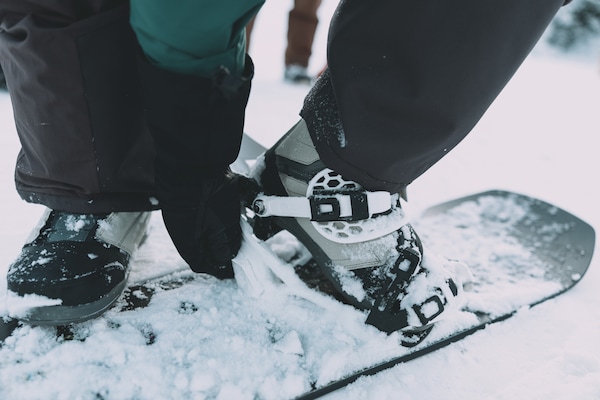
Once you've skated off the lift, sit down on the snow to get your board on (unless you have step-in bindings). With the board below you, put your other foot into the binding and close the straps. With high-back bindings, buckle the ankle straps first and then the other one or two straps.
To stand up from this sitting position, there are 2 common methods:
- Roll over onto your knees, keeping your board downslope from you. (To roll easily, lie on your back, kick the board up onto its tail with your front foot and roll onto your hands and knees as if doing a cartwheel.) Kneel with the board across the hill, dig in the toe edge, and walk your hands toward the board. Then shift your weight forward over your front foot and push yourself up.
- Lean back and thrust or pull yourself up with the toe edge of the board.
When standing, you should always put the same amount of weight on both feet and make sure the board is across the hill before trying to stand. Check that all straps and buckles are firmly closed. Then stand in ready position. The basic stance is to keep your weight balanced over the front leg, arms forward and ankles, knees and hip joints slightly flexed. Except when finishing a turn or in deep snow, always keep your weight forward over your front foot.
Walking the Board
To walk the board, lift one foot and then the other, keeping the board relatively level when raised. Next try walking the board by taking a step and then sliding the board forward as you go.
Pivoting
Place your hips over your front foot in the ready position with your rear foot placed on its binding. Balance yourself, bend your knees (especially the front one) and balance on the front foot, using the rear foot to push and pull the board back and forth as if to make an X in the snow.
Walking Pivot
When your rear foot is out of the binding, pick up your board by bending the knee of your front leg and setting it down perpendicular and ahead of the rear foot. Pivot on the rear foot and then repeat again to make a 180-degree turn.
Skating
With the front binding attached, balance on your front foot and push forward with the rear foot. Glide by holding your rear foot above the board or by balancing it on the traction pad.
Sideslipping
Sideslipping is a controlled way to get down a steep slope. Keep the board across the fall line and slide sideways on and off the board's edges.
To toe sideslip, face into the hill putting balanced weight on your toes. The uphill edge should grip the snow. Then to start moving, release the grip and flatten the board on the snow so it begins to slide. To stop, go back on your toes, and put knees into the slope.
To heelside sideslip, do the same steps, but use your heels to the slope. To stop, lift your toes to roll the board back to the heel edge.
Traversing
Glide across a fall line using a sideslip motion.
Climbing
With your front foot strapped in, face the slope so that the board is across the fall line. Take small steps with the rear foot and kick the uphill edge into the snow on each step.
Turning
Start and finish a turn by being low and balanced. Start the turn by rising and turning your torso toward the inside of your turn. At the same time, use the rear foot to pivot by pushing or pulling the back of the board. Once into the turn, roll the board to the inside edge for control.
Frontside Curve
Go down the slope on a slight diagonal with your knees bent, then straighten up and put weight on your front foot. The board will level out, allowing you to switch to the other edge. Your weight will shift to the front of your feet when you straighten up. Then lean forward, and your weight will shift to the frontside edge. Return your weight to the center of the board and continue on a diagonal descent.
Backside Turn
With your knees bent, go downhill on a slight diagonal with your weight over the center of the board. Next, straighten up. The board should be flat, you should feel pressure on your heels, and your body and eyes should face the direction you're moving. Shift your weight from your toes to your foot and then to your heels to transfer pressure to the backside edge. The weight should be on your front leg. Begin the turn by bending your front knee forward, still facing the direction you are moving. Keep pressure on your front leg, and bend your knees to lower your center of gravity. Bend your knees and ankles more as you shift on the backside edge to complete the turn. Move back to the center of the board, balance and prepare for the next turn. Straighten up and face the direction you are going.
Moguls
Moguls are simply a field of small "bumps" in close proximity. Maneuvering through them may seem a little intimidating at first, but it can become fun and exhilarating once you learn a few basic techniques.
- As you approach moguls, keep your body and legs relaxed, your hands and arms forward, and your shoulders horizontal. Go into the mogul at a moderate, yet controlled, speed.
- When you change edges to turn, bend your ankles and knees and bring them as close to your chest as possible. Use your legs as you turn the board, stay low and avoid unnecessary movements. Keep the pressure distributed evenly along the length of the edge. Use your legs to absorb the shock and as springs to lighten the board for direction changes.
- To start, get comfortable riding moguls by staying in the troughs (the valleys between the bumps). Once you're able to maneuver through the troughs, try banking off the walls they create. Then try jumping a mogul, clearing the trough and landing on the crest (top) of the next one before going into your turn.
Once you've mastered these basics, you'll be able to add your own techniques. That's when you'll discover that the mogul field offers one of the best places on the slopes to express yourself.
Freestyle
Following are the most common freestyle tricks and maneuvers and a few basic guidelines:
Fakie
Riding the board backwards—called riding "fakie"—is an essential maneuver for freestylers. Begin by riding diagonals, forward at first, and then backward. As you switch, shift your weight from your front leg to the back leg, reversing other movements at the same time. Your body weight should not be back too far.
Wheelie
This move is similar to popping a wheelie on a bicycle. First, bend the leg that will be in contact with the snow and then lift the opposite end of the board. Balance on the back leg, stretch your body and raise your arms.
Ollie
An ollie is a basic freestyle maneuver on flat ground. Begin by bending your knees and shifting your weight to your rear leg. Then quickly straighten up and bring your front leg to your chest. The board's nose will lift up from the snow. Then move your weight to the center of the board and bring the tail up with your bent, rear leg. As you straighten, bring your arms out. In the air, move your legs up to your body in a crouched position to keep flying. When landing, keep your knees slightly bent to absorb the impact.
Stiffy
A stiffy is a jump where both legs are completely straight as you grab the frontside edge with your forward arm. Begin by approaching a ramp or wall at a steady speed while crouched down. Then straighten up to launch yourself higher into the jump while staying centered. After takeoff, bend and grab your frontside edge with your forward hand as you straighten your legs. Before landing, release your hand and bring the board beneath your body. Slightly bend your knees for impact. Keep your weight centered.
Boning
Boning means to jump with one leg straight and one leg bent. When the front leg is extended, the jump is called a nose-bone. When the back leg is straight, the jump is a tail-bone. When exiting the pipe, put equal pressure on both legs. When landing, straighten your bent leg and bend the other so you'll be in the right position to land.
Tail Grab
Grabs can be made in the air with 1 or 2 hands, in a variety of positions. The simplest involves grabbing the frontside edge with the back hand near the nose of the board.
Backside Air
The backside air is a basic half-pipe trick that resembles method air(see below). Start the jump by approaching the pipe wall on your backside edge at an almost perpendicular angle. Bend your legs with knees close, center your weight, eye the pipe rim, and get ready to push. Once into the jump, use your arms for power and straighten your legs. Immediately after jumping, bend your legs and grab the backside edge of the board. Keep your eyes focused on your landing point. After reaching the highest point of the jump, begin to straighten out to prepare for landing. Before coming down the pipe wall, remove your hand from the backside edge and bring your legs under your body. Try to reenter the pipe at its steepest part and begin your next approach.
Method Air
Begin by entering the steepest slope at a moderate speed in a crouched position, ready to straighten up, and push up above the lip. Grab the backside edge with your front hand and crouch. As you stall at the high point, arch your body with the rear arm stretched out. Then bring the board up under your body, rotate in the direction of your exit and get ready to land.
Backcountry
In the days before snowboarding was accepted at ski resorts, boarders took to the backcountry. Today, it's still a great way to find fresh snow and avoid the resort crowds. In fact, snowboards perform very well in fresh snow. Thanks to their large surface area, a snowboard floats well in powder, riding atop it rather than sinking. And though there are specialized backcountry boards, many riders use their freeriding gear.
Of course, getting to the backcountry isn't as easy as riding a chairlift. And whether you get there by foot (hiking, snowshoeing, skiing) or by helicopter, snowcat or snowmobile, you're going to need more preparation.
Think Safety
Once on the mountain, you'll need to be careful of rocks, tree wells, hidden streams, cornices and crevasses. You'll also need to be aware of avalanche potential in the area. Avoid questionable areas. Don't travel alone. Use a transceiver if possible. And ALWAYS tell someone where you're going.
While boarding, keep your eyes focused ahead and anticipate changes in snow consistency and the terrain such as trees, cliffs and flats. If a slope does not look safe, hike back out and find a safer route.
Be Prepared
Think like a backpacker while preparing for a backcountry snowboarding trip. In fact, you'll need a backpack to carry all your gear. Dress in layers and take extra clothing. Carry plenty of food and water, and the 10 essentials, and be prepared for extreme weather changes or any possible mishap.
Useful Gear
In addition to your normal snowboarding gear, consider these items:
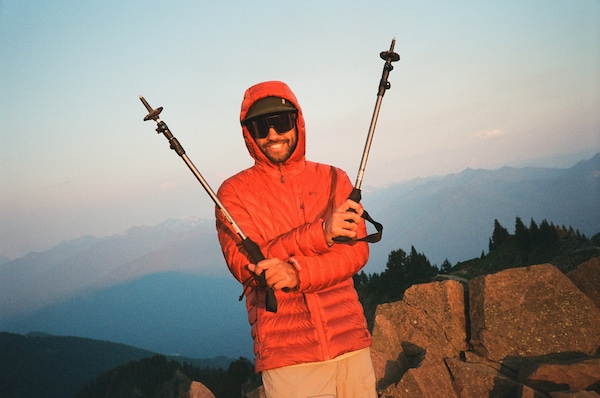
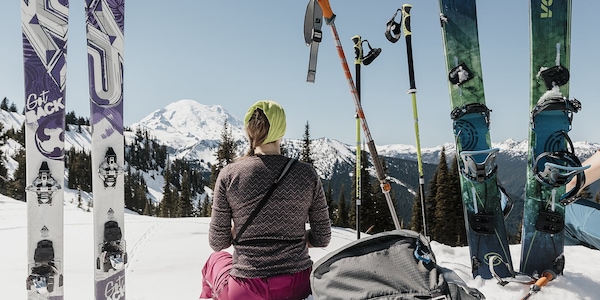
Poles - Using poles can give you more stability while climbing. Collapsible poles will fit nicely in your pack for the descent.
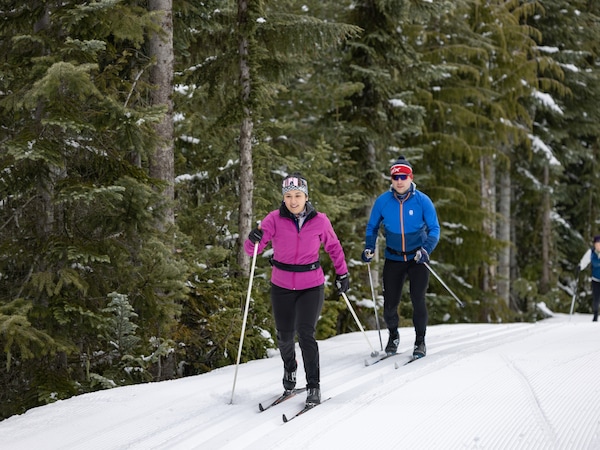
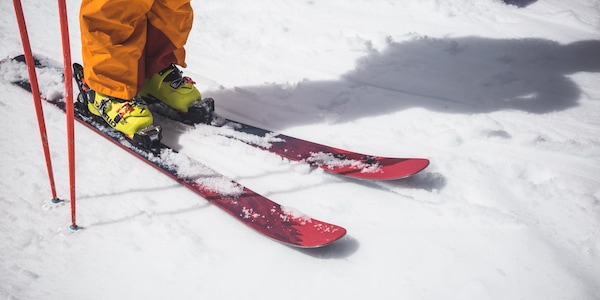
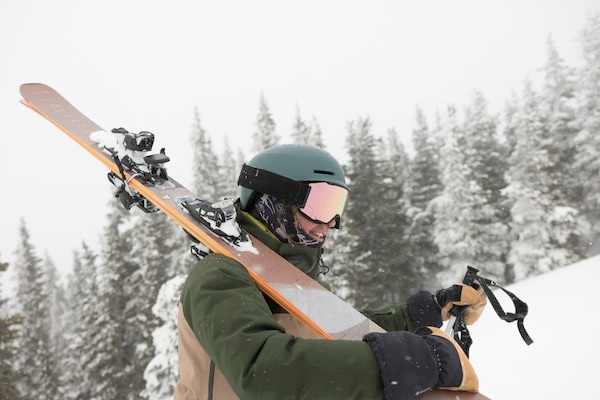
Skis - Using Cross-Country skis for the ascent can be very effective, especially when creating a pace line with other skiers. They also make the trip through the downhill portion of undulating trails much quicker. The biggest disadvantages of skiing in are that you'll probably need different boots for boarding, and skis are cumbersome when boarding out.
Skins - Using skins, uphill traction devices that are attached to cross-country skis, will definitely give you a better grip on the hills when ascending.
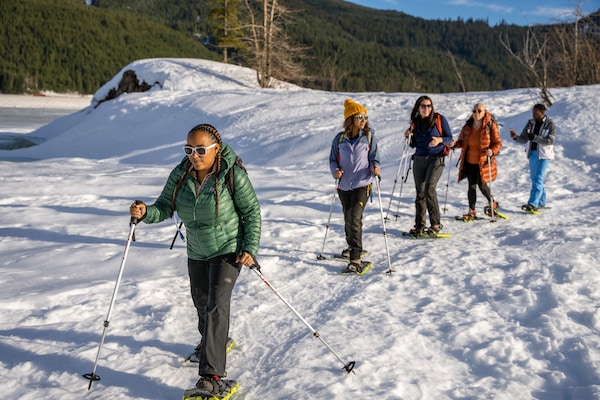
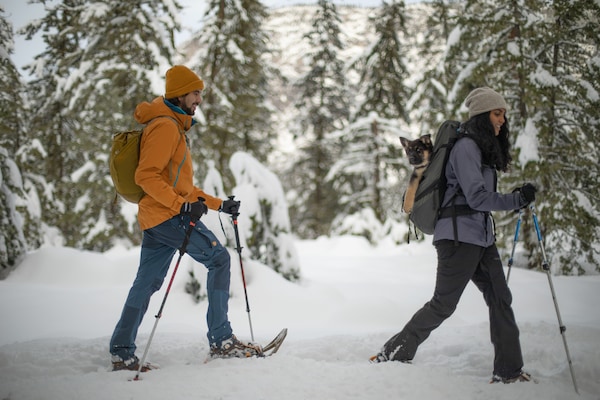
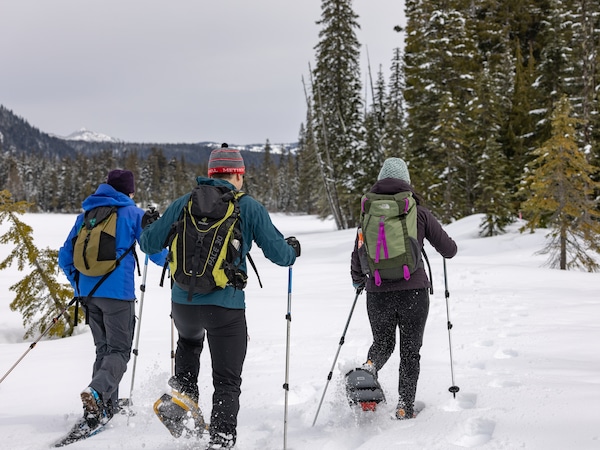
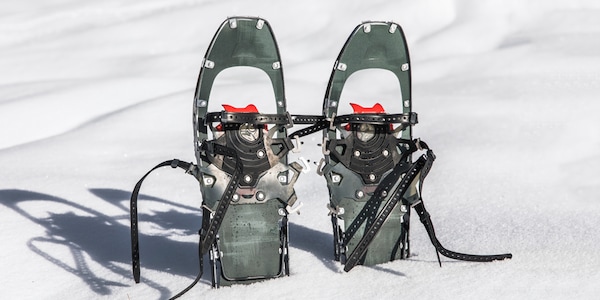
Snowshoes - Using snowshoes is easy and works well with snowboard boots. They're lightweight, keep you on top of the snow, and are easily attached to a backpack for the descent.
Crampons - If the terrain is extreme, you may need crampons. Crampons attach to your boots and have metal teeth that grip snow and ice. Most crampons are step-ins, so you'll need boots with toe and heel grooves to attach them.
Ice Axe - If crampons are needed, then so is an ice axe. The ice axe should be long enough to reach the ground while hiking, but short enough to strap to your backpack and not hit you in the head on the descent.
Backpack - A backpack with compression straps, ice axe loops and gear compartments will work well. REI also offers snowboarding-specific backpacks.
Other Gear
For glacier travel, be sure to take all your glacier gear—helmet, prusiks, pickets, flukes, ice screws, carabiners, harness and ropes.
For overnight snowboarding trips, you'll need a larger backpack with all of your mountaineering gear—stove, fuel, cookware, 4-season sleeping bag, sleeping pad, 4-season tent, more food and more clothing.
Tip: When skiing in the backcountry and carrying a backpack you may want a larger board to compensate for the extra weight.
Safety and Etiquette
Snowboarding and winter in the mountains are a lot of fun. But, as with any sport, you need to practice common sense and be aware of potential hazards.
The basic strategy is to be prepared. Snowboard with the correct gear and supplies and know as much as you can about the area before you go there—particularly in backcountry snowboarding. Whether you are going to a resort or to the backcountry, tell someone where you are going and when you expect to return.
Stay within your own physical limits. Do not take on more than you can do, stay out of closed areas, do not go off exploring by yourself, and be aware of your surroundings. Understand the weather and, if you are headed into the backcountry, know what kinds of conditions you are going into.
Altitude
Altitude sickness, or acute mountain sickness (AMS), most commonly occurs at altitudes over 8,000 feet. It is caused by low oxygen levels because people ascend too quickly, are dehydrated, cold, in poor physical shape and/or are eating improperly. Early symptoms can be difficulty sleeping, headache, decreased urinary output, general weakness, fatigue, nausea, dizziness, poor appetite, coughing and swollen hands, feet and face. Advanced symptoms include persistent headache, difficulty breathing, shortness of breath, vomiting, difficulty walking and poor judgment.
To avoid altitude sickness, ascend slowly, eat regularly, stay hydrated (before and during), avoid alcohol, stay warm and rest frequently. If symptoms occur, return to lower elevations immediately.
Sun
The sun is always a factor, even if it is not out. On a cloudy day, you can still get sunburned. Always use a sunscreen, lip balm and sunglasses with UVB protection. Snow blindness is a real possibility without them. This condition can leave you with severely blurred vision or temporary blindness.
Frostbite
If you are getting frostbite, your snowboarding partners may actually notice it before you do, because your skin will become dull, pale or frosted. Other symptoms include numbness, pain, redness or swelling. Your skin can also turn purple, become hard and actually freeze. Areas that are more exposed like fingers, toes, ears, nose and cheeks are the most susceptible.
Hypothermia
Feeling cold, wet and tired? Hypothermia is when the body's core temperature cools. Early symptoms of hypothermia include shivering, cool skin and just the feeling of coldness. Advanced symptoms include stiff muscles, slow breathing, loss of coordination, irritability and fatigue.
Weather
Be prepared for any weather. Just as important, be willing to sit out periods of bad weather. In a whiteout (heavy fog), you may not be able to see 10 feet in front of you. In case of lightning, get to low ground, stay away from metal objects, use a sleeping pad or pack to insulate yourself from the ground and avoid being the highest object for lightning to strike.
Hazards
Watch out for hidden streams, logs, rocks and tree wells. Especially in deep snow, a tree well can be dangerous. A snowboarder could land headfirst and suffocate because the snow is so deep, and there is little air circulating.
Avalanches
In ski resorts, avalanches are not much of a worry—the resorts do regular avalanche control and any dangerous areas will be roped off. In the backcountry, though, you must be more aware and exercise more caution. Take an avalanche class and learn what to look for, travel with experienced partners and avoid questionable areas.
Do not take on more than your ability permits. In ski resorts, a green circle means the easiest route, a blue square is an intermediate run, a black diamond is difficult and a double diamond run is very difficult. If an area is roped off, it is usually due to a safety factor. Especially in backcountry skiing, know how to read a map and be able to function.
Etiquette
Don't be a snake! Always follow these common-sense rules when riding.
- Snowboard in control and be able to avoid other objects and people.
- Do not stop where you aren't visible to an oncoming skier or rider.
- Be respectful with speed and conduct to other people on the trails and slopes.
- Remember, the people ahead of you have the right of way.
- Look uphill and yield to others.
- Do not change directions suddenly without checking to see if your surroundings are clear.
- Do not stop in the middle of a trail.
- Make sure no one is coming down a trail before you enter it.
- When passing a person, leave enough space for him or her to maneuver.
- If you have to walk down a slope with the board, walk on the outside to stay out of the way of others.
- Respect nature.
- Always use a safety leash to prevent a runaway board.
- Respect warning signs and closed areas.
- Do not use trails that have specially been prepared for races.
- Always carry identification in case of an accident.

Ratings and Comments
Unable to Post Comment
We were unable to post your comment at this time. Your opinion matters, so please try again later.
Close