Virtually all downhill skis these days incorporate rocker technology. So why did rocker become the biggest news in ski design since shaped skis?
First used to boost performance in powder skis, rocker evolved to produce countless subtle refinements that can fine-tune many types of skis.
This article explains how rocker works.
What Is Rocker?
Before rocker there was (and still is) camber.
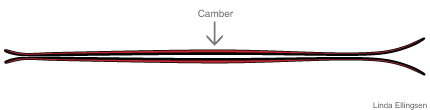
Camber describes the shape of a traditional ski. Place one on a flat surface. It will rest on points near its tip and tail while its waist (midsection) arcs upward. This built-in arch is the camber of the ski.
Camber puts springiness and pop into a ski. It permits easy handling, responsive turning, powerful carving, stability and, due to ample edge contact with the snow, good grip on icy slopes. It remains a popular choice when skiing groomed slopes or on hardpack snow. Alternate terms for camber include standard alpine and positive camber.
Rocker was introduced in 2002 when the late Shane McConkey introduced the first commercial rockered ski, the Volant Spatula. The concept: Create a downhill ski that mimics the attributes of a water ski, enabling a skier to skim over a surface with minimized risk of snagging an edge. It was originally envisioned as a powder ski.
Rocker is essentially the opposite of camber, thus is also known as reverse camber or negative camber. The side profile of a rockered ski resembles the upturned rails of an old-school rocking chair. On a flat surface, the midsection of a rockered ski will rest on the ground while its tips and tails rise off the ground much earlier than they do on a cambered ski.
So what's the better choice—rocker or camber? It's not an either/or proposition. Many skis today use both underfoot camber and tip and tail rocker in their designs.
What Does Rocker Do?
Rocker offers skiers several advantages:
- Improved flotation in powder. Early-rising tips help you stay on top of soft snow and keep those shovels out of the powder.
- Greater maneuverability. Fully rockered skis, made to stay afloat, have a shorter effective edge. Less edge contact with the snow permits easier initiation of turns. Rocker, one manufacturer's rep tells us, pre-cocks the ski into the arc of the turn. This allows the sidecut of the ski to be engaged more smoothly and easily.
- Enhanced park experience. Not all park skis are rockered, but those that are tend to make sliding rails and doing tricks easier. There's less risk of catching an edge when landing a trick, too.
Why Are There So Many Rocker Variations?
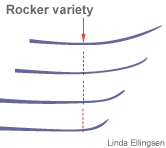
Ski manufacturers gradually realized rocker could be combined with camber to address specific performance needs. Soon companies began putting their own individual spin on rocker technology.
Having lots of rocker options is a good thing. But trying to digest a lot of techy names for rocker can be daunting. So as new variations of rocker and rocker-camber combos emerge each season, the following observations might be helpful:
- Rocker can be located many places. It can be in the tip alone, in both the tip and the tail, or in the full length of the ski. Modified sidecuts (some wide, some not so wide) are often also part of a rockered ski's design package. Any of these approaches may be marketed as rockered skis, or as hybrid skis, or by some other term. Confused? You are not alone.
- Rocker may be referred to by many terms. Most popular are reverse camber and negative camber, as noted earlier, but also inverse camber or early rise.
How to match a rocker design with your usual ski and terrain preference:
All-mountain and all-mountain wide: A popular combination is a rockered tip (for easier turning and good flotation for skiing off-piste in powder), cambered or flat midsection (providing some edge control) and possibly a flat or low-rise tail (for skiers eager to hold speed). Such skis may be categorized as rockered or hybrid skis; keep in mind that ski makers often have different takes on essentially the same design.
Shop REI's selection of all-mountain skis and all-mountain-wide skis.
Powder: This is what rockered skis were originally created to address. Though many models are cambered underfoot, their classic rockered tips and tails are best for taking on deep powder. Reverse sidecut at the tip (i.e., a narrower shovel) maneuvers more easily and is less likely to snag an edge. Such skis do a good job floating on the top layer of powder; they turn quickly (handy when in trees) and stop swiftly. Downside: Don't count on them to hold an edge consistently.
Shop REI's selection of powder skis.
Twin tip/park/pipe/freestyle: A rockered ski offers more contact space in the ski's midsection so sliding rails is easier. It creates a more stable landing platform and reduces the chance of catching an edge, too.
Shop REI's selection of twin-tip skis.
How Do I Shop for Rockered Skis?
Since rocker specs and terminology vary by ski manufacturer and from model to model, it's best to shop for skis based on the terrain you'll be skiing. Your REI sales specialist can guide you to specific ski models.
On REI.com, skis equipped with rocker at the tip and/or tail are called out in the "ski camber" section (under the Specs tab on each product page).
Shop REI's selection of downhill skis.