Transporting a kayak is not terribly difficult, but it's important to make sure you load your boat properly onto your vehicle to ensure it stays secure. In this video, you'll learn how to:
- Carry a kayak: With two people, each person holds a grab handle and lifts. If you're by yourself, you can get the kayak onto a shoulder.
- Put a kayak on a vehicle: The easiest way is with the help of a friend. You'll pick the boat up by each end and place it on the rack. If you're solo, there are a couple of options depending on your rack system.
- Tie down a kayak: Using cam straps is the simplest and fastest way to secure the boat.
Video: How to Transport a Kayak
How to Carry a Kayak

Carrying a kayak with two people is simple:
- Each person grabs an end of the boat by the grab handle at the bow or stern.
- Lift the boat. Rather than having one person backpedal, both people can face the direction you're going.
- You can carry two boats this way, taking a grab handle from each boat in each hand.
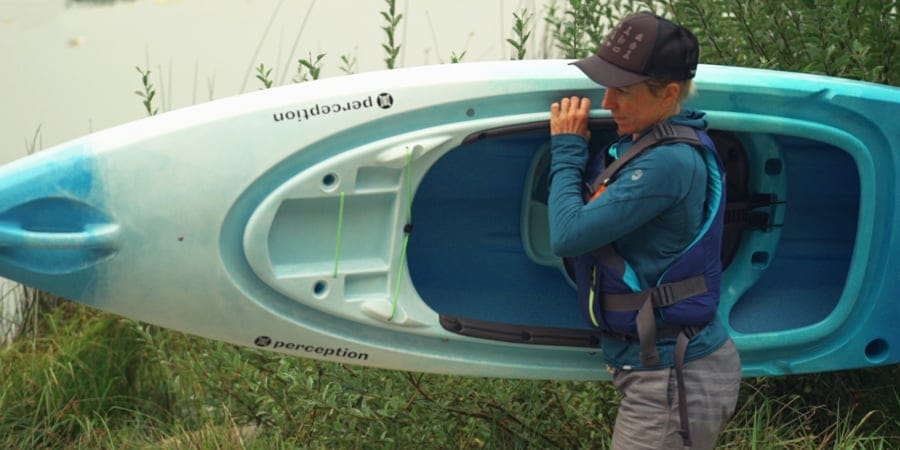
If you're solo, you can likely still carry your kayak, unless it is really large and heavy. Here's how to carry a kayak by yourself:
- Stand on the left side of your kayak and face the boat.
- Squat down and grab the edge of the cockpit that's closest to you with both hands and pull the edge of the boat up onto your thighs.
- Reach across the boat with your right arm and grab the inside of the boat by the underside of the cockpit.
- As you stand up, lift the kayak up onto your right shoulder.
- Let the rim of the cockpit rest on your shoulder. Find a balanced positioned so that the boat neither tips forward nor back.
(If you'd prefer to carry the kayak with your left arm, start out on the right side of your boat and use the opposite arm in the steps above.)
Tips for Carrying a Kayak
Protect your back: Bend with your knees and keep your back straight when reaching down to pick up your kayak.
Wear your PFD: If you're carrying your boat by yourself, you can wear your PFD to add padding at your shoulder for the kayak to rest on.
Use a cart: If you find carrying a kayak solely by hand to be too difficult, look into a cart with wheels.
How to Put a Kayak on a Vehicle
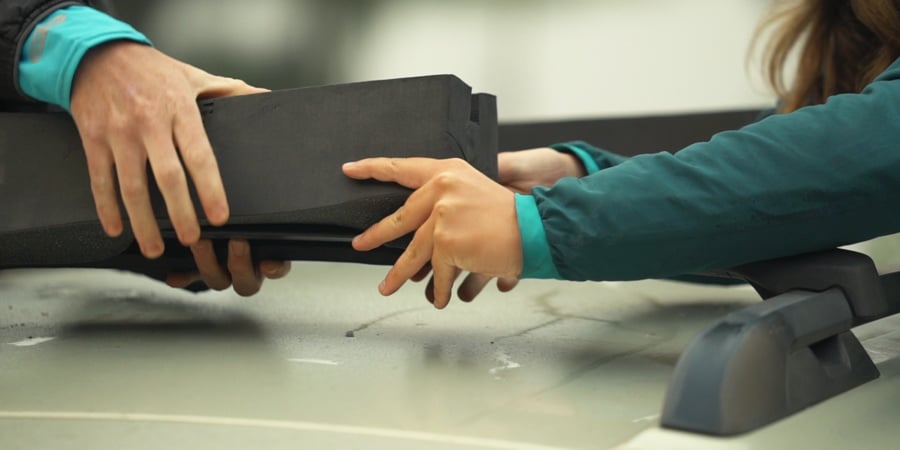
Before putting a kayak on top of your vehicle, you need only a handful of essentials:
- Crossbars: Crossbars run across the roof of your vehicle. Most crossbars attach to factory-installed bars that run front to back on your car, but this depends on your vehicle type. There are also crossbars that go in the bed of a truck.
- Rack/padding: Specific kayak rack systems that attach to the crossbars and cradle the boat in J- or V-shaped forms are most secure. Read our article on how to choose a cartop boat mount.
- Cam straps: Cam straps quickly and securely hold your kayak down. You'll need two straps that are about 12 feet long or longer.
- Bow and stern lines: You can use a nonstretch, water-resistant rope (rope will vibrate less than nylon webbing), but special ratcheting lines make the job quick and easy. You usually need one line for the bow and one for the stern, though this can vary based on the length of your boat and your vehicle.

Loading a Kayak With Help
With the crossbars and rack/padding installed and the straps/lines at the ready, you can place your kayak on top of your vehicle. The easiest way to load a kayak onto a car is with two people:
- With one person at each end, carry the kayak by the grab handles and position it next to and parallel to your vehicle with the bow toward the front of the car.
- Grab the kayak at each end by the hull (not the grab handles) and lift the boat overhead. Take care to lift with your legs, not your back.
- With the boat overhead, place the boat so it's directly above the rack, then set it down gently on the rack. The proper position for the boat is determined by the type of rack you have.

Loading a Kayak by Yourself
Some people have the muscles and height to lift a kayak onto their car by themselves, but if that's not you, here are some tips for solo loading:
- Use a lift system: There are kayak racks with integrated lift systems that make loading the boat simple. They typically slide from the top of your vehicle down to the side so you don't have to lift your kayak as high. Once the boat is properly loaded and strapped down, you lift the rack system up on top of your vehicle. These racks are pricey, but effective.
- Get rolling wheels: Another rack solution is to use one that incorporates rolling wheels. These allow you to simply set the bow of the boat into the rear rack cradle, pick up the stern end and roll the kayak forward into the front cradle. These are less expensive than racks with integrated lift systems.
- Use a towel or blanket: For a low-tech, low-cost solution, try placing a towel or blanket on top of the rear of your vehicle and then setting the bow of the boat on the towel or blanket. Pick up the stern and push the boat up and forward onto the rack.
Loading Multiple Kayaks
If you have enough space, it's possible to transport more than one kayak on top of your car. (Note: Make sure you have enough straps.) Here are some tips for how to carry multiple boats:
- Add a second rack: By adding another rack to the crossbars, you may be able to transport a second kayak the same way as the first one, but it will depend on the width of your boats and your crossbars.
- Use stacker bars: If you're trying to get two, three or even more boats on top, stacker bars may be the answer. These let you put the boats on their side so they take up less space. Stacker bars are frequently used with lighter, shorter whitewater kayaks, but they can also be used with recreational and touring boats.
How to Tie Down a Kayak
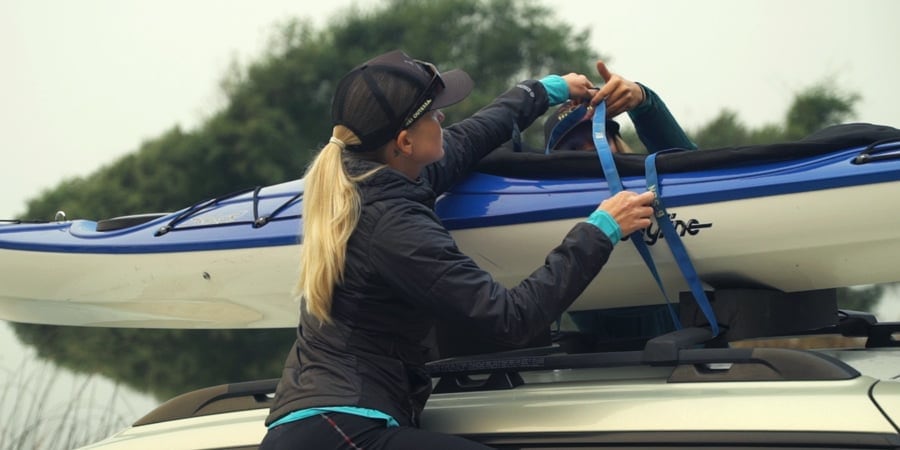
The easiest way to tie down your kayak to your car is with cam straps. You won't need to know any special knots; you simply feed the straps through buckles and cinch them down.
- Make sure your kayak is centered fore and aft between the crossbars on your car and running parallel with the car.
- Take a cam strap and position the buckle so it is resting on the side of the kayak a few inches above and to the side of one of the crossbars. Toss the other end of the strap over your kayak.
- Walk around to the other side of your vehicle, grab the end of the strap and loop it underneath the crossbar then toss it back over your boat. Make sure the strap is to the inside of where the crossbar attaches to the vehicle. This will prevent the strap from slipping off the end of the crossbar.
- Walk around to the first side again and loop the end of the strap underneath the crossbar then up into the cam buckle and cinch it down. Again, make sure the strap is to the inside of where the crossbar attaches to the vehicle.
- Repeat with the other strap on the other crossbar.
- Tighten both straps until snug but not overtight. Too much tension can deform plastic hulls and crack fiberglass.
- Tie off the loose ends of the straps just below the cam buckles, then tie any remaining slack to the crossbars. This backs up the cam buckles and prevents the slack from flapping around while you're driving.
- Grab hold of either end of the kayak and shake it from side to side to make sure it is secure.
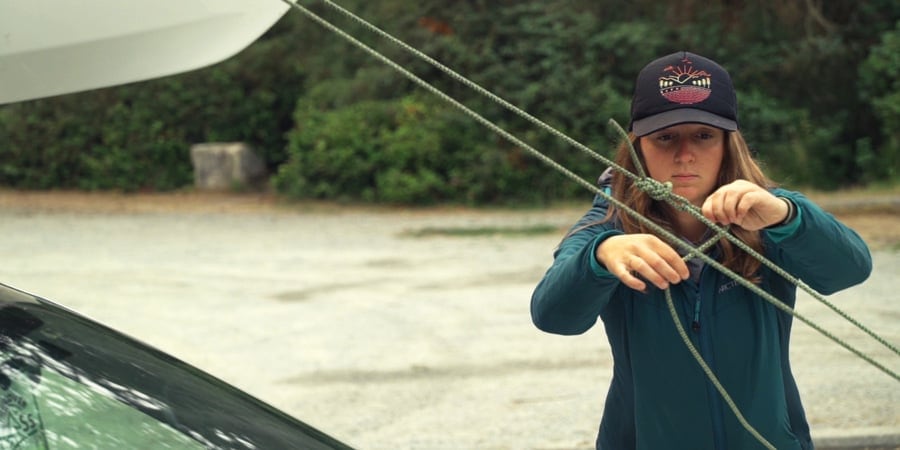
Bow and stern straps: It's also recommended that you secure the bow and stern of the kayak to your vehicle, especially if you'll be driving in high winds or on the freeway. Ratcheting bow and stern lines make it simple. Here's how to install ratcheting bow and stern lines:
- Hook the end of the line with the ratchet to a secure point on the front of the kayak, such as the grab handle.
- Attach the other end of the line to a secure point on your vehicle. If you don't have a secure point, such as a tow hook, you can install a hood loop strap to create one. Never attach the tie-down straps to plastic parts on your car.
- Pull the free end of the line down to tighten the line until snug. Be careful not to overtighten.
- Tie off the loose end of the line just below the ratchet.
- Repeat with the stern line.
Tips for tying down a kayak:
- Keep it simple: Using fancy knots and wrapping straps every which way may look cool, but keeping things simple is often the fastest and most-secure way to go.
- Use a ladder: If you're shorter and/or have a tall vehicle, keep a small stepladder in the back of your car that you can use to make reaching the straps a whole lot easier.
- Add a twist: Putting a simple twist in the cam straps can help prevent annoying strap vibration while you're driving.
- Lock the straps: You can buy locking cam straps that can only be unfastened with a key. These can give you peace of mind when leaving your boat on your car for a quick run into a store or restaurant. If you're leaving your kayak for an extended time, you'll need a more secure solution, such as a locking cable.
- Know the trucker's hitch: If you don't have cam straps or ratcheting bow and stern lines, you can use rope instead. Make sure it is nonstretch and water-resistant. And know how to tie a trucker's hitch so you can get the lines nice and tight.
- Stop and check: After about 15 minutes of driving, pull over and give the kayak a tug to make sure it is still secure. Sometimes the straps can loosen up while driving.