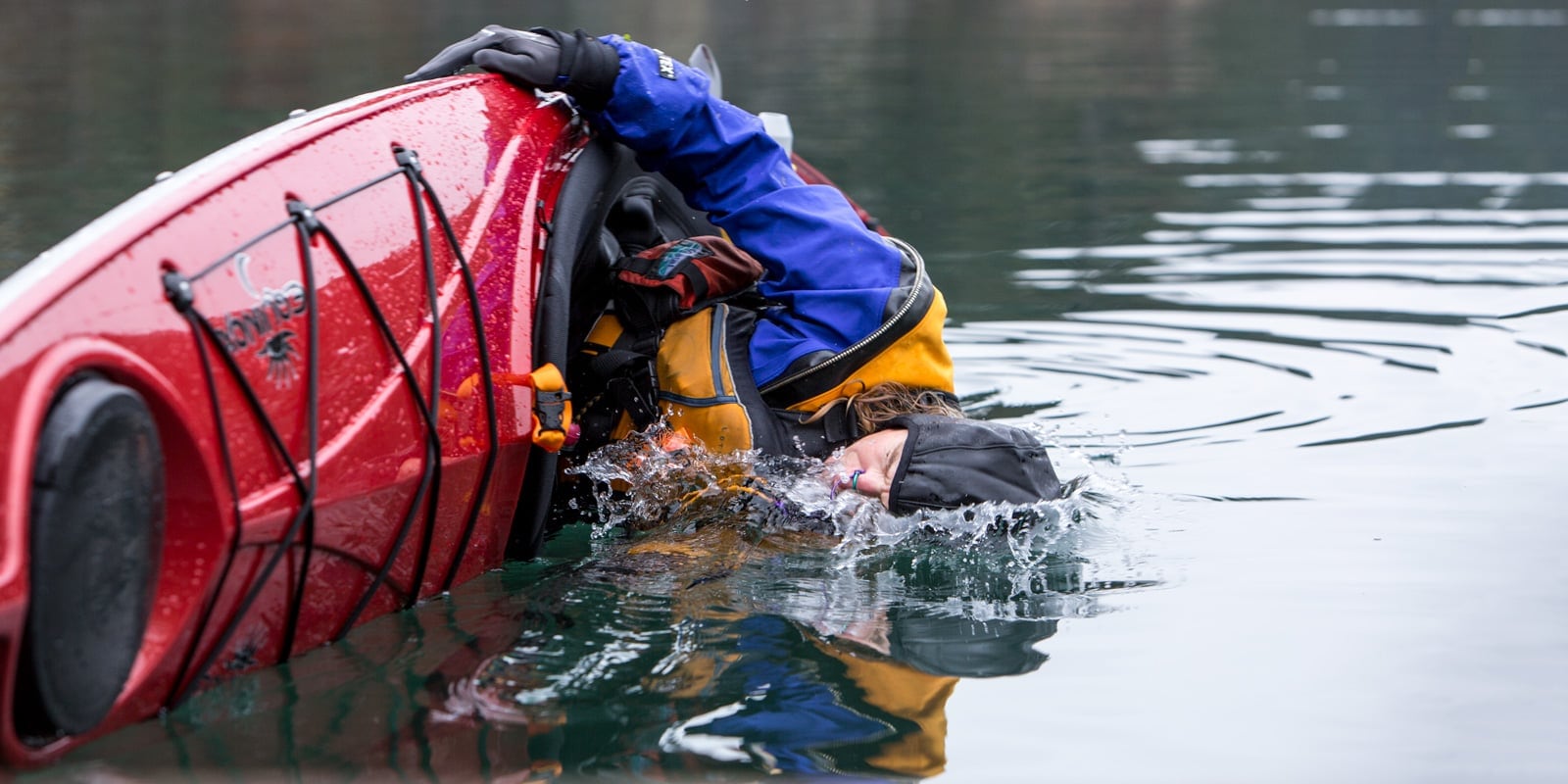
Here are the basic techniques, as taught by REI Outdoor School instructors, that you should know if your kayak capsizes and you need to safely exit and reenter your boat.
Wet Exit
Your boat capsizes while you are wearing a spray skirt. The skirt has you sealed inside
the cockpit. What should you do? Stay calm and use the wet exit
technique. As noted in the video:
- Prior to heading out, make sure your spray skirt’s grab loop is accessible (on the
outside of the cockpit combing and in front of you).
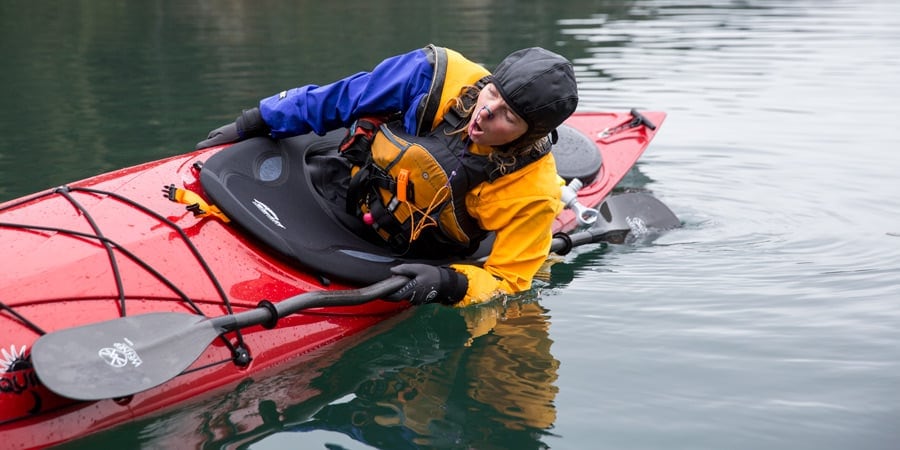
- About to capsize? Speedily do the following:
- Release your paddle.
- Take a quick breath of air.
- Tuck your head close to the boat or shield your head with your arms. You don’t
know what’s beneath you.
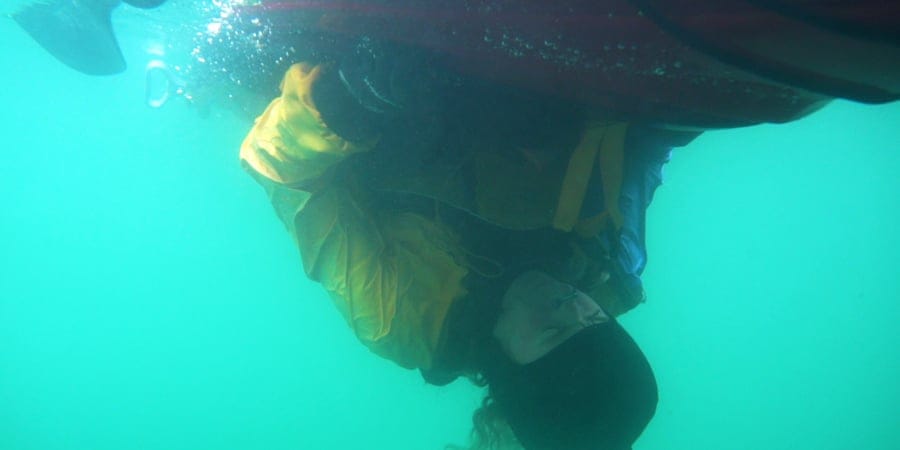
- As you go under:
- Grab the sides of the cockpit’s combing with both hands.
- Slide hands forward until you locate the spray skirt’s grab loop.
- Grasp the loop, extend your arms and push forward to detach the skirt.
- Lift backwards, using elbows for leverage, and peel the entire skirt off the
combing.
- Ideally, lift the skirt over your head put it behind you.
- Put your hands on the back deck of the boat just behind your hips.
- Push on the kayak and lift your knees out of the thigh braces.
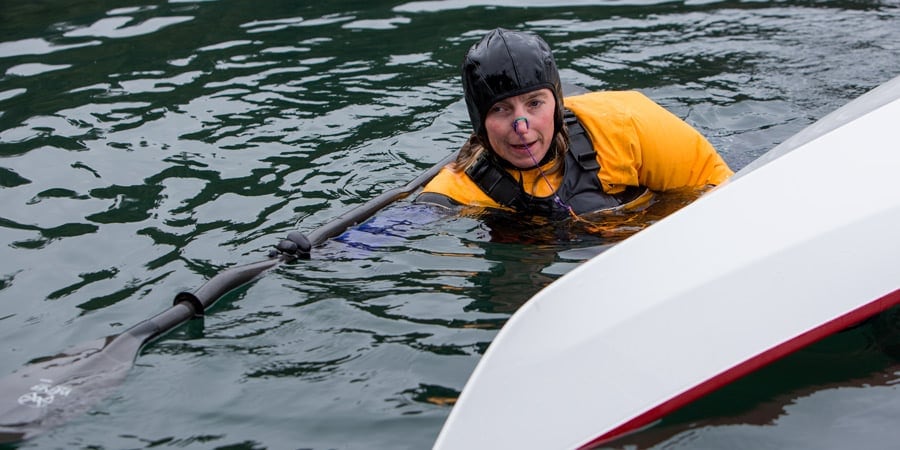
- Your head will pop up on one side of the boat.
- Think of the process as sliding off a big pair of plastic pants.
Spray skirts come in 2 common materials:
- Nylon spray skirts release easily because they use a simple
shockcord around their perimeters. Novice paddlers typically use nylon spray skirts.
- Neoprene spray skirts create a very tight hold and are harder
for beginners to use.
Combing can vary between boats:
- Plastic boats offer rounder, thicker combing. It is easier to
get skirts on and off, particularly nylon spray skirts. A paddler may be able to extract
himself from a plastic boat-nylon skirt combo without manually removing the skirt.
- Composite boat use a thinner, sharper combing. This allows
skirts to create a tight seal. Most instructors thus advise newcomers to avoid using a
neoprene spray skirt on a composite boat.
Self Rescue (Paddle Float Rescue)
Following a wet exit, how do you reenter your boat when you’re paddling solo? A good
technique is to deploy a self or paddle float rescue.
- Following a wet exit, grab your paddle and boat. Wind can carry them away faster than
most people can swim.
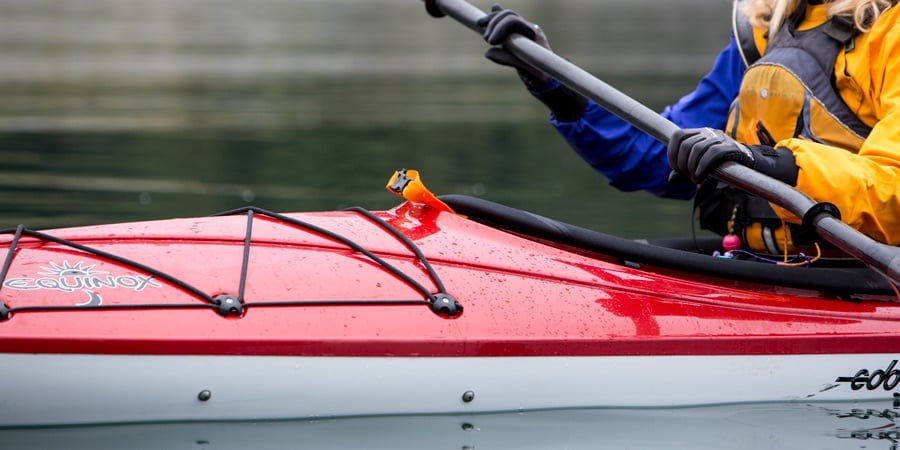
- Reach under the capsized boat and grab your paddle float. It is a rolled-up piece of
material normally stored under the bungee cords on your boat’s deck.
- Hook one leg inside the boat’s cockpit. Why?
- To keep the boat from drifting away.
- To permit use of both hands.
- Unroll the paddle float, open one of the tubes and inflate the chamber.
- Slide a paddle blade into the inflated sleeve.
- Clip the sleeve to the shaft to secure it in place.
- Take your feet out of the cockpit and flip the boat right-side up. How?
- Reach under the capsized boat.
- Grab the far edge of the combing and pull it toward you while pushing on the hull
section nearest you. The boat should roll over like a log in the water.
- Place the paddle on the boat and perpendicular to the boat (like an outrigger).
- The blade with the paddle float goes in the water.
- The bare blade stays on the boat, out of the water.
- Gripping the paddle and using it as a brace, execute a frog kick (a 2-legged thrusting
motion) and push your body out of the water, keeping weight low and close to the boat.
- Keep a hand on the paddle; balance your weight between the boat and the paddle float;
slip your body into the cockpit.
- Use your bilge pump to purge water from the cockpit.
- Leave the paddle float in place for stability until you reattach your spray skirt.
T Rescue
If a boat capsizes and another paddler is nearby, a T rescue is
an excellent technique to use.
In our video, you can watch Katy and I, REI Outdoor School instructors from the San
Francisco Bay Area, demonstrate the process outlined here:
- My boat has capsized. Katy (still afloat) paddles toward the front of my boat.
- Her goal: Position her boat so it is perpendicular (in the form of a T) to the bow of
the capsized boat.
- I perform a wet exit and swim to the back of my overturned boat.
- I execute a big frog kick and push down on the back of my boat; Katy
simultaneously lifts the front. The action breaks the suction created by the cockpit
combing, making it easier for Katy to place my bow on her deck (so the 2 boats
roughly form a T).
- Katy rocks my tipped boat back and forth to empty water from the cockpit.
- She and I right the capsized boat.
- Katy repositions her boat so it is:
- parallel to my boat
- facing my boat (stern to bow)
- Katy takes my paddle.
- Katy stabilizes my boat by leaning hard into it with maximum body weight.
- I use a frog kick to swim under my boat and surface between the 2 boats.
- Keeping my weight very low, I put my feet into my boat’s cockpit.
- Balancing my weight between both boats, I face Katy’s boat (so I can lean on
either boat) and swivel into my cockpit.
- Katy stabilizes the 2 boats as I reenter the cockpit.
- She helps me reattach my spray skirt and hands me my paddle. We’re ready to
go.
General Rescue Tips
- A T rescue is the preferred method of getting someone back in a boat quickly. Most
paddlers can re-enter their boats in 2 or 3 minutes.
- A self or paddle float rescue is a good technique for solo paddlers. It's always safer,
though, to paddle with a friend—and usually more fun, too. A self rescue often
takes several minutes, up to 20.
- When dealing with cold water situations, hypothermia and fatigue can set in pretty
quickly. So dress for immersion by wearing a wet suit.
- In rough conditions that can a capsize a boat, a T rescue is always preferred. Being
able to swim to a floating boat is similar to swimming to the side of a swimming
pool—it feels stable and secure.
- When re-entering the cockpit, you must:
- keep your weight very low.
- face toward the stern the whole time.
- lift your legs into the cockpit.
- What if your paddling partner capsizes and is rendered unconscious?
- Paddle quickly to his or her location and stabilize your boat.
- Grab your partner’s PFD and flip him or her into an upright position.
Advanced Rescues
Other reentry methods exist, but the 2 described above are the essential techniques for
beginners to know and to have practiced.
One advanced re-entry technique is the Eskimo bow rescue. Like the T rescue, this method
requires the assistance of another nearby paddler (in a boat that is still afloat).
However, it involves some risk of shoulder injury. Here is the basic process:
- Boat A capsizes. Paddler A, though upside-down and underwater, stays in his cockpit.
- Paddler A pounds his hands on the sides of his boat to alert other paddlers of his
plight.
- Paddler B paddles his boat (Boat B) to the capsized boat and lets the two hulls tap
together.
- Paddler A (still in his cockpit) reaches out with his arms, grabs one end of Boat B
(preferably the bow) and pulls himself up and out of the water, righting Boat A in the
process.
Considerations:
- A T rescue is the preferred method of getting someone back in a boat quickly. Most
paddlers can reenter their boats in 2 or 3 minutes.
- This technique usually does not involve great strength. The buoyancy of a PFD helps a
capsized paddler resurface fairly easily.
- Some hip movement also facilitates this rescue.
- This rescue works best when the submerged paddler uses both hands and keeps his elbows.
- Beware of overreaching backwards to grab the floating boat. A submerged paddler could
be vulnerable to a shoulder injury.
- Two factors are crucial for this technique to be successful:
- The capsized paddler must be skilled at holding his breath.
- The floating boat must be able to reach the capsized boat within seconds.
- For the reasons explained above, Eskimo bow rescues (and other advanced rescues) are
recommended for experienced paddlers only.
Back to Top
Find REI on:
Facebook
Twitter
YouTube
MySpace
Flickr