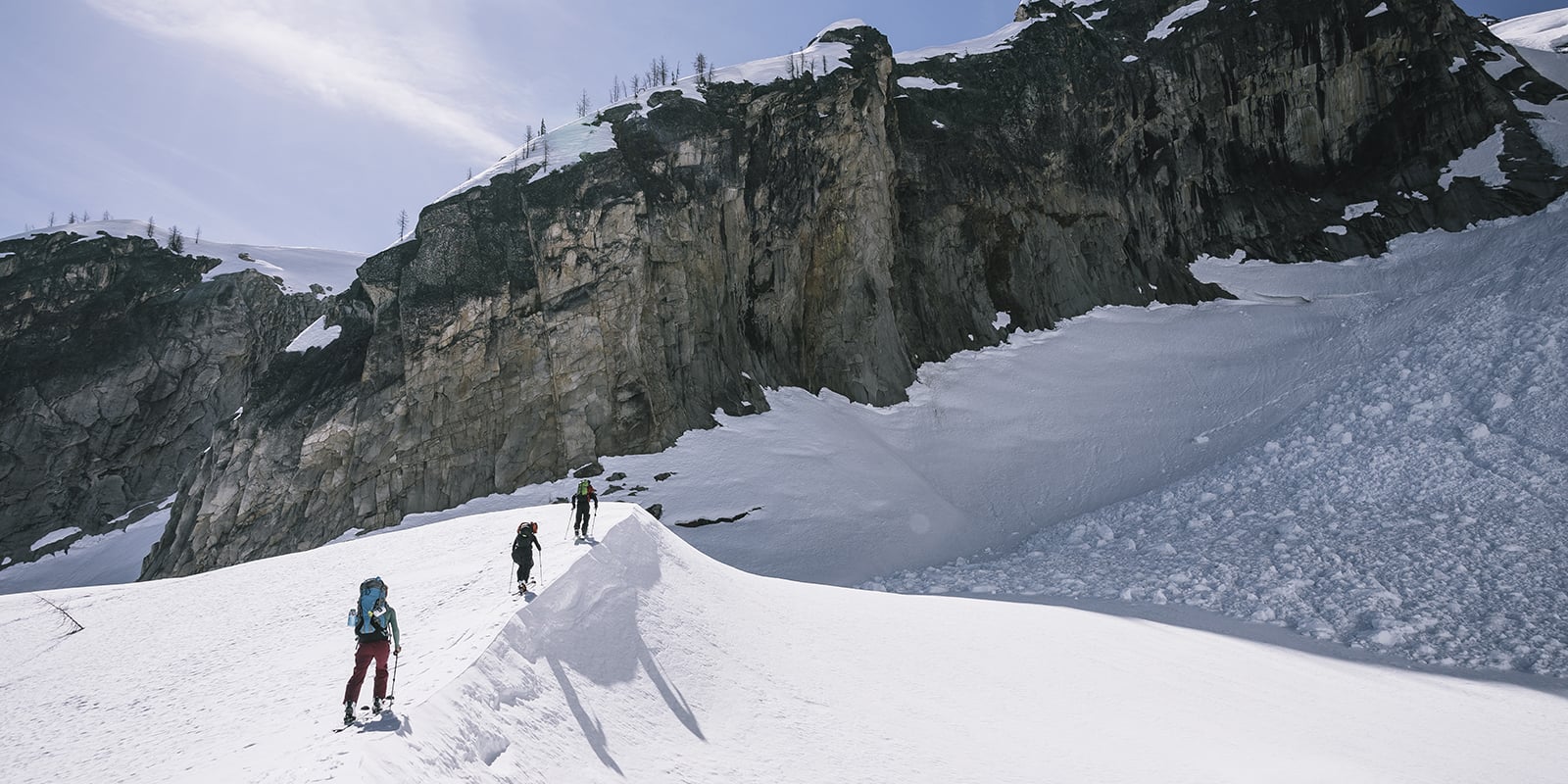
Yearning to blaze your own trail across the snowy slopes that beckon from beyond the ski resorts? Backcountry travel is an increasingly popular way to explore new terrain.
This article gives a primer on the ways of enjoying winter adventures: telemark or randoneé skiing, snowshoeing, and snowboarding or splitboarding.
Understanding the Risks
In the backcountry, there's no lodge, no bar—and no lift line. You're skiing in an uncontrolled environment, whether it's out-of-bounds of a ski area, or in the wilderness. (Not sure where those boundaries lie? Do your homework before you go to make sure you're in compliance with local land-use restrictions.)
There's no ski patrol out there, either. In the backcountry, it's just you and your buddies, testing your know-how against nature. All the preparation, safety considerations and navigational planning for a day in the snow are up to you, so take these tasks seriously.
Topping the list of safety concerns is avalanches. These pose a very real and lethal danger to backcountry travelers. Before venturing out, it's essential that you get the education and skills to recognize—and avoid—these killers.
To get started, read the REI Expert Advice series of articles starting with Avalanche Basics, then seek training from avalanche experts. Your local REI store may offer such clinics during the winter season.
Backcountry Travel Methods
There are 4 primary modes of winter backcountry travel. Each skiing or boarding style equips you to ascend a slope under your own power and enjoy the thrill of the downhill as you rip your descent. Snowshoeing is a great complementary activity or offers easy-to-learn fun in its own right.
Telemark Skiing
"Free-heeled" telemark ski bindings allow your feet and ankles to flex free of the skis, whether you're climbing with skins (discussed below) or descending the steep terrain of the backcountry. Named for the Telemark region of Norway where it was developed, "tele skiing" is a challenging style that combines striding with a bent-knee technique for carving downhill turns.
Why do it?
- It's fun: Telemark combines an element of "downhill thrill" with the go-anywhere flavor of free-heel skiing.
- It's unique: Telemark is a cross-country style all its own. It can be a refreshing change of pace for skiers of all ability levels.
Randoneé Skiing
Also referred to as alpine touring (AT) and ski mountaineering, randoneé (which means "excursion" in French) has spiked in popularity in recent years. Randoneé ski gear combines the distinctive features of cross-country and alpine skis. The bindings convert from free-heeled (for touring and climbing) to a locked-down position for downhill runs. No need to learn a new turning technique—with randoneé gear, you can descend backcountry slopes with the same type of turns you learned at the downhill resort.
Why do it?
- It's exciting: Randonneé skiing opens up an entirely new world of adventure to downhill skiers.
- See more scenery: This style lets you cover more terrain than you can with snowshoes, and you can climb with greater efficiency than you can with telemark skis.
Snowshoeing
By itself, snowshoeing makes for an enjoyable backcountry outing, one that is especially suited to rolling terrain. The leader breaks the trail, making it an easier activity to do as a group.
Snowshoeing can also be part of a 2-step approach to backcountry travel. In this scenario, you put a board on your pack and strap on snowshoes to make an ascent. Snowshoe heel lifters (on some models) make climbing steep slopes easier. At the summit, simply swap gear to float gleefully down the powder.
Why do it?
- It's easy: Snowshoeing is a fun, simple-to-learn winter sport. As the saying goes: "If you can walk, you can snowshoe."
- Snowshoes are small, light and easy to pack. Plus, most snowboard boots or hiking boots will work just fine with snowshoes.
- Versatility: You can snowshoe many trails that you can't ski due to trees or low-snow conditions.
For details, see the REI Expert Advice article, Snowshoes: How to Choose.
Snowboards and Splitboards
As noted above, traditional snowboards can be paired with snowshoes to hike up the slopes and then ride back down.
An increasingly popular alternative are splitboards. These are modified snowboards that split into 2 free-heeled skis for a backcountry approach that bypasses the lifts. With skins (discussed below) on the bottom, they climb much like skis. Once you've reached your destination, simply reassemble the board and surf the power all the way back down. Sweet!
Why do it?
- They're great in powder: The high flotation and single edge of a snowboard are arguably your best choice in powder conditions.
- Splitboards are versatile: They have special, movable bindings that allow you to easily tour alongside your telemark and randoneé/alpine touring (AT) buddies.
For details, see the REI Expert Advice article, Snowboards: How to Choose.
What to Bring
Buddies: Traveling alone in the winter backcountry is a high-risk endeavor. Don't do it solo.
Climbing skins: Whether you travel the backcountry by ski or by splitboard, skins are a crucial piece of gear. Like a piece of carpeting, skins temporarily stick to the underside of a ski (or board) to provide the traction that greatly aids your climb up the backcountry slopes. See the REI Expert Advice article, Climbing Skins and Accessories, for details.
Avalanche safety gear: The must-have gear for each and every backcountry explorer in your group is an avalanche transceiver, snow shovel and probe. Equally important is knowing how to use this gear—practice before you go! Also consider the innovative safety gear options of avalanche airbags or Avalung packs. For details, see the REI Expert Advice article, Avalanche Safety Gear.
Proper clothing: Layering is the key to comfort when you're exerting in winter conditions. For details, see the REI Expert Advice article, Layering Basics.
The Ten Essentials: For a day in the backcountry, you need to carry—and know how to use—the Ten Essentials. This time-honored list of emergency and safety gear has evolved into the Ten Essentials systems. For details, see the REI Expert Advice article, The Ten Essentials.
Repair gear: Bring items that can help you repair your gear in the field. A few basics: screwdrivers, pliers, duct tape, bailing wire and rub-on ski wax.
Once armed with safety and navigational skills and outfitted with the proper gear, you're all set to explore the wide open spaces of the backcountry. Be safe, and have fun!
Remember: Safety is your responsibility. No internet article or video can replace proper instruction and experience—this article is intended solely as supplemental information. Be sure you're practiced in proper techniques and safety requirements before you engage in any outdoors activity.