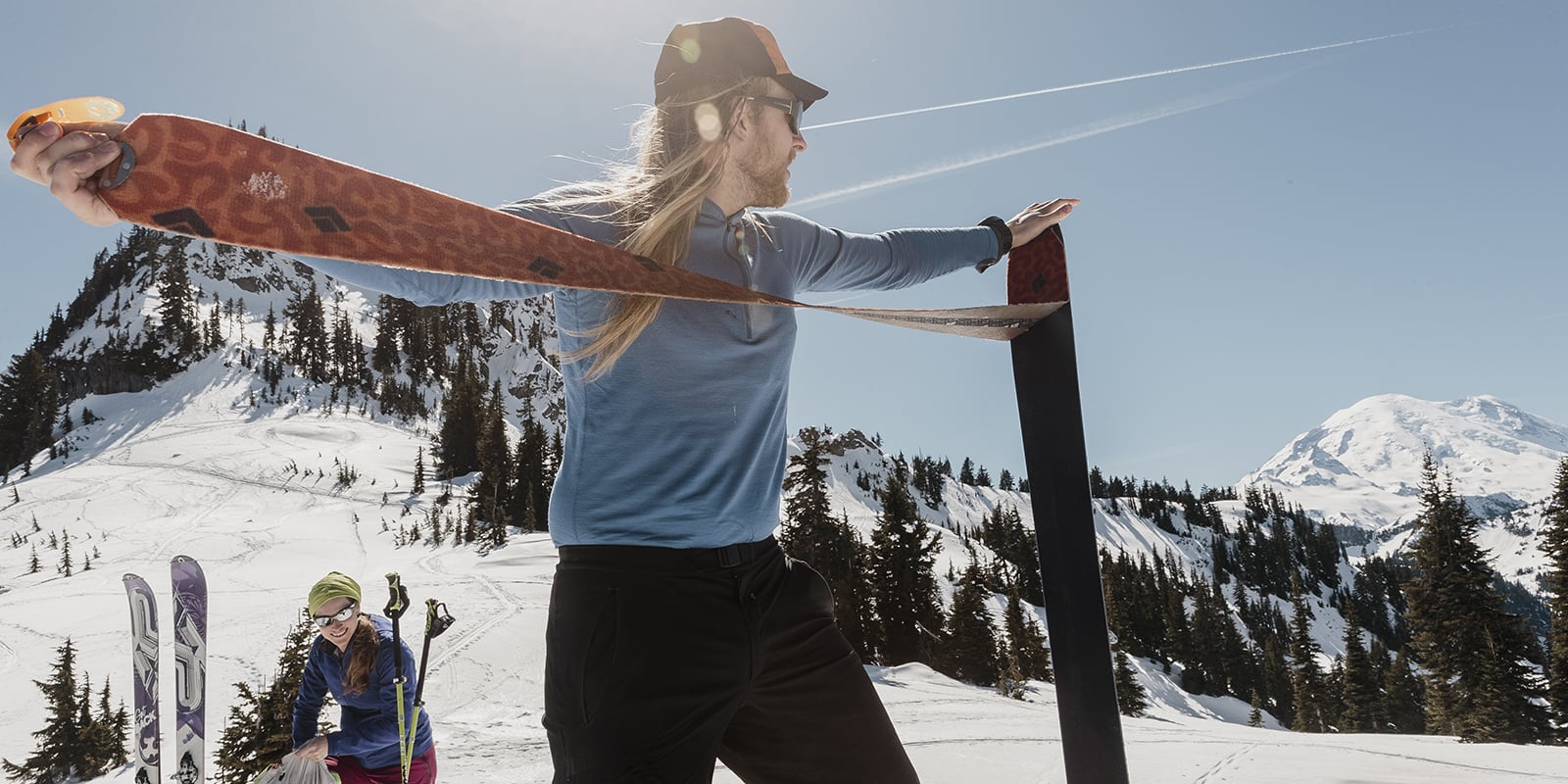
Ready for some backcountry skiing? Climbing skins, ski crampons, climbing wires, telemark leashes and knee pads are all useful accessories to consider.
This article covers the basics of each item.
Climbing Skins
Skins are strips of material (once actual animal skins, but now all synthetic) that attach to the undersides of backcountry and metal-edge touring skis to provide traction for climbing. Advantages:
- They save energy by keeping you from backsliding on moderate terrain.
- They save time by allowing you to take a direct, uphill route instead of having to traverse across gentler terrain.
- They provide a little extra control when you're carrying a heavy pack.
The outer surface of skins has hairs or scales that grab the snow, preventing backward movement of the skis. When the skis are moved forward, these surfaces flatten out to allow some glide.
Skins can cover the full length of the ski or just the middle section (so-called kicker skins). They typically attach to ski bases with adhesive, buckles, straps or a combination of these.
Your choice of skins depends on:
- Where you will be skiing?
- With how much gear?
Winter camping or hut-to-hut skiing with a big pack is much easier with full-length skins. On a day trip devoted to carving as many turns as you can, you may do just fine with shorter skins. How often you ski can also determine how much you want to invest in your skins.
For metal-edge touring skis with relatively little sidecut, buy skins in a width as close to your skis' waist width as possible. You want them to cover the ski base up to the metal edges.
For telemark and randonee skis with wide tips and tails, you have 2 choices. You can use waist-width skins on these skis, but a significant portion of the ski base at the tips and tails will not be covered, reducing climbing grip. Or you can buy skins in a width close to that of your skis' tips and then trim them to the exact hourglass shape of your skis, allowing optimal climbing grip.
A few ski manufacturers are now offering skins designed and pre-trimmed specifically for their skis. In some cases, they may be the only skins that will work on those skis.
Tip: Adhesive-backed skins require some care when handled. Avoid dropping them in the snow, and try to keep them clean so the adhesives remain sticky.
To store skins, make sure they are completely dry, then fold them, sticky sides together. Use the mesh sheet typically provided with skins to make it easier to pull the skins apart. This also prolongs the life of the adhesive. Keep some skin wax handy, too, to prevent freezing or ice/snow buildup.
Ski Crampons
Snow can sometimes be too steep or icy for skins alone to provide enough traction. Use ski crampons to add traction and security for going up or crossing especially steep, icy slopes. Ski crampons usually attach to the binding hinges. When you step down, the crampon bites in; when you lift your foot, it comes up off the snow.
Climbing Wires
Most telemark and randonee bindings have a mechanism to provide a raised platform for your heels when climbing. This platform positions your feet at a gentler angle than the angle of the slope, thus reducing stretch on your Achilles tendons and relieving muscle fatigue in your calves. Replacement wires are available if you need to replace a broken wire. Note: Climbing wires cannot be added to metal-edge touring bindings.
Telemark Knee Pads and Leashes
Telemark skiers have the unique experience of "kneeling" in the snow as they carve turns down a slope. Unfortunately, this sometimes leads to the misfortune of finding rocks, stumps or avalanche debris—with your knees. Knee pads help alleviate this problem. Carry them along on early- and late-season trips when the snow is not deep enough to bury obstacles completely.
Telemark skis normally don't have integrated ski brakes, so consider using leashes to prevent runaway skis. This is often a requirement when skiing at a lift-assisted resort.